
Introduction
For centuries, the question of how Ancient Israel came to be in the land of Canaan was not much of a question at all: the historical reliability of the biblical accounts was simply assumed, and those accounts were taken at face value. More recently, and in light of modern critical scholarship and the discoveries of archaeology, the issue of Israel’s emergence in Canaan has become much more complicated. In fact, as one scholar puts it,
“there is no problem of biblical history which is more difficult than that of reconstructing the historical process by which the Twelve Tribes of ancient Israel became established in Palestine and northern Transjordan.”[1]
That difficulty is illustrated by the abundance of competing models that have been proposed to explain Israel’s emergence. This study will provide a broad overview of the major theories that have been suggested and seek to evaluate them based on the relevant data, including textual witnesses and archaeology. The relevant texts include the biblical accounts, the Merneptah Stele, and to a lesser degree, the Amarna Letters.
Much of the disagreement on the issue of how Israel came to be in Canaan stems from differing views on the reliability and usefulness of the biblical texts when it comes to providing historically accurate accounts. Although some minimalist scholars see the biblical accounts as very late productions with biased viewpoints and little to no historical accuracy and dismiss them accordingly, most scholars recognize the historical value of the biblical witness and the need to examine and interpret it closely. This study adopts the latter perspective, and based on a close reading of the biblical accounts and an overview of the other data, will propose an “eclectic” theory for the emergence of Ancient Israel in Canaan.[2]
The Conquest Model
Described by one scholar as the “eldest son of modern scholarship,”[3] the conquest model is the oldest of the different emergence theories, and is based on a traditional, straightforward reading of the biblical text. In this perspective, the Book of Joshua is read as the narration of a three-part military campaign (central, southern, northern) which resulted in sweeping destruction across the land of Canaan.[4] The conquest model is especially associated with William F. Albright, who supported his understanding of the basic historicity of the biblical account with archaeological finds that revealed a number of violent destructions in the thirteenth century BC in many sites throughout Canaan.[5]
As impressive as this combination of biblical narrative and archaeology might seem at first, the Albrightian model has now fallen almost entirely out of favor, because it misreads both the archaeological evidence and the biblical text. Archaeologically, despite the widespread destruction found in Canaan from the thirteenth century, it has not been demonstrated that this destruction was caused by the Israelites rather than the Egyptians or the invading Sea Peoples.[6] Furthermore, there has proven to be little correlation between sites showing archaeological evidence of destruction and those mentioned in the narrative of Joshua. Only two of the nineteen sites that have been possibly identified with sites in the Book of Joshua show evidence of destruction in the thirteenth century,[7] and other sites which do show destruction like Megiddo are not reported to be destroyed in either Joshua or Judges.[8]
Biblically, as Younger points out, “the [conquest] model was doomed from the beginning because of its literal, simplistic reading of Joshua.”[9] Rather than claiming widespread destruction by the Israelites, verses like Joshua 11.13 convey a very different perspective: “But none of the cities that stood on mounds did Israel burn, except Hazor alone.”[10] In fact, the Bible makes very modest claims about the physical destruction wrought by the invading Israelites, as the books of Joshua and Judges only describe five Canaanite cities being burned with fire: Jericho, Ai, Hazor, Jerusalem, and Laish.[11] Thus, it is clear that the archaeological quest for evidence of widespread destruction in Canaan is misguided because the Bible does not suggest such destruction ever occurred.
The Peaceful Infiltration Model
Another older theory for the emergence of Israel in Canaan is the peaceful infiltration model, first proposed by Albrecht Alt and later modified by Martin Noth.[12] Like the conquest model, this theory shares the idea that the Israelites entered Canaan from the outside, but as its name suggests, the peaceful infiltration model argues that this occurred without significant violence. According to this model, the Israelites were nomadic pastoralists who, over a period of centuries, migrated into Canaan to take advantage of seasonal grazing conditions. Over the course of this lengthy process, the theory suggests that they developed friendly relations with the inhabitants of the Late Bronze Age towns and villages, and eventually settled down peacefully in the sparsely populated hill country in order to cultivate the land.[13] They gradually grew in number and strength, expanded into more fertile areas, and only then occasionally came into violent conflict with their neighbors. These skirmishes formed the historical base for the folkloric tales that would later be presented in Joshua and Judges.[14] Politically, the Israelites were united by the worship of Yahweh, and had the shape of a twelve-tribe amphictyony.[15]
The peaceful infiltration model has been criticized on a variety of grounds. First, while the biblical witness does refer to certain areas occupied by the Israelites with no accompanying description of military conquest,[16] it is undeniable that the Bible insists that the initial occupation of the land involved an element of significant military conflict in certain areas. Also, from an anthropological perspective, this model has been criticized for the outdated assumption that, as a rule, nomadic peoples gradually evolve to settle down and become farmers over time.[17] Finally, the suggestion that the Israelites comprised a twelve-tribe amphictyony has been roundly criticized as anachronistic, as the amphictyony concept was imported from classical Greece.[18]
The Peasant Revolt Model
While the conquest and peaceful infiltration models both suggest that Israel entered Canaan from outside the land (exogenous), the peasant revolt model, first formulated by George Mendenhall,[19] differs significantly in that it holds that Israel’s emergence was endogenous, coming primarily from populations which were already inside Canaan.[20] At this time, Canaan was part of the empire of Egypt, but local Canaanite overlords exercised control over the surrounding agricultural areas. As the theory goes, this urban aristocracy oppressed the rural peasant laborers, using their forced labor to provide the needed resources to build city walls, produce weapons, and pay tribute to Pharaoh.[21] The catalyst for revolt occurred when this already unhappy peasant population was joined by a small but influential group of former slaves from the outside, who believed they had been delivered from bondage by the god Yahweh and derived their identity from their allegiance to him. For Mendenhall, this mixed group became Hebrews, or habiru, a non-ethnic term found in the fourteenth-century BC Amarna Letters and other ancient sources. Mendenhall defines habiru as groups of people “which have no legal status and have indeed severed themselves from an earlier political community.”[22] The Hebrew/habiru revolted against their Canaanite overlords, withdrawing to the hill country to establish an egalitarian society united by its devotion to a new Overlord—Yahweh.[23] For Mendenhall, the revolt was not based on ethnic differences, but on political and social ones:
“The conflict between ancient Israel and the non-Israelite population had nothing to do with ethnic identity. It was a conflict with an old political regime or system of regimes which were rightly dying out all over the civilized world because they valued power more than ethic, and valued property and wealth more than persons.”[24]
Later, Norman Gottwald argued for a modified version of the peasant revolt theory, framing it in terms of a Marxist socio-political revolution.[25] In addition to his Marxist perspective, Gottwald differs from Mendenhall in that he sees the early Israelites as being much more diverse than a group of predominantly peasants,[26] and also thinks Mendenhall overemphasized the role that Yahwism played in the revolt. For Gottwald, a more significant factor in the revolution was the supposed widespread unrest and oppression that was commonplace in Canaan during the Amarna period.[27]
Both versions of the peasant revolt model are beset by problems. To begin with, Mendenhall admits that his theory lacks “sufficient data” and that it is an “‘ideal model’ of what ought to have been the case…inevitably based upon that which is known to have been true of other times and places.”[28] Second, Mendenhall’s claim that the Israelites were the habiru of ancient writings is troublesome for most scholars, as in most cases, the habiru cannot be equated with the biblical Hebrews, and he provides no example of a case in ancient society where all the peasants withdraw to become habiru and then successfully overthrow their rulers.[29] Third, Mendenhall’s model assumes that a large number of Canaanites became followers of Yahweh, but the biblical tradition gives no trace of a mass Canaanite conversion, and in fact, the practice of mass conversion in ancient Israel was impossible prior to the second temple period.[30] Finally, both versions of the model are significantly anachronistic, projecting modern views of society, economics, politics, and religion onto an ancient society.[31]
Endogenous Evolutionary Models
Since the 1980s, a host of new models have been proposed to explain the emergence of Ancient Israel in Canaan. Although these models are distinct from one another in various ways, they do show a few broad similarities and will be treated together here.[32] First, the models in this category share a general agreement that the biblical texts are of little value in reconstructing the history of the origins of Israel. Second, because of this low view of the historicity of the biblical accounts, these models rely instead on archaeological data and texts and inscriptions from outside of Scripture. Third, these models emphasize that the emergence of Israel was not an event, but rather, an evolutionary process that gradually took place over a long period of time. This process was related to the breakdown of the Late Bronze Age international political and economic systems, which led to the movement and displacement of different groups of people and the surge in small settlements in the highlands of Canaan. Finally, based on the large degree of continuity in the archaeological record and the archaeological similarity between supposed “Israelite” sites and others throughout Canaan, there is agreement that the emergence of Israel happened from within: the Israelites were essentially Canaanites who eventually became a distinct people with distinct beliefs and practices.[33]
Two significant and related differences between the various proposals concern whether or not Israel emerges as a distinct ethnicity or simply a new political entity, and the date at which that emergence occurs. Two important types of data related to these issues are the archaeological finds from settlements in the highlands of Canaan and the inscription on the Merneptah Stele.
Archaeological excavations of the Iron I settlements in the highlands of Canaan have yielded several finds which have been tied to the emergence of Israel. Some, like the collared-rim jar and the pillared “four-room” house, were once considered to be distinctively Israelite, but have since been found in other locations and are no longer considered to be Israelite identity markers.[34] Others still seem to be significant, including the elliptical shape of many of the highland villages, the extensive use of underground silos for the storage of grain, and terraces for hillside farming.[35] One particularly suggestive find is the absence of pig bones in the Iron I settlements of the central hill country. From archaeological finds, we know that pig husbandry was practiced in Canaanite communities in the Bronze Age, so the lack of pig remains in these settlements suggests that eating pork may have been a religious taboo for the inhabitants.[36] Putting all of this together, Israel Finkelstein suggests that the emergence of Israel should be viewed in political rather than ethnic terms, and that Israel emerged as a political entity in the late eleventh century, and can be identified in these hill settlements.[37]
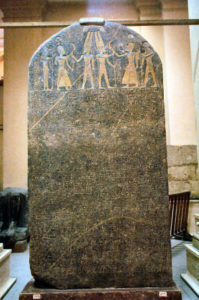
The Merneptah Stele
The Merneptah Stele is an inscription by the Egyptian Pharaoh Merneptah celebrating his defeat of the Libyans in the fifth year of his reign. Included in the inscription is a brief reference to Merneptah’s domination of his foes in Syria-Palestine, and among those various foes over whom the Pharaoh claims victory is Israel: “Israel is laid waste; his seed is not.”[38] This reference to “Israel” is the first that occurs outside of the biblical texts, and the inscription indicates that an entity known as “Israel” existed c. 1210 BC, but was that entity an ethnic group or a political association?
Gösta W. Ahlström believes that the reference to “Israel” refers primarily to a place rather than an ethnic distinction, but that living in that location eventually led to the people themselves being known by the same name.[39] However, scholars representing a wide range of views on Israel’s emergence disagree with this perspective, arguing instead that Merneptah’s reference to Israel refers specifically to a people group, based on the fact that the “Egyptian determinative sign preceding the word ‘Israel’ is that for ‘people’, not ‘nation/state.’”[40] Combining the archaeological finds described above with the Merneptah data, William Dever, disagreeing with Finkelstein, argues for the emergence of an Israelite ethnic group sometime just before 1200 BC:
“If these ‘Israelites’ were not our hill-country people, then who and where were Merneptah’s ‘Israelites’? And how can we account for our hill-country complex if it is not ‘Israelite’? Simple logic suggests connecting the two sets of facts…. To put it in a nutshell, we have at least as much warrant for using the ethnic term ‘Israelite’ in the early twelfth century BCE for archaeological assemblages as we do for using the terms ‘Egyptian’, ‘Canaanite’ or ‘Philistine’.”[41]
Despite the popularity of the different endogenous evolutionary models, they do possess some significant difficulties. First, all of these theories either severely discount or entirely ignore the biblical accounts. If the biblical text possesses historical value, however, as this paper has suggested, then theories that ignore biblical testimony are skewed from the beginning. Second, there seems to be a chronological problem between the attempts by several scholars in this perspective[42] to tie Israel’s emergence to hill settlements from the late eleventh century BC, while the Merneptah Stele clearly acknowledges the existence of Israel two hundred years earlier.[43] Third, these approaches fail to explain “what prompted people to subscribe to a radically different religious identity,”[44] and related to this, if food resources were limited following the supposed breakdown of the international economic systems which undergirds these theories, why would people suddenly avoid the consumption of pigs, a food source with which they were familiar and could have used to better survive?[45]
The Eclectic Model
As opposed to the specific theories described above, this paper advocates for a more eclectic approach that follows the presentation of the biblical text. This approach derives from the realization that the picture of Israel’s emergence that is presented in the Bible is actually a complex one, which contains elements from many of the various models.[46]
First off, the common notion that the Bible presents a picture of widespread destruction of the cities of Canaan must be rejected.[47] Certainly the text indicates that the Israelites were supposed to eradicate the Canaanite peoples in order to punish them for their wickedness and also to claim the territory that had been promised to Abraham’s descendants,[48] but the cities were largely supposed to be left intact, so that the Israelites could live in cities that they did not build, and houses full of good things which they did not fill.[49] From this perspective, the widespread destruction of the conquest model is overstated, but certainly there were elements of destruction, as the Book of Joshua specifically mentions the burning of the cities of Jericho, Ai, and Hazor. Archaeologically, there is good evidence for the destruction of Hazor that could coincide well with the biblical account,[50] but admittedly, there are some difficulties with Jericho and Ai in that the general archaeological consensus is that these cities were unoccupied at the time of the biblical conquest.[51] Still, Dale Manor points out some problems with this consensus, stating that in a site with significant portions to still be excavated, “it is fairer to point out that no evidence of occupation has been located at Jericho than to argue definitively that it was not occupied at the time,” and that at Ai, much of the site has not been excavated, and it seems possible that we have not yet even identified the proper location of the biblical city.[52]
Despite the fact that the Israelites were supposed to wipe out the Canaanites, the biblical witness indicates that they did not, and thus, shares some elements in common with the peaceful infiltration theory. Rahab and her family become allies with the Israelites after her assistance in the destruction of Jericho (Joshua 2; 6.17; 6.22-23). Through a ruse, the Gibeonites tricked the Israelites into making peace with them (Joshua 9), and ultimately were made to work in the service of the tabernacle. Further, there are indications of the Israelites living peacefully in Shechem, without any references to a military battle there (Joshua 24.1, 24.32).[53]
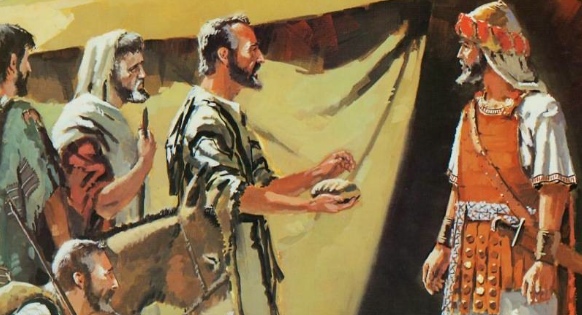
The Gibeonites trick the Israelites
Although there are not significant elements of social unrest that would bring the biblical accounts into harmony with the peasant revolt model, the Bible does similarly suggest that the Israelites were made up of a diverse group of people. In addition to the allies mentioned above, Exodus 12.38 claims that a “mixed multitude” went up with the people of Israel with they left Egypt, and Judges 1.16 indicates that the Kenites, the descendants of Moses’ father-in-law, were also present with them.
Finally, the endogenous evolutionary models assume that the Israelites were simply Canaanites because of the high degree of archaeological continuity. However, if the Israelites were, as described above, living in houses that they did not build, archaeological continuity would only be natural. Furthermore, the idea that “every ethnic group must have a distinct, archaeologically observable culture is not well founded,” and even so, the biblical texts “attest to Israel’s West Semitic origins, similar to all Canaanites in the land.”[54] In other words, a high degree of archaeological continuity is exactly what we should expect based on the biblical testimony.
Conclusion
The emergence of Ancient Israel in Canaan was undoubtedly a complex process, and one that can best be reconstructed by paying close attention to the biblical text and to archaeological finds as well. When all of this data is considered, it seems clear that the various emergence models are accurate in some ways, and an eclectic theory presents the best approach.
The Hebrew people left Egypt as part of a “mixed multitude” that eventually entered the land of Canaan to possess it under the direction of Yahweh. This occurred through a process of military conquest and occupation, but that military occupation was incomplete to the degree that some peaceful coexistence with the Canaanite residents clearly occurred. Apart from a small number of admitted difficulties, this picture also fits well with the archaeological record, which suggests (as Scripture does) that the Israelites were similar to the Canaanites in many ways. From a theological perspective, however, that similarity was a problem, as it was indicative of an Israelite people that failed to be distinctive as Yahweh had directed, and instead mingled with and adopted the practices of their Canaanite neighbors. In the end, it would lead to the loss of the land they had been promised and had occupied in such complex fashion.
[1] George E. Mendenhall, “The Hebrew Conquest of Palestine,” Biblical Archaeologist 25, no. 3 (September 1962): 66.
[2] For minimalists, see Niels Peter Lemche, “The Origin of the Israelite State: A Copenhagen Perspective on the Emergence of Critical Historical Studies of Ancient Israel in Recent Times,” Scandinavian Journal of the Old Testament 12, no. 1 (1998): 44-63; Robert B. Coote, “Early Israel,” Scandinavian Journal of the Old Testament 2 (1991): 35-46; Keith W. Whitelam, “Between History and Literature: The Social Production of Israel’s Traditions of Origin,” Scandinavian Journal of the Old Testament 2 (1991): 60-74. Coote, 37, argues that the biblical accounts should be heavily discounted, and Whitelam, 71, describes the Hebrew Scriptures as a “danger and a distraction” for the historian, because they “…lull us into believing that they represent reality.”
For scholars who see historical value in the Bible, see Anthony J. Frendo, “Back to Basics: A Holistic Approach to the Problem of the Emergence of Ancient Israel,” in In Search of Pre-Exilic Israel: Proceedings of the Oxford Old Testament Seminar, ed. John Day (London: T & T Clark, 2004): 41-64; Hartmut N. Rösel, “The Emergence of Ancient Israel—Some Related Problems,” Biblische Notizen 114-115 (2002): 151-60. K. Lawson, Younger, Jr., “Early Israel in Recent Biblical Scholarship,” in The Face of Old Testament Studies: A Survey of Contemporary Approaches, ed. David W. Baker and Bill T. Arnold (Grand Rapids: Baker Books, 1999), 200-205, emphasizes the limitations of archaeology and the problems for scholars who try to form emergence models based solely on archaeological data. Younger also emphasizes the need to read books like Joshua and Judges better and less simplistically.
[3] Baruch Halpern, The Emergence of Israel in Canaan, Society of Biblical Literature Monograph Series, vol. 29 (Chico, CA: Scholars Press, 1983), 49.
[4] Younger, 178-79.
[5] W. F. Albright, “The Israelite Conquest of Canaan in the Light of Archaeology,” Bulletin of the American Schools of Oriental Research 74 (April 1939): 11-23. Other scholars who hold to the Conquest model include John Bright, A History of Israel, 4th ed. (Louisville: Westminster John Knox Press, 2000); Yigael Yadin, “Is the Biblical Account of the Israelite Conquest of Canaan Historically Reliable?” Biblical Archaeology Review 8, no. 2 (March 1982): 16-23.
[6] Robert Gnuse, “Israelite Settlement of Canaan: A Peaceful Internal Process—Part 1,” Biblical Theology Bulletin 21, no. 2 (1991): 58.
[7] Younger, 178. The issue of the date of the Exodus and Israel’s entrance into Canaan is beyond the scope of this paper, but is certainly related. Even among scholars who hold to the historicity of the biblical narratives regarding the Exodus, the wanderings in the wilderness, and the occupation of Canaan, there are those who argue for an early date in the fifteenth century BC, while others argue for a late date in the thirteenth century. See James K. Hoffmeier, “What is the Biblical Date for the Exodus? A Response to Bryant Wood,” Journal of the Evangelical Theological Society 50, no. 2 (June 2007): 225-47; Bryant G. Wood, “The Biblical Date for the Exodus is 1446 BC: A Response to James Hoffmeier,” Journal of the Evangelical Theological Society 50, no. 2 (June 2007): 249-58; Ralph K. Hawkins, “The Date of the Exodus-Conquest is Still an Open Question: A Response to Rodger Young and Bryant Wood,” Journal of the Evangelical Theological Society 51, no. 2 (June 2008): 245-66; Dale W. Manor, “The Emergence of Israel: The Bible and Archaeology,” ΠΝΕΥΜΑΤΙΚΑ 1, no. 1 (2013): 90-110. Needless to say, as Hoffmeier, Israel in Egypt: The Evidence for the Authenticity of the Exodus Tradition (Oxford: Oxford University Press, 1997), 34, points out, the chronology does impact the archaeological data, because if the presumed chronology is incorrect, archaeologists should not expect to find data related to destruction at the wrong time.
[8] Hoffmeier, Israel in Egypt, 33.
[9] Younger, 179.
[10] All Scripture references are taken from the English Standard Version.
[11] This list is pointed out in Manor, 96. The accounts of the destruction of these cities are recorded as follows: Jericho (Joshua 6), Ai (Joshua 7-8), Hazor (Joshua 11.11-13), Jerusalem (Judges 1.8), and Laish (Judges 18).
[12] Albrecht Alt, Essays on Old Testament History and Religion, trans. R. A. Wilson (Oxford: Basil Blackwell, 1966), Martin Noth, The History of Israel (New York: Harper, 1958). Alt originally published his theory in 1925.
[13] Ann E. Killebrew, “The Emergence of Ancient Israel: The Social Boundaries of a “Mixed Multitude,” in Canaan,” in I Will Speak the Riddles of Ancient Times, ed. Aren M. Maeir and Pierre de Miroschedji (Winona Lake, IN: Eisenbrauns, 2006), 561; Younger, 179; Gnuse, 57.
[14] Gnuse, 57; Killebrew, 561.
[15] Younger, 179: “An amphictyony is a league of tribes or cities, usually with six or twelve members, bound by common allegiance to a deity and to the god’s shrine.
[16] For example, in Joshua 24.1, 24.32, there are references to the Israelites being in Shechem, but there is no record of a military conquest of Shechem in the biblical accounts.
[17] Gnuse, 58, and Marvin L. Chaney, “Ancient Palestinian Peasant Movements and the Formation of Premonarchic Israel,” in Palestine in Transition: The Emergence of Ancient Israel, ed. David Noel Freedman and David Frank Graf (Sheffield, England: The Almond Press, 1983), 42-43, discuss this issue at length. Sometimes people groups become nomadic following a period of settled land cultivation; other groups live in an ongoing state of seasonal alternating between land cultivation and pastoralism.
[18] Younger, 180; Richard S. Hess, “Early Israel in Canaan: A Survey of Recent Evidence and Interpretations,” Palestine Exploration Quarterly 125 (July 1993): 127. Of course, this is not to deny that Ancient Israel could have been based on tribal associations (the Bible insists that it was); but it could not have been based on an amphictyony system that was developed hundreds of years later.
[19] Mendenhall, “The Hebrew Conquest of Palestine,” 66-87.
[20] Iain Provan, V. Philips Long, and Tremper Longman III, A Biblical History of Israel (Louisville: Westminster John Knox Press, 2003), 141.
[21] Hess, 129.
[22] George E. Mendenhall, The Tenth Generation: The Origins of the Biblical Tradition (Baltimore: Johns Hopkins University Press, 1973): 136-37. Mendenhall goes on to argue that David (in his “outlaw” stage), Jephthah, Abraham, and Jacob are all specific examples of habiru who operated outside of the protection of and obligation to the governing authorities in the areas in which they lived.
[23] Mendenhall, “The Hebrew Conquest of Palestine,” 75: “The subjection of individuals and groups to a non-human Overlord by covenant, the solidarity of the newly formed community meant that they could and did reject the religious, economic, and political obligations to the existing network of political organizations. By this process, they became “Hebrews.”
[24] Mendenhall, The Tenth Generation, 225.
[25] Norman K. Gottwald, “Early Israel and the Canaanite Socio-Economic System,” in Palestine in Transition: The Emergence of Ancient Israel, ed. David Noel Freedman and David Frank Graf (Sheffield, England: The Almond Press, 1983): 25-38; Norman K. Gottwald, “Israel’s Emergence in Canaan,” Bible Review 5, no. 5 (October 1989): 26-34; Norman K. Gottwald, “Religious Conversion and the Societal Origins of Ancient Israel,” Perspectives in Religious Studies 15, no. 4 (Winter 1988): 49-65.
[26] Gottwald, “Israel’s Emergence in Canaan,” 32-33. For example, Gottwald rejects Mendenhall’s equation of “Hebrew” with habiru, and argues that some of the early Hebrews were likely habiru outcasts and bandits, but many were simply disorganized peasant groups, artisans, and other groups. Elsewhere, Norman K. Gottwald, “The Hypothesis of the Revolutionary Origins of Ancient Israel: A Response to Hauser and Thompson,” Journal for the Study of the Old Testament 7 (May 1978): 46, suggests that habiru mercenaries and brigands shared their military expertise with the peasantry and thus strengthened the growing Israelite movement.
[27] Manor, 99.
[28] Mendenhall, 66.
[29] Younger, 182; Alan J. Hauser, “Israel’s Conquest of Palestine: a Peasants’ Rebellion?,” Journal for the Study of the Old Testament 7 (May 1978): 12-13. Hauser goes on to dispute Mendenhall’s examples of David and Jephthah as examples of habiru, as neither David nor Jephthah willingly chose to withdraw from their respective societies to become habiru, but rather, had that status forced upon them. This is fundamentally different from Mendenhall’s claim of a large group of peasants willingly withdrawing from the Canaanite city-state society as a matter of revolt.
[30] Jacob Milgrom, “Religious Conversion and the Revolt Model for the Formation of Israel,” Journal of Biblical Literature 101, no. 2 (June 1982): 169-76.
[31] Hauser, 7, “Finally, Mendenhall sees the Israelite revolution as he reconstructs it to be a uniquely creative experience in the socio-economic history of the ancient world. The uniqueness he describes, however, derives from the modern views of religions and revolution which Mendenhall has uncritically transplanted into the context of ancient society.” William G. Dever, “Archaeology and the Emergence of Early Israel,” in Archaeology and Biblical Interpretation, ed. John R. Bartlett (London: Routledge, 1997): 24, states that the model should be rejected “because it is too obviously a projection of modern Marxist notions of ‘class-conflict’ onto ancient Israel.”
[32] The literature published by scholars supporting a model of this type is substantial. See Dever, “Archaeology and the Emergence of Early Israel”; Israel Finkelstein, “The Emergence of Israel: a Phase in the Cyclic History of Canaan in the Third and Second Millennia BCE,” in From Nomadism to Monarchy: Archaeological and Historical Aspects of Early Israel, ed. Israel Finkelstein and Nadav Na’aman (Washington: Biblical Archaeology Society, 1994): 150-78; Israel Finkelstein, “The Emergence of Israel in Canaan: Consensus, Mainstream and Dispute,” Scandinavian Journal of the Old Testament 2 (1991): 47-59; Lemche, “The Origin of the Israelite State: A Copenhagen Perspective on the Emergence of Critical Historical Studies of Ancient Israel in Recent Times”; Coote, “Early Israel”; Whitelam, “Between History and Literature: The Social Production of Israel’s Traditions of Origin”; Gösta W. Ahlström, “The Origin of Israel in Palestine.” Scandinavian Journal of the Old Testament 2 (1991): 19-34; Robert B. Coote and Keith W. Whitelam, The Emergence of Early Israel in Historical Perspective, The Social World of Biblical Antiquity Series, vol. 5 (Sheffield, England: Almond Press, 1987); Robert B. Coote and Keith W. Whitelam, “The Emergence of Israel: Social Transformation and State Formation Following the Decline in Late Bronze Age Trade,” Semeia 37 (1986): 107-47.
[33] Diana Edelman, “Introduction.” Scandinavian Journal of the Old Testament 2 (1991): 3-6; Killebrew, 564-65.
[34] Hoffmeier, 32; Killebrew, 568; Hess, 129; Coote and Whitelam, The Emergence of Early Israel in Historical Perspective, 126.
[35] Finkelstein, “The Emergence of Israel in Canaan: Consensus, Mainstream and Dispute”; Finkelstein, “The Emergence of Israel: A Phase in the Cyclic History of Canaan”; Dever, 30; Robert Gnuse, “Israelite Settlement of Canaan: A Peaceful Internal Process—Part 2,” Biblical Theology Bulletin 21, no. 3 (1991): 111.
[36] Dever, 43. See also Mark G. Brett, “Israel’s Indigenous Origins: Cultural Hybridity and the Formation of Israelite Ethnicity,” Biblical Interpretation 11, no. 3 (2003): 404-05; Manor, 101; Younger, 195-96.
[37] Finkelstein, “The Emergence of Israel: A Phase in the Cyclic History of Canaan,” 169; Finkelestein, “The Emergence of Israel in Canaan: Consensus, Mainstream and Dispute,” 56. Coote, “Early Israel,” also prefers to think of Israel’s emergence in political rather than ethnic terms.
[38] John J. Bimson, “Merenptah’s Israel and Recent Theories of Israelite Origins,” Journal for the Study of the Old Testament 49 (February 1991): 13; Dever, 43.
[39] Ahlström, 27-29.
[40] Dever, 43. Brett, 406-07. Hoffmeier, 27-31, addresses the issue in some detail.
[41] Dever, 43.
[42] Though not Dever; see above.
[43] Bimson, 13-24.
[44] Manor, 101.
[45] Ibid.
[46] This approach is greatly influenced by the presentations of Provan, Long, and Longman, A Biblical History of Israel, and Manor, “The Emergence of Israel: The Bible and Archaeology.” See also Hess, 132, 139; Frendo, 58; Younger, 205; Hoffmeier, 43-44.
[47] Careful reading of the biblical text must account for the use of hyperbole. Joshua 10.20 states, “When Joshua and the sons of Israel had finished striking them with a great blow until they were wiped out, and when the remnant that remained of them had entered into the fortified cities….” If Joshua’s enemies had been literally wiped out, then there could be no remnant; clearly, hyperbole is involved here. See also Younger, 200-01.
[48] Manor, 90, presents a helpful understanding of the biblical ideal and the way it is connected with other theories of Israel’s emergence and his own eclectic approach: “It is vital, however, to demonstrate from the Bible what the conquest was supposed to accomplish and why it failed. In Israel’s failure to do what they were supposed to do, almost by default elements of the competing models became components to explain Israel’s emergence.”
[49] Deut. 6:11; Josh. 24:13.
[50] Provan, Long, Longman, 178-81.
[51] Manor, 94-95; Provan, Long, and Longman, 174-78.
[52] Manor, 95. For an alternative perspective on the remains of Jericho, see Bryant G. Wood, “Did the Israelites Conquer Jericho: A New Look at the Archaeological Evidence,” Biblical Archaeology Review 16, no. 2 (March 1990): 44-58. Wood, who holds to an early date for the Exodus and Conquest, believes he has found pottery evidence which indicates inhabitation at Jericho during the late fifteenth century BC.
[53] Manor, 104-05, mentions hints of other groups who may have made peace with the Israelites, at least in an informal fashion.
[54] Hess, 130. See also Ezekiel 16.3: “…Thus says the Lord God to Jerusalem: Your origin and your birth are of the land of the Canaanites; your father was an Amorite and your mother a Hittite.” This verse should probably not be pressed for literalness; but surely it denotes a similarity between the Israelites and the Canaanites.



 Tweet This








