
The online journal of Luke Dockery

Category: Bible Study (Page 31 of 40)

Three Views on the Permanence of Salvation

This is a post that I have been intending to write for some time, but recent readings on God’s providence and sovereignty have brought it to my mind again.

When someone becomes a Christian and is saved, is that salvation permanent, or can it be lost? The answer to that question has been hotly debated for a long time, and in this post, I’d like to briefly summarize three different popular answers. My point in this post is not to argue which answer is correct (though I’ll let you know where I stand), but rather to emphasize the practical consequences of each viewpoint, and to indicate that two views which people frequently equate with one another are actually significantly different.

Perseverance of the Saints

This perspective is one of the central tenants of Calvinism (the “P” in “TULIP”). It holds that God, in his sovereign power, keeps those who are saved, saved. Also known as eternal security, the idea is that nothing in heaven or earth can separate true Christians from the loved of God (Romans 8.39). The adjective true in “true Christians” from the previous sentence is an important one, as we’ll see in our hypothetical example below.

Once Saved Always Saved

A popular version (or perversion?) of Perseverance of the Saints is the teaching of Once Saved Always Saved which you hear in many evangelical groups today. Many of the same Bible verses will be used to support this view, and this perspective is often held to be synonymous with Perseverance of the Saints, but as we will see below, there is a crucial difference between the two.

The Reality of Apostasy

The third perspective holds that someone can be truly saved and then later fall away from that salvation (the word apostasy means to fall away). This view does not intend to undermine God’s sovereignty, but rather holds than in his sovereignty, God has chosen to give free will to humanity, and that he will permit them to use that free will to walk away from their faith. This is the view that I hold, and I think it is the only one that correctly interprets passages like Hebrews 6.4-6.

A Hypothetical Case Study

To examine some of the practical applications of these different perspectives, let’s take a look at a hypothetical case study.

Frank grew up going to church sporadically, but never really took it seriously. Then, at a summer church camp after his senior year in high school, his conscience was pricked, he decided that he wanted to dedicate his life to the Lord, and he became a Christian and was saved.*

For several weeks after this, Frank was very active in a local church, and even tried to share his faith with his friends. Then, he went off to college, struggled to find a church there, and before long, completely quit attending. Furthermore, he got heavily involved in the college party scene. Before long, he became a heavy drinker, was sexually promiscuous, and experimented with illegal drugs.

After a few semesters, Frank actually dropped out of college, and began selling drugs to make a living and to support his own habit. As time went on, he moved on to increasingly dangerous drugs, and his lifestyle became more dangerous and volatile; he would use violence to get what he wanted, and was even implicated in a couple of drug-related murders. Ultimately, he is killed one night in a drug deal gone bad.

So, at the point of his death, was Frank saved? Let’s look at how the three perspectives above would answer that question.

In the Perseverance of the Saints view, Frank was never saved in the first place. Although God guarantees the salvation of those who are truly converted, it is evident based on Frank’s lifestyle of selfish choices and sinful behavior that he was never truly converted in the first place. In other words, true Christians are eternally secure in their salvation, but Frank was never saved in the first place: whatever happened at church camp his senior year just looked like he was being saved; he really wasn’t. If he had really been saved, he would have lived a drastically different sort of life.

In the Once Saved Always Saved view, Frank was saved. Back in summer camp he had done what was necessary to be saved, and God promises to keep those who are saved, saved. Thus, regardless of whatever Frank did later in life, God is faithful, and saves him anyway.

In the Reality of Apostasy view, Frank was saved but then forfeited that salvation. Back in summer camp Frank did was was necessary to be saved, and so he really did receive salvation. Sadly, the choices he made following conversion did not live up to the commitment he made at conversion, and since God honors the free will of humans, he allowed Frank to choose to forfeit his salvation.

Conclusion

I think the three views and their practical implications can be summarized as follows:
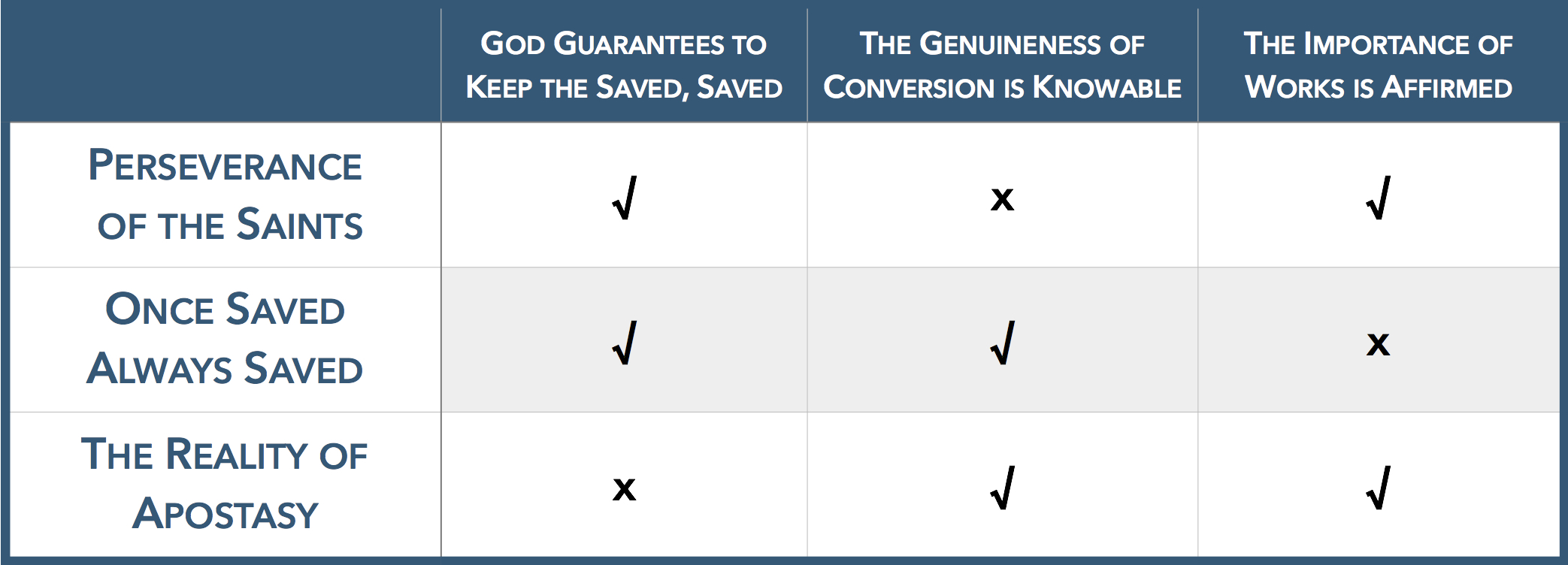
Perseverance of the Saints: God guarantees the salvation of the truly saved, but the genuineness of our salvation is borne out in our works. If we don’t show good works in our lives, it’s evident that we were never really saved in the first place. Of course, the practical problem with this is that it becomes impossible to tell (at least, from the outside) if a person’s salvation experience is truly genuine: we have to wait and see how they live before we can know. For me this is a big problem, because I think Scripture teaches that we can know that we are saved. At least from a practical standpoint, that is denied in this view.

Once Saved Always Saved: God guarantees the salvation of those who are saved, so those who do what is necessary to be saved are saved forever, regardless of what they do later in life. The practical problem here is that it completely devalues the importance of good works in our lives: we can apparently be saved without them. For me, this is completely unacceptable: I don’t know how the Bible could be any clearer that what we do in life actually matters. Practically, that idea is denied in this view.

Reality of Apostasy: God guarantees the salvation of his people, the church, and so those who are saved, added to the church, and remain a part of the church, are saved. However, if our lifestyle is characterized by continual disobedience to God’s will, then God honors our choices and allows us to forfeit our salvation. This view affirms that we can really know we are saved when it happens (as apposed to the first view), and that our works matter (as opposed to the second). Instead, it gives up the idea that those who are saved are saved no matter what. That in and of itself is not a problem (because I think the Bible teaches that salvation can be lost), but the practical problem that can arise is that people can press this view to unhealthy extremes lose all assurance of their salvation and are constantly unsure of their status before God (e.g. I went to church this morning and took communion, so I am okay/I got upset and cursed at my spouse today so I am lost). However, I don’t think this unhealthy extreme is the necessary result of this view, and in my personal life, I affirm the reality of apostasy while remaining confident that I am saved by God’s grace and that his grace continues to keep me saved as long as I continue to follow Him.

*Obviously, people also have different views on what a person must do to be saved. The Bible teaches that we are saved by grace through faith, but there is significant disagreement about the nature of that faith: is it mental assent, or is it an obedient faith that requires specific acts on our part? The way we are saved is not the focus of this post, however. For the sake of our hypothetical argument, just assume that being saved means what you, the reader, think it means.


Jesus, the Pharisees, and the Sadducees

In Backgrounds of Early Christianity, Everett Ferguson has a really good summary of the Pharisees and Sadducees, especially in the sense that he moves past a lot of unhelpful oversimplifications of the Pharisees (i.e., the idea that all Pharisees were hypocrites).

I really liked this summary statement of what separated Jesus’ views of the Hebrew Scriptures from that of the Pharisees and Sadducees:

[The] interpretation of the law in terms of fundamental principles distinguishes Jesus from the rival groups in Judaism of his day. According to him the Sadducees were right in exegesis—the Scriptures did not mean what the Pharisees made them mean—but they were wrong in relegating Scripture to the place of an archaic relic with less and less relevance to the present. The Pharisees were right in trying to keep Scripture applicable, but were wrong in their method by making tradition superior or equal to the written word.

Jesus offered a corrective to both viewpoints. The written word is authoritative, but the great fundamental principles therein take precedence and provide the standard by which it is to be interpreted and applied.

(p.518)

The Role of the Individual Person in God’s Universal Plan

For an upcoming grad school class, I have been reading Everett Ferguson’s Backgrounds of Early Christianity. It is a bit of a dense work, but I am enjoying it: Ferguson is brilliant, and is unparalleled in his knowledge and understanding of early Christianity. I read as much of his stuff as I can.

In Backgrounds of Early Christianity, he has a discussion of apocalyptic literature that I really enjoyed. Apocalypse was a certain literary form that was very popular for a few centuries on either side of the life of Christ. We are familiar with it in the Bible largely through the Book of Revelation and portions of Daniel (and small sections of a couple gospels), but there are a lot of extrabiblical works which feature apocalyptic writing as well.

We tend to equate apocalyptic literature with eschatology (which refers to teaching about the last days or end of the world), but it’s not always or even primarily focused on that. Here are Ferguson’s words:

Although much study of apocalyptic literature has centered on its eschatology, its authors’ main concern was with revelation (as the word apocalypse indicates) rather than eschatology. Events are marching toward a predetermined goal; but while history is under divine control, individual decisions are not. There is both a universalism and an individualism in apocalypticism. God’s plans are universal, but the individual (not the nation as a whole) decides whose side he is on and so where he will stand in the final cataclysm.

(p. 476-77)

Put in other words, works like the Book of Revelation aren’t about providing us with a detailed map of future events. Rather, they are meant to underscore that God is ultimately in control, and things will unfold according to His plan and will. For us as individuals, it is imperative that we choose to follow that will, and be on His side.

How to do a Bad Word Study in the Bible

A while back, I came across an excellent article on a blog called, “7 Ways to Do a Bad Word Study.” The author does a great job of highlighting some common traps that preachers, Bible class teachers, and would-be scholars frequently fall into as they try to delve into the original languages of the Bible (primarily Greek and Hebrew).

I had the article bookmarked for a long time, but I ultimately decided that it was so helpful that I would share it, in full, on my blog. To be clear, I did not write the content below, but I am quoting from the blog linked above because I figured more people would read it here than click through and read it on the original page.

This week has been a fascinating walk through the world of “Word-Studies”. My guess is, you’ve encountered some sort of word story in the last couple of months: a Bible study, a sermon, a commentary, a quip about agape love or a defense of a biblical viewpoint you’re not sure of. But sometimes it’s hard to wade through the muck and know when you’re being short changed. How can a lay person (or pastor) know whether a word study is legitimate? Here are some bad ways to do a word study, courtesy of Dr. Jennings of Gordon Conwell and Dr. Grant Osborne of Trinity Evangelical Divinity School:

1. The Root Word Fallacy. You’ve heard this: “The word ekklesia is a Greek word for the church that literally means, “called out ones””. Technically, this isn’t true. While combining the two root words (“called out from”) does indeed create something like “called out ones”, the truth is, the word ekklesia is never used that way in the New Testament or its contemporaries. In fact, ekklesia was used to refer to a group of philosophers, mathematicians, or any other kind of assembly in the Greco-Roman world. So unless we’re supposing that actors and gladiators were called to a holy lifestyle by assembling together, we can’t create a relationship between holiness and ekklesia necessarily. While it’s true that the church is composed of “called out” ones – that’s not the particular point of this word. It just means “assembly” or “gathering”.

2. The Origin Fallacy. If a commentary ever drives you back 50-100 or more years to find the origin of a particular word, steer clear. 50 years ago, “gay” meant something totally different in America than it does today. I would hope someone living 300 years from now wouldn’t pick up a newspaper and say, “Aha! The debate about gay-marriage in the early 2000’s is, in fact, a debate about whether marriage ought to be ‘happy’. Just look at the word’s origin!” The meaning of a word can change very quickly over time, so any legitimate word study won’t find much help by going back to the “origin” of a word, or even looking too to the future.

3. The “Everything” Fallacy. John writes “God so loved the world that he gave his only son.” The word “world” or “kosmos” is one of John’s favorites. But the word kosmos has a flexible meaning – it can mean man, mankind, humankind, world, universe, or dirt. So which meaning did John intend? We can be sure of this: John did not intend all the meanings. In other words, John didn’t mean to say, “God so loved not just sinful mankind, but the entire creation, even the dirt we walk on!” No – John uses the word “kosmos” in a very particular way in all of his writing, and by knowing John’s writing, we know that he meant “the sinful world”, not “all of the above”. While certain Bible translations might lead you to believe that we can pick and choose any one among a number of alternate meanings (ehem…maybe just one translation) this is a recipe for a Bible that means whatever we want it to mean.

4. The Lexical Fallacy. While it might be tempting, pointing to the lexical definition of a Greek word doesn’t tell you what the word means in a particular context. Consider sentence: “I know a pilot who likes to fly, who went camping and put a fly over his tent, went fly fishing, then realized he was late for a plane and had to fly to an airport, where he realized he didn’t look very fly because his fly was undone, and just at that moment a fly landed on his nose (Thank you, Dr. Jennings!).” There’s one word used seven times in seven different ways, and my guess is you had no question what I meant each time I used it. Words have meaning only in relationship to other words; for this reason, a lexicon can only tell you potential meaning, not actual meaning.

5. The Word-Argument Fallacy. No matter what anyone tells you, don’t suppose that the definition of one word can solve a theological argument. As a general rule, resorting to the meaning of a particular word to make a theological point is unhelpful at best, destructive at worst. If I need to appeal to the meaning of a word in a certain verse to settle a theological debate, I’ve already lost. Don’t get me wrong – sometimes word studies are great aids to good theology. But if my whole argument hinges on one flexible word, I’m probably off.

6. The Authorless Fallacy. Not every author speaks the same way. James doesn’t use the word “justify” the same way Paul uses the word “justify”. By the same token, the same author usually speaks the same way. So when Jesus says to Peter, “Do you agape me? or “Do you phileo me?” is he making a giant distinction between selfless love and romantic love that can only be seen in the Greek? Actually, no. John uses the word phileo and agape interchangeably in his narrative to refer to Jesus’ love for his disciples, their love for them, etc. To make a credible case we’re going to need to cite the same author’s use of the same word to justify its definition.

7. The “Webster’s Dictionary” fallacy. First, Noah Webster didn’t write the Bible. Secondly, taking a Greek word like “Dunamai” (I have power, or authority) and saying, “This is where we get our word for “Dynamite”, which Webster defines as “a high explosive, originally consisting of nitroglycerin mixed with an absorbent substance, now with ammonium nitrate usually replacing the nitroglycerin’ is just plain abusive. Its a backward way of defining a term. Just because we borrow from the Greek doesn’t mean there’s a univocal relationship between root words and modern terms.

If you are someone who preaches or teaches from the Bible, I urge you to take note of the problems described above and seek to avoid them. As readers of this blog are aware, I have spent the last three years involved in intensive study of Greek and Hebrew as part of my graduate school program, and that study has made me much more careful in the way I teach about these languages.

The information above is perhaps overstated at times and confusing in one or two places, but on the whole is extremely helpful.

Watching Out for our Brothers and Sisters

More good stuff from David deSilva’s An Introduction to the New Testament: Contexts, Methods & Ministry Formation. In his discussion of the Book of Matthew, deSilva points out that Matthew locates the parable of the lost sheep (Matthew 18.10-14) within the context of several teachings about how believers are supposed to interact with one another:

“Matthew’s particular application of the parable of the “lost sheep” reminds the congregation that it is to be a community of people watching out for the sister or brother, a community in which members help one another to stay on track, to continue to “walk in line with the truth of the Gospel,” to borrow a phrase from Paul. Other New Testament voices also have much to say regarding our responsibility toward one another (Gal 6:1-2; Jas 5:19-20). Out of respect for another’s “privacy” or “rights,” or out of a philosophy of “minding one’s own business,” or out of a postmodern sense of “toleration” and “diversity,” many believers are reluctant to take up Matthew’s challenge to identify the ring, go after the wanderers, and bring them back to the right way. That hesitancy has facilitated many affairs, divorces, acts of dishonesty, and acts of abuse. Individuals facing powerful temptations or deep-rooted tendencies need the support, encouragement and commitment of their sisters and brothers if they are to rise victorious over the powers that seek to make shipwreck of their faith.”

(p.296)

How true this is! In our individualistic society, one of the worst things you can do is to stick your nose into someone else’s business. And yet, this is a fundamental part of what we are supposed to do as members of the family of God! If we ever find ourselves afraid of gently inserting ourselves into the lives of our brothers and sisters to help steer them on the right path, then we are listening more to the values of our culture than the values of Christ.

« Older posts Newer posts »

© 2026 The Doc File

Theme by Anders Noren — Up ↑







