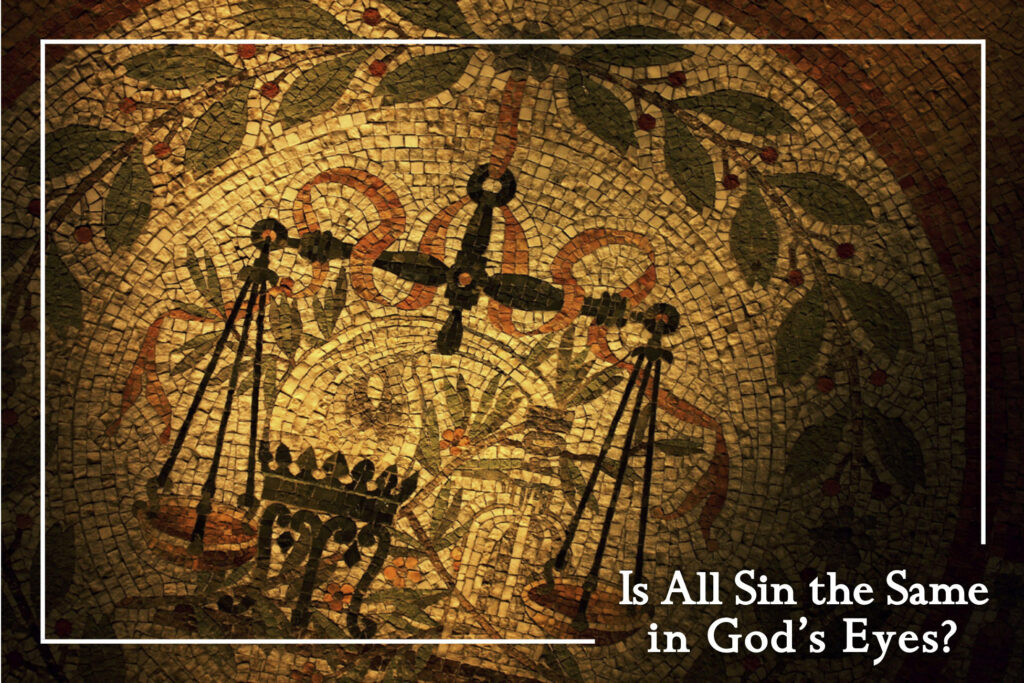
During my years of ministry, I don’t know how many times I have heard someone claim, in one form or another, that “all sins are the same in God’s eyes”. Basically the idea is that we as humans distinguish between different types of sin and consider some to be worse than others, but that God doesn’t do that—He is holy, He doesn’t tolerate any type of sin, and therefore, to him one type of sin is just as bad as any other.[1]
This idea has certainly become a basic tenet of pop theology, but is it biblical? I would humbly submit that it is not, and it’s an idea that I wish could be put to rest.
Why Isn’t All Sin Equal?
First off, we should mention that all sin is equal in the sense that it separates us from God. Romans 6.23 says that the wages of sin is death—we can’t have any relationship with God until we do something about the sin in our lives. So all sin, any sin, is a big deal because it damages our relationship with the Father.
So why, then, isn’t all sin equal?
(1) The Bible teaches that there are different degrees of sin.
There are a whole lot of examples that could be used here, but just consider the following:
- In John 19.11, when speaking to Pilate in the context of his arrest and trial, Jesus says,“You would have no authority over Me, unless it had been given you from above; for this reason he who delivered Me to you has the greater sin.” Here Jesus explicitly says that one sin is worse than another.
- Speaking to the Pharisees in Matthew 23.23-24, Jesus says that they had neglected the “weightier provisions of the law”—justice and mercy and faithfulness—and had instead focused on minor issues. To me, if some parts of the law were more important than others, then the implication is that neglecting those portions was a greater sin.
- In Matthew 7.3, in the context of being careful about the way we judge others, Jesus says, “Why do you look at the speck that is in your brother’s eye, but do not notice the log that is in your own eye?” The clear indication here is that the log is a bigger problem than the speck, and should therefore be dealt with first.
- Luke 12.10 talks about sinning against the Holy Spirit, and how it is unforgivable. People debate all the time about exactly what this sin refers to (and I have my own thoughts on this), but if there is a certain sin that is unforgivable, doesn’t that mean that it is worse than others?
- Ezekiel 23 compares the cities of Samaria (the capital of Israel) and Jerusalem (the capital of Judah), and clearly states that Jerusalem was more corrupt than Samaria (v.11) because of her greater degree of unfaithfulness.
- When the Israelites worshiped the golden calf at Mt. Sinai (Exodus 32), Moses charged them with committing a “great sin”. If all sins are the same, why is this one specifically referred to as “great”?
- In Paul’s first letter to Timothy, he emphasizes how terrible it is for a Christian man to neglect his family. In 1 Timothy 5.8, he says, “But if anyone does not provide for his people, and especially his own household, he has denied the faith, and is worse than an unbeliever.” If one can be worse than someone else, doesn’t that imply greater sinfulness?
(2) Some sins have harsher consequences than others.
When you think of the earthly consequences of sin, do all sins seem to be the same? Committing lust in your heart is undoubtedly a sin, but does it have the same consequences as committing adultery? In one case, the sin is limited to yourself, while the other necessarily involves another person and could potentially destroy an entire family. Stealing a piece of gum is a sin, but it is unlikely that it will cause great damage to the person you steal it from. On the other hand, committing murder destroys a life and affects an untold number of people. In short, some sins might not have long-lasting temporal effects, while others literally destroy people’s lives.
This can also be seen in the Bible—if all sin is the same, why did God decide to basically reboot the whole system in the days of Noah and start from scratch? At no other point did God decide to do this, so the indication is that things must have somehow been worse in the days of Noah.
What about Sodom and Gomorrah? Undoubtedly every city on earth is plagued by a great amount of sin—why were these cities singled out for destruction? I would submit that it was because their sinfulness was so widespread—in just the small glimpse we get of Sodom, it appears that the majority of people were guilty of homosexuality, inhospitality, violence against strangers, and sexual assault. It seems that the sinfulness of Sodom was worse than in other places.
There is also some indication in the Bible that different types of sin may have different eternal consequences as well.
First, in Matthew 11.20-24, Jesus pronounces woe upon cities which had witnessed the signs He had performed but failed to repent (particularly relevant parts in the following scriptures are emphasized in bold):
“Then He began to denounce the cities where most of His mighty works had been done, because they did not repent. ‘Woe to you, Chorazin! Woe to you, Bethsaida! For if the mighty works done in you had been done in Tyre and Sidon, they would have repented long ago in sackcloth and ashes. But I tell you, it will be more bearable on the day of judgment for Tyre and Sidon than for you. And you, Capernaum, will you be exalted to heaven? You will be brought down to Hades. For if the mighty works done in you had been done in Sodom, it would have remained until this day. But I tell you that it will be more tolerable on the day of judgment for the land of Sodom than for you.’”
Now, granted, Jesus seems to be personifying entire cities here and it’s difficult to draw firm conclusions based on passages of figurative language, but the implication is that condemnation will be worse for some in the Day of Judgment than for others. If some persons/cities merit greater punishment in the Day of Judgment than others, that certainly indicates to me that all sins are not equal.
Secondly, in Luke 12.35-48, Jesus tells a parable about the importance of being ready for the (second) coming of the Son of Man:
“‘Stay dressed for action and keep your lamps burning, and be like men who are waiting for their master to come home from the wedding feast, so that they may open the door to him at once when he comes and knocks. Blessed are those servants whom the master finds awake when he comes. Truly I say to you, he will dress himself for service and have them recline at the table, and he will come and serve them. If he comes in the second watch, or in the third, and finds them awake, blessed are those servants! But know this, that if the master of the house had known at what hour the thief was coming, he wold not have left his house to be broken into. You also must be ready, for the Son of Man is coming at an hour you do not expect.’
Peter said, ‘Lord, are you telling this parable for us or for all?’ And the Lord said, ‘Who then is the faithful and wise manager, whom his master will set over his household, to give them their portion of food at the proper time? Blessed is that servant whom his master will find so doing when he comes. Truly, I say to you, he will set him over all his possessions. But if that servant says to himself, ‘My master is delayed in coming,’ and begins to beat the male and female servants, and to eat and drink and get drunk, the master of that servant will come on a day when he does not expect him and at an hour he does not know, and will cut him in pieces and put him with the unfaithful. And that servant who knew his master’s will but did not get ready or act according to his will, will receive a severe beating. But the one who did not know, and did what deserved a beating, will receive a light beating. Everyone to whom much was given, of him much will be required, and from him to whom they entrusted much, they will demand the more.’”
Again, Jesus is speaking in a parable here, but the parable does deal with His unexpected return and the accompanying judgment. Once again, the indication is that in the Day of Judgment, some sins will have worse consequences than others, as some who are guilty and bound for punishment will receive “severe beatings” while others receive “light beatings.”
Finally, Hebrews 10.26-29:
“For if we go on sinning deliberately after receiving the knowledge of the truth, there no longer remains a sacrifice for sins, but a fearful expectation of judgment, and a fury of fire that will consume the adversaries. Anyone who has set aside the law of Moses dies without mercy on the evidence of two or three witnesses. How much worse punishment, do you think, will be deserved by the one who has trampled underfoot the Son of God, and has profaned the blood of the covenant by which he was sanctified, and has outraged the Spirit of grace?”
Here the Hebrew writer suggests that those who had come to know Christ and then subsequently forsaken Him would merit worse punishment than others. Furthermore, to underscore why such persons would receive harsher treatment, the author uses extreme language to emphasize the severity of such an action, describing it as trampling the Son of God, profaning His blood, and outraging the Spirit.
Perhaps none of these three passages are crystal clear, but taken together, they suggest at least the possibility that there will be different “levels” or “degrees” of eternal punishment for different people.
(3) Some sins are harder to repent of than others.
Biblically, repentance isn’t just being “sorry” for sin, it’s a conscious turning away from the sin in your life. From that perspective, some sins are harder to repent of than others. It’s one thing to turn away from a sin that you commit by accident; it’s another thing entirely to repent of a sin that you plan out ahead of time and intentionally commit—in other words, it’s easier to turn away from sins we are already trying to avoid than those we seek out.
Hebrews 6.4-8 conveys a similar message, saying that for those who have “tasted the good word of God” and then fallen away, it is “impossible to renew them again to repentance.” This is a much-debated passage, but at the very least, the indication is that the sin of these people places them in a category that makes repentance more difficult than for others.
Furthermore, sinful addictions that destroy people’s lives are much harder to repent of than single, isolated sins.[2]
(4) Simple logic tells us that not all sin is the same.
To reiterate what I said above, all sin is the same in the sense that it separates us from God, but if it was the same in every sense, then that would mean that stealing a piece of gum is just as bad as stealing a car, which is just as bad as killing someone, which is just as bad as killing 20 people. Does that really make any sense?
Put another way, that would mean that in God’s eyes, Mother Teresa and Adolf Hitler are exactly the same, because they both committed sin at some point in their lives. If it’s so easy for us to see the difference in the goodness of those two people, does it make any sense at all that God would look at them in exactly the same way (where do you think our moral code comes from in the first place?)?
Then Why Do So Many People Believe This?
If the idea of all sins being equal didn’t come from the Bible, where did it come from? I don’t have any proof of this, but I suspect it came out of the desire to emphasize two ideas about sin that are very true:
(1) Every sin, no matter how small it seems, is a big deal and requires forgiveness.
Sometimes, in an effort to emphasize the grace of God and His willingness to forgive, some people effectively minimize the magnitude of sin. The idea here is that it doesn’t matter what kind of language you use, it doesn’t matter if you live a sexually immoral life, it doesn’t matter if you are a chronic gossip, because you can just ask for forgiveness and it’s that easy.
The thing to remember is that while grace is free, it isn’t cheap. The sin of mankind is such a big deal that it required the death of the sinless Son of God to make grace possible. Sin—all sin—is a big deal.
(2) Even the “big” sins that we think of as being terrible can still be forgiven.
Sometimes, when people commit very public, very damaging sins, we tend to write them off. A girl gets pregnant out of wedlock or a man divorces his wife, and too often, they are treated like their lives are over and that God has no use for them anymore. The idea here is that only especially saintly people who avoid all “major” sins can ever hope to have a relationship with God.
As mentioned above, it cost God a lot to forgive sin, but thanks to the work of Christ on the cross, He is able and eager to do just that, regardless of how “bad” your sin is (Prodigal Son, Apostle Paul, etc.).
With these two ideas in mind, it’s easy enough to imagine where the “All Sin is Equal” idea came from: simultaneously wanting to underscore that even the “worst” of sins can be forgiven but that even “minor” sins are a big deal and separate us from God, it’s not a huge jump to just declare that all sins must be the same from God’s perspective.
Hopefully, as I’ve explained above, that idea doesn’t make sense logically, and it doesn’t square with the teachings of Scripture either. As we move forward, let’s emphasize that all sin is a big deal, but that it can still be forgiven.
I want to be clear that my intention in this post is not to maximize or minimize any specific sin, or to encourage active reflection on how some sins “rank” in comparison to others. Instead, I am simply calling for people to quit saying, “All sin is the same in God’s eyes”, because biblically, that just isn’t a true statement.
[1]This is an edited version of the original post on this topic.
[2]I’m not intending to debate addiction as sin vs. addiction as illness. Really, I think it’s a moot point—even if addictions affect the body and mind like illnesses do, they still begin with sinful behavior.