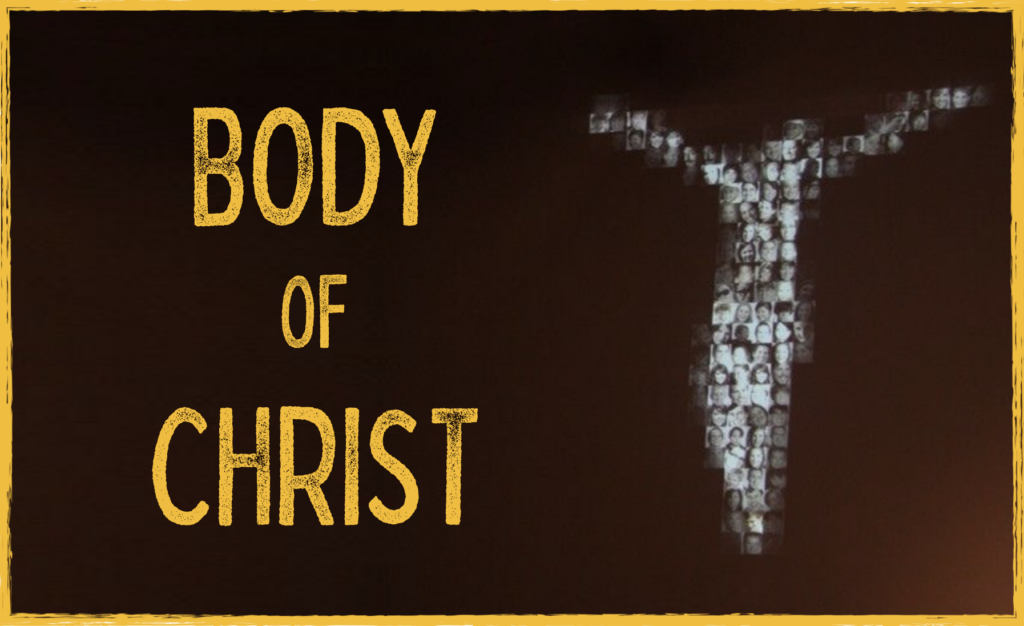
The idea of the church as the body of Christ is a metaphor that Paul particularly enjoys, and he uses it in various ways in several passages. In Romans 12, Paul connects the idea of being parts of a body to giftedness and how we serve in the church. In 1 Corinthians 12, there is a similar idea. First, in 1 Corinthians 12.4-11, Paul begins by talking about spiritual gifts. It is clear that the Christians at Corinth were struggling with their spiritual gifts and the way that they evaluated and ranked certain gifts (and the people who had them) above others, because Paul spends the better part of three chapters (1 Corinthians 12–14) addressing this specific problem. He says in 1 Corinthians 12 that God gives a variety of gifts to different people, and how it is important for the church to have them all. Then, he goes on to use the body metaphor:
12 For just as the body is one and has many members, and all the members of the body, though many, are one body, so it is with Christ. 13 For in one Spirit we were all baptized into one body—Jews or Greeks, slaves or free—and all were made to drink of one Spirit. 14 For the body does not consist of one member but of many. 15 If the foot should say, “Because I am not a hand, I do not belong to the body,” that would not make it any less a part of the body. 16 And if the ear should say, “Because I am not an eye, I do not belong to the body,” that would not make it any less a part of the body. 17 If the whole body were an eye, where would be the sense of hearing? If the whole body were an ear, where would be the sense of smell? 18 But as it is, God arranged the members in the body, each one of them, as he chose. 19 If all were a single member, where would the body be? 20 As it is, there are many parts, yet one body.
21 The eye cannot say to the hand, “I have no need of you,” nor again the head to the feet, “I have no need of you.” 22 On the contrary, the parts of the body that seem to be weaker are indispensable, 23 and on those parts of the body that we think less honorable we bestow the greater honor, and our unpresentable parts are treated with greater modesty, 24 which our more presentable parts do not require. But God has so composed the body, giving greater honor to the part that lacked it, 25 that there may be no division in the body, but that the members may have the same care for one another. 26 If one member suffers, all suffer together; if one member is honored, all rejoice together. 27 Now you are the body of Christ and individually members of it.
(1 Corinthians 12.12-27)
Obviously, the contexts of Romans 12 and 1 Corinthians 12 were somewhat different, but it is interesting that Paul uses a similar strategy to deal with issues he is facing in either context.
The church in Corinth was plagued by factions. The church is divided along multiple fronts: social class, doctrinal disagreements, and party loyalty. It seems clear that there is a problem in Corinth with the wealthy looking down on the poor. Further, the church is in disagreement over a host of doctrinal issues. And, it seems that different groups have arisen within the church at Corinth who are expressing their loyalties to different Christian leaders (1 Corinthians 1.12-16). And to these Christians with divided loyalties, Paul emphasizes their diversity, their unity, and their interdependence.
Later, when Paul is writing Romans (although Romans appears first in our New Testaments, 1 Corinthians was actually written before Romans), he is writing to a church made up of Jews and Gentiles, and it is clear from the things he emphasizes throughout the book that tensions have arisen from these ethnic differences. So, to a divided church in Rome, Paul emphasizes their unity as a body.[1]
So, we have different contexts here, but still a very similar strategy; what can we learn from these texts about the church as the body of Christ?
A Body is Made Up of Different Parts
The metaphor that Paul uses of the church as a body is not one that he makes up. In fact, he “adapts an image commonly used for the Roman state or for the universe and applies it to the church.” At one point, when the plebians, the lower social class in Rome, was considering revolt, the upper classes convinced them not to do this, arguing that were all joined together in Roman society as part of a body. The lower class might have a less noticeable role, like the stomach, but was still important.[2] This argument was largely just a rhetorical device to keep the massive poor class in its place—the rich and powerful don’t want revolt!—but Paul adapts this image for his use. He is not concerned about the lower-class members of the church revolting, but rather that the so-called superior members will act with arrogance and disregard for those who they consider inferior.[3]
As we have already mentioned, in both Romans 12 and 1 Corinthians 12, Paul ties the imagery of the body to different spiritual gifts. Specifically, in 1 Corinthians 12.11-13 and following, the idea is that when we are baptized into Christ, we become a part of the body, and the Holy Spirit gifts us in such a way that we can be useful as part of the body.[4]
But, those gifts are not all the same—different body parts have different roles, and different Christians are gifted to serve differently within the church. This diversity that exists within the church is absolutely essential: “The point is that the body is one not despite its diversity, but is one body only by virtue of its diversity; without that diversity the body would be a monstrosity.”[5] What would a body look like if it was just a bunch of ears or eyes? That would be pretty scary, and it’s not really a body.
The diversity of people, gifts, and roles within the church is absolutely essential. In the body of Christ, we don’t all have the same function, but we all have some function.
In the Romans passage, in 12.3, Paul encourages his audience to be sober-minded and think clearly about the gifts they have been given by God. “[This] “sober judgment” not only excludes an exaggerated opinion of oneself, but also warns us not to underestimate the abilities God has given us.”[6]
This is a really important idea: there is no place for arrogance or shame about the gifts God has given us or the ways in which we serve within the church.
We’ve all been around people who are really good at something, and they go out of their way to make sure that everyone else knows that they’re really good at it too. Those people are frustrating to be around, and when it comes to the gifts that God gives us, Paul says that it is absolutely ludicrous for us to be prideful about those things—we did nothing to deserve them! They were a gift from God! That’s what he says earlier in 1 Corinthians 4.7: “What do you have that you did not receive?” All that we have is a gift from God; a gift is something that we do not deserve, it is something we receive because of the grace of the giver, and Paul’s point here is that since these are gifts, it is absurd and ungrateful for us to take any sort of credit for them or be prideful about them.
But there can also be a danger in not valuing our gifts enough: thinking that we have nothing to offer or contribute. The clear teaching of Scripture is that God has gifted all of us as parts of the body to aid in the work of His church. It may seem like a modest thing to claim that you have nothing to offer, but it is actually a faithless response: you are denying the gifts of God! Sometimes a false modesty may be just as detrimental to the church as pride.[7]
Earlier in 1 Corinthians 12 and later in 1 Corinthians 14, Paul discusses how different people have different spiritual gifts. Apparently in the Corinthian church, some gifts were more desired than others, and some people were jealous of the gifts of others. The body parts that Paul references in 1 Corinthians 12 are likely significant: ““Eye” and “head” are transparent metaphors for those in leadership roles, who are likely to be more affluent and better educated. The “hands” and “feet” represent the laboring class or slaves.”[8] It is not hard to imagine that the Christians in Corinth were evaluating one another based on their social location and also their giftedness.
But Paul makes the point that in the church, just like in a physical body, different members have different roles. God gifts us with different talents and abilities, and it’s our responsibility to use these for the good of the church. Paul rejects the Corinthians’ practice of competing over which gifts they have, because he says that all of these gifts are empowered by the Holy Spirit who gives them to people as He chooses. So it is not our place to elevate some people over others because of the gifts they have, or to be jealous of someone else who has a gift that we would like to have: it is the Holy Spirit who bestows these gifts, and He knows what He’s doing. There are different roles for each of us to fill.
There is diversity in a body: different parts have different functions.
A Body Works When Its Parts Work Together
This idea is an extension of the previous point: a body is made up of different parts, but those parts must work together for the body to truly function as a body. Paul begins by emphasizing the diversity of the members of the body (v. 14-20); his focus then shifts to the interdependence of the members of the body (v. 21-26).[9]
In our physical bodies, each part has its own job to do, but in a healthy body, “all the parts function harmoniously and independently for the good of the whole body. So should it be in the church, which is the body of Christ.”[10] The parts of my physical body don’t resent each other or get jealous of each other; they are not suspicious of one another or refuse to work together. What if my different body parts fought and quarreled with each other? What if, while working on some project, one body part got mad at the other, and decided never to work with it again? Just the suggestion of that is ridiculous when we think in terms of our physical bodies!
It should be similarly ridiculous for members of Christ’s body to resent one another, be jealous of one another, be suspicious of one another, or refuse to work with each other. We are to use our gifts for the benefit of the whole body, for the common good, without any envy or jealousy of the gifts that others may have.[11] We are to work together for the good of the body of Christ.
Paul goes on in his body metaphor to emphasize that, in the body of Christ, our diversity is actually directly connected to our interdependence: instead of separating us from one another, the variety of gifts brings us closer together when we see how much we depend on one another:[12]
22 On the contrary, the parts of the body that seem to be weaker are indispensable, 23 and on those parts of the body that we think less honorable we bestow the greater honor, and our unpresentable parts are treated with greater modesty, 24 which our more presentable parts do not require. But God has so composed the body, giving greater honor to the part that lacked it, 25 that there may be no division in the body, but that the members may have the same care for one another.
(1 Corinthians 12.22-25)
Paul is using a euphemism here. As parents of small children know, one of the challenges of parenting (and sometimes a very humorous challenge) is impressing upon our kids that there are certain body parts that require special honor and protection. They are private parts, and need to be treated with respect, not because they are shameful or unimportant, but because they are very important![13] In the same way, Paul is arguing here that it is God’s plan that those in the church who appear to have less honor should receive special honor.[14]
So here is the point: no matter how humble my gift may be or seem, every other member of the body depends on it, and no matter how honorable my gift may be or seem, I am dependent upon and blessed by the humblest contribution from every other member.[15]
Too often in the church, when we talk about our gifts, I think we are too limited in our thinking. God bestows a variety of gifts and abilities on a variety of people, and they can all be used for the good of the church. We shouldn’t put people on a pedestal because they are good at delivering a sermon or leading worship. Those gifts are needed, but the gifts of everyone are needed and important:
- One of the very basic tasks of the church is to take care of those of our number who are struggling. How difficult would it be for the church to properly care for those of our number who are sick or grieving without the help of all those who have the ability to prepare food for them? Or without those who are willing to visit those who are sick and struggling?
- A lot of the work of the church—whether we’re talking about benevolence, or local outreach, or global missions, or paying the preacher’s salary so he can dedicate his life to study and the work of the church, or just keeping the lights and air conditioner on—a lot of the work of the church requires a great deal of money. How difficult would it be for the church to continue to function without those who have been blessed financially and with generous hearts help support the work?
- Or what about fellowship meals? A lot of times I don’t think we give fellowship meals their due respect. What was called the “love feast” is an ancient Christian practice. Table fellowship is a very important part of who we are. Having said that, I am a terrible cook. Can you imagine how dreadful meals would be if people like me were the only ones to prepare food? (Well, it looks like we’ve got some cereal over here…and there’s some toast…and oh! You warmed up a couple dozen Hot Pockets…greeeeaaat. I think I’ll pass.) What a blessing it is to have people with the talent and desire to prepare food for one another! These are not unimportant contributions!
- Or what about those folks who are friendly and outgoing and always seeking out visitors to talk to? That’s not me. I am not friendly and outgoing; I have to give myself a pep talk every time I even go talk to people I know and like! People with this gift are so valuable to the work of the church.
- Or what about those who have been gifted with a spirit of encouragement? You know, the ones who always seem to be able to cheer you up or offer a kind word when you are down? Without people like that and the constant encouragement they provide, there would be some Christians who would just be ready to give up.
We could go on and on, but you see the point: God gives a variety of gifts and talents which are vital for the work of the church to be successful, even if some of those gifts and talents are not the ones we generally think about or honor. All of it is important. That’s Paul’s point. All of those gifts matter. You know what you’re good at—use your gifts and glorify God with them by helping other people and building up the church. When we use the gifts that God has given us to glorify Him, the church works the way it’s supposed to, and it’s a beautiful thing.
A body only functions properly when its parts work together.
A Body is Directed by Its Head
In a physical body, you make decisions with your head, with your brain. Based on what the head decides, the body acts accordingly, moving in a certain way or performing a certain task. The church works the same way, and the Bible tells us that Christ is the head of the church.
This is an important truth, but it is not one that is taught explicitly in either of the two texts that we’ve been looking at. We know from experience that bodies have heads, and Paul says that we “are the body of Christ and individually members of it” (1 Cor. 12.27). There is much in these passages about how it is God who is appointing gifts and organizing the members of the body,[16] so it is implied, but this idea is plainly stated in other writings from Paul:[17]
“And [Jesus] is the head of the body, the church; He is the beginning and the firstborn from among the dead, so that in everything He might have the supremacy.”
(Colossians 1.18)
“And God placed all things under [Jesus’] feet and appointed Him to be head over everything for the church, which is His body, the fullness of Him who fills everything in every way.”
(Ephesians 1.22-23)
So, here is the big idea: Jesus is our Head. He tells us what to do, and it is our job to do that! Now, we have a lot of Jesus’ teaching preserved in Scripture for us, but we could sum up those teachings with the Great Commandments and the Great Commission: we are to love the Lord our God with everything we have and love our neighbors as ourselves, and we are to go into all the world, making disciples of all the nations, baptizing them in the name of the Father, Son, and the Holy Spirit, and teaching them to observe all the commandments, of Jesus, our Head. Now, exactly what it looks like for us to carry out those commandments in our specific context, both as a church and individually, requires some discernment and allows for some freedom, but the directives are clear—this is what we must be about.
Not only does this idea mean that the body must submit to the authority of Jesus, it also means that for a member to be connected to the head, it must be a part of the body. What that means is that this teaching—that Christ is the head of the church—is unpopular in modern Christianity (at least as practiced in the United States) for two very different reasons.
For some, this teaching is problematic because they are interested in the Head, but don’t want to be a part of the body. This would be the folks who say things like, “I like Jesus, but not the church.” That is a problematic idea, and this is not the place to fully critique that, but using our metaphor, you don’t get to be a free agent arm or liver connected to the Head. It is through our belonging to the body that we are connected to Jesus, our Head.
For others, this teaching is problematic because they may be quite willing to be a part of a body, a community of self-styled Christians, but they’re not willing to listen to the Head when He says things they don’t like. Jesus says hard things about all sorts of idols like money, sex, and power to which we can be tempted to devote our lives. We don’t always like the things He says; but the reality is that we don’t get to be a part of Christ’s body if we refuse to listen to the Head.
A body is directed by its head.
A Body Takes Care of Its Parts
This idea is implied in Paul’s teaching about the unity and interdependence of the body and the way that we treat certain parts with special honor, but it’s also clearly stated in 1 Corinthians 12.26: “If one member suffers, all suffer together; if one member is honored, all rejoice together.”
What happens when you are hammering a nail and the hammer slips and you hit your finger, or maybe you shut your finger in a drawer? Your whole body reacts—you rush to protect the finger…you may start jumping up and down…your mouth may start exclaiming all sorts of things.
Over 15 years ago, I hurt my thumb dunking on a student in my youth group on an 8-foot basketball goal. I must have done some actual damage to ligaments in my thumb that never healed properly, because now, if I bang that thumb or if it gets pulled in the wrong way, it hurts a lot. What’s interesting is that, over time, my body has learned that my thumb is weak and seeks to protect it. Without even thinking, I carry things and move around in a way that protects my injured thumb.
An injury to a body part can “absorb the entire body’s energy and attention.” Paul contends that this is how things are in the church, as well: “the body really is diminished and pained by the suffering of any of its members.”[18]
When one of our members or one of our families suffers, we should all suffer together—we surround and protect them and show concern. And the flip side is also true: when one member is honored in some way or celebrates something, we all celebrate together. We are all part of one body—we are not jealous of one another; if something good happens for one of us, it happens for all of us![19] As Paul says a little later on in Romans 12: “Rejoice with those who rejoice, weep with those who weep.” (Romans 12.15).
A body takes care of its parts.
Conclusion
Scripture teaches that the church as the Body of Christ, and a body is made up of different parts, a body works when its parts work together, a body is directed by its head, and a body takes care of its parts.
So, what do we do with this? Here are a few questions to reflect on:
- Are you part of Christ’s body? As taught in 1 Corinthians 12.13 and several other places, it is through baptism that we are added to the church and become a member of Christ’s body. If you haven’t received baptism, that is the next step (and I’d love to talk to you about that!).
- Are you using your gifts for the good of the body? There is so much work to be done, and the body only works well when its parts work together. Are you part of a local church, and are you using your gifts for the good of that body?
- Who can you rejoice or weep with? If you are plugged into a local church, there are all sorts of people who are carrying heavy burdens, and all of these are real, tangible opportunities for you to rejoice or weep with someone. Marriages, births, sicknesses, surgeries, and deaths—these present need within the body and give us opportunity to step into those needs and serve.
“Now you are the body of Christ and individually members of it…”
[1] Joseph A. Fitzmyer, Romans: A New Translation with Introduction and Commentary, The Anchor Bible, 646.
[2] Craig Keener, The IVP Bible Background Commentary: New Testament, 485; James. D.G. Dunn, Romans 9-16, Word Biblical Commentary, 733.
[3] David E. Garland, 1 Corinthians, Baker Exegetical Commentary on the New Testament, 594.
[4] Richard E. Oster, Jr., 1 Corinthians, The College Press NIV Commentary, 300.
[5] Dunn, Romans 9-16, Word Biblical Commentary, 725.
[6] Jack Cottrell, Romans, Volume 2, The College Press NIV Commentary, 319.
[7] Cottrell, 319.
[8] Garland, 595. Oster, 304: “This seems to be a clear instance of the social stratification of urban Corinth penetrating the ranks of the church, resulting in some believers assuming a posture of superiority in terms of gifts. It is surely not an accident that in Paul’s social setting where manual labor was judged inferior in the minds upper crust people, that it was hands and feet that were being snubbed. While eyes and head reflected the body parts more symbolized by affluence and educational elitism, hands and feet were the essential body parts for the mass of urban lower classes and slaves.”
[9] Richard B. Hays, First Corinthians, Interpretation, 215.
[10] F.F. Bruce, The Epistle of Paul to the Romans, Tyndale New Testament Commentaries, 227.
[11] Fitzmyer, 647; William Barclay, Letters to the Corinthians, The Daily Study Bible, 127; William Barclay, The Letter to the Romans, The Daily Study Bible, 172; Garland, 597 (quoting Luther), “These gifts are from God; I did not confer them upon myself. One should not be puffed up on their account. If someone else does not have the gifts I have, then he has others. If I exalt my gifts and despise another’s, that is pride.”
[12] Cottrell, 322.
[13] Ben Witherington III, Conflict & Community in Corinth: A Socio-Rhetorical Commentary on 1 and 2 Corinthians, 259: “God composed the body by giving the parts that were lacking in appearance even more honor, bestowing on them the most crucial of functions, that is, reproduction.”
[14] Oster, 305.
[15] Cottrell, 322.
[16] Oster, 303, says the church in Corinth “is a manifestation of divine arrangement.…all believers and their God-given gifts, irrespective of their prestige in human eyes, are a work of God and belong exactly where God has placed them.”
[17] Bruce, 228.
[18] Hays, 216.
[19] Hays, 216; Oster, 306.