The online journal of Luke Dockery

Category: Discipleship (Page 21 of 23)

The Best Lesson I’ve Taught on Integrity

One of the foundational lessons I’ve learned from my years of youth ministry is this: regardless of what I teach to my students in Bible class, the loudest message they hear from me is the one I proclaim by the way I live my life on a daily basis. In fact, I consider one’s example to be one of the essential elements of effective youth ministry.

That’s not really a ground-breaking observation—we have common sayings in our culture that illustrate that our actions matter more than our claims or words (“Do as I say, not as I do”, “Don’t talk the talk if you can’t walk the walk”)—but I can remember well an event from church camp a few years ago that hammered this home to me more so than ever before.

Every summer our youth group spends a week at Green Valley Bible Camp, and I work as a counselor. Green Valley is a great place with a lot of fun and meaningful activities, and one of the long-standing camp traditions is that on Friday afternoons, there is an All-Star softball game between the male counselors and the senior boy campers. The All-Star game is kind of a big deal, especially for the campers, for whom it serves as some sort of coming-of-age rite of passage and an opportunity to talk trash to yours truly all year.

Anyway, in a particular game a few years ago, the campers shot out to a significant early lead while the counselors struggled mightily. We hit very poorly for the first couple of innings, but finally, we got a bit of a rally going: down several runs, we managed to score a couple and then had runners on second and third with two outs.

On the senior softball field at Green Valley, there is a big tree in foul ground down the third base line, with a large branch that reaches out over fair territory. The ground rules that we played with this particular year (sometimes they change from year to year depending on who the umpires are) were that any ball that hit the branch was automatically foul.

Our next hitter got up and hit a towering shot down the third base line that just barely nicked a few leaves from the overhanging branch. It didn’t alter the flight of the ball in any way, and neither umpire was able to tell that it had hit the tree at all. It soared into the outfield past the left fielder; both runners would have easily scored, and we would have been right back in the game.

Except…

I was the third base coach at the time, and since I was standing right by the overhanging branch, I could easily see and hear that the ball had grazed a couple of leaves. I let the umpire know, and it was ruled a foul ball. On the next pitch, the batter popped out to the pitcher. The rally ended, and we never really challenged again in the game. We ended up losing 10-4, and I got to hear taunts from my students for the next year about how they beat us. So, it was kind of a bummer.

Except…

One of my students was playing shortstop for the campers’ team and witnessed all that had happened. He was keenly aware of how big of a hit that would have been for us and how it could have changed the game. Within a few days of the event, he brought it up about six times and repeatedly talked about how awesome it was that I spoke up and told the truth regardless of the fact that it hurt my team.

I have done some figuring, and I think I’ve taught the youth group about 1100-1200 times during my years at Farmington. And probably dozens of times, I have taught about the importance of honesty and integrity, either as the focus of a lesson, or mentioned it in passing. But it became clear to me that none of those lessons made as much of an impression on this particular student as a simple action that I did at camp without thinking. Regardless of what I teach my students in Bible class, the loudest message they hear from me is the one I proclaim by the way I live my life on a daily basis.

There is always a danger to sharing a personal story where you are the hero (something I learned in preaching class), so I want to be clear here: I am not a hero; I make a lot of mistakes, and there are definitely times when I fail as an example. Rather, I share this story because it illustrates how important it is that we as parents, youth ministers, church leaders, etc. back up the things that we teach by the way that we live. I shudder to think what would’ve happened if I had kept my mouth shut and let the incorrect call stand—would this student have ever listened to me again when I talked about honesty and integrity, or would he have tuned me out since my actions wouldn’t have matched up with my teaching?

But by God’s grace, that’s not what happened. Instead, I was able to take advantage of an opportunity to teach a better lesson on integrity than all of those which I had spent hours and hours preparing.

Two Graduations: What My Special Needs Daughter Taught Me About Following Jesus

It’s June, which means that we have just completed another graduation season. As a youth minister, I go to a lot of graduations, but this year there were a couple of graduation ceremonies that were more significant to me.

First was my own graduation from Harding School of Theology. This one was a long time coming. It was an extensive program (a 78-hour degree, which is more coursework than many master’s and doctorate programs combined), and add to that the fact that I completed it while working full time, figuring out how to be a dad, and living hundreds of miles away, and I can say with only minimal chagrin that I started the program way back in 2010. Finishing a program that you have been engaged in for so long is certainly an accomplishment of sorts, and I’ve had a lot of people ask me how it feels to be done. I definitely feel grateful for all that I have learned and for all who made it possible (HST faculty and staff, my wife, my elders at church, etc.). I am also pleased to be done. But my overwhelming emotion is a little more difficult to explain, and that’s what this post is about.

About 10 days after my graduation, I went to another graduation ceremony—Kinsley’s Kindergarten graduation. I have written in different places about how the last 18 months or so have been very difficult for my little girl. Increased seizure activity has been hard to control and has led to several regressions (i.e., she has lost abilities that she once had). Nevertheless, during this past school year, she started Kindergarten in a self-contained class. Kinsley’s academic goals were made with her special needs in mind and were very modest by the standards of “typical” children, but still, due to the regressions, she didn’t hit those goals. In some sense, you could even say that her graduation from Kindergarten was something of a formality. But I can tell you this: I am far prouder of her graduation than my own.


I have always been a high achiever. I have always gotten good grades and done well in school. I was involved in a bunch of extracurricular activities to beef up my college résumé. I was a good (not great) athlete who worked hard and was, at times, pretty successful.

When I started grad school, I began to work even harder. I had become convinced that doing my best was a spiritual requirement (I still believe this, by the way), but “doing my best” easily became a justification for obsessive perfectionism. In school, I wanted every research paper to be perfect. In ministry, I wanted every teenager to be faithful and every sermon to be excellent. In my personal faith and theology, I wanted to be right on every issue and know the answer to every question. Some of this obsessive perfectionism I come by naturally (it runs in my family), but also, it was a core component of my faith. To be clear, I was never taught works righteousness growing up, or that God’s love for me was tied to my achievements and accomplishments, but somewhere along the way this became a big part of what following Jesus was for me.

When Kinsley came into my life (and more specifically, when she began to miss developmental milestones and we received her diagnosis), everything began to change for me. The reality is that I have a beautiful, wonderful daughter who, from a worldly perspective, will never achieve much of anything. And while I lament the ways in which her horrible disease has placed limitations upon her life, the reality is this: I don’t care about her achievements. I love her because she is my daughter, and I delight in her.

This realization and the implications of it have significantly affected my life. I don’t really care about achievement anymore. I don’t care about intelligence or talent. When parents talk about how clever their children are, or when friends speak of their accomplishments, I smile and try to be affirming, but it simply doesn’t matter much to me. And from that perspective, my own graduation doesn’t matter much to me either.

I still work hard, because I believe it is a spiritual imperative to do so—in all things I work as if I am working for Jesus because, really, I am. But I don’t work hard so God will love me more, or because my value is tied to my achievements. God loves me because I am His child, and that is enough.


I grew up in the church, have been a Christian for 20 years, a minister for 12, and I have a graduate degree in theology. But it was my daughter who taught me about grace simply by being her perfect, disabled self.

On second thought, that’s quite an achievement.


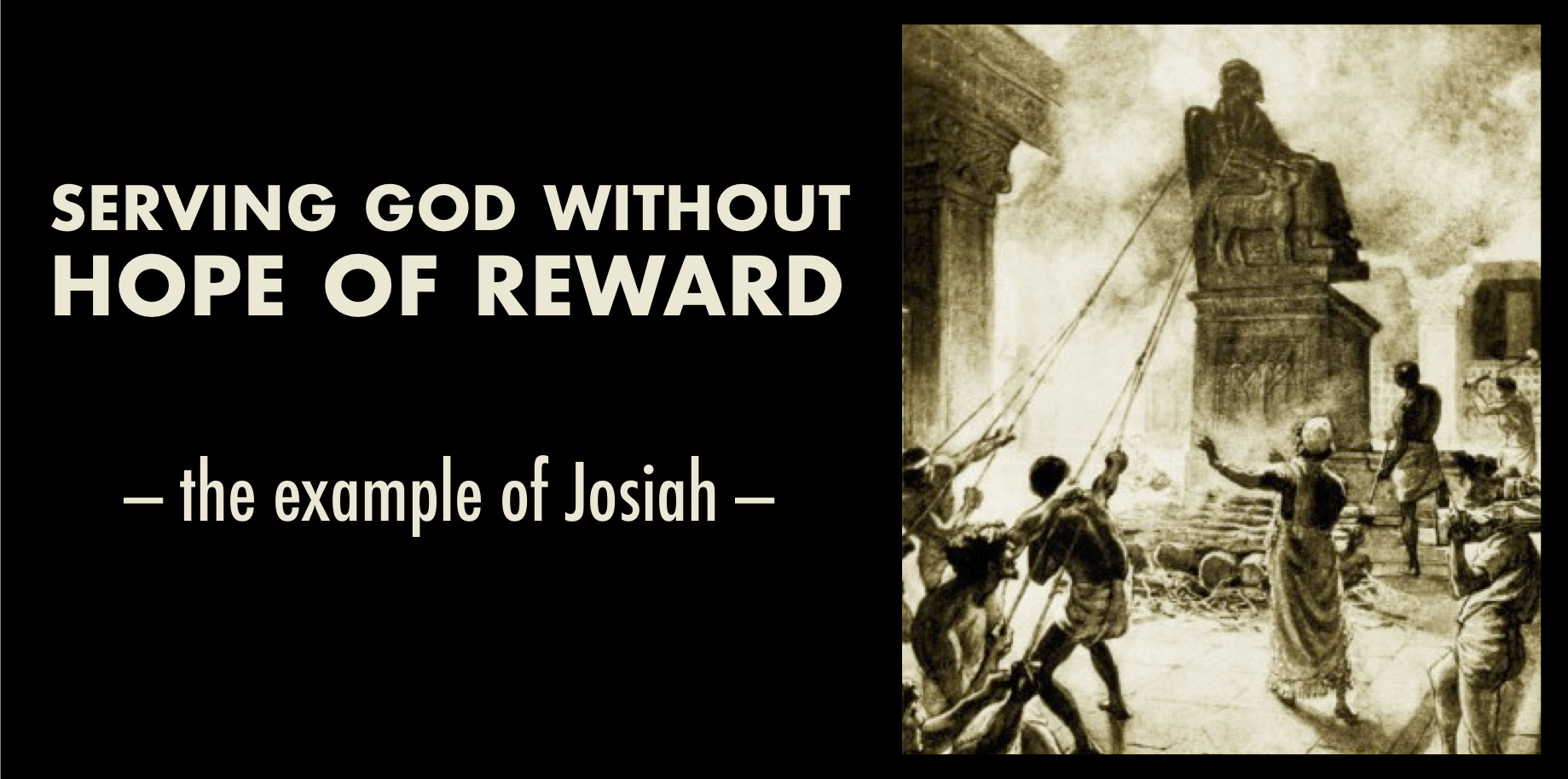
Serving God Without Hope of Reward: The Example of Josiah

A while back, I wrote a research paper on King Josiah, and ever since then he has been one of my favorite biblical characters.

Josiah came to power in the Southern Kingdom of Judah around 640 BC. This is a long time after the time of David and Solomon: the kingdom had been divided for almost 300 years, the Northern Kingdom of Israel has already been conquered by Assyria, and the Southern kingdom isn’t too far behind—a long series of mostly unfaithful kings (including Josiah’s father, Amon) have led Judah away from God, and before long, Babylon will begin to conquer them.

This is the situation when Josiah comes to power at the age of 8. Even though he’s young, and even though he had a wicked father, the Bible tells us in 2 Kings 2.22 that Josiah was a good and faithful king:

“He did right in the sight of the LORD and walked in all the way of his father David, nor did he turn aside to the right or to the left.”

According to 2 Kings 22, in the 18th year of his reign, Josiah begins a project to repair and restore the Temple, and during the construction project, the book of the law is found. Scholars and commentators disagree on exactly what this means, but basically, the Law of Moses has been found—either the entire Torah (the books of Genesis through Deuteronomy), or at the very least, the Book of Deuteronomy on its own. Either way, what this means is that the Law of Moses—the record of the covenant that God made with His people and the laws He gave them to follow—has been found and is read to King Josiah for the first time. It shows just how bad things had gotten under Josiah’s wicked father that Josiah apparently hadn’t been exposed to the Torah before now!

A covenant is an agreement or a promise made between two parties. To put it simply, in God’s covenant with the Israelites, God promised to be their God and protect them, and in return, the people were to be faithful and obedient to His commands. When Josiah hears the words of the Law, he tears his clothes because he realizes just how unfaithful Judah has been—they haven’t followed the commands of the Law of Moses, and they’ve worshipped gods other than Yahweh. In short, they haven’t kept up their part of the bargain.

So Josiah sends to Huldah the prophetess to inquire of the LORD—what does God say about the situation? Huldah responds in 2 Kings 22.15-20, but it isn’t good news:

“‘Thus says the LORD, the God of Israel: ‘Tell the man who sent you to me, Thus says the LORD, Behold, I will bring disaster upon this place and upon its inhabitants, all the words of the book that the king of Judah has read. Because they have forsaken me and have made offerings to other gods, that they might provoke me to anger with all the work of their hands, therefore my wrath will be kindled against this place, and it will not be quenched.

But to the king of Judah, who sent you to inquire of the LORD, thus shall you say to him, Thus says the LORD, the God of Israel: Regarding the words that you have heard, because your heart was penitent, and you humbled yourself before the LORD, when you heard how I spoke against this place and against its inhabitants, that they should become a desolation and a curse, and you have torn your clothes and wept before me, I also have heard you, declares the LORD.

Therefore, behold, I will gather you to your fathers, and you shall be gathered to your grave in peace, and your eyes shall not see all the disaster that I will bring upon this place.’’

And they brought back word to the king.”

So basically, God says that for all their wickedness, the people of Judah will be punished, but because Josiah humbled himself before God, he won’t have to witness the destruction of his country and will die before it happens.

Put yourself in the place of Josiah: what do you do next? No matter what you do, it’s too late for Judah and they’re going to be punished for their past sins after you die. It seems like whatever you do doesn’t matter, because the same negative consequence will happen either way. This is Josiah’s situation; what will he do next?

And this is why Josiah is one of my favorite Bible characters, and why he is such a good example for us: even when he knows that there’s no reward coming his way, he still does the right thing because of his devotion to God.

In 2 Kings 23, Josiah goes out and reads the Book of the Law in front of all the people and along with them, reestablishes the covenant with God. Then, he sets about in a systematic way to make things right. He goes throughout Judah and even into the northern territory of Israel and does away with unauthorized worship practices, destroying idols and pagan altars and getting rid of idolatrous priests. He removes the mediums and spiritists from the land as well, and also re-institutes the Passover feast:

“For no such Passover had been kept since the days of the judges who judged Israel, or during all the days of the kings of Israel or of the kings of Judah. But in the eighteenth year of King Josiah this Passover was kept to the LORD in Jerusalem.”

Josiah does all of this despite the knowledge that Judah is going to be punished no matter what, and sure enough, after Josiah is killed in a battle against Egypt, Judah is quickly overthrown.


Josiah’s life underscores how important it is to serve God because we love Him, not because we’re hoping to get something for doing so. I think a lot of times people get the idea that as Christians, we spend our lives doing good things for God and that He then pays us back by granting us eternal life.

To be clear, the Bible does speak of eternal life as a reward and the hope of living eternally in God’s presence should help to motivate us to keep going, especially when times get rough. But if the only reason you’re serving God is so He’ll pay you back with eternal life, then you really have the wrong perspective on things. Serving God will seem like a chore and, before long, you’ll fool yourself into thinking that God owes you something, when nothing could be further from the truth.

What Would Jesus Resolve?

I remember that I was in junior high when the “What Would Jesus Do?” craze swept the nation. It became cool to wear the cloth WWJD bracelets—even at my young age, I remember that I was struck by the fact that a lot of the people wearing the bracelets didn’t actually seem to care too much about applying the answer to the question to their lives! Over the years, I have heard various criticisms of the whole WWJD phenomenon, but at its heart, I think the idea of trying to determine one’s own course of action by considering the character of Jesus is a healthy one.

It is the beginning of a new year, which means that a lot of people are working at keeping resolutions that they made for the year. I have several things I want to work on this year, but a primary focus is my physical health: I am wanting to lower my cholesterol by eating better, and I am also counting calories in an effort to lose a bit a weight.

As I was weighing myself this morning and reflecting on the idea of resolutions, I suddenly thought to myself, “What Would Jesus Resolve?” In some ways, this is perhaps a ridiculous question, as I don’t aim to impose modern notions of New Year’s Resolutions on Jesus (though, according to Wikipedia, Resolutions actually have ancient origins, and a parallel practice is observed at the Jewish New Year, so who knows?). Furthermore, Resolutions generally involve improving ourselves, or correcting some sort of vice or perceived deficiency: as the Perfect Human, what did Jesus need to improve upon?

Still, in another sense, Resolutions are about establishing and ordering priorities: what will we focus on in the New Year? What are the important things that need our attention? In this sense, I think we are on firmer ground, because Jesus’ teachings and actions absolutely reveal his priorities. In Mark 12.29-31, Jesus says that the two greatest commandments are to love God with all of our heart, soul, mind, and strength, and to love our neighbors as we love ourselves.

In his own life, Jesus reflected his love for the Father by perfectly following his will and keeping his commandments (cf. John 14.15, 21, 23), and showed his love for others in his healing, his teaching, his service, and ultimately, in his death on behalf of all humanity (cf. John 15.13).

Whether you believe in New Year’s Resolutions or not, if you are a Christian, you should resolve to love God and other people more each and every day. This is the heart of the Christian message. It is what Jesus resolved/intended/purposed to do each day of his life, and it is what his followers should do as well.

Full Calendars, Empty Souls

We live in a busy and hectic world where the never-ending list of things to get done often crowds out other things which are really important. In Family Ministry Field Guide: How Your Church Can Equip Parents to Make Disciples, Timothy Paul Jones touches on this idea. Specifically, he describes how our focus (obsession?) on making our children happy and successful betrays our lack of perspective.

Read these good and convicting thoughts (emphasis is mine):

If children were nothing more than a gift for this life, a single-minded focus on children’s happiness and success might make sense. As long as the family’s frantic schedule secures a spot for the child in a top-tier university, forfeiting intentional spiritual formation for the sake of competitive sports leagues and advanced placement classes would be understandable—if children were a gift for this life only. Perhaps working around the clock would be plausible provided that your children’s friends are visibly impressed with the house you can barely afford. If children were a gift for this life only, maybe it would make sense to raise them with calendars that are full but souls that are empty, captives of the deadly delusion that their value depends on what they accomplish here and now.

But children are far more than a gift in this life. They are bearers of the gospel to generations yet unborn. In God’s good design, your children and mine will raise children who will in turn beget more children. How we mold our children’s souls while they reside in our households will shape the lives of children who have yet to draw their first gasp of air (Ps.78:6-7).

Your children and mine are also eternal beings whose days will long outlast the rise and fall of all the kingdoms of the earth. They and their children and their children’s children will flit ever so briefly across the face of this earth before being swept away into eternity (James 4.14). If our children become our brothers and sisters in Christ, their days upon this earth are preparatory for glory that will never end (Dan. 12:3; 2 Cor. 4:17—5:4; 2 Pet. 1:10-11). That’s why our primary purpose for these children must not be anything as small and miserable as success. Our purpose should be to leverage our children’s lives to advance God’s kingdom so that every tribe, every nation, and every people group gains the opportunity to respond in faith to the rightful King of kings.

“For what does it profit a man to gain the whole world and forfeit his soul?” Jesus asked his first followers (Mark 8:36, ESV).

When it comes to our children, we might ask a similar question: What does it profit our child to gain a baseball scholarship and yet never experience consistent prayer and devotional times with us, the parents? What will it profit our child to succeed as a ballet dancer and yet never know the rhythms of a home where we are willing to release any dream at any moment if we become too busy to disciple one another? What will it profit the children all around us in our churches to be accepted into the finest colleges and yet never leverage their lives for the sake of proclaiming the gospel to the nations? What will it profit pastors to lead the largest churches with the greatest discipleship programs if they don’t disciple their own households?

There is no profit in such endeavors—no real or lasting profit, anyway—but the costs are painful, infinite, and eternal.

These are sobering thoughts, but thoughts which I think Christian parents desperately need to hear.

« Older posts Newer posts »

© 2026 The Doc File

Theme by Anders Noren — Up ↑