The online journal of Luke Dockery

Category: Discipleship (Page 23 of 23)

Destroying the Works of Satan

A couple of weeks ago I had the opportunity to speak at a youth rally and my topic was the purpose of the church. I talked about how the church is God’s vehicle for saving the world today (through the preaching of the gospel), for influencing the world and trying to make it a better place (through service), and equipping Christians for those first two tasks (through education and discipleship).

And those are all pretty standard ideas—we hear about those things a lot when we talk about what the church should do. But the church has another important purpose that is often neglected in such discussions: the mission of the church is to oppose and destroy the works of Satan.

In 1 John 3.8, John said that Jesus came to earth so that “He might destroy the works of the devil.” In Ephesians 6.12, Paul says that our struggle as Christians is not against flesh and blood, but against the forces of darkness.

These verses make it clear that as the church, we are a part of a spiritual battle against Satan and his influence. Moral corruption and sin are the works of the Devil (and we focus on things like that a lot),  but so are things like disease, starvation, poverty, terrorism, and racism.

When you look at all the sad and messed up stuff that happens in our world—do you think God likes that stuff? Of course not! Children starving to death in the developing world, or innocent people being killed because of racial wars, or bombs going off at marathon finish lines—those are works of Satan, and when we take part in efforts to fight against those things, we are fulfilling the purpose of the church in opposing and destroying the works of the Devil.

To me, realizing that when we fight against evil, we’re part of a cosmic struggle and are fighting against Satan himself gives us a whole new level of motivation for doing it. The decisions we make each and every day are important because we have the opportunity to stand up against evil.

A cosmic struggle against evil: think about that the next time one of your friends tells a racist joke—are you going to sit there and laugh at the works of Satan, or realizing that God loves all people regardless of race and that racism comes from Satan, are you going to speak up and put a stop to it?

Or the next time you have an opportunity to give to people, maybe people living on the other side of the world who have less than you do—are you going to be willing to use what you have to fight against the works of Satan like poverty and starvation, or are you going to hold onto those things so you can continue to pursue the idolatry of the “American dream”?

Studies show that a whole bunch of teens leave the church after high school, and I think a big reason for that is because it just doesn’t seem like the work of the church is all that important. After all, if we narrow down what church is to only a couple hours of activity a week, of course its importance is going to be diminished. But when we realize the cosmic nature of the struggle we are involved in—saving the world, serving the world, training Christians to do those things, and opposing the works of Satan—we see that the church is absolutely a cause worth giving our lives to.
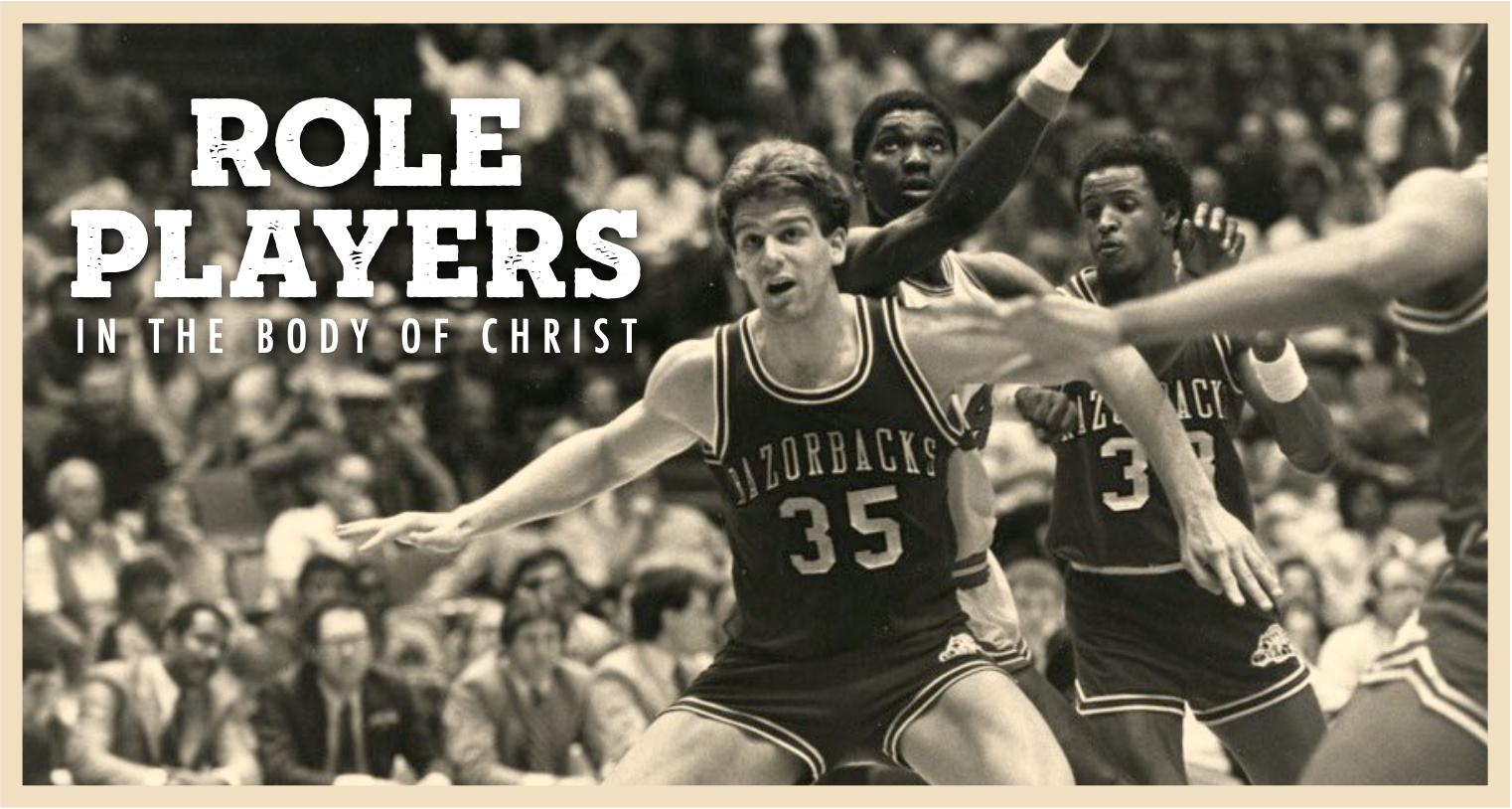

Role Players in the Body of Christ

Joe Kleine was one of the best basketball players in Arkansas Razorback history. An All-Conference Selection in 1984 and 1985, and Kleine also played on the 1984 Gold Medal U.S. Olympic team. In a game against the 2nd-ranked Houston Cougars in 1984, Kleine led the Razorbacks to victory, snapping Houston’s 31-game conference winning streak and outscoring future Hall of Famer Hakeem Olajuwon 22-10. During his career at Arkansas, Kleine averaged 18 points per game—more than Michael Jordan averaged during his career at the University of North Carolina.

But, after completing his collegiate career and joining the NBA in 1985, Kleine went from being a stand-out all-star to an average, backup, role player. In the late 80s and early 90s, Kleine played for the Boston Celtics. While he was there, he was overshadowed by a number of very famous and very good players—Larry Bird, Kevin McHale, Reggie Lewis, and Robert Parrish. Parrish in particular overshadowed Kleine, because Parrish played the exact position that Kleine did—center. Robert Parrish is considered by basketball experts to be one of the greatest centers who has ever played the game, so Joe Kleine got to be Parrish’s backup.

It’s not easy being a backup, a second-teamer. Backups are called things like “substitutes” and “bench-warmers” and “role players”. Backups don’t get to play on the Dream Team; they don’t get to play in All-Star games. Their basketball cards aren’t worth very much, and they don’t get to make many commercials. It would seem that being a backup isn’t a very important job.

Nothing could be further from the truth, however. Consider the following description of Joe Kleine from an article by a Celtic sportswriter a few years back:

“He is what he is. And he knows exactly what that is—the backup center on an NBA team. Every NBA team would love to have Kleine be what he is, which, in addition to being a competent NBA center, includes being a first-rate person.”

The article goes on to quote one of Kleine’s former coaches:

“When we had him here, Joe was our lug. Now, he’s your lug. But you know what? He’s a good lug, I wish we still had him.”

Why is Joe Kleine, a second-string backup center, the kind of player that every coach wants on his team? Why is he the kind of player that coaches don’t want to give up? Because he is willing to accept the role he is given, and do his best performing in that role, even if it is not exciting or glamorous. 

Paul talked about role players in 1 Corinthians 12.14-18:

“Now the body is not made up of one part but of many. If the foot should say, ‘Because I am not a hand, I do not belong to the body,’ it would not for that reason cease to be a part of the body. And if the ear should say, ‘Because I am not an eye, I do not belong to the body,’ it would not for that reason cease to be a part of the body. If the whole body were an eye, where would the sense of hearing be? If the whole body were an ear, where would the sense of smell be? But in fact, God has arranged the parts in the body, every one of them, just as He wanted them to be.”

We don’t each fill the same role, but Paul goes on to tell us that we each have a role to fill. Moreover, he tells us that God bestows an extra measure of honor upon those who fill roles that seem unglamorous:

“The eye cannot say to the hand, ‘I don’t need you!’ And the head cannot say to the feet, ‘I don’t need you!’ On the contrary, those parts of the body that seem to be weaker are indispensable, and the parts that we think of as less honorable we treat with special honor. And the parts that are unpresentable are treated with special modesty, while our presentable parts need no special treatment. But God has combined the members of the body and has given greater honor to the parts that lacked it, so that there should be no division in the body, but that its parts should have equal concern for each other.”

Just as role players are an integral part of any NBA team, they are also indispensable within the church. Unfortunately, this is often a difficult lesson for Christians to learn. Even some of Jesus’ apostles struggled with this concept—in Mark 10, James and John asked to sit at the right and left hand of Jesus so that they could receive special recognition. This request was made because they did not understand the role that God had given them. In Mark 10.43-45, Jesus explained to them that “whoever wishes to become great among you shall be your servant, and whoever wishes to be first among you shall be slave of all. For even the Son of Man did not come to be served, but to serve, and to give His life as a ransom for many.”

Are you willing to be a role player in the Body of Christ? Because that’s the kind of player that God is looking for on His team.

Friday Summary Report, February 15

It’s been a while since I’ve done one of these, but I have read some good articles lately that I would like to share with you:

(1) This article, “Top 10 Reasons our Kids Leave Church”, has been talked about a lot over the last few days, but it is an important one. The author makes some outstanding observations. One of his important points is about the church always trying to be “relevant” (notice the quotation marks). The church should always be relevant because the Gospel is relevant, but we have to be careful of trying to be trendy, (which is what churches often try to be instead). Being relevant is crucial; being trendy is lame.

(2) This post is now a month old, but is hilarious: it stereotypes youth ministers based on the type of facial hair they sport (or don’t).

(3) Here is an excellent post and video for parents on how to teach priorities to your children using a family calendar. Don’t be alarmed by the attention-grabbing title of the post—this is an excellent and practical idea for Christian families. Listen to the video all the way through, as some of the best stuff is his discussion on priorities leading to identity and the realization that sometimes living according to our values will come with consequences.

(4) This post I wrote on Hashtag Media has gotten some attention. If you haven’t yet gone to check out the good work these guys are doing, please do so.

Failure and Faithfulness

I had written a fairly lengthy post on the subject of failure and faithfulness, but then I deleted it because it didn’t accomplish my goal—I found it to be more discouraging than encouraging.

Here was the overall point of that post: I fail. A lot. With my family, in my personal life, and in my ministry—especially in my ministry (it was in my attempt to list some of those failures that the post quickly became discouraging!).

But while failures can be incredibly disappointing and can sometimes even paralyze us into inaction, ultimately, they aren’t that big of a deal.

I ran across a quotation a year or so ago that I really liked:

“God doesn’t call us to be successful; He calls us to be faithful.”

I don’t remember where I came across it originally, and a quick Google search didn’t reveal the author. Nevertheless, I think it’s a good message: over and over again in Scripture, God calls for faithfulness from His followers, but He doesn’t demand success.

For a Christian, husband, father, and minister who seems to spend a lot of his time failing, that’s a comforting thought—God cares more about my unrelenting, dogged pursuit of Him than my triumphs (or lack thereof) on earth.

I can live with that.

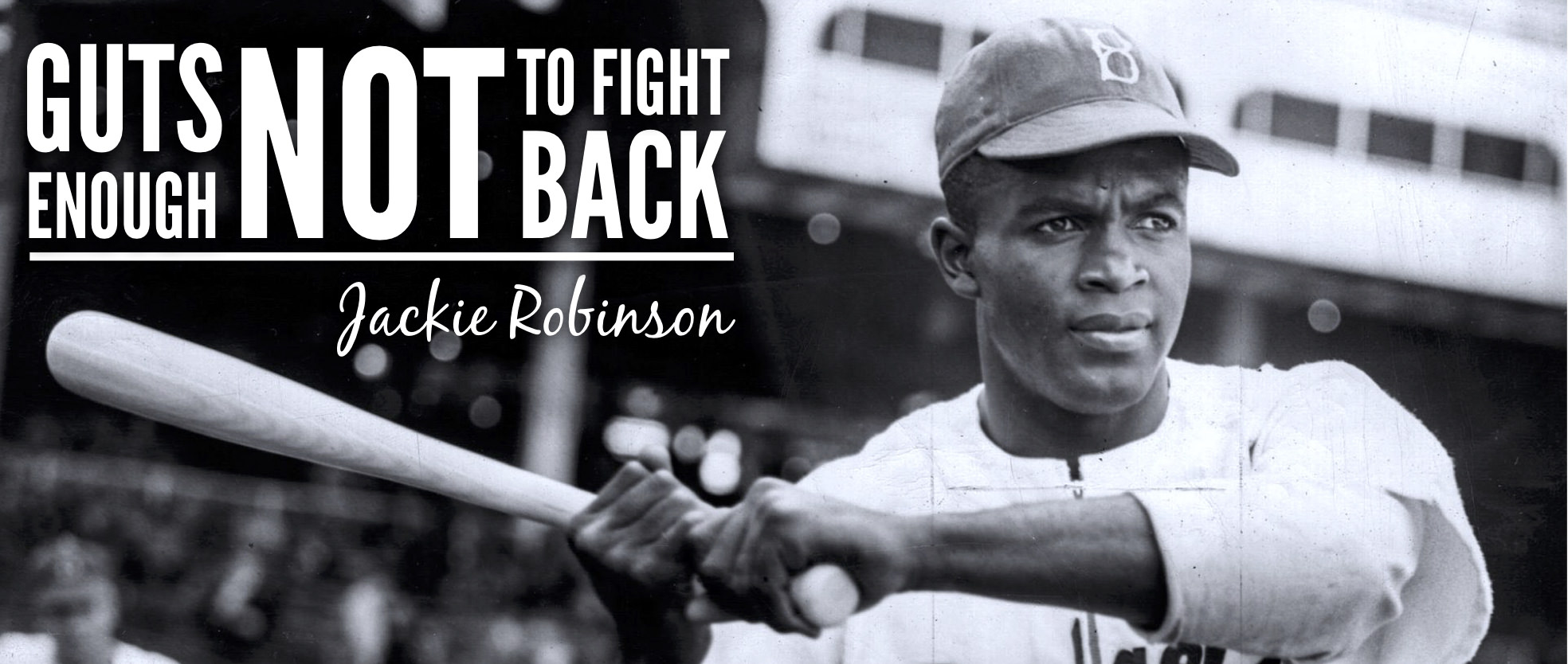
Guts Enough Not To Fight Back: Jackie Robinson

As a general rule in college and professional sports, teams retire the jersey numbers of the all-time greats who played for them. For example, no Chicago Bull can wear number 23, because that was Michael Jordan’s number and it has been retired. No New York Yankee can wear number 3, because that was Babe Ruth’s number and it has been retired. If you play Major League Baseball, regardless of what team you play for, you can’t wear the number 42, because that was Jackie Robinson’s number, and it is the only number to be retired by Major League Baseball.[1]

Sixty years ago yesterday, on April 15, 1947, Jackie Robinson donned that number 42 Brooklyn Dodgers jersey and appeared in his first regular-season Major League game, breaking baseball’s racial color barrier.[2]

Robinson’s Hall of Fame career and the way he handled himself on and off the field opened doors for other black athletes in professional sports (and ultimately many other fields as well), and it has been said that only Dr. Martin Luther King Jr. accomplished more for the American Civil Rights Movement than did Jackie Robinson.

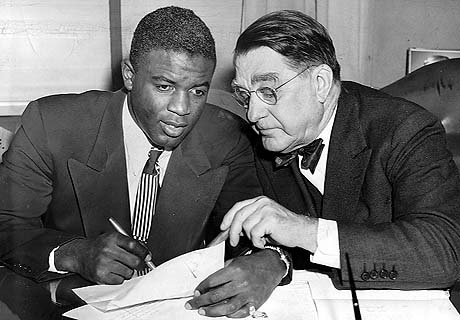
Jackie Robinson and Branch Rickey

Before he signed a contract to play for the Dodgers, Robinson was called into the office of Team President and General Manager Branch Rickey. To give him a taste of what it would be like to be the only black player in the Big Leagues, Rickey spent three hours taunting and insulting Robinson, calling him every racial slur he could think of. Rickey then told Robinson that this is what he would face every day on the field and that if he wanted it to work out, he would have to promise not to fight back or respond to insults of any kind for the first three years of his career.

Robinson, who possessed a fiery temperament and was very outspoken (he was actually court marshaled for refusing to sit at the back of a military bus), was put off by this and asked, incredulously, “Mr. Rickey, are you looking for a player who is afraid to fight back?”

Branch Rickey replied, “No, I want someone with guts enough not to fight back.”

After some deliberation, Robinson agreed to Rickey’s terms, and he lived up to them on the field. When opposing baserunners tried to spike him when sliding into second base, he didn’t fight back. When fans and players yelled and cursed at him and even questioned his very humanity, he showed them how wrong they were by taking the moral high ground.

He had the guts not to fight back.

What Branch Rickey told Jackie Robinson reminds me of Jesus’ words in The Sermon on the Mount in Matthew 5:

“But I tell you, do not resist an evil person. If someone strikes you on the right cheek, turn to him the other also. And if someone wants to sue you and take your tunic, let him have your cloak as well. If someone forces you to go one mile, go with him two miles.”

The world tells us to stand up for ourselves when we are treated unjustly. It tells us to have the courage to fight back and not let others push us around. On the other hand, Jesus tells us to have the courage to show that we are different from the world because we don’t fight back, and He tells us to forgive others when they mistreat us.

Jesus wants followers with guts enough not to fight back.


[1] Major League Baseball has established the practice of temporarily lifting this prohibition on April 15 to commemorate the anniversary of Robinson’s first game as a Dodger, as representatives from each Major League team wear number 42 in his honor.

[2] Contrary to popular belief, Robinson was not the first African-American to play in the Major Leagues. That honor goes to Moses Fleetwood Walker, who played for the Toledo Blue Stockings in 1884. Regardless of this, Robinson was the first African-American to play Major League Baseball in the 20th century, and it was his breaking of baseball’s color barrier that led to the permanent integration of the Major Leagues.

Newer posts »

© 2026 The Doc File

Theme by Anders Noren — Up ↑