The online journal of Luke Dockery

Category: Christianity (Page 23 of 64)

Scripture Is Like The Ocean

Scripture is like the ocean.

People appreciate the ocean at all different levels of depth:

  • For some, simply seeing the beautiful array of blue colors in the water and being near the waves is enough. Some take vacations to the beach to be near the water, but never actually get into it.
  • Others get into the water and play in the shallow surf. As a non-swimmer, this is what I like to do when traveling to the beach: I spend hours on a bodyboard, riding the waves and making sure that I don’t get too deep.[1]
  • Some enjoy getting in deeper water, where they can swim in the ocean. They may use goggles and a snorkel to see all kinds of fish that aren’t visible from the surface of the water. Safely navigating deeper water requires skill, and hours of practice are necessary to develop that skill.
  • For those who have put in a lot of hours of training and receive certification and have access to the right equipment, scuba diving allows you to go even deeper, and make all sorts of discoveries that most of us will never get to see in person.
  • And for the very, very few who have incredibly specialized training or, perhaps, VIP access to those who do, a trip in a deep-sea submarine allows glimpses of all sorts of amazing things near the ocean floor. Even so, the reality is that the vast majority of the ocean remains unexplored.[2]


The doctrine of the perspicuity of Scripture basically holds that you don’t have to be a theologian or scholar to understand the Bible’s teaching on salvation: in His Grace, God has made the revelation of His will clear enough for us to understand. I believe that this is true, but at different times in my life, I have heard a more simplistic version of this doctrine that I do not believe to be true: that Scripture is easy to understand.

I have basically spent my adult life studying Scripture and seeking to understand it better. I have learned so much doing so, and I understand it so much better than I did twenty, ten, or even five years ago. But the better I come to understand the Bible’s teachings, the more clearly I realize that I will never fully understand it.

In one sense, that is incredibly frustrating; you are pursuing a goal that you know you will never obtain. Furthermore, as you learn more, you uncover more and more things that you don’t know; paradoxically, the learning process seems to reveal your own ignorance in exponential ways.

Yesterday, though, it struck me: Scripture is like the ocean.

Yes, it is vast and mysterious, and in our human limitations, there are areas that we will never explore, indeed, huge territories of which we are totally ignorant. But also like the ocean, you don’t have to be in a deep-sea submarine to appreciate it:

  • We can admire its beauty—the powerful stories it shares, the moral vision it puts forth, and the revelation of the nature of God through Jesus—even from a distance.
  • We can also wade into the shallow waters of Scripture, and clearly and safely enough, learn how God calls us to respond to His work in the world, how we can receive His grace, and how we can live as His children.
  • It takes more work, but we can go deeper. We can dive in and swim, learning about biblical history and biblical genres. Tools like concordances, Bible dictionaries, and commentaries are like snorkels that help us to see things that weren’t visible on the surface.
  • Like scuba diving, a relative few are able to put in a lot of hours of training. That training involves all sorts of elements—learning biblical languages, studying ancient culture and history to learn about the contexts in which Scripture came to be, reading about Christian interpretation of Scripture and doctrine throughout the centuries, etc.—and with the new skills it provides and with access to the right equipment, new frontiers for personal learning and discovery are opened up.[3]
  • And for the very, very few, who have been gifted with brilliant minds and have devoted themselves to decades of study, occasionally new discoveries (or, more accurately, the discovery of things that were once known, but had been forgotten or lost over the years) are made, and our collective understanding is expanded. Like with those who plumb the ocean depths in a submarine, these sorts of discoveries may be inaccessible to us in a first-hand way, but we can still receive benefits from what is learned.

I do not believe that every Christian is called to learn Hebrew and Greek, to understand how the creation story of Genesis compares to those of Israel’s neighbors in the Ancient Near East, or to be able to explain textual criticism. In fact, Paul’s teaching in 1 Corinthians 12 about how Christians are all part of the Body of Christ and how we have different roles and perform different functions would seem to speak directly against the notion that all of us are supposed to be biblical scholars. God has gifted us in different ways and expects us to use our gifts to His glory, but not everyone has the gift of learning Hebrew and Greek (especially after the first few years of life!).

However, that reality is not an excuse for a lack of study or a sense of complacency. We have different aptitudes and different opportunities, so of course, we won’t all interact with the biblical ocean in the same way. But the call of Christian discipleship prompts each of us to stretch ourselves and gradually go deeper so that we can better understand what God has revealed to us, rather than to remain all of our lives where we are comfortable. Put differently, not all Christians are called to be scholars, but all are called to be students.

Not all Christians are called to be scholars, but all are called to be students. Share on X

That is a challenging process. It takes a lot of work and it can be disconcerting, but it is also valuable and wonderful.

Scripture is like the ocean.

It is beautiful and comforting, but also vast and mysterious. We will never fully explore or understand it, but we will find unsettling and thrilling adventure in our lifelong exploration of it, and untold blessings at each new level of depth.


[1]  Did you know that I can’t swim? I’m not sure if I’ve ever mentioned it on The Doc File. This is a great source of shame for me, and I am determined to remedy this.

[2]  Andrea Mustain, “Mysteries of the Oceans Remain Vast and Deep,” Live Science, June 8, 2011.

[3]  For what it’s worth, in this extended metaphor I would consider myself to be a novice scuba diver.

Ranking The Chronicles of Narnia, Part 6: The Silver Chair

For a few months now, I have been ranking the different volumes of C.S. Lewis’s masterpiece, The Chronicles of Narnia. So far, I have covered The Magician’s Nephew, The Lion, the Witch and the Wardrobe, The Horse and His Boy, Prince Caspian, and The Voyage of the Dawn Treader.

To evaluate each book, I am using a rubric with four different categories: story, characters, worldcraft, and theology. For each category, I will provide a subscore of 1-10, yielding a cumulative maximum score of 40 points.

I have been following the chronological order of the books (even though I don’t consider that to be the best order in which to read the books), which means that this week, I will be ranking The Silver Chair (SC). Compared to some of the other books in the series, SC is not one of my favorites, but it is still a good book, and some elements are not only thoughtful, but incredibly relevant for our own time.

The Silver Chair
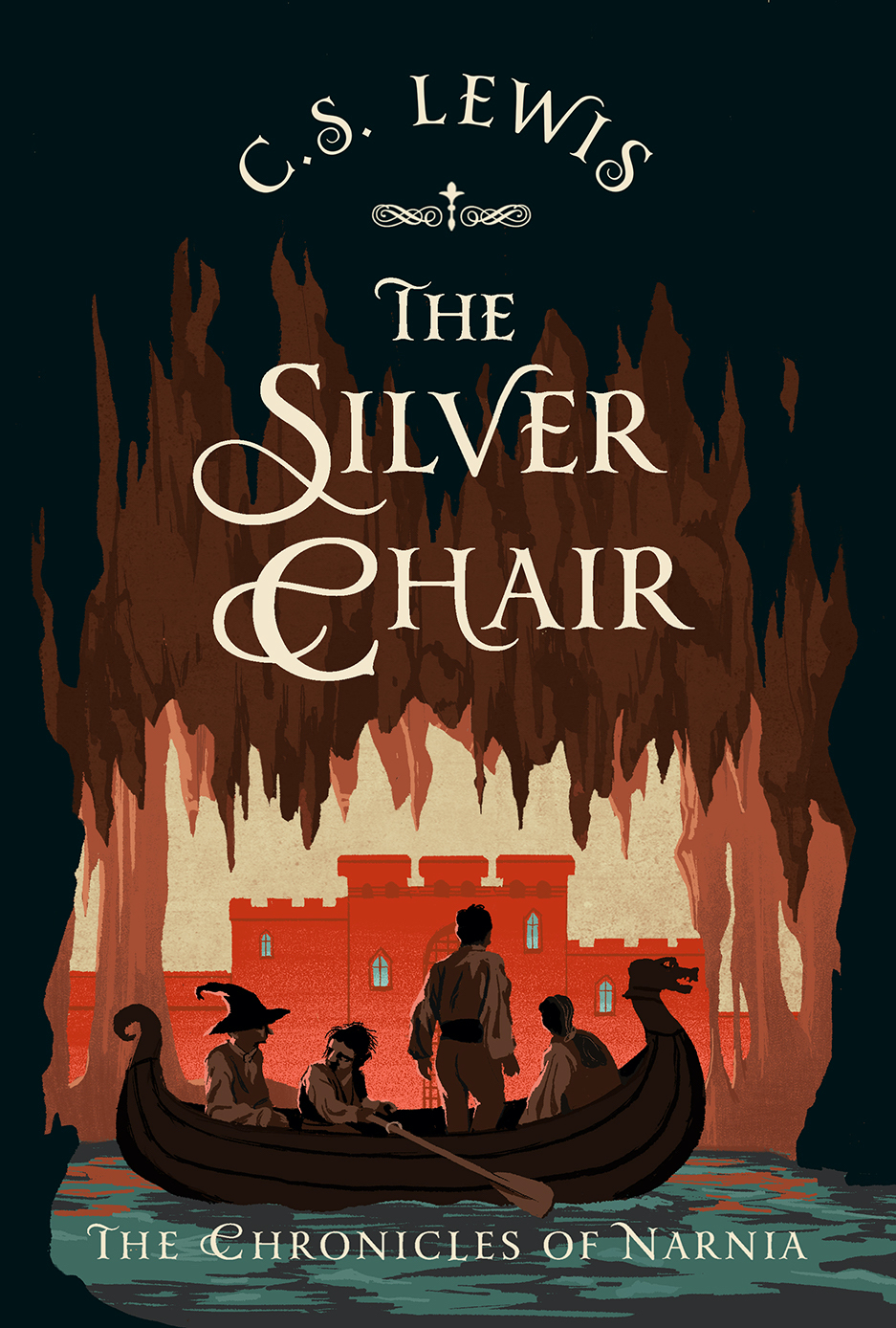
This is from a series of brilliant Narnia cover designs by Jeffrey Nguyen

Story

At least on a superficial level, the main plot device of SC bears some similarity to VDT, as it is the story of a journey that is undertaken for the purpose of finding a missing character. Rather than a sea voyage to the Great Eastern Ocean however, SC chronicles a journey into the wild lands to the North of Narnia.

The book begins with Eustace Scrubb (of VDT fame) and his classmate, Jill Pole, being whisked into Aslan’s Country after Eustace had asked for Aslan’s help in escaping from bullies at their horrid school, Experiment House. They are given a quest to find the missing Prince Rilian of Narnia (son of the famed Caspian of PC and VDT), who disappeared ten years earlier while hunting a large green serpent that had killed his mother. To aid them on their quest, Aslan gives Jill four signs that she is supposed to remember.

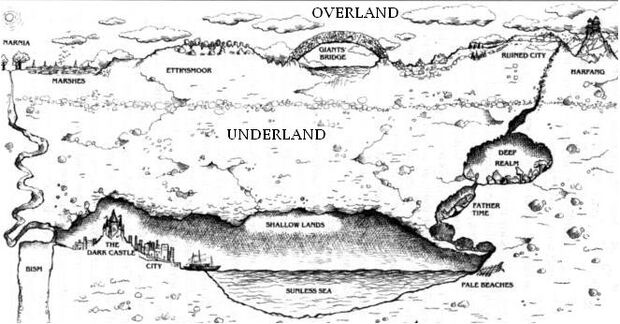
The children are joined in their quest by Puddleglum the Marsh-wiggle who serves as a guide, but the quest does not go particularly well, as they miss two of the signs and struggle to follow the other two. They travel through the wild giant lands of Ettinsmoor, narrowly escaping the “gentle” giants of Harfang, and ultimately find themselves in Underland, where a host of underground-dwelling earthmen take them in a boat across a subterranean sea to the city ruled by the Queen of Underland, the Lady of the Green Kirtle, who turns out to be a witch who keeps Rilian imprisoned and bewitched. As the three travelers seek to free him, the Queen returns, setting up the climax of the story.

Although parts of the journey in SC drag and the climax of the novel seems to fizzle out too quickly, the story on the whole is interesting enough, and foreshadowing, intrigue, and the constant agonizing over seeking to discern and heed Aslan’s signs all add tension and excitement to the narrative.

Story: 7.5/10

Characters

SC is somewhat unusual in The Chronicles of Narnia because the Pevensie children do not appear at all,[1] but human children still play a leading role, this time in the characters of Eustace Scrubb and Jill Pole.

Eustace was a major character in VDT, and that novel described his significant transformation from a dragon (both in a literal sense, and also metaphorical: Eustace was beastly) to a much better sort of person. This changed is evidenced by the fact that Eustace no longer gets along well at Experiment House, the horrid school that he and Jill attend together. The former Eustace would have been a lackey and crony to the bullies who rule the school; now, Eustace stands up to the bullies, is bullied by them himself, and befriends unfortunates like Jill.

Eustace doesn’t get the same level of attention in SC, but we still get a clear enough picture of him. He is not perfect; in fact, he can be obstinate, quarrelsome, and makes rash decisions at times, but he is far removed from the annoying little brat he was at the beginning of VDT, and he is resolutely a friend of Aslan.

Jill is the new child who is introduced in SC, and although I am sure some would disagree with me, I think she is one of the more disappointing characters in The Chronicles of Narnia, considering the lack of development she receives despite the amount of focus that is placed on her.

Jill is a classmate of Eustace’s, and is constantly bullied at school. When she is whisked away into the world of Narnia, her efforts to show off nearly result in the death of Eustace, but Aslan intervenes. Throughout the course of the book, Jill (and Eustace and Puddleglum) struggle to obey the signs Aslan had given her. Ultimately, though, she does not give up: despite personal limitations and fears (she is both claustrophobic and afraid of the dark, which become major issues in Underland), she presses on, and, along with Eustace and Puddleglum, ultimately accomplishes the mission Aslan gives her.
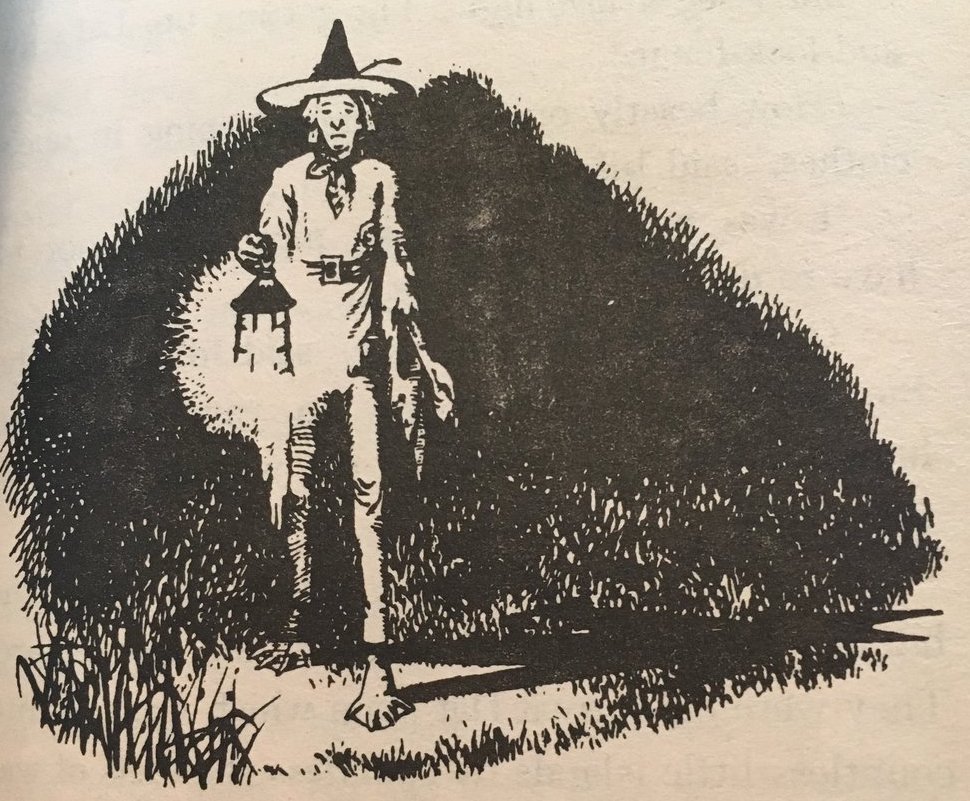
Puddleglum the Marsh-Wiggle

If Eustace and Jill are a little disappointing in SC, Puddleglum really shines. Puddleglum is a marsh-wiggle, a tall, thin creature who seems to be all arms and legs with a long thin face, a high pointed hat, green-gray hair that looks like tiny reeds, and webbed feet. Puddleglum is an Eeyore-like figure who always sees the worst in things (although he indicates that, compared to other marsh-wiggles, he is seen as a wide-eyed optimist), but he is absolutely devoted to Aslan, is loyal to and protective of the children who are placed in his care, and is really the hero of the book, shining most brightly when the circumstances are the darkest.

Rilian is the son of Caspian, and has been missing for the last ten years, ever since he had gone out in search of the great green serpent that had killed his mother. We learn that he has been enchanted and enslaved by the Lady of the Green Kirtle during this time, and is her devoted servant most of the time, only returning to his right mind at night, when he is bound to a silver chair to keep him from running away or rising against the Lady.

In Rilian, we see some of the adventurous spirit and the courage of his father, but arrogance as well. On the whole, I would argue that he is another character in SC like Jill who is not developed as well as one might hope.

The Lady of the Green Kirtle serves as the main antagonist in the novel. She is beautiful in appearance, is an enchantress, and can also turn into a great serpent. Although certainly capable of doing her own dirty work, her preferred method of malevolence seems to be in subverting and manipulating others to do her bidding, as seen in Rilian, the Earthmen, and even the giants of Harfang.

The first time I read SC, I thought this was another incarnation of Jadis, White Witch from MN and LWW, and apparently, this is a common conclusion. However, equating the two seems to be a mistake, as Lewis never does so. The White Witch is killed at the end of LWW, and although there is discussion of bringing her back to life through dark magic in PC, this doesn’t actually materialize. What seems better is to see The Lady of the Green Kirtle (also known as the Queen of Underland) as being a part of the same class of “Northern witches” to which Jadis also belongs.

This also seems to fit better with the main theme of SC, which Lewis described as “the continued war against the powers of darkness”.[2] The reality is that the powers of darkness are both many and persistent, and the destruction of one evil force does not mean that evil itself has been defeated.

Aslan’s role in SC is a little different than in the other books. He appears much earlier on and gives specific direction to the children (specifically, Jill) as to what they are supposed to do. Rather than swoop in to save the day (either directly or indirectly) as he often does in other novels, he instead gives his little group of followers instructions and then seemingly stays distant (does Aslan even enter Narnia in SC? It appears that he remains in his own country). After the plot of SC has been largely resolved, the children see him again in Aslan’s Country, where they have a meaningful conversation about death and resurrection.

On the whole, the characterization in SC is not bad, but it’s also not at the same level as several of the other books.

Characters: 7.5/10

Worldcraft

For me, this was the strongest aspect of SC, as it significantly expands the world of Narnia by taking us both to the Wild Lands of the North and also down into Underland.

We get to see only a little bit of the marshes that seem to form a northern border of Narnia and which are the home of Puddleglum and his fellow marsh-wiggles. From there, the group of seekers travel further north first to Ettinsmoor, a rugged and rocky moor traversed by many streams. This wild land is the home of the giants, some of whom are wild and uncivilized, but others who are more intelligent, and live in the Castle of Harfang.[3]

In the vicinity of Harfang is the ruins of an ancient giant city, and under this city, the group of seekers discover Underland, an entire civilization ruled by the Lady of the Green Kirtle, and populated by a gloomy, depressed multitude who have been enslaved by her enchantments. These Earthmen are actually originally from Bism, another nation six thousand feet below Underland, who hate being so close to the surface. In sum, Lewis actually creates an entire world under the world, filled with tunnels and lakes and a succession of caverns (see image here). In terms of worldcraft, this is the high point of the book.

Worldcraft: 8.5/10

Theology

Although SC is full of biblical allusions, as we have previously noted, Lewis said that this book was about the “continued war against the powers of darkness,” and so, my reflections in this section will be clustered around that theme.

The Weapons of War

First, we must take notice of the importance of the signs that Aslan gives to Jill, and what Lewis intends these signs to represent. As the children and Puddleglum engage in the war against the powers of darkness, a war in which, as noted above, Aslan seems strangely distant, what they are given to aid them in that struggle are Aslan’s signs.

Before Aslan sends Jill off to Narnia, he gives her these final words:

“But, first, remember, remember, remember the signs. Say them to yourself when you walk in the morning and when you lie down at night, and when you wake in the middle of the night. And whatever strange things may happen to you, let nothing turn your mind from following the signs. And secondly, I give you a warning. Here on the mountain I have spoken to you clearly: I will not often do so down in Narnia. Here on the mountain, the air is clear and your mind is clear; as you drop down into Narnia, the air will thicken. Take great care that it does not confuse your mind. And the signs which you have learned here will not look at all as you expect them to look, when you meet them were. That is why it is so important to know them by heart and pay no attention to appearances. Remember the signs and believe the signs. Nothing else matters.” (25-26)

The opening lines of the quotation above seem to be a clear allusion to Deuteronomy 6.7, part of the Shema:

4 Hear, O Israel: The LORD our God, the LORD is one. 5 You shall love the LORD your God with all your heart and with all your soul and with all your might. 6 And these words that I command you today shall be on your heart. 7 You shall teach them diligently to your children, and shall talk of them when you sit in your house, and when you walk by the way, and when you lie down, and when you rise. 8 You shall bind them as a sign on your hand, and they shall be as frontlets between your eyes. 9 You shall write them on the doorposts of your house and on your gates.

(Deuteronomy 6.4-9)

It is the words of God, His revealed teaching and instruction, Scripture, that must be our guiding light as we enter into the world for the sake of God’s mission and engage the forces of darkness. Indeed, this is what we see Jesus do, as He rebuffs each of Satan’s temptations with Scripture (Matthew 4; Luke 4), and also the indication we get from Paul in Ephesians 6, as he describes the Christian’s main offensive weapon, the sword of the Spirit, as the word of God.

Alas, Jill and her companions bungle the task. They fail to follow some of the signs, and their mission is made much more difficult as a result. Then, in the moment of crisis, when a raging Rilian, chained to the chair but finally in his right mind asks the group to free him in the name of Aslan (the fourth sign), the group is racked by indecision:

“It was a dreadful question. What had been the use of promising one another that they would not on any account set the King free, if they were now to do so the first time he happened to call upon a name they really cared about? On the other hand, what had been the use of learning the signs if they weren’t going to obey them? Yet could Aslan have really meant them to unbind anyone—even a lunatic—who asked it in his name? Could it be a mere accident? Or how if the Queen of the Underworld knew all about the signs and had made the Knight learn this name simply in order to entrap them? But then, supposing this was the real sign? …They had muffed three already; they daren’t muff the fourth.

“Oh, if only we knew!” said Jill.

“I think we do know,” said Puddleglum.

“Do you mean you think everything will come right if we do untie him?” said Scrubb.

“I don’t know about that,” said Puddleglum. “You see, Aslan didn’t tell Pole what would happen. He only told her what to do. That fellow will be the death of us once he’s up, I shouldn’t wonder. But that doesn’t let us off following the sign.” (174-75)

Puddleglum shines through. The task was to remember and believe the signs, regardless of appearances. The group does so; they are obedient in the moment of crisis, and ultimately, this leads to the successful completion of the mission.

Later, when they encounter Aslan, Jill feels terrible at how poorly they handled Aslan’s signs:

“I have come,” said a deep voice behind them. They turned and saw the Lion himself, so bright and real and strong that everything else began at once to look pale and shadowy compared with him. And in less time that it takes to breathe Jill forgot about the dead King of Narnia and remembered only how she had made Eustace fall over the cliff, and how she had helped to muff nearly all the signs, and about all the snappings and quarrelings. And she wanted to say “I’m sorry” but she could not speak. Then the Lion drew them toward him with his eyes, and bent down and touched their pale faces with his tongue, and said:

“Think of that no more. I will not always be scolding. You have done the work for which I sent you into Narnia.” (250)

Jill, Eustace, and Puddleglum didn’t perfectly follow the signs, but perfect obedience was not necessary to fulfill the mission Aslan had given them. In our own lives, we will not perfectly follow the signs, but in His grace, our God is not always scolding. He has given us what is needed for us to carry out His mission and engage in the ongoing battle against evil: His revealed instruction in the pages of Scripture.

The Enchantment of Evil

In this ongoing war against the forces of darkness, it is vitally important that we understand who our enemy is. In SC, on the surface, there appear to be all sorts of enemies that Jill, Eustace, and Puddleglum must face and overcome: the giants of Harfang who would seek to eat them, the Black Knight (Rilian in disguise) who rides at the side of the Lady of the Green Kirtle and does her bidding, and the entire army of Earthmen who live in Underland and wait to invade Narnia under the leadership of the bewitched Rilian.

But really, none of these are the true enemies of Narnia or our trio of heroes; that dubious distinction lies with the Lady of the Green Kirtle. Rilian and the Earthmen are her victims; enslaved by her enchantments to do her will. Even the giants of Harfang rely on the evil queen’s influence, at least for their human victims.

As Lewis wrote on the ongoing battle against evil, the words of Paul in Ephesians 6 were undoubtedly on his mind:

12 For we do not wrestle against flesh and blood, but against the rulers, against the authorities, against the cosmic powers over this present darkness, against the spiritual forces of evil in the heavenly places.

(Ephesians 6.12)

Despite appearances, it was not flesh and blood that Jill, Eustace, and Puddleglum were really fighting against; it was the spiritual forces of evil that empowered and manipulated those other, seeming enemies. You would be hard-pressed to find a more pertinent lesson for us to learn in our own time! In a society bitterly divided across various ideological axes, it is so easy to identify, target, and seek to destroy our enemies. This is, however, contrary to the call of Christ. Our enemies are not flesh and blood, but the spiritual forces of evil that so easily confuse and corrupt, and furthermore, even those who we mistakenly view as our enemies are not be targets of our hateful destruction, but objects of our love.

And the methods used by those spiritual forces of evil can confuse us as well: when the Lady of the Green Kirtle discovers that Rilian has been freed by the three adventurers, she doesn’t spring upon them in the form of a serpent; instead, she seeks to enchant them with hypnotic music and incense. With their senses dulled (remember, Aslan had warned Jill that the thickness of the air of Narnia would confuse their minds), the evil witch begins to convince them that Narnia, Aslan, and even lions themselves do not exist, that they are nothing more than a dream, and that all that does exist is the here and now in which the children and the marsh-wiggle find themselves. The enchantment very nearly works.

This is, I believe, instructive for us, as evil is no less enchanting in our own world. Evil is at its most dangerous not when it manifests as a great serpent threatening to bite and devour, but as a beautiful and regal lady comforting us that nothing is wrong. The spiritual forces of evil are not so enchanting because they suddenly entice us to do horrible things; indeed, such temptations are not tempting at all for the vast majority of people. Instead, they are enchanting because they subtly distract us from the divine mission we have been given. They encourage us to focus only on the here and now, to forget all higher and loftier callings, and in our dreamy state, to succumb to our own selfish desires and to do the bidding of the Evil One who seeks to divide us and turn us against one another.

Puddleglum comes to the rescue again; he sticks his webbed foot in the fireplace. The burning pain shatters the power of the enchantment and brings clarity to his mind. He addresses the queen:

“Suppose we have only dreamed, or made up, all those things—trees and grass and sun and moon and stars and Aslan himself. Suppose we have. Then all I can say is that, in that case the made-up things seem a good deal more important than the real ones…We’re just babies making up a game, if you’re right. But four babies playing a game can make a play-world which licks your real world hollow. That’s why I’m going to stand by the play-world. I’m on Aslan’s side even if there isn’t any Aslan to lead it. I’m going to live as like a Narnian as I can even if there isn’t any Narnia.” (190-91)

In a world where evil seeks to lull us to a comfortable sleep, making us more susceptible to its influence, Lewis suggests that an antidote to the enchantment of evil is suffering. For a society that perhaps goes to greater lengths to avoid suffering than any in history, this is perhaps a medicine that we would like to refuse, but it is difficult to argue with Lewis’s prescription. Suffering (at least, from a Christian perspective) helps us to see the broken reality of our existence, and to place ourselves “one Aslan’s side” so that we can be a part of the creation of a different sort of place, where evil is defeated and the suffering is no more.

In SC, Jill, Eustace, and Puddleglum embark on a mission to bring the missing Prince Rilian home, and this mission will bring them into close contact with evil. It is this same mission into which God continues to call believers:

“So, my friends, a reminder for today: in Lewis’ conception of the world, we are invited into a war with dark forces. Not against people, but against those who would harm people. Our mission, our quest, our role is to seek and to find those who have been captured, enchanted, corrupted or deceived—even if they are serving the darkness—and bring them home. And, we hope, to learn something about ourselves and to make new, lifelong friends along the way.”[4]

Theology: 7.5/10
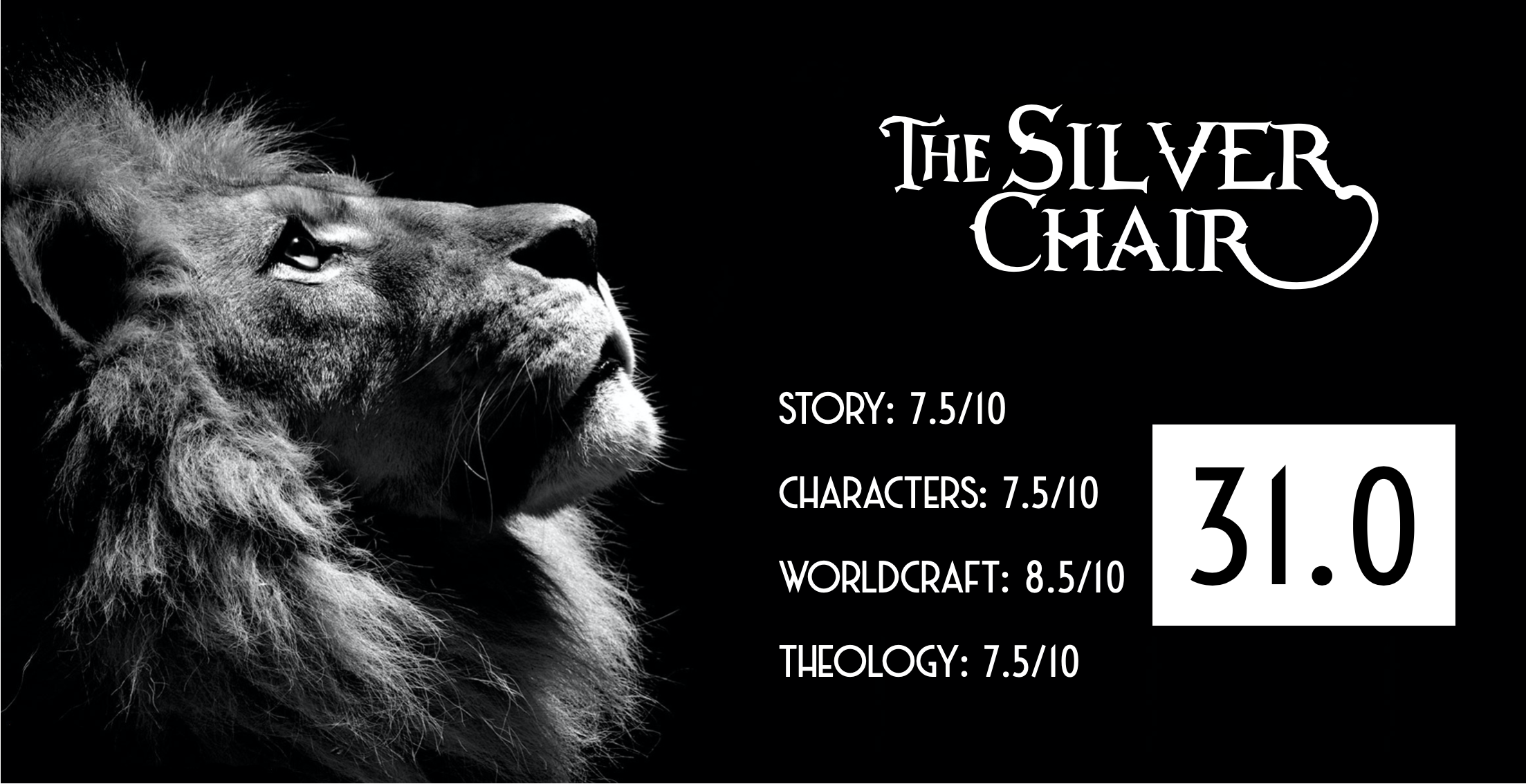
With a score of 31/40, SC is a mid-level Narnia book, very similar to PC. It is not on the same level as books like LWW, HHB, or VDT, but is still a noticeable step above MN. If I were rating it on Amazon, it would round up to a 4-star rating, but in the spectrum of Narnia books, it is my second-to-least-favorite.


Check out the full series of posts:


[1]  Peter and Susan “aged out” of Narnia at the end of PC; Edmund and Lucy did the same at the end of VDT.

[2]  Paul Ford, Companion to Narnia: Revised Edition (San Franciso: HarperCollins, 2005): 6.

[3] Despite their greater intelligence and their organization of living in a castle and elements of a more sophisticated society, I hesitate to describe the giants of Harfang as civilized, as we learn that they knowingly hunt and eat sentient animals, and plan to eat Eustace, Jill, and Puddleglum as well.

[4] Matt Mikalotos, “Saving the Lost: Quests, Signs, and Unclear Instructions in The Silver Chair,” in The Great C.S. Lewis Reread. I have mentioned this before, but Mikalotos is writing a great series of articles on The Chronicles of Narnia. He covers a lot of stuff that I don’t get into in my own series here, and has been influential in my own thoughts, and helping me to see some elements that I had previously missed.

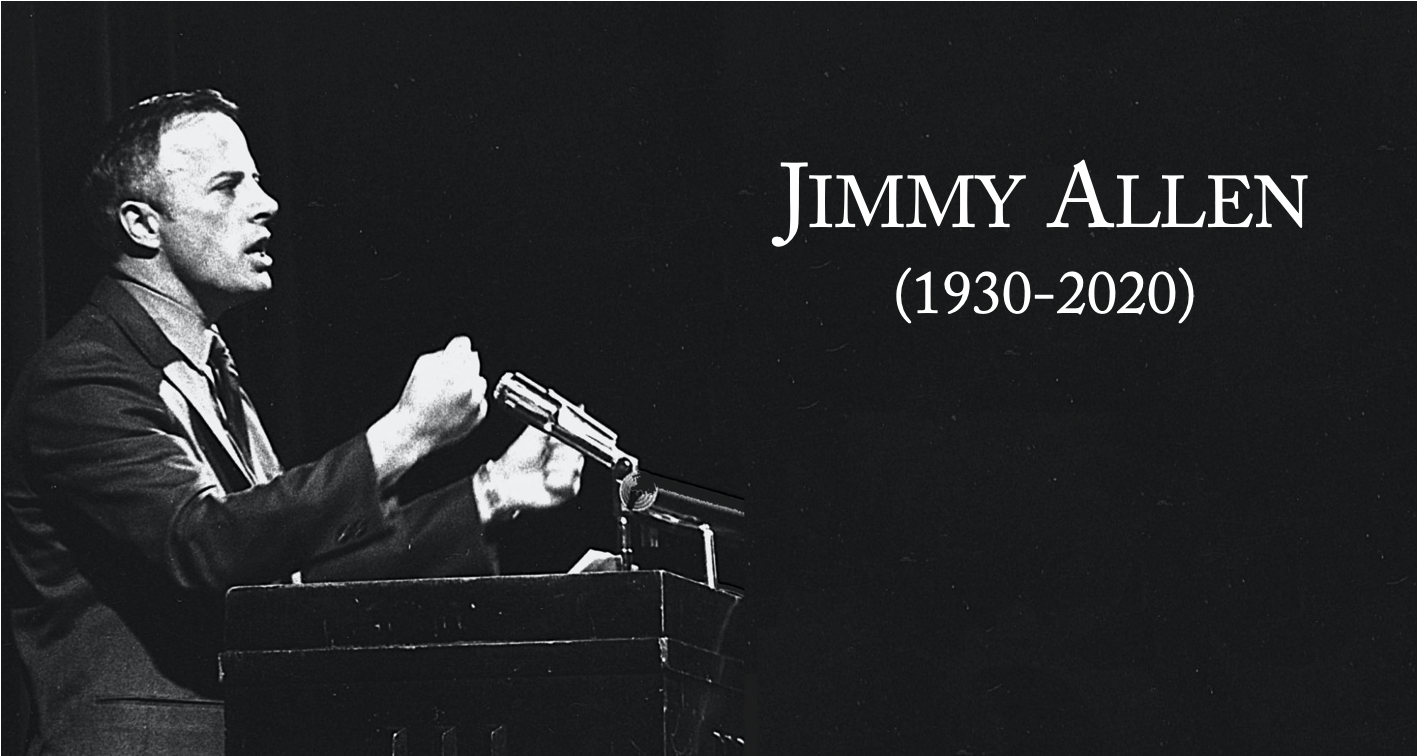
Jimmy Allen (1930-2020)

I was saddened to hear that Jimmy Allen, well-known evangelist and long-time Bible professor at Harding University, passed away early yesterday morning. He had been in poor health for some time, so his passing was not a surprise, but still, I feel that the world has been made a dimmer place by his absence.

Allen was best known as an evangelist, and specifically, was a revivalist in the style of Billy Graham. In the 1960s and 1970s, he held a series of citywide gospel meetings, preaching to thousands and thousands in coliseums and sports stadiums. It is estimated that his evangelistic efforts led to over 10,000 baptisms.

Within the Harding community, however, Allen was also well-known as a Bible professor, and it was in that role that I knew him best. Dr. Allen was one of three absolutely outstanding Bible teachers that I had at Harding who made a profound impact upon my life (another was Neale Pryor, who I wrote about after his passing in 2011). By the time I came to Harding in the early 2000s, Allen’s style of fiery preaching was not popular with college students, but he seemed to be universally loved by those who had him as a teacher, and this despite the fact that he was notorious for rarely giving out A’s (the running joke was that the Apostle Paul couldn’t swing better than a B+ in Allen’s Romans class).

When I took Allen’s Romans class (and, also, when I read his autobiography, Fire In My Bones), I learned so much. Here are some lessons that have stayed with me:

Burden for the Lost

The driving passion of Jimmy Allen’s life was telling people about Jesus. He did not hide the fact that he had lived a prodigal sort of life before giving his life to Christ, but once he made Jesus the Lord of his life, he was obsessed with telling others about Him. There are so many stories of Allen taking advantage of “captive audiences” (friends in his fishing boat, even hitchhikers in his car!) and converting them to Christ. Allen didn’t consider himself to be a preacher (he would say, “I’m not a preacher, I’m a school teacher!”), but he felt that it was his mission to share his faith and it was unfathomable to him that so many other Christians didn’t seem to feel the same way.

Biblical Interpretation

I well remember an idea that Allen repeated often:

“You don’t learn anything about a Bible subject by reading a verse where it is not mentioned.”

This, perhaps, seems obvious, but people neglect this sound advice all the time. For example, if you want to know what baptism accomplishes, you need to read the various passages that talk about baptism and what it does. It is poor biblical interpretation to read passages that don’t mention baptism and then infer ideas about baptism from its absence.

Believing the Best of Others

I don’t remember the specific context, but it was in his Romans class that Allen said these words that I’ll never forget:

“If I hear something bad about someone, I never believe it. If it comes to the point that I have no choice but to believe it, I do not delight in it.”

These words have become a standard for my life. I do not always abide by them perfectly, but this is the goal that I seek. In an increasingly graceless cancel culture that pounces on the misdeeds of others and seeks to write them off, these words obviously represent a different path, but I believe it to be a path of profound wisdom.

Continual Learning

In Fire In My Bones, Allen shares several areas in which his views have changed over the years. He introduces that chapter with these words:

“A brother who says, “I haven’t changed any of my Biblical views in the last twenty five years,” has not had his head in the Bible. Furthermore, he would make a stagnant, mosquito-infested, mud hole look like fresh water! In teaching others, we are continually asking them to change from error to truth. We should be willing to practice the same.” (201)

This idea has played out in my own life: the more I study Scripture, the more my understanding of it grows. Some beliefs are anchored more deeply, others are nuanced and refined, and still others are changed significantly, as I learn new things that I didn’t know before. Like Allen, I am deeply suspicious of those who hold their never-changing ideas up as some sort of badge of pride.

Hope of Resurrection

In his younger days, Allen was an impressive athlete. I remember he used to tell us that when he was in college, he could run the 100-yard dash in 10 seconds flat, and there are all sorts of stories about his exploits on faculty teams in intramural sports. When I had him as a teacher, he was in his 70s, but I would still see him jogging outside.

In Romans class, I well remember his exposition of Romans 8.18-25, and his discussion of the resurrection body. Well aware of his own decaying body that no longer could do the things it once did, he eagerly anticipated “the redemption of our bodies” (v. 23), and the splendid and powerful body that he would have post-resurrection. His emphasis on bodily resurrection as the center of Christian hope was re-orienting for me, and remains influential in my own views; his teaching on the redemption of creation (from the same passage) was a significant influence in my understanding of eschatology that has developed over the last several years.

In addition to what I mentioned above, Allen was also noteworthy for his teaching on grace at a time when that had not been properly emphasized, his commitment to racial equality in a time of segregation and racial tensions, and his dedication to a nonsectarian Restoration ideal. In short, he was an impressive and inspirational man in a lot of ways.


For a man who was so active and had such a brilliant mind, I cannot imagine how frustrating the last few years must have been: from what I understand, he was confined to a nursing home, in declining physical and cognitive health.

Echoing the words of the Apostle Paul, we can truly say that for a man whose life was Christ, his death is gain: Jimmy Allen is now with Jesus, and he awaits the resurrection. But at the same time, we can lament, for death is never a good thing; it is not a part of God’s plan. It is an enemy, indeed, the last enemy to be defeated. But as Christians, we believe that it will be defeated, that our bodies will be raised, and our lowly, corruptible bodies will be transformed and become like Christ’s glorious, incorruptible body. Jimmy will enjoy that; he has long anticipated it.

Lament For A Son: Speaking Into Suffering

This is part of a sub-series of posts under a larger, loosely-united series entitled A Theological View of Suffering.


I have been writing some brief reflections on Nicholas Wolterstorff’s excellent Lament For A Son. One aspect of this little book that I really enjoyed was Wolterstorff’s discussion of what we should say to people when they are suffering.

Hopefully, many of us have heard and heeded the warnings to not be like Job’s friends, who sat with him in comfort for several days and then began to talk, only to make matters much worse. I would wager that anyone who has experienced significant pain and loss has also dealt with “miserable comforters” like Job’s friends.

And yet, while we should be careful about what we say to those who are suffering, we should not let the fear of saying the wrong thing prevent us from saying anything or from avoiding the suffering person altogether.

“What do you say to someone who is suffering? Some people are gifted with words of wisdom. For such, one is profoundly grateful. There were many such for us. But not all are gifted in that way. Some blurted out strange, inept things. That’s OK too. Your words don’t have to be wise. The heart that speaks is heard more than the words spoken. And if you can’t think of anything at all to say, just say, “I can’t think of anything to say. But I want you to know that we are with you in your grief.”

Or even, just embrace. Not even the best of words can take away the pain. What words can do is testify that there is more than pain in our journey on earth to a new day. Of those things that are more, the greatest is love. Express your love. How appallingly grim must be the death of a child in the absence of love.” (34)

While Wolterstorff offers grace to those who blurt our “strange, inept things,” he does offer a caution for the sort of thing that should not be said:

“But please: Don’t say it’s not really so bad. Because it is. Death is awful, demonic. If you think your task as comforter is to tell me that really, all things considered, it’s not so bad, you do not sit with me in my grief but place yourself off in the distance away from me. Over there, you are of no help. What I need to hear from you is that you recognize how painful it is. I need to hear from you that you are with me in my desperation. To comfort me, you have to come close. Come sit beside me on my mourning bench.” (34)

And, finally:

“Some say nothing because they find the topic too painful for themselves. They fear they will break down. So they put on a brave face and lid their feelings—never reflecting, I suppose, that this adds new pain to the sorrow of their suffering friends. Your tears are salve on our wound, your silence is salt.” (35)

This brings us back to what I said in the beginning. While care should certainly be used in what we say to those who are suffering, ignoring the sufferer out of concern that we may say something hurtful is, itself, a hurtful act. In many ways, it may feel like just being with those who are suffering and expressing our love for them is “the least we can do”, but in a very real sense, it’s also the most we can do.

It reminds me of a Swedish proverb that I have come to love: “Shared joy is a double joy; shared sorrow is half a sorrow.”

Increasingly, I have come to realize how much we live in a society that seeks to avoid and minimize death as much as possible. In such an environment, the sort of meaningful presence that Wolterstorff suggests does not feel natural, and is something that we may be tempted to avoid. But as followers of Jesus, we must seek to “bear one another’s burdens” (Galatians 6.2); we must speak into the suffering, whether we use words or not.

Ranking The Chronicles of Narnia, Part 5: The Voyage of the Dawn Treader

We are now halfway through a series of posts in which I am ranking the different volumes of C.S. Lewis’s masterpiece, The Chronicles of Narnia. So far, I have covered The Magician’s Nephew, The Lion, the Witch and the Wardrobe, The Horse and His Boy, and Prince Caspian.

To evaluate each book, I am using a rubric with four different categories: story, characters, worldcraft, and theology. For each category, I will provide a subscore of 1-10, yielding a cumulative maximum score of 40 points.

I have been following the chronological order of the books (even though I don’t consider that to be the best order in which to read the books), which means that this week, I will be ranking The Voyage of the Dawn Treader (VDT). I think this was my third time to read VDT, and it remains one of my favorites of the Narnia series.

The Voyage of the Dawn Treader

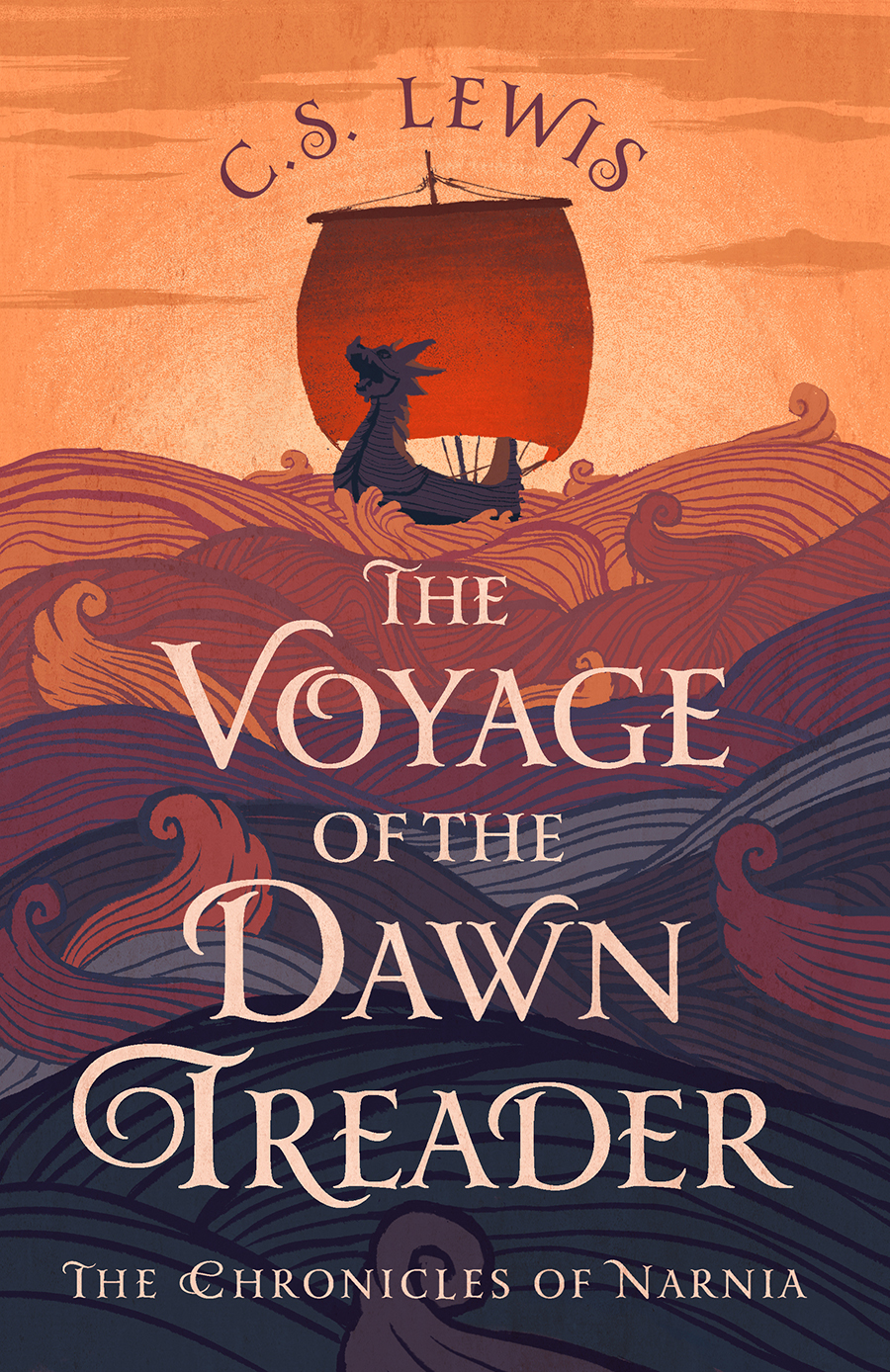
This is from a series of brilliant Narnia cover designs by Jeffrey Nguyen

Story

Some may feel differently, but I have always enjoyed the narrative flow of VDT. It is a story of exploration in the form of a sea voyage to remote and undiscovered lands, and of course, this voyage is paralleled by the spiritual journeys of the characters themselves.

As the book begins, Edmund and Lucy Pevensie are staying with their cousin Eustace.[1] The three children are suddenly taken up into Narnia through a painting of a ship at sea hanging on the wall of a bedroom. The three children find themselves in the ocean near the Dawn Treader, a Narnian ship upon which they are quickly taken aboard, and where they find King Caspian, Reepicheep, and other Narnians. The Dawn Treader is in the midst of a sea voyage with two goals. First and foremost, the mission is to locate the seven lost Lords of Narnia (who had been friends and supporters of Caspian’s father, but exiled or encouraged to leave by his uncle Miraz). But in addition to that mission (and ultimately, more important than it) is Reepicheep’s goal of finding Aslan’s Country beyond the seas, in the “utter East.”

The narrative arc of VDT is somewhat repetitive, as Caspian, his friends, and his crew sail from one island to another, gradually meeting (or finding the remains of) all of the lost lords and experiencing significant trials and transformative experiences along the way. However, the variety of the places they visit, the characters they meet, and the trials they face combine in such a way that the story doesn’t seem repetitive at all: it is interesting and gripping throughout, and also cultivates a building anticipation as the Dawn Treader grows increasingly closer to Aslan’s Country.

Story: 9/10

Characters

As is always the case in The Chronicles of Narnia, human children from our world feature prominently in VDT; in this instance, it is Edmund and Lucy Pevensie, along with their cousin, Eustace Scrubb.

Eustace is a major character in VDT, especially early in the book, so we will start with him. The opening line of the book is an all-time great:

“There was a boy called Eustace Clarence Scrubb, and he almost deserved it.” (1)

Lewis then goes on to explain just why this Eustace fellow is so unlikeable:

“His parents called him Eustace Clarence and masters called him Scrubb. I can’t tell you how his friends spoke to him, for he had none. He didn’t call his Father and Mother “Father” and “Mother,” but Harold and Alberta. They were very up-to-date and advanced people. They were vegetarians, non-smokers and teetotalers and wore a special kind of underclothes. In their house there was very little furniture and very few clothes on beds and the windows were always open.

Eustace Clarence liked animals, especially beetles, if they were dead and pinned on a card. He liked books if they were books of information and had pictures of grain elevators or of fat foreign children doing exercises in model schools.

Eustace Clarence disliked his cousins the four Pevensies, Peter, Susan, Edmund and Lucy.” (1-2)

In addition to clueing us in to some character traits that Lewis himself apparently didn’t think too highly of, he gives us the impression of an annoying little boy, but one who largely seems to be so due to the influence of his annoying parents. Perhaps this is unsurprising, because adults can be pragmatic and unimaginative in a way that can be a barrier to faith, but there may be a glimmer of hope in this description as well: if freed from the influence of his parents, perhaps there is hope for Eustace.

His time in Narnia doesn’t begin well. He insults the honor of Reepicheep, complains about everything, and is constantly seasick. He refuses (or is unable) to acknowledge the reality of Narnia, and keeps asking to see the British consulate. Finally, everything comes to a head when they reach Dragon Island, where, upon discovering the hoard of a dead dragon, Eustace greedily stuffs his pockets with treasure before falling asleep. He awakens to discover that he has become a dragon. In his dragonish state, Eustace begins to reevaluate things. He realizes that his cousins and shipmates weren’t so bad after all, and that it was really he himself who had been acting beastly all along. Eustace begins to change his behavior, and now seeks to help his friends. But it is not until he encounters Aslan that he is able to return to human form, and this only occurs when Aslan uses his claws to cut through his dragon skin in painful fashion, throws him into a pool of water, and then dresses him in new clothes. Later, Eustace describes his experience with the Lion to his cousin Edmund:

“What do you think it was, then?” asked Eustace.

“I think you’ve seen Aslan,” said Edmund.

“Aslan!” said Eustace. “I’ve heard that name mentioned several times since we joined the Dawn Treader. And I felt—I don’t know what—I hated it. But I was hating everything then. And by the way, I’d like to apologize. I’m afraid I’ve been pretty beastly.”

“That’s all right,” said Edmund. “Between ourselves, you haven’t been as bad as I was on my first trip to Narnia. You were only an ass, but I was a traitor.” (117)

The whole experience transforms Eustace, and he is dramatically different for the rest of the book. In fact, the book closes with this description:

“…Back in our own world everyone soon started saying how Eustace had improved, and how “You’d never know him for the same boy”: everyone except Aunt Alberta, who said he had become very commonplace and tiresome and it must have been the influence of those Pevensie children.” (270-71)[2]

Lucy shows some familiar character traits from previous novels. Moved by compassion, she uses her vial of magical healing liquid on two occasions to bring relief to Eustace. She also shows her spunk and courage when she gets in between Edmund and Caspian when they quarrel at Deathwater Island.

But Lucy also struggles. On the Magician’s Island, she is tempted to use a spell to make herself beautiful, and is only prevented from doing so by the image of an unhappy Aslan. She gives in to a lesser temptation to spy on her classmates at school, and damages a relationship with a friend in the process. And like everyone else (except, perhaps, Reepicheep) she is plagued by terror at the Dark Island.

Edmund takes somewhat of a backseat in VDT, but does show up in key moments. It is Edmund to whom Eustace reveals his transformation, and Edmund responds with comfort and understanding. Later, Edmund opposes the foolish behavior of Caspian on two occasions, but it is unclear how pure his motives are: both times, he ruffles at the implication that he is subject to Caspian, and we are left realizing that Edmund still has some growing to do.

Caspian is now three years older than he was in PC, is a confident king rather than an inexperienced youth, and is possessed with the spirit of adventure and obligation as he leads the expedition to explore the Great Eastern Ocean in search of the seven lost lords of Narnia. On the whole, he shows wisdom and courage, but he struggles as well in VDT. First, at Deathwater Island, he is tempted by greed and desires to seize the magic pool that turns everything to gold. Ultimately, Aslan appears and Caspian comes to his senses. Later, Caspian is tempted to go to Aslan’s Country with Reepicheep and to shirk his duties as king in order to do so. Again, it is an appearance from Aslan that sets him straight.

Reepicheep was previously introduced in PC, but is a much more central character in VDT. All of his previous characteristics are on display again—his bravery, daring, keen sense of honor—but most prominent is his devotion to Aslan, and his desire to travel to Aslan’s Country:

“My own plans are made. While I can, I sail east in the Dawn Treader. When she fails me, I paddle east in my coracle. When she sinks, I shall swim east with my four paws. And when I can swim no longer, if I have not reached Aslan’s country, or shot over the edge of the world in some vast cataract, I shall sink with my nose to the sunrise and Peepiceek will be head of the talking mice in Narnia.” (231)

All of the other events of the book—dragons, gold, sea serpents, lost Narnian lords, and the rest—cannot distract Reepicheep from his singled-minded goal: to reach Aslan’s Country and forever dwell in the presence of the Lion.

Aslan appears more frequently in VDT than in the other books, but for brief periods each time, and generally, at a time of crisis or a moment of transformation for the various characters. He appears to Eustace and frees him of his dragon skin. He appears to Caspian, Edmund, and company on Deathwater and brings an end to their argument. He appears to Lucy on the Magician’s Island, helping her to overcome one temptation and to understand the consequences of her actions in giving into another. In response to a prayer from Lucy on the Dark Island, he encourages her. When Caspian seeks to abdicate the throne, he offers correction. And when it is time for Edmund, Lucy, and Eustace to leave Narnia (and for Edmund and Lucy to never return), he gives them spiritual guidance in their own country. In short, in a book about the journey of faith (see Theology section below), Aslan is a co-traveler and guide who shows up in the journeys of various characters, granting what is needed in the moment. It is a typically apt characterization.

Characters: 9/10

Worldcraft

Although I consider VDT to be all-around excellent, I think this is its strongest area. It significantly expands the world of Narnia by taking is us into the Great Eastern Ocean, to never-before-discovered places and then even beyond the world of Narnia itself, giving us glimpses of Aslan’s Country.

The Lone Islands are intriguing. Unlike the other places the Dawn Treader will visit, these islands are not totally new. They were the previously-known “ends of the earth” and were technically under the authority of Narnia. But Miraz feared Aslan, the sea, and everything from the East, and it had been a long time since Narnia had exercised jurisdiction over the Lone Islands. In the meantime, the Islands have come under the influence of Calormen and now practice the slave trade (really, these are the only villains in VDT). Caspian and his forces stage a coup and insert Lord Bern as the Duke of the Long Islands.

After leaving the Lone Islands, though, everything is totally new: it is now a voyage of discovery. Dragons, sea serpents, and water that turns everything submerged in it to gold add to the mystery and enchantment of the journey. On another island, we discover the delightful Dufflepuds, and are introduced to the notion of a former star who now rules them as punishment. The Dawn Treader then stumbles upon the Dark Island, where dreams actually come true (which means that nightmares come true), and then encounter another former star, Ramandu, who lives with his daughter on the Island of the Star, where they sing the sunrise each morning.

As the journey continues, they encounter merpeople, water that is now sweet rather than salty, and an increasing shallowness to the sea. Eventually, only the three children and Reepicheep are allowed to continue in the ship’s small boat, and they move ahead through a sea of lilies until they reach a wave of water that extends into the sky like a waterfall. Beyond that, they catch glimpses of impossibly-high green mountains: Aslan’s Country.

The nature of the journey means that we don’t get to dwell long and fully explore any one location, but the sheer number of novel places, the wondrous discoveries, and the expansion of the world of Narnia that we experience renders a high score in this category.

Worldcraft: 9.5/10

Theology

I have mentioned this multiple times in this series, but late in his life, C.S. Lewis wrote a letter in which he provided a brief overview of The Chronicles from a spiritual perspective. Describing VDT, he said it was about the spiritual journey, and that this was especially seen in the character of Reepicheep.[3] While the valiant mouse is doggedly determined in his quest for Aslan, the other significant characters are on spiritual journeys of their own, and must repeatedly face their own flaws and overcome them with the assistance of the Great Lion:

“In contrast to other Narnia books, Dawn Treader has virtually no overt villains, other than the slavers in the very beginning who are quickly overcome and disposed of. Rather, the plot confronts the protagonists again and again with the flaws of their own character. Eustace’s greediness and general bad behavior cause him to turn into a dragon, and he must work hard to show himself worthy of becoming human again; Caspian is tempted to seize the magic pool which turns everything to gold—which would have turned Caspian himself into a greedy tyrant ready to kill in order to preserve his power and wealth; later, Caspian faces the nobler but still wrong-headed temptation to go off to Aslan’s Country and abandon his responsibilities as a King; Lucy is tempted to make herself magically beautiful, which would have led to her becoming the focus of terrible wars devastating Narnia and all its neighbors; and having resisted this temptation, she succumbs to a lesser temptation to magically spy on her schoolmates—and is punished by hearing malicious things and destroying what could have developed into an enduring nice friendship.…Edmund, who had undergone a very severe test of his character on his first arrival in Narnia, is spared such an experience in the present book, and acts as the most mature and grown-up member of the group.”[4]

Through the various characters, Lewis highlights different aspects of the spiritual journey.

In Reepicheep, we see the ideal: despite everything that surrounds him, he “seeks first the kingdom of God.” Above all else, he wants to dwell in the presence of Aslan. It is his greatest goal, ever present at the forefront of his mind.

In Eustace, we see the cost of spiritual transformation and rebirth. As Aslan cuts through Eustace’s dragon skin, I have always thought of the image of Jesus pruning branches in John 15, and the inherent pain of that metaphor. Then, in a clear baptismal scene, Aslan “kills” Eustace’s old, dragonish self, buries him in water, and then dresses him as a new creation.

In Lucy, we see the importance of gracious judgment. Through magic, Lucy spied on her classmates and heard one of her friends make hurtful statements about her. Lucy calls her a “two-faced little beast”, but is later chastened by Aslan:

“‘Spying on people by magic is the same as spying on them in any other way. And you have misjudged your friend. She is weak, but she loves you. She was afraid of the older girl and said what she doesn’t mean.’” (170)

In Caspian, we also see the unfortunate reality that part of the spiritual journey is saying goodbye to fellow travelers with whom we would prefer to travel longer. Caspian is determined to travel with his friends to the end of the world and into Aslan’s Country, even if it means deserting his duties as king. Aslan appears to Caspian to gently correct him, and we see Caspian’s motivations more clearly when he describes the encounter to his friends:

“It’s no good,” he said. “I might as well have behaved decently for all the good I did with my temper and swagger. Aslan has spoken to me. No—I don’t mean he was actually here. He wouldn’t fit into the cabin, for one thing. But that gold lion’s head on the wall came to life and spoke to me. It was terrible—his eyes. Not that he was at all rough with me—only a bit stern at first. But it was terrible all the same. And he said—he said—oh, I can’t bear it. The worst thing he could have said. You’re to go on—Reep and Edmund, and Lucy, and Eustace; and I’m to go back. Alone. And at once. And what is the good of anything?”

“Caspian, dear,” said Lucy. “You knew we’d have to go back to our own world sooner or later.”

“Yes,” said Caspian with a sob, “but this is sooner.” (262-63)

In a fallen world marked by the painful realities of sin and death, it is a sad fact that a significant part of life is saying goodbye to some of the people we most care about.

And finally, in multiple characters (Eustace, Lucy, Caspian, even Edmund), we see that often, as we progress through the spiritual journeys of our lives, our greatest opposition comes not from without, but within: our own internal flaws and inclination toward sin must be addressed and overcome, and this can only be done with the help of Aslan. As one author points out in reflecting upon this:

“I will leave us with this: I grew up in religious culture, and so often I was told that I needed to stop being a dragon. It was a sort of moralistic teaching that said something like, “Stop being a dragon and come to Aslan.” But if I could stop being a dragon myself, what need did I have of Aslan? I’ve been a minister for over twenty years and I’ve met a lot of dark places in a lot of broken hearts, including my own. I don’t know where you may be on your journey, whether stuck at sea, or lost in darkness, or in some place better or worse than that. But I do know this: you are not alone. Aslan, whether you see the great lion or not (“I was always here”), and whether you know the great lion or not (“follow me” he said to Eustace, not even saying his own name), and whether you feel hope or despair…there is a lamb, an albatross, a painting, a picture, a lion, or whatever you need Aslan to be. I believe Aslan will take that form to bring us hope. To free us from our dragon skin. To show us the way out of darkness. To give us what we need to know peace.”[5]

Aslan’s final appearance to the three children has strong echoes of John 21.[6] After Reepicheep has paddled into Aslan’s Country, the three children walk to dry land where the heavens seem to meet earth. Aslan appears to them as a Lamb and invites them to breakfast.

He tells the children that it is time for them to return home, and that Lucy and Edmund will never return: they are too old, reminiscent of what Peter and Susan are told at the end of PC. Edmund and Lucy have learned all they can in Narnia, and now, it is time for them to come to know Aslan in their own world:

“Are—are you there too, Sir?” said Edmund.

“I am,” said Aslan. “But there I have another name. You must learn to know me by that name. This was the very reason why you were brought to Narnia, that by knowing me here for a little, you may know me better there.” (270)

It is for this reason that Edmund and Lucy were brought to Narnia, and it is the same reason that we, the readers, are taken there by Lewis: that having seen Aslan in Narnia, we can better know in our own lives the Lion who is also a Lamb, and that we, with the determination of Reepicheep, may seek first His kingdom and live eternally with Him Someday.

Theology: 9/10

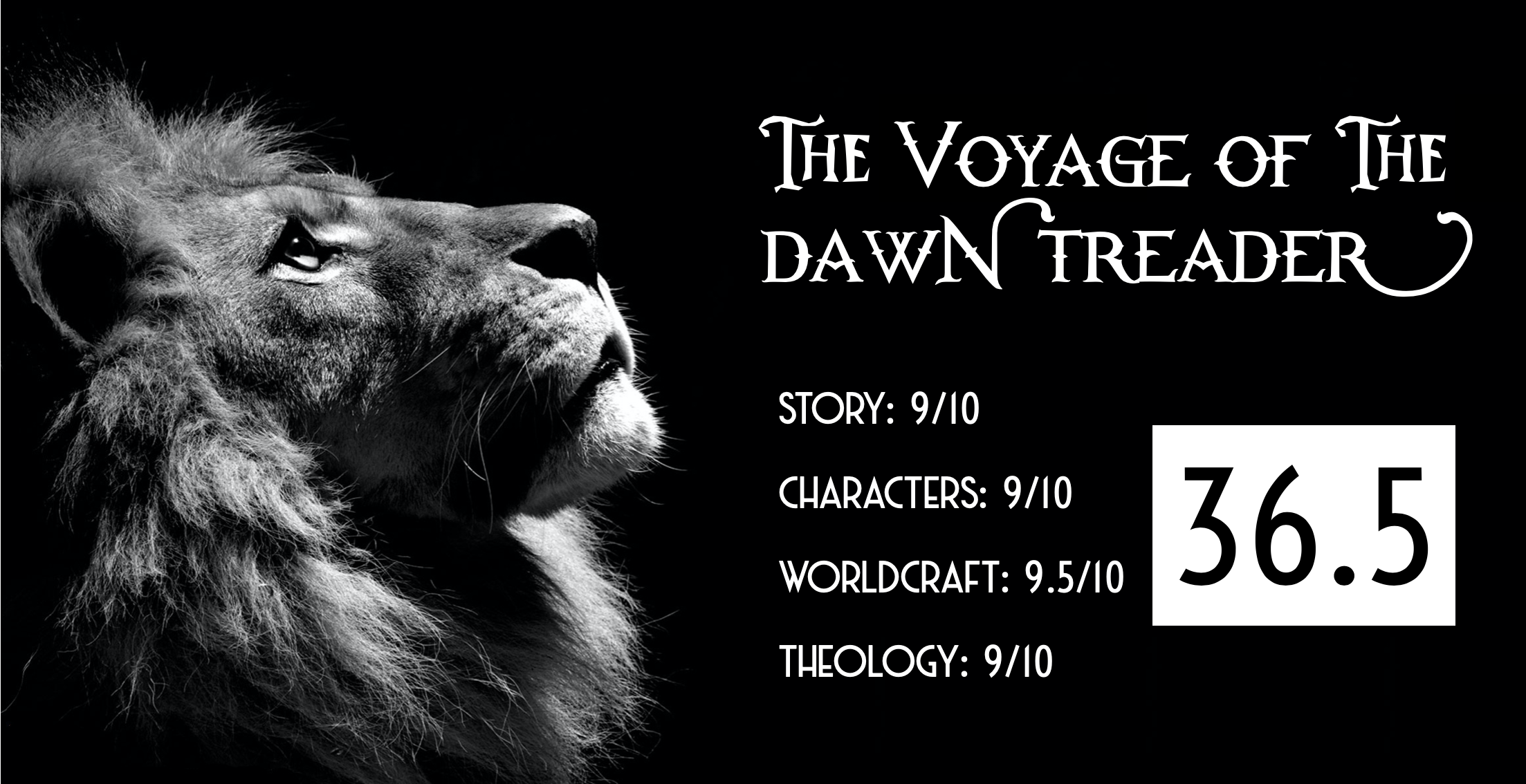
With a score of 36.5/40, VDT is an excellent book, and in my ranking system, resides as a near neighbor in the stratosphere of LWW and HHB, fitting in between those two books. Unlike those two books, VDT did not receive a perfect 10 in any subcategory, but it got consistent high scores all around: no real weaknesses. On Amazon, this would be a clear 5-star rating.


Check out the full series of posts:


[1]  We learned in PC that Peter and Susan would not be returning to Narnia. Here, we are told that Susan is traveling with her parents in America, and that Peter is studying to prepare for an exam with the help of Professor Digory Kirke (of MN fame).

[2] Although several characters receive significant attention in VDT, I would argue that Eustace is the main character, as evidenced by the way that content about him frames the entire novel. Hopefully, that justifies me spending so much time on him here!

[3] Paul Ford, Companion to Narnia: Revised Edition (San Franciso: HarperCollins, 2005): 6.

[4] Sue Baines, “Moral and educational themes in the Narnia and Harry Potter books” in Gerald Sumner (ed.) “Round Table on the Development of Twentieth Century Fantasy”.

I do not believe, though, that Edmund comes off as spotless as Baines claims. As I described in the Characters section, in both of the instances where Caspian acts foolishly, Edmund opposes him. He was right to do so, but his opposition is based on his own pride and position: in both instances, Edmund asserts that he is no subject of Caspian’s. This echoes the dark side of Edmund’s character in LWW, and I think should give us caution before fully approving of his behavior here: to do the right thing (oppose Caspian’s foolishness) for the wrong reason (out of a competitive sense of pride) is, ultimately, to do the wrong thing.

[5] Matt Mikalotos, “Eustace Was a Dragon All Along,” in The Great C.S. Lewis Reread. I have mentioned this before, but Mikalotos is writing a great series of articles on The Chronicles of Narnia. He covers a lot of stuff that I don’t get into in my own series here.

[6] The parallels with John 21 are numerous and striking. The image of Aslan serving breakfast clearly echoes Jesus serving breakfast to His apostles, and Aslan’s appearance as a Lamb echoes the language Jesus uses with Peter. We see further echoes of Jesus’ conversation with Peter in Aslan telling the children unpleasant news (they will not return to Narnia/Peter will be killed for his faith), giving them a task (to discover Aslan in their own country/to shepherd the flock), and gently refraining from telling them the destiny of others (not speaking of whether or not Eustace will return to Narnia/not telling Peter what will happen to John).

« Older posts Newer posts »

© 2026 The Doc File

Theme by Anders Noren — Up ↑