The online journal of Luke Dockery

Category: Christianity (Page 40 of 64)

Jesus, Christmas, and Hanukkah

Christmas can be a controversial subject in Christian circles.

In our modern climate of culture wars, the battle of Christmas creeps up every year. You know what I’m talking about: the debate between “Merry Christmas” and “Happy Holidays” as the appropriate seasonal greeting. Secular extremists claim that being wished “Merry Christmas” forces Christianity upon them, and Christian extremists claim to be persecuted by political correctness if any other greeting is used. As I have written before, I refuse to take offense about such things, so this particular controversy is not a great concern to me. I sympathize with the “Keep Christ in Christmas” crowd, but it is not a banner I regularly wave. I cheerfully wish “Merry Christmas” to people without a second thought or any ulterior motive.

If you are not part of the fellowship of Churches of Christ, you might be unaware that some Christians actually have the opposite concern: they want to keep Christ out of Christmas. At first glance this may seem unbelievable, but traditionally, members of Churches of Christ have been uncomfortable with celebrating Christmas as a religious holiday (i.e. the birth of Jesus). To my knowledge, there are three reasons for this.

First, historically, Jesus was almost certainly not born on December 25. The Bible does not tell us exactly when Jesus was born. He was born at a time when shepherds were out in the fields with their sheep, and although it is possible that sheep would be grazing in the outskirts of Bethlehem in the middle of winter, it is not prime sheep-grazing time. Since we don’t know when Jesus was born but do know that he most likely was not born on December 25, some people are uncomfortable with seeming to support a factual error. I understand that concern, but I think it is possible to observe the holiday while also maintaining historical accuracy.

Second, many people claim that Christmas has pagan origins. This is a common and generally-accepted claim, but it is also historically inaccurate. As far as I can tell, there may be specific aspects of the ways that people celebrate Christmas that have some pagan connections, but the origins of the holiday itself are not pagan. And even if they were, the reality is that there are a lot of things in our culture that have roots in paganism that don’t bother us today. For example, the names of many of our months and days have roots in paganism, but I don’t ever remember anyone rising up in arms about how terrible it is that we celebrate the god Thor every Thursday. Regardless, the historical reality that Christmas was not co-opted from pagan celebrations should render this argument irrelevant.

Third, and perhaps most important, is the argument that the Scriptures do not command us to celebrate the birth of Jesus and thus, do not authorize us to do so. We do celebrate the death and the resurrection of Jesus through the Lord’s Supper and are commanded to do so, but we have no similar command to observe Jesus’ birth, so the argument goes.

Here’s the problem with that third argument: Jesus’ own behavior illustrates that it is permissible to observe religious holidays that are not prescribed in Scripture.

In the Gospel of John, one of the recurring themes that John uses to describe the life of Jesus is Jewish religious feasts. Frequently he will describe how Jesus went up to Jerusalem to attend one feast or another, and when He does, exciting things tend to happen:

  • In John 2.13ff., Jesus goes to Jerusalem to attend the Passover and cleanses the temple.
  • In John 5, Jesus goes up to Jerusalem to observe an (unnamed) “feast of the Jews” and heals an invalid on the Sabbath.
  • In John 6, while the Passover is at hand, Jesus feeds the 5,000.
  • In John 7, Jesus goes up to Jerusalem to for the Feast of Tabernacles and begins teaching in the temple, leading to sharp arguments about who He is and where He comes from.

In this list of feasts that Jesus attends, we should also include John 10.22-23:

“At that time the Feast of Dedication took place at Jerusalem. It was winter, and Jesus was walking in the temple, in the colonnade of Solomon.”

Again, His appearance at a Jewish religious feast leads to excitement: Jesus tells the Jews who gather around Him, “I and the Father are one,” and as a result, they want to stone Him to death. But what I really want to emphasize is the part about the “Feast of Dedication”. You won’t find that feast described and commanded in the Old Testament along with Passover, Tabernacles, and Pentecost.

The Feast of Dedication came about many years later, and we know it better by a different name: Hanukkah, or the Festival of Lights. It was instituted during the Maccabean revolt in 164/163 B.C. and celebrates the rededication of the temple after it had been defiled under Antiochus IV Epiphanes of the Seleucid Empire.

So John 10 tells us that Jesus was in Jerusalem, walking in the temple, during a holiday celebrating the rededication of the temple. In other words, Jesus was celebrating a religious holiday that was not commanded by the Hebrew Bible. Based on His example, I think we are on safe grounds to do the same thing today. 

I am certainly not arguing that the birth of Jesus is more important than His death or resurrection, but it is significant: it was God putting on flesh and becoming a human, and fully identifying with the trials and temptation of the human experience. It was the beginning stage of the prerequisite process that enabled Jesus to be the perfect sacrifice for our sins. It was God establishing a beachhead in the realm of Satan and beginning the frontal assault that would ultimately result in the defeat of sin and death.

And thus, it is worth celebrating. The Bible doesn’t command that we do so, but the example of Jesus certainly shows that the Bible doesn’t forbid us from doing so, either. Besides, as Christians, we should celebrate Jesus—His birth, life, teachings, miracles, death, resurrection, ascension—each and every day of the year, Christmas included.

Ultimately, I think this whole discussion falls squarely into Romans 14.1-12, where Paul talks about how Christian brothers and sisters should avoid passing judgment on one another over disputable matters.

At the end of the day, if a Christian brother or sister wants to celebrate the birth of Jesus and what it represents as a part of Christmas, you are not to pass judgment that person. And if a Christian brother or sister decides that it is inappropriate to celebrate Christmas in a religious fashion, you are not to pass judgment on that person either. In matters such as these, Paul says that we are to respect the beliefs of one another, rather than forcing our beliefs on others in a way that causes them to stumble.

Healthy Parent-Teen Conflict

I do a lot of reading and research on issues related to youth ministry, teenagers, the development of young people, parenting, etc., and I like to share helpful information that I come across.

I am currently reading Chap Clark’s Hurt 2.0: Inside the World of Today’s Teenagers. It is a pretty well-known book in youth ministry circles, and in it, Clark engages in extensive qualitative research to enter the world of teenagers today and seek to understand and describe the pervasive sense of isolation and abandonment they feel from the adult world as a whole.

The book is a challenging read, in large part because of the disturbing claims it makes. I have some questions about some of Clark’s research methods and conclusions (especially the very generalized nature of the latter), but I think he has some really good things to say, and he brings up issues that should make anyone who works with teenagers pause and reflect (parents, youth ministers, teachers, coaches, etc.).

Any parent of a teenager knows that conflict with your kids is an inevitable thing, and I thought the following quotation provides some helpful thoughts for ways in which the inevitable conflicts of parenting can be dealt with in a way that doesn’t damage the parent-child relationship at the specific developmental time when teens need their parents the most:

“Research has shown that parent-child conflict increases during adolescence, especially during midadolescence [ages 15-18]. These conflicts are often rooted in how a parent deals with a growing adolescent rather than in a specific issue.

What matters most in the lives of adolescents, then, is how parents deal with conflict. Most midadolescents rapidly get over the day-to-day conflicts they experience at home, especially if they feel close to their parents. But parents are not as resilient. For many parents, even simple conflicts can push their buttons and drive a wedge in their relationships with their children. Over time, midadolescents pick up on this general sense of separation. This causes them to pull away from their parents.

Parents have a tremendous responsibility not to be thrown off or emotionally entrapped by parent-adolescent conflict. Adolescents know that their parents are supposed to be the adults, those who are to lead and guide them, without letting any conflict or emotion get out of hand. Far too often students described their parents as “out of control,” “always mad,” or “totally upset.” They responded by backing down to avoid conflict and becoming relationally disengaged. When pressed, few midadolescents wanted a distant relationship with their parents, yet most feel they have no choice but to distance themselves from emotional entanglement with their families.”

–Chap Clark, Hurt 2.0: Inside the World of Today’s Teenagers (99)

Hurting With God: Faith and Lament, Part 2

The Disappearance of Lament

In addition to the examples we looked at in the last post, there are many, many more that we could look at just in the Book of Psalms. In fact, there are more lament psalms in the Book of Psalms than any other type!

  • Psalms of Lament: 60 out of 150 (40%)
  • Psalms of Praise: 41 out of 150 (27.3%)
  • Psalms of Thanksgiving and Trust: 27 out of 150 (18%)
  • Miscellaneous Psalms (teaching, wisdom, worship, etc.): 22 out of 150 (14.7%)*

We know that the Book of Psalms functioned much like a songbook for worship in both the lives of the Israelites and also the early church; with 40% of their songs containing lament, clearly lament was an acceptable part of their worship and their lives!

What about us? Are we as comfortable with the language of lament as our spiritual ancestors?

A research assistant at Abilene Christian University did a project where he examined some modern hymnals (song books), divided the songs into different categories, and compared them to the Book of Psalms. One of the books he examined was Songs of Faith and Praise, which is the hymnal we use at the congregation where I work, and is a popular hymnal in Churches of Christ.

Of the 885 songs in Songs of Faith and Praise: 

  • Songs of Thanksgiving and Trust: 392 out of 885 (44%)
  • Songs Praise: 264 out of 885 (30%)
  • Miscellaneous Songs (songs on worship, invitation songs, patriotic, about Christ): 197 out of 885 (22%)
  • Songs of Lament: 32 out of 885 (<4%)

Compared to the Book of Psalms, 40% of which is comprised of lament psalms, Songs of Faith and Praise includes lament songs 1/10 as often! I know this is not the most scientific study, but I still think it shows a general truth, which is that we have largely lost the biblical language of lament. Something which is a huge part of the Book of Psalms, and thus a major part of the worship of God’s people in the Old Testament and the early church has largely been removed from the way we speak to each other and to God.

If you think about it, really the only time where we lament together is in the aftermath of a death, but even then in our modern funerals we’ve gotten to where we hardly leave room for lament. Instead, we try to have upbeat “memorial services” where we tell funny stories about the departed, and we expect that after a few weeks people ought to “get over” their grief and get on with their lives. We live in a culture that does everything it can to avoid death, suffering, or discomfort, and a lot of times, that’s how it is in the church as well.

There is no room for lament in our lives.

Now some people might think that this is a good thing: “Well, sure there are a lot of these laments in Psalms and Jeremiah, Habakkuk, etc., but those are in the Old Testament! We live under the new covenant; as Christians, we shouldn’t say things like this because we have victory through Jesus! We should be able to face any trial with a smile on our face!”

Historically though, we know that the early church valued the Book of Psalms as much as the Jews did. New Testament writers refer to the book of Psalms over 400 times, and as already mentioned, the Book of Psalms served as the hymnbook of the early church. The Psalms were very important to the early Christians.

Furthermore, Jesus, our example in all things, shows the characteristics of lament in his life. When His friend Lazarus dies, Jesus weeps, despite the fact that he knew he would raise Lazarus from the dead! If it was okay for Jesus to show emotion and be upset when He was troubled, it’s certainly okay for us as well.

When Jesus approaches Jerusalem before the Triumphal Entry, He laments over it because He knows it will be destroyed. Soon after that, in the Garden of Gethsemane, contemplating His coming arrest and crucifixion, Jesus cries out to God and says, in effect, “Father, if there is any way You can save Me from the horror of what’s coming, please do so!” That is lament.

On the cross, in the midst of his torment, Jesus famously cries out, “My God, My God, why have You forsaken Me?” This is a direct quote from Psalm 22, which is one of the lament Psalms.

In addition to the value of the psalms in the early church, we can see clearly that lament was a part of the life of Jesus. Lament is not just an Old Testament phenomenon, it is a biblical phenomenon. It’s a part of faith.

Bringing Lament Back Into Our Lives

And we can see that it’s a part of faith by looking at the laments themselves. In the laments we read together, there is a pattern which arises and this is generally true in the laments:

  1. They are addressed to God recognizing that He is the One who is in control.
  2. They involve a complaint; something is wrong in the life of the one who is lamenting.
  3. They contain a request: the lamenter wants God to do something about the complaint.
  4. Usually, the laments close with confidence and praise: having turned their request over to God, the lamenter is confident that God is in control, and praises Him for His watchful care.

Seeing these different parts of lament shows that laments are different from just whining and complaining: lament is not about pouting because we don’t get our way. Instead, lament is what occurs when deep faith confronts deep suffering: we suffer, and in our faith, we turn to the Only One who can do anything about our suffering, the God who is in charge and who cares for us.

This faith language which we have lost is something that we need to reclaim.

Think about it this way: you can tell how close your relationship with another person is based on how honest you can be with that person. With that in mind, how honest can you be with God? I think that we’ve gotten the impression that somehow it is wrong or irreverent when bad things happen to ask God questions or to express our frustration or even anger with Him. And because of that, when times get tough, people either walk away from their faith, or they just bury their emotions and pretend that everything is okay.

But God knows us better than we know ourselves. He knows when we questions. He knows when we are frustrated. He knows when we are angry with Him. And He can handle that. And rather than us trying to swallow these feelings and pretend they don’t exist, God wants us to bring that to Him. 1 Peter 5.7 tells us to cast all of our anxieties on God, because He cares for us.

And Scripture shows us how to do that. Through the language of lament, we can see how we can cry out to God in our suffering in ways that are honest, but in ways that are still faithful.

Conclusion

Is the church meant to be a place of support and healing where we can be honest with one another about what is going on in our lives and honest with God? Or is it a place of white-washing and mask-wearing, where we put on a brave face and pretend everything is okay even when it most definitely is not?

In these last two posts, we have looked at lament:

We’ve seen how it is a biblical practice, a language of faith that we see throughout Scripture, and especially in the Psalms. We’ve noted the disturbing way in which lament has largely disappeared from the songs we sing, from our culture at large, and even from funerals sometimes. And hopefully, we’ve seen that lament is something we need to reclaim and bring back as a part of our lives of faith. Lament emphasizes that God is in control, that He is the One who can do something about our suffering, and that as a result, it only makes sense that we bring it to Him.

I want to close with three suggestions for how lament can aid us when we go through difficult times in life. When the tough times come, I urge you:

  1. Be open with your brothers and sisters in Christ about what is going on and how you feel. If we are serious about being the family of God, then that means we are here for one another, and we need to support one another.
  2. Read through the Psalms. We just looked at a few examples, but 40% of the book is lament. There is a wide array of language which is used to cover a wide array of problems; see how people of faith voiced their suffering to God.
  3. And most importantly, be honest with God about your suffering. Maybe using some of that same lament language from Psalms, take your suffering and lay it at His feet. He is the one who can handle it and do something about it.

*As I mentioned in the last post, these thoughts (and also the statistics) are greatly informed by Glenn Pemberton’s Hurting With God: Learning to Lament with the Psalms.

Hurting With God: Faith and Lament, Part 1

Introduction

For the next two posts in the ongoing A Theological View of Suffering series, I wanted to talk about the idea of lament, something which is a very biblical concept, but one which we ignore too often in our churches and in our individual spiritual lives (the following material was substantially informed by an excellent book, Glenn Pemberton’s Hurting With God: Learning to Lament with the Psalms.)

One of my favorite quotations comes from the Scottish theologian Ian Maclaren who said, “Be kind, for everyone you meet is fighting a hard battle.” I like that quotation, not only because it encourages us to always be mindful of the way we treat other people, but also because it emphasizes that this life is full of struggles and problems—all of us have hard battles that we have to fight. And if you aren’t fighting one right now, you probably have in the past or you will in the future. We live in a broken world, and as a result, heartache and suffering is a part of our existence.

So really, it isn’t a question of whether or not we will suffer (we will), nor when we will suffer (we don’t have much control over that), but rather: how should we respond when tough times come?

As a believer, as a person of faith, how do you respond, when you learn that a loved one has inoperable cancer?

  • when your marriage falls apart?
  • when you lose your job?
  • when your child is diagnosed with an incurable disease?
  • when your mother or father or husband or wife dies?

As a Christian, what is the appropriate response when things like this happen? How do we respond to the emotions that arise? Are we supposed to turn off those emotions like some sort of faucet? Pretend they’re not there? When we come to worship with our Christian family, are we supposed to put on a brave face and act like everything’s okay and smile and say, “Everything’s great!” when everything most certainly is not?

Or, is there a biblically-approved way to take those feelings—feelings of frustration, disappointment, confusion, anger—before God (who, by the way, knows what we’re feeling anyway)?

I want to spend a couple of posts talking about the idea of lament. In a general sense, lament is a “passionate expression of grief or sorrow.” In the context of faith, lament means being honest with God, and taking our feelings of frustration, disappointment, and anger over the problems we face and laying those feelings at His feet.

This practice of lament is very biblical, but unfortunately, seems to have fallen out of favor in the modern church. I think it is important that we reclaim the language of lament so that we can be more honest in our faith with one another and with God.

Lament as a Biblical Language

I want to begin by noticing how common lament is in the Bible. In a sense, it really is a biblical language: it is a specific type of communication that people in Scripture use to bring their problems before God.

We can see lament in several places in the Old Testament, like Jeremiah or Lamentations or Habakkuk, but lament is especially common in the Book of Psalms, and I want us to look at a few of the Psalms in order to get an idea about lament.

(1) Sometimes, the authors of the Psalms lament because of sickness or grief or danger: 

For example, Psalm 6, which is a song of David:

O LORD, rebuke me not in Your anger, nor discipline me in Your wrath.

Be gracious to me, O LORD, for I am languishing; heal me, O LORD, for my bones are troubled.

My soul also is greatly troubled.

But You, O LORD—how long? Turn, O LORD, deliver my life; save me for the sake of Your steadfast love.

For in death there is no remembrance of You; in Sheol who will give You praise?

I am weary with my moaning; every night I flood my bed with tears;

I drench my couch with my weeping.

My eye wastes away because of grief; it grows weak because of all my foes.

Depart from me, all you workers of evil, for the LORD has heard the sound of my weeping.

The LORD has heard my plea; the LORD accepts my prayer.

All my enemies shall be ashamed and greatly troubled; they shall turn back and be put to shame in a moment.

Here we see that David is in great distress; he asks how long God will wait before He intervenes and saves him from his poor condition. At the end, David is confident that the Lord has heard his cry and that He will come to his rescue.

(2) Other times, the Psalmists will complain that they cannot feel God’s presence in their lives.

Psalm 13 is a psalm of David:

How long, O LORD? Will You forget me forever? How long will You hide Your face from me?

How long must I take counsel in my soul and have sorrow in my heart all the day?

How long shall my enemy be exalted over me?

Consider and answer me, O LORD my God; light up my eyes, lest I sleep the sleep of death,

lest my enemy say, “I have prevailed over him,” lest my foes rejoice because I am shaken.

But I have trusted in Your steadfast love; my heart shall rejoice in Your salvation.

I will sing to the LORD, because He has dealt bountifully with me.

Here we have some strong language from David: “God, how long will you forget me?! How long will you ignore me? Will you always allow my enemy to triumph over me?” But at the end, we again see that David trusts in God’s steadfast love; he knows that God has dealt kindly with him in the past, and is confident that He will do so again.

(3) And then there are psalms where the authors accuse God of breaking his promises.

For example, Psalm 44 (this one is longer, but I think really makes the point well). The language might make us a little uncomfortable, because the author is very blunt with God:

O God, we have heard with our ears, our fathers have told us,

what deeds You performed in their days, in the days of old:

You with Your own hand drove out the nations, but them You planted;

You afflicted the peoples, but them You set free;

for not by their own sword did they win the land, nor did their own arm save them,

but Your right hand and your arm, and the light of Your face, for You delighted in them.

You are my King, O God; ordain salvation for Jacob!

Through You we push down our foes; through Your name we tread down those who rise up against us.

For not in my bow do I trust, nor can my sword save me.

But You have saved us from our foes and have put to shame those who hate us.

In God we have boasted continually, and we will give thanks to Your name forever. Selah

But You have rejected us and disgraced us and have not gone out with our armies.

You have made us turn back from the foe, and those who hate us have gotten spoil.

You have made us like sheep for slaughter and have scattered us among the nations.

You have sold your people for a trifle, demanding no high price for them.

You have made us the taunt of our neighbors, the derision and scorn of those around us.

You have made us a byword among the nations, a laughingstock among the peoples.

All day long my disgrace is before me, and shame has covered my face

at the sound of the taunter and reviler, at the sight of the enemy and the avenger.

All this has come upon us, though we have not forgotten You, and we have not been false to Your covenant.

Our heart has not turned back, nor have our steps departed from your way;

yet You have broken us in the place of jackals and covered us with the shadow of death.

If we had forgotten the name of our God or spread out our hands to a foreign god,

would not God discover this? For He knows the secrets of the heart.

Yet for Your sake we are killed all the day long; we are regarded as sheep to be slaughtered.

Awake! Why are you sleeping, O Lord? Rouse yourself! Do not reject us forever!

Why do you hide Your face? Why do You forget our affliction and oppression?

For our soul is bowed down to the dust; our belly clings to the ground.

Rise up; come to our help! Redeem us for the sake of Your steadfast love!

Here the psalmist starts by talking about the great things God has done in Israel’s past, and how it is in God that they place their trust, but then there is a sudden and sharp turn in v. 9: “But God, you have rejected and disgraced us!” And it goes on for the rest of the psalm talking about all the ways that it seems God has turned his back on them:

  • “You have made us like sheep for slaughter, and have scattered us among the nations.”
  • “You have sold Your people for a trifle, demanding no high price for them.”
  • “You have made us the taunt of our neighbors, the derision and scorn of those around us.”
  • “You have made us a byword among the nations, a laughingstock among the peoples.”

And all of this has happened despite the fact that, according to the psalmist, the people have been faithful to the covenant! They have upheld their part of the bargain, but they accuse God of not doing His part! And the psalm closes as he begs and pleads with God to remember His people and come to their aid.

This blunt, abrasive language is the language of lament, and most likely, it is not the sort of language you hear very often in prayers and songs at worship. In the next post, I want to look at the disappearance of lament from our spiritual dialect, and the need to bring it back into our lives.

Grace, Law, and Salvation: What “Legalism” Does Not Mean

I confess that I write this post with a little bit of an axe to grind, so I’ll state it up front: it bothers me the way that people cavalierly toss around the word legalism and its variations (legalist, legalistic, etc.) in religious or theological discussions. This is a great example of a word that has been used so imprecisely that it has largely been divorced from its actual meaning.

I don’t know how many times I have heard someone who is very strict on a certain issue—whether or not it is permissible for a Christian to drink alcohol, what the corporate worship of the church should look like, whether or not it is okay to celebrate Christmas as a religious holiday*—be written off as a legalist by someone who is less strict. But that is not what the word means. It is nothing more than an ad hominem attack, and a lazy refusal to actually engage the person’s views on the issue at hand.

I think it is important that we be more careful with our words in this case, because as we will see, the idea of legalism is directly tied to salvation. And that makes it a big deal.

The Definition of Legalism

Put simply, in theology, legalism is works righteousness: it is the idea that we can somehow earn our salvation by the things that we do. To be clear, that idea is heresy. It is false doctrine. It is not what the Bible teaches.

It’s also not something that very many Christians believe. Now, I’m sure that if you look hard enough, there are Christians out there who feel like they earn salvation by their good deeds, whether by abstaining from liquor, worshiping correctly, feeding the poor, reading their Bibles, or whatever else. Really though, this idea is more of a perversion of Christianity as understood by the culture at large (i.e. “Good people go to heaven when they die”), than it is an actual belief of most Christians. The vast majority of Christians are absolutely aware that they are sinners who are incapable of saving themselves, and are saved by God’s grace through faith. This is what the Bible teaches.

Thus, a legalist is someone who believes he or she can earn their salvation through their good behavior; it is not someone who has very strict or rigid views on a particular doctrinal or moral issue.

So, for example, unless the person who strictly believes that it is wrong to eat in a church building actually believes that avoiding that practice saves them, you cannot accurately call that person a legalist. You can disagree with their viewpoint and believe that it is biblically or theologically unsound, but you can’t dismiss it as “legalistic” because that simply is not what the word means. 

Terms Related to Legalism

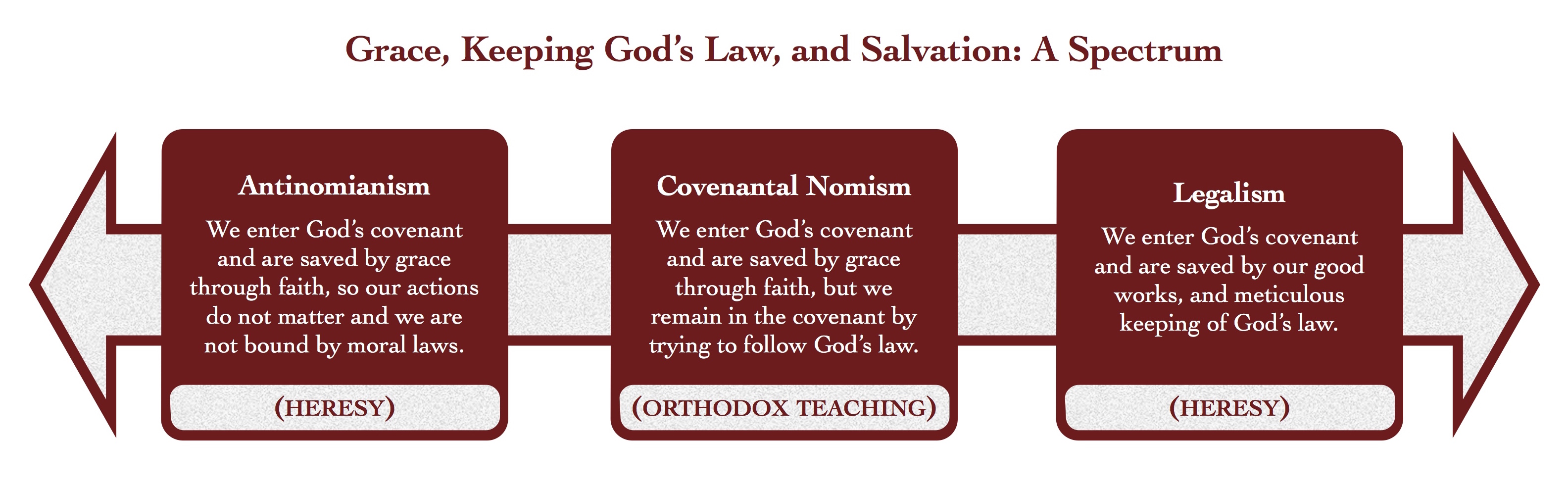
If you were to imagine a spectrum charting different ideas on grace, keeping God’s law, and salvation (see below), at the opposite end from legalism you would find antinomianism. Antinomianism is the idea that we are saved by grace through faith to the extent that our works have nothing to do with salvation at all: we are not bound to try to keep God’s moral laws (nomos is the Greek word for law, so the word really just refers to the rejection of law-keeping).

This view, the opposite extreme of legalism, is also heresy. It is not what the Bible teaches. Just think of all the passages in the New Testament that provide lists of sinful behaviors that are not in keeping with God’s law and will exclude those who practice them from God’s kingdom (Romans 1.18-31, 1 Corinthians 6.9-10, Galatians 5.19-21, Ephesians 4.17-32, Ephesians 5.3-5, 1 Timothy 1.8-11, and Revelation 21.8, to name a few). Clearly, the things we do matter to God and thus, are related to our salvation as well!

Thankfully, not many Christians are antinomians either (although, extreme proponents of the “Once Saved Always Saved” perspective come pretty close to this, in my opinion).

In between the two extremes of legalism and antinomianism is what the Bible actually teaches, and hopefully what you believe, even if you aren’t familiar with the theological term: covenantal nomism. Covenantal nomism suggests that we enter into God’s covenant and are covered by His grace through faith in Christ, but that we “stay in” that covenant by trying to do God’s will and obey His commands. 

Now, certainly we don’t do this perfectly—all of us sin and fall short from time to time. And covenantal nomism does not hold that our attempts to obey God’s commands somehow earn our salvation; salvation is by grace through faith. But covenantal nomism does hold that as Christians who have been saved by God’s grace, we should do our very best to obey His commands and live our lives as He desires. In the words of Dallas Willard, “Grace is opposed to earning, it is not opposed to effort” (emphasis mine).

Conclusion

So what’s the big deal? Why does this even matter, and why would someone spend time writing about it?

First, I think it is good general practice to use words appropriately. We live in a world where texts, tweets, and twenty second sound bites dominate communication, and where people are not particularly inclined to give people with whom they disagree a fair hearing. In that context, I think it is important that we speak with precision, and do our best to be clear and accurate in our communication. That cannot happen when we assume that words mean something other than what they actually mean.

Second, there really is a theological issue here. When you call someone a legalist, you are saying that they believe they can earn their salvation through good works. You are, in essence, calling them a heretic. That is not something to do lightly.

So the next time you encounter someone who seems overly scrupulous about a particular issue, or, from your perspective, makes a mountain of doctrine out of a molehill of opinion, take a moment to get them to explain their viewpoint, and maybe even take some time to study Scripture together on that issue. But whatever you do, please don’t dismissively call them a legalist.

*Throughout this post, I reference as examples different issues which I have heard people associate with legalism. Please understand that in this article, I am making no argument one way or the other about any of these particular issues.

« Older posts Newer posts »

© 2026 The Doc File

Theme by Anders Noren — Up ↑