The online journal of Luke Dockery

Category: Christianity (Page 46 of 64)

Reaching Your Spiritual Potential: Pray!

This is the continuation of a series which began here.

Prayer in the Bible

The importance of prayer is a basic teaching of Scripture. In the life of Jesus Himself, we see the importance of prayer:

  • He often went off by Himself to pray.
  • He took time for the express purpose of teaching His disciples how to pray.
  • He prayed with His disciples and prayed for them in their presence.
  • In the night before His crucifixion, when He faced the most difficult time of His life, He spent the night in the Garden of Gethsemane in fervent prayer.

Elsewhere in Scripture we see the importance of prayer emphasized as well:

  • The apostles would use prayer to aid in the performance of miracles.
  • Philippians 4.6-7: “Do not be anxious about anything, but in everything by prayer and supplication with thanksgiving let your requests be made known to God. And the peace of God, which surpasses all understanding, will guard your hearts and your minds in Christ Jesus.”
  • James 5.14-16: “Is anyone among you sick? Let him call for the elders of the church, and let hem pray over him, anointing him with oil in the name of the Lord. And the prayer of faith will save the one who is sick, and the Lord will raise him up. And if he has committed sins, he will be forgiven. Therefore, confess your sins to one another and pray for one another, that you may be healed. The prayer of a righteous person has great power as it is working.”
  • 1 Thessalonians 5.17: “Pray without ceasing.”

Prayer and You

What is your prayer life like?

A lot of very different people read this blog, and there are probably some who are reading who have an outstanding prayer life…who truly pray without ceasing…who spend a great deal of time in conversation with the Father. That’s great—keep doing what you’re doing. But I think a lot of us probably need to increase our efforts.

Some people go through most of their day (or most of their lives!) ignoring prayer, unless something really bad comes up. For them, prayer is like a parachute—something you only use in an emergency.

Others might have regular times of prayer—before meals, when they wake up, when they go to sleep—and there’s nothing wrong with that. In fact, I think it’s a good and healthy thing to have regular times of prayer. But if we’re not careful, that can become just a pattern we fall into without much thought.

Sometimes we may struggle to pray because we feel like we don’t have a lot to say. You know, generally, when you look at your relationships, the closer you are to someone, the easier it is for you to talk to them (there are some people to whom it’s hard to say two sentences; with others you can go on indefinitely). I think the same thing is true when it comes to our prayer lives. At first, it might be hard to find things to talk about, but the more time you spend in prayer, the easier it gets.

And in the meantime, before you get “good” at it, there are plenty of things to pray for—the church, the leaders of your church, those who are sick, those whom you know who are lost, the government, the military, your family, that you avoid temptation, etc.

The Bottom Line

There’s no way that we can reach our spiritual potential and become mature Christians if we don’t regularly spend time talking to our Heavenly Father in prayer!

Make a commitment today to be a person of prayer. Set aside specific times to pray; be on the lookout for people and causes to pray for, and consider keeping notes or a journal to help you remember those things.

Pray!
Reaching Your Spiritual Potential: Introduction

Misunderstanding the Spiritual

The Gospel of John is one of my favorite books in the Bible. I took a course on it in undergrad and a second one in grad school. I’m also now teaching it for the second time.

One of the repeated themes in John’s Gospel, something that you see over and over, is the idea of misunderstanding—Jesus presents some form of teaching, and His audience completely fails to understand what He is talking about.

  • This is very apparent in John 3, where Jesus tells Nicodemus that he must be born again, and Nicodemus can’t understand Him because he’s trying to imagine a physical rebirth—re-entering his mother’s womb to be born again (which, admittedly, would be pretty difficult).
  • We see it again in John 4, when Jesus is talking to the Samaritan woman at the well; Jesus talks about “living water”, referring to something spiritual, but the woman assumes that He is talking about a special kind of water which can be seen, touched, and drunk.
  • Later on in John 6, Jesus says that He is the bread of life, and that those who eat His flesh and drink His blood have eternal life. This turns off a lot of the people, because they think He is literally talking about eating Him.

There are more examples that we could give, but I think you can see the point—over and over again in John’s Gospel, people misunderstand what Jesus is saying, and the reason for this is that Jesus is focused on spiritual teachings while His audience is locked in on the physical side of things.

You know, I think we have a very similar problem today.

Oftentimes I think we struggle to do the things that Jesus calls us to do and to live the way He expects us to live because we are so focused on the physical—what we can see and touch—that we tend to neglect the spiritual.

“Reaching your Potential”

There’s a lot of talk in our world today about “reaching your potential”.

You hear it a lot in the context of athletes and sports teams. A coach might talk about how his team has a lot of talent, but how they have to work to reach their full potential. You also hear it in the context of education—a particular student may have a lot of natural ability, but a lot of work is involved to be the best student he or she can be.

Potential involves raw talent and ability, but getting the most out of it requires hard work! No Hall of Fame athlete achieved that success without committing himself to long hours of exercise and practice. No Rhodes Scholar ever achieved that honor without committing herself to long hours of study and review.

I think the same thing is true in regards to spiritual potential.

For those of us who have committed our lives to Christ and have put Him on in the waters of baptism, it is our responsibility to mature and develop spiritually, to work to follow Jesus more closely and live increasingly holy lives. Another way of saying that is that it is our duty to reach our spiritual potential![1]

But how do we do that? I’d like to spend a few posts looking at practical ways in which we can develop our spiritual potential. These aren’t new or flashy ideas; they are simple steps which require hard work and diligence. But if followed, they are practices which will help us to reach our spiritual potential and serve God more effectively.


[1]Some readers will likely feel uncomfortable by some of the language in this paragraph which emphasizes our role in our spiritual growth and development. Isn’t it God’s work (though Christ) which saves us? Isn’t it God’s work (though the Spirit) which sanctifies us? Certainly. But neither of those truths eliminates the fact that we also have a role to play. Your own personal efforts can’t make you holy, but at the same time, the work of the Spirit won’t happen without your willingness and cooperation.

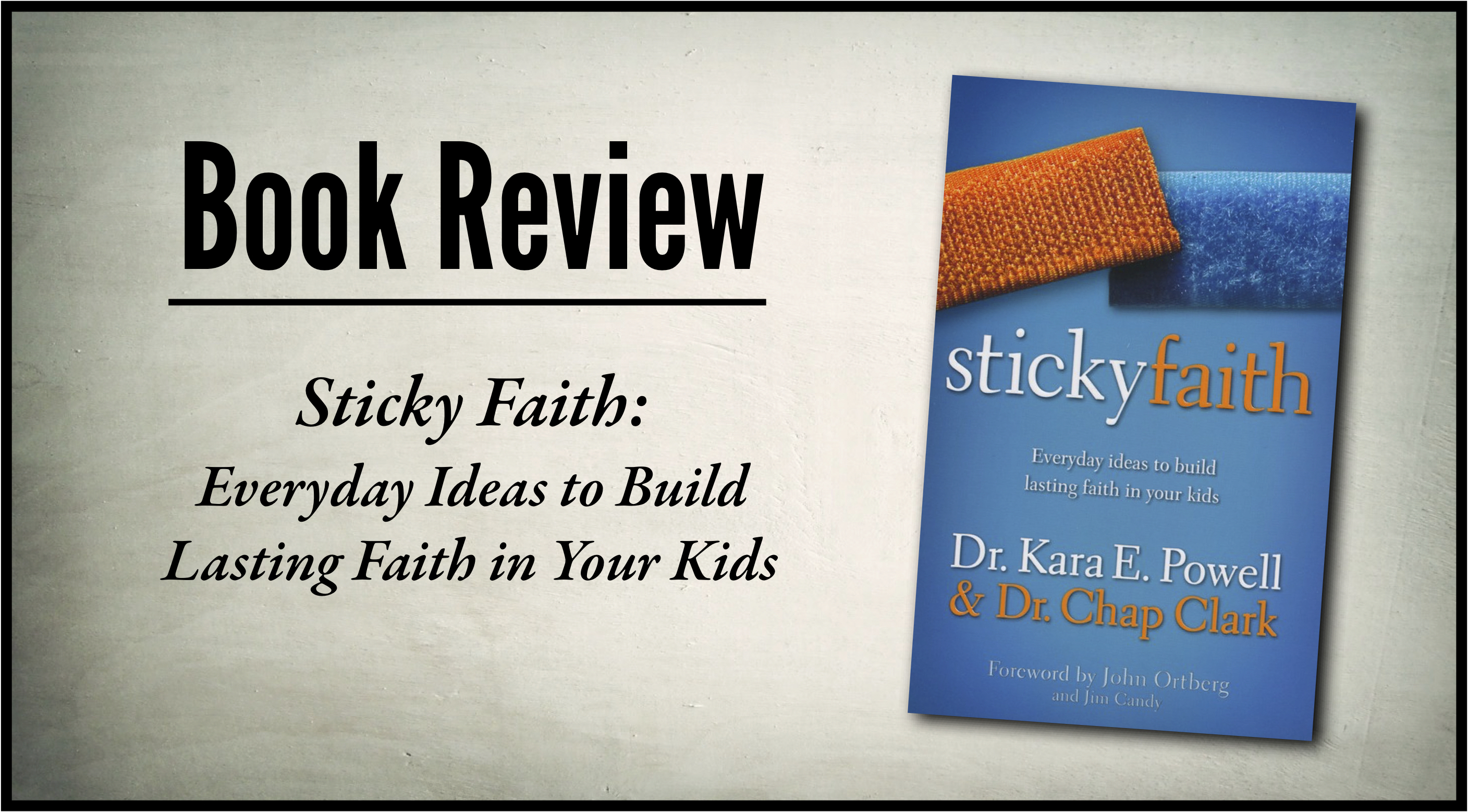
Book Review: Sticky Faith

I have just finished reading Sticky Faith: Everyday Ideas to Build Lasting Faith in Your Kids for the second time. Looking back, I was surprised that I hadn’t reviewed it here on my blog previously (though I have referenced it several times), so I thought I would quickly do so today. Quite simply, Sticky Faith is an outstanding book, and it’s one that I think all parents should read. I’m actually co-teaching a class on it right now at church, and along with 2-3 other sources, it forms the core of my youth ministry library.

Sticky Faith is written for parents (though there are other versions for youth workers and students), and is all about helping you to instill a lasting faith (or a faith that “sticks”, hence the title) in your children. And I’m sure there are a lot of books like that, but what I really like about Sticky Faith is that (1) it is based on extensive research, and (2) it offers incredibly practical suggestions of tangible things you can do to help faith development in your kids.

Like any book, there are some ideas and suggestions in Sticky Faith that I disagree with, and I’m sure it will be that way for you too. But that doesn’t change the fact that, overall, it is an incredibly helpful resource for Christian parents.

Here are some of my favorite quotations from the book [my comments are added in brackets]:

“…Our conclusion is that 40 to 50 percent of kids who graduate from a church of youth group will fail to stick with their faith in college…only 20 percent of college students who leave the faith planned to do so during high school. The remaining 80 percent intended to stick with their faith but didn’t.” (pp. 15-16) [There are a lot of other alarming statistics which they gather from their research. These helpful numbers describe a big problem, which the rest of the book then sets about trying to address.]

“How you express and live out your faith may have a greater impact on your son or daughter than anything else.” (p. 25)

“…A performance-based Christianity can last only so long.” (p. 36)

“The greatest gift you can give your children is to let them see you struggle and wrestle with how to live a lifetime of trust in God.” (p. 46)

“If I had to choose between living out my faith or talking about my faith in front of my kids, I’d choose the former every time. But I don’t have to choose. And neither do you. We can do both.” (p.70)

“The closest our research has come to that definitive silver bullet is this sticky finding: for high school and college students, there is a relationship between attendance at church-wide worship services and Sticky Faith.” (p. 97) [Parents, this should make you think twice before missing church for a hunting trip, or a baseball tournament, or some other family outing. It matters. Youth ministers, this should make us think twice before frequently removing our youth groups from our congregational worship gatherings. A big part of being the Body of Christ is being present with the Body of Christ.]

“Over and over, students have told us that the first two weeks at college are when they make key decisions about drinking and other high-risk behaviors, right along with choosing whether to go to church or to a campus ministry.” (p. 151)

“It’s okay to go through periods of doubt and distrust and disillusionment. It’s okay to go through periods of questioning and confusion. Don’t run away from them. At the same time, don’t go off the deep end. Do the intellectual and spiritual soul searching within the context of a secure community of people who truly love you.” (p. 172) [This quote actually came from a student who was part of the research study—a lot of wisdom here!]

“But [kids] soon come to know that faith is ultimately meaningless unless they choose it for themselves.” (p. 179) [Yes. We must own our faith, rather than simply inherit the faith of our parents.]

“Especially during their lowest times, your kids need to know that, above all else, you are there for them, regardless of what they are going through.” (p. 180)

“If your family has served Christ through much of your child’s life, the seeds you have planted are potent and real.” (p. 187)

I could go on and on—large sections of my copy of Sticky Faith are highlighted or underlined—but these quotations should give you an idea of what the book is like. In short, I would recommend it to any Christian parent, or anyone who works closely with teens.

The Perfect Church

A lot of people really struggle with the idea of the church.

You have the I-love-Jesus-but-hate-the-church crowd who are under the (mistaken) impression that somehow they can be faithful to Christ without being associated with His Body. Then you have the disgruntled church members who hop from one church to another whenever they get upset or offended by something or someone.

And honestly, I get a lot of the frustration that people have with the church. The church is made up of people, and thus, by definition, is imperfect and riddled with problems. I love the congregation where I work and worship, but it has its problems—sometimes people gossip, there are some people who struggle to get along with other people, some people have anger issues, etc. And I would venture to guess that your church is pretty similar.

G.K. Chesterton, the famous author and theologian, was once asked, “What’s wrong with the world?” He thought about it and then replied, “Dear Sirs, I am.” His point could just as easily be made about the church—the problem with the church is me and people like me, and the fact that we bring our problems into it. So before you start yearning for a perfect church, it’s probably worth remembering that it would cease to be perfect once you joined it!

It’s also probably worth remembering that the church, as imperfect as it seems to us, is also described in the New Testament as the Bride of Christ. What does Christ think about His Bride? Paul gives us an indication:

Husbands, love your wives, as Christ loved the church and gave himself up for her, that he might sanctify her, having cleansed her by the washing of water with the word, so that he might present the church to himself in splendor, without spot or wrinkle or any such thing, that she might be holy and without blemish.

(Ephesians 5.25-27)

If Christ sees the church as splendid, holy, and without blemish, spot, or wrinkle, what does that suggest? To me, it doesn’t suggest that He has poor eyesight and is just missing all of our flaws and imperfections; rather, it suggests that He has redeemed us, sanctified us and made us His own, and that His Spirit is working on us collectively and individually to make us what we ought to be. In other words, we don’t possess the characteristics mentioned above because we ourselves are perfect or amazing; we possess them because He gives them to us. He transforms us into what He wants us to be.

And it also suggests that if Christ can look at the church and love her and place great pride in her, then I can too, and that I can quit obsessing about perfection. Which is good, because any church I am a part of will fall short of that standard.

Photo credit: http://www.sharefaith.com

Lessons from David: Sin Can Be Forgiven

In our quick look at some of the many lessons that could be learned from the life of King David, we have noted that God Can Use Unlikely People To Accomplish His Will, and somewhat somberly, that Sin Has Consequences. Today we conclude this series on an upbeat note by pointing out one of Scripture’s central truths: Sin Can Be Forgiven.

David’s guilt was plain in the matter of Bathsheba and Uriah the Hittite: he lusted after Bathsheba, he committed fornication, he abused his power as king, and ultimately, he had Uriah killed to cover up what he had done.

But ultimately, God forgave David of his great sin:

“Then David said to Nathan, ‘I have sinned against the LORD.’ And Nathan said to David, ‘The LORD also has taken away your sin; you shall not die.’”

(2 Samuel 12.13)

The Book of Psalms records David’s words of repentance:

“Be gracious to me, O God, according to Your lovingkindness; According to the greatness of Your compassion blot out my transgressions. Wash me thoroughly from my iniquity and cleans me from my sin. For I know my transgressions, and my sin is ever before me.

Create in me a clean heart, O God. And renew a steadfast spirit within me. Do not cast me away from Your presence. And do not take your Holy Spirit from me. Restore to me the joy of Your salvation And sustain me with a willing spirit.”

(Psalm 51.1-3; 10-12)

God was willing to forgive David of his sins, and the good news for us is that He will do the same for us if we repent. Some of my favorite verses in all of the Bible speak to this truth:

“As far as the east is from the west, so far has He removed our transgressions from us.”

(Psalm 103.12)

“…If we walk in the light as He Himself is in the light, we have fellowship with one another and the blood of Jesus His Son cleanses us from all sin.”

(1 John 1.7)

That forgiveness doesn’t mean that all of the physical consequences of sin will necessarily go away. David’s child still died, no matter how hard he prayed about it. The drunk driver who takes a life will still face prison time, and will still have to deal with the guilt of having killed someone for the rest of his life. The pregnant teenage girl will still have to face the trials and stigma of being a single parent. No matter how hard the woman tries, she may never be able to completely undo the damage of hateful words.

But, the eternal, spiritual consequences can disappear.

Jesus died on the cross to bridge the gap that sin had created between us and God, and when He did that, He received the punishment for sin so that we would not have to. The Bible’s best-known verse, John 3.16, says, “For God so loved the world, that He gave His only begotten Son, that whoever believes in Him shall not perish, but have eternal life.”

As mentioned in the last post, our wages—what we deserve in return for our sin—is death. But thanks to Jesus, we don’t have to get what we deserve; we can have eternal life with Him instead.

« Older posts Newer posts »

© 2026 The Doc File

Theme by Anders Noren — Up ↑