The online journal of Luke Dockery

Category: Christianity (Page 59 of 64)

Unity and Restoration in Churches of Christ Part 1: A Historical Primer

Churches of Christ, of which I am a part, are a group of autonomous congregations of believers which have historical ties to the American Restoration Movement of the 1800s. This movement, led primarily by men such as Alexander Campbell and Barton W. Stone (and thus sometimes called “The Stone-Campbell Movement”), sought to strip away man-made traditions and restore the Church which they read about in the pages of the New Testament.

Although the restoration of the New Testament church was seen as important in its own right, it was also viewed as a means of bringing unity to a fragmented world of denominationalism:[1] if Christ-followers of different varieties could all just agree to follow the beliefs and practices described in the New Testament, then the elusive unity among His disciples which Jesus prayed for could finally be achieved. To an extent, it worked, as thousands of people left their respective denominations and linked up with the new movement, wanting to be known only as Christians and recognizing only the authority of the Bible.

Sadly, this unity did not last. Restoration congregations began to divide in the late 19th century, and in 1906, the U.S. Census recognized a formal division between Churches of Christ and Disciples of Christ. It has long been held that the primary causes for this division stemmed from disagreements over missionary societies and instrumental music in worship, but in Reviving the Ancient Faith: The Story of Churches of Christ in America, author Richard Hughes makes the argument that these issues were merely symptoms of a greater problem, and that the seeds of division were actually sown decades before, and can be traced to the thoughts and perspectives of Alexander Campbell himself.[2]

According to Hughes, Campbell’s twin goals of unity and restoration[3] were, in many ways, mutually exclusive. To illustrate:

  • If Person A places a great deal of importance on unity, he will be more likely to overlook the fact that Person B does not completely agree with and follow the teachings and practices of the New Testament. Unity is upheld, but restoration is diminished.
  • On the other hand, if Person A places a great deal of importance on restoration, the fact that Person B does not completely agree with and follow the teachings and practices of the New Testament will be a major issue that will prevent full fellowship. Here, restoration is upheld but unity is diminished.

Hughes argues that Campbell’s failure to fully think through the implications of unity and restoration enabled him to always cling to both goals despite any inherent tension between the two, but that his followers inevitably divided into hostile groups which focused on one of those concerns to the neglect of the other.[4] Ultimately, those who held up unity as being of primary importance became the Disciples of Christ following the split of 1906, while Churches of Christ maintained a primary focus on restoration.

Hughes’ perspective is interesting and I think it does hold some merit, but I think he takes it too far. Certainly there is an element of tension between the ideals of unity and restoration, but to say that the two are mutually exclusive and that Alexander Campbell sowed the seeds of division because he was incapable of grasping this idea seems to place great limitations on Campbell’s universally-renowned intellect.

What seems more likely is that Campbell’s subtle understanding of the connection between unity and restoration was not adequately disseminated to the majority of the people he influenced. Not understanding how the two ideas could be reconciled, his followers later tended to group around one or the other, as Hughes rightly suggested. And it wasn’t a problem which was limited to the late 19th and early 20th centuries—many people today still struggle to reconcile the concepts of unity and restoration.

But I do believe that such a reconciliation is possible, and can be clearly seen through the example of J.N. Armstrong, the first President of Harding College, who lived roughly 100 years after Campbell. More on that in the next post.


[1] A note on ”denominationalism”: there is a strong historical perspective in the Restoration Movement that laments the disunity in Christendom as evidenced by the countless denominational groups that exist. Churches of Christ aim to be undenominational in the sense that they seek to be nothing more (or less) than the New Testament Church, and because of this, members will sometimes react strongly to the notion that the Church of Christ is “just another denomination.” Of course, regardless of intention, to denominate literally means “to name”, and at least in that sense Churches of Christ are a denomination, as they have persistently and somewhat rigidly applied that specific name to themselves. From that perspective, it is hard for anyone unfamiliar with their core beliefs and goals to think of the Church of Christ as anything other than “just another denomination.” I wish more of us understood this.
[2] Richard T. Hughes, Reviving the Ancient Faith: The Story of the Churches of Christ in America (Grand Rapids: William B. Eerdmans Publishing Company, 1996), 22-26.
[3] To be more accurate, Hughes, 45, suggests that unity and restoration, while important, were not Campbell’s primary concern. Rather, as a postmillenialist, “Campbell’s ultimate concern was for the kingdom of God, the millennium on earth. In Campbell’s mind, unity was merely a means to the millennial dawn, and restoration a basis for unity.”
[4] Hughes, 46.

The ARK 2012: Shake Up The World

The ARK Retreat is one of our big youth group events which occurs each spring. Over the last few years it has steadily grown in size and scope and it has actually become a pretty neat event as youth groups from six area congregations spend a weekend playing, fellowshipping, and worshipping with one another. 
For some of the teens, it is one of the high points of the year, and despite all the work and effort that goes into planning the ARK each year, that makes it all worth it.
The theme for the ARK for this year was “Shake Up The World,” and we heard several good lessons on that idea throughout the weekend. It was my task to introduce that theme on Friday night, and you can read a summary of my thoughts below:
I want to explain this year’s theme by telling you two stories.
The Man Who Shook Up The World
The first story is a boxing story, and for it to make sense, you have to realize that boxing used to be a really big deal. Today, if I asked you to name the heavyweight champion of the world, probably very few of you would know the answer. But if you lived, say, 50 years ago, you would’ve known because boxing was a big deal back then. And that’s when our story takes place, almost 50 years ago, in 1964, when two men squared off with the heavyweight championship on the line.
Sonny Liston
The first man was the reigning champion. His name was Sonny Liston, and he was terrifying. He was 35-1 for his career, and he hadn’t lost a fight in almost 10 years. He had defeated the previous heavyweight champion twice, both times via knockout in just over 2 minutes. If that wasn’t intimidating enough, he was also known to have connections with criminals and gangsters.
The second man was young, at 22 years old, not much older than some of you. His name was Cassius Clay, and he was somewhat well-known himself, because he had won an Olympic Gold Medal in boxing four years earlier. After turning professional, he had won 19 fights in a row without a single loss, and he had become the top-rated challenger. Despite this, no one gave him a chance in this fight, and the odds were 7-1 in favor of Liston winning.
But although Liston was regarded as the more powerful fighter, Clay was much quicker, and he used his quickness to duck and dodge most of Liston’s devastating punches, while landing a lot of his own. That was the difference in the fight. Liston didn’t come out to fight the 7th round, saying that he had a shoulder injury, Cassius Clay was declared the heavyweight champion of the world, and at 22, was the youngest boxer to ever take a heavyweight title from a reigning champion.
After the fight, speaking to the press who had doubted that he could win, Clay shouted, “I am the greatest…I shook up the world…I shook up the world!”
Eighteen months later, he defeated Sonny Liston again, and by this time, he had changed his name to name that most people know him by—Muhammad Ali, considered by most people to be the greatest boxer of all time.
Certainly, that’s one way of “Shaking up the world”—doing something amazing and then immediately letting everyone know just how amazing it was—but there’s another way to shake up the world, and that’s what we want to focus on this weekend…
The Men Who Turned The World Upside Down

The second story is about two other guys who shook up the world in a different way, and they lived a long time before Sonny Liston and Muhammad Ali. Their names are Paul and Silas and we read about them in the Book of Acts in the New Testament.
Paul and Silas in prison
Paul and Silas were missionaries—they traveled around telling people about the life, death, and resurrection of Jesus. In Acts 16, Paul and Silas are thrown into prison because people are upset by their preaching, but while in prison, they spend their time praying and praising God in song and they end up baptizing their jailer!
In Acts 17, after being released from prison, Paul and Silas travel to another city called Thessalonica, and there they continue preaching. As was his custom when entering a new city, Paul went to the local synagogue, and there he used the Scriptures (what would be our Old Testament) to show the Jews in Thessalonica that the Messiah of prophecy would have to suffer and then be raised from the dead, and that Jesus of Nazareth was the Messiah that the Scriptures talked about.
When many of the people believed the words of Paul and began to follow Christ, it made some of the Jews jealous, and they formed a mob and sought Paul and Silas at the home of Jason, a local Christian leader. 

“And when they could not find them, they dragged Jason and some of the brothers before the city authorities, shouting, ‘These men who have turned the world upside down have come here also, and Jason has received them, and they are all acting against the decrees of Caesar, saying that there is another king, Jesus.’ And the people and the city authorities were disturbed when they heard these things.”

Did you catch what the jealous and evil men said about Paul and Silas? “These men who have turned the world upside down have come here also…” They could’ve said, “These men who shook up the world….”
The men who said this about Paul and Silas didn’t mean it as a compliment! They’re saying that Paul and Silas have ruined everything—they’ve messed everything up! That seems hard for us to understand though—what were Paul and Silas doing that was so terrible? After all, they were just Christians, doing their best to follow Christ.
What About Us?
And that makes me think: maybe, just maybe, when Christians live like they’re really supposed to, when they really take up their cross daily and follow Jesus, maybe that shakes the world up! If Paul and Silas turned the world upside down by living for Christ, you would think that Christians today would be doing the same thing. But here’s the problem: when you look at Christianity today, do you really see a group of people who turn the world upside down? People who shake up the world? For the most part, I don’t think so.
Why is that? Unfortunately, I think it is because a lot of the time (especially with teenagers), it seems like we dumb down what it means to be a Christian until we basically have a list of do’s and don’ts: 
  • Don’t have sex before marriage.
  • Don’t do drugs.
  • Don’t cuss.
  • Do come to church and youth group activities.
  • Do pray to God and read your Bibles.
And let me be clear, all of that stuff is true—as a Christian, there are certain things that you shouldn’t do and other things that you should do. But this weekend, we want to suggest to you that being a Christian—living as Jesus Christ called us to live—means a lot more than a list of do’s and don’ts.
Being a Christian doesn’t mean that you’re basically like everyone else around you except that you just happen to spend an hour on Sunday morning in a church building. Being a Christian does mean being radically different from your peers and consciously and intentionally denying yourself and sacrificing your life and the things you want to do on a daily basis in order to instead use your life to glorify God.
If you do that, you’ll shake up the world.

Why Non-Christians Don’t Like Christians

For the purposes of this post, I am using the term “Christian” in the broadest sense. After all, many of those who aren’t Christians don’t understand the (significant) differences within Christianity anyway.

Generally speaking, I think there are two main reasons why a lot of people don’t find Christians to be very likable:

(1) It can be hard for people to like Christians when they don’t resemble Christ. Another way of saying that is people can’t stand it when Christians are hypocrites:
–When it turns out that famous televangelists have been cheating on their wives for years or embezzling hundreds of thousands of dollars from their viewers, it turns people off of Christianity.

–When Catholic priests who are supposed to be caring for the members of their parishes turn out to be pedophiles who prey on innocent children, it turns people off of Christianity.

–And perhaps a little closer to home, when Christians spend their Sundays worshipping God and the rest of the week denying Him by lifestyles of materialism, gossip, judgment, and immoral behavior, it turns people off of Christianity.

Non-Christians aren’t the only ones who are turned off by such people—God has never been pleased with people who honor Him with their lips but have hearts which are far from Him (Isaiah 29.13), and Jesus would prefer that such Christians quit pretending to follow Him and get out of the Church (Revelation 3.16)!

Mahatma Gandhi famously summed it up this way:

“I like your Christ; I do not like your Christians. Your Christians are so unlike your Christ.”

On a fundamental level, we as Christians are supposed to resemble Christ. Certainly all Christians fail to do that from time to time, but when we do so repeatedly as a way of life, we invalidate what we claim to be most important.
(2) It can be hard for people to like Christians when they do resemble Christ. This point might be harder for some to understand, so bear with me.

When trying to peg why the world doesn’t like Christians, I think a lot of people easily identify hypocrisy in the church (after all, we hear this reason all the time) and think that the way of Christ is only unappealing to people because we fail to live it correctly.

The thing is, sometimes when we do live as Jesus calls us to, people still don’t like Christians. A good example of this today would be Tim Tebow—although he has a ton of fans, he also gets a lot of negative attention and a lot of people say terrible things about him, not because of his play, but because of his Christianity.*

It might be surprising to us that a lot of people don’t like us for living the way Christ has called us to, but it really shouldn’t, because Jesus Himself explicitly said that it would happen!

“If the world hates you, know that it has hated me before it hated you. If you were of the world, the world would love you as its own; but because you are not of the world, but I chose you out of the world, therefore the world hates you. Remember the word that I said to you: ‘A servant is not greater than his master.’ If they persecuted me, they will also persecute you.” (John 15.18-20)

It’s hard for us to remember this sometimes, but when Jesus was on earth, a lot of people didn’t like Him at all—they disliked Him so much, in fact, that they conspired to have him killed! If we seek to exemplify Jesus in our daily lives, a lot of people won’t like us any more than they did Him.

So, if some people won’t like us if we don’t act like Christ, while others won’t like us if we do, where does that leave us? Basically, there will be people in the world who dislike us no matter what. As Christians, we need to make sure that if the world doesn’t like us, it’s because we do look like Jesus, not because we don’t.


*Certainly people criticize Tebow for his quarterback play as well (and that might even be the main source of the criticism), but some people criticize Tebow specifically for his character or his faith. All of this despite the fact that Tebow uses his fame and wealth to help those who are less fortunate, by all accounts is a genuinely nice guy, and doesn’t at all seem to be hypocritical about his faith.

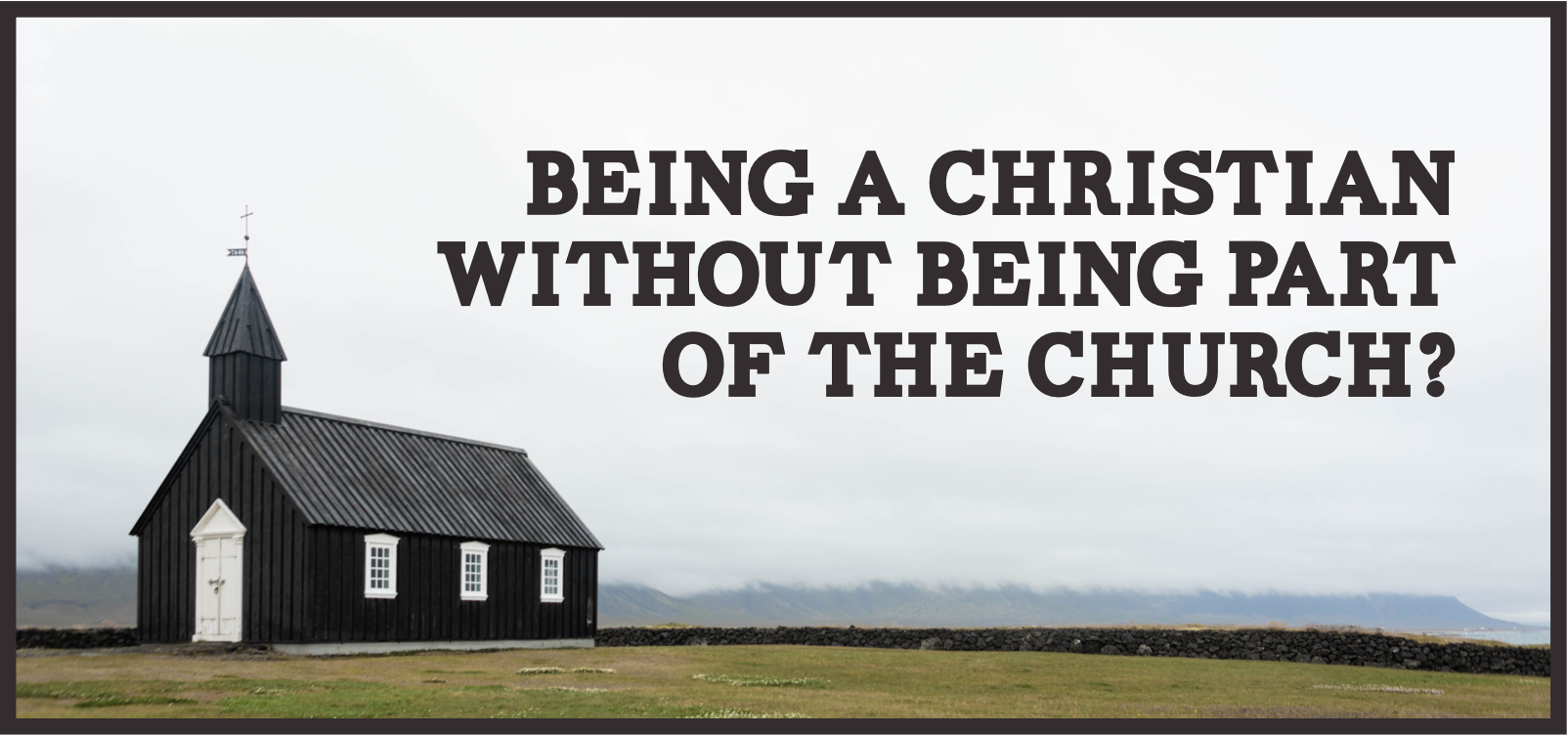
Being a Christian Without Being Part of the Church?

It’s a popular notion today that one can be a Christian without being a part of the Church. It’s also a thoroughly unbiblical notion.

In The Prodigal God, Timothy Keller has some good thoughts in this regard:

“Christians commonly say that they want to “get to know Jesus better.” You will never be able to do that by yourself. You must be deeply involved in the church, in Christian community, with strong relationships of love and accountability. Only if you are a part of a community of believers seeking to resemble, serve, and love Jesus will you ever get to know him and grow into his likeness.”

I have known plenty of people who were in one sense or another actively involved with the Church who did not particularly resemble Jesus. That’s a common enough claim, and shows that just “going to church” or being involved in church activities doesn’t necessarily transform someone to the image of Christ.

Of course, at the same time, I haven’t known anyone who resembled Jesus who wasn’t also deeply devoted to the Church. Jesus loved the Church enough that he paid for it with his blood (Acts 20.28); to think that one can somehow be a Christian without belonging to that Body is absurd.

The Old Testament and Immigration

It’s always potentially controversial to mix the Bible and politics, but as Christians, shouldn’t our political views be informed by Scripture? If they are not, isn’t that a problem?

I have written some brief thoughts on the issue of immigration before, but in general, it is surprising and disappointing to me how frequently Christians endorse anti-immigrant political views considering the repeated and consistent witness of the Old Testament.

Consider the following scriptures:

“You shall not wrong a sojourner or oppress him, for you were sojourners in the land of Egypt.” (Exodus 22.21) 

“When a stranger sojourns with you in your land, you shall not do him wrong. You shall treat the stranger who sojourns with you as the native among you, and you shall love him as yourself, for you were strangers in the land of Egypt: I am the Lord your God.” (Leviticus 19.33-34) 

“He executes justice for the fatherless and the widow, and loves the sojourner, giving him food and clothing.” (Deuteronomy 10.18) 

“‘Cursed be anyone who perverts the justice due to the sojourner, the fatherless, and the widow.’ And all the people shall say, ‘Amen.’” (Deuteronomy 27.19) 

“For if you truly amend your ways and your deeds, if you truly execute justice one with another, if you do not oppress the sojourner, the fatherless, or the widow, or shed innocent blood in this place, and if you do not go after other gods to your own harm, then I will let you dwell in this place, in the land that I gave of old to your fathers…” (Jeremiah 7.5-7) 

“You shall allot it as an inheritance for yourselves and for the sojourners who reside among you and have had children among you. They shall be to you as native-born children of Israel. With you they shall be allotted an inheritance among the tribes of Israel.” (Ezekiel 47.22) 

“Thus says the Lord of hosts, Render true judgments, show kindness and mercy to one another, do not oppress the widow, the fatherless, the sojourner, or the poor, and let none of you devise evil against another in your heart.” (Zechariah 7.9-10) 

“Then I will draw near to you for judgment. I will be a swift witness against the sorcerers, against the adulterers, against those who swear falsely, against those who oppress the hired worker in his wages, the widow and the fatherless, against those who thrust aside the sojourner, and do not fear me, says the Lord of hosts.” (Malachi 3.5)

A few brief observations based on those verses:
First, someone will probably be quick to say something like, “All of those scriptures are from the Old Testament; Christians live under the New Testament” (because someone is always quick to say something like that). Of course, in a sense, they would be correct—as a Christian, I am not bound by all of the rules and regulations of the Law of Moses. At the same time, that doesn’t mean that consistent ethical principles from the Old Testament aren’t also meant to apply to Christians today (cf. Micah 6.8; Matthew 5.17).
Secondly, someone might point out that, while we are supposed to be kind and welcoming to immigrants (based on the verses above), according to Romans 13.1-7, we are to be subject to the laws of our land which means that we shouldn’t be supportive of illegal immigrants. And that might be true—I’m not really suggesting that Christians should develop an Underground Railroad to smuggle immigrants into the country illegally. However, if the consistent witness of Scripture is to suggest an “Open Arms” policy toward immigrants, then Christians probably do need to use their political influence to make immigration laws more immigrant-friendly (and thereby enable Christians to be subject to the laws of the land and also loving to immigrants).
Third, it should be remembered that these Old Testament directives were given to the Israelites, a people who were, as a general rule, supposed to remain ethnically pure as a means of ensuring faithfulness to Jehovah (when the people would intermarry with the surrounding peoples, it invariably led to the adoption of idolatry). Despite this, the Israelites were still supposed to be welcoming to foreigners. This is important to keep in mind, as a common objection to immigration has been a fear of the mixing of races or the influence of different religious beliefs.
Finally, a practical argument in favor of immigration has been that the United States is, fundamentally, a country of immigrants—how can we (American citizens) reject immigrants when the vast majority of us are here only because of the immigration of our ancestors? Interestingly, this is a repeated rationale of Scripture as well—how can the Israelites mistreat sojourners, when they themselves were sojourners in Egypt?
I have a hard time identifying closely with either major political party because, I believe, they both fail to consistently embrace biblical principles. When it comes to immigration, I think the rhetoric from the Right (and therefore, from a lot of Christians) often fails to live up to the biblical standard.

« Older posts Newer posts »

© 2026 The Doc File

Theme by Anders Noren — Up ↑