The online journal of Luke Dockery

Category: Culture (Page 8 of 14)

Inalienable Rights, Slavery, & Abortion

Relative Rights

Famously, the second paragraph of the Declaration of Independence states:

 We hold these truths to be self-evident, that all men are created equal, that they are endowed by their Creator with certain unalienable Rights, that among these are Life, Liberty and the Pursuit of Happiness. That to secure these rights, Governments are instituted among Men, deriving their just powers from the consent of the governed;

These are beautiful words, and the ideas they express run deep in our national ethos—even if we have struggled to live up to them at times.

One thing I have come to believe over time that I don’t hear people talk about very often is how our unalienable rights themselves are not, or should not be, considered equal: their importance is relative to one another.

Stated mathematically:

Life > Liberty > the Pursuit of Happiness

What I mean by that is that my right to pursue happiness should not infringe upon your liberty, and my right to liberty should not infringe upon your life. Stated positively, people need to have life before they can have liberty, and they need to have liberty before they are free to pursue happiness.

Great Evils

I think that slavery and abortion stand as two of the great evils in American history, and I think these two issues share striking similarities:

  • In both cases, the suffering of the victims was allowed on the basis that they were considered to be somewhat-less-than-human. This thinking was furthered by the use of dehumanizing terms like slave and fetus.
  • In both cases, the victims were treated as the property of others, without rights of their own.
  • In both cases, an evil practice was justified because of its economic benefit. Slavery was the backbone of Southern economy, considered by many to be a necessary evil. “What would happen to our economy without slave labor?” they cried. Similarly, proponents of abortion often describe it as a necessary evil, sometimes the only option for impoverished mothers. “What would happen to our economy if we had to support all of these unwanted babies?” they cry.
  • And in both cases, good but misguided people made the mistake of refusing to condemn the unacceptable behavior of others. Slavery continued for as long as it did because too many people who would never consider owning a slave themselves refused to take that “right” away from others. Think about the typical Pro-Choice bumper stickers and protest signs you see and translate them to the slavery issue: “Opposed to slavery? Don’t buy one!” It seems ludicrous to us today, but until we as a culture can realize that with abortion—as with slavery—humans are being denied basic human rights, such flawed thinking will continue.

These two issues are also similar in the way the relate to the issue of the relative importance of our inalienable rights which I set forth above:

  • In the case of slavery, one group’s right to pursue happiness through a certain type of agricultural lifestyle supported by slave labor was used to strip the liberty of another group. If inalienable rights are weighted correctly, the right to freedom would come first, and liberty would not be removed from someone to enable someone else’s pursuit of happiness.
  • In the case of abortion, one group’s right to freedom over control of their bodies is used to strip the life of another group. If inalienable rights are weighted correctly, the right to live would come first, and life would not be taken away from an infant because of someone else’s liberty.

When the words of the Declaration of Independence quoted above were penned, a profound and beautiful truth was set forth with implications that even the authors didn’t fully grasp or live out. May we strive for a society where all people are guaranteed their Creator-endowed inalienable rights: Life first, then Liberty, and then the Pursuit of Happiness.

The Sin(s) of Sodom

Genesis 18-19 recounts the destruction of the cities of Sodom and Gomorrah, which God determined to destroy “Because the outcry against Sodom and Gomorrah is great and their sin is very grave” (Genesis 18.20). This verse makes it clear that these two cities were places of wickedness. The Bible doesn’t say much about Gomorrah specifically, but instead tends to focus on Sodom (cf. Genesis 13.12-13), probably because that was where Abraham’s nephew Lot decided to live with his family.

It may surprise you to learn that in recent years, the destruction of Sodom has become somewhat controversial because of its relation (or not) to the issue of homosexuality. In light of this, it is a worthwhile question to ask, “For what sin was the city of Sodom destroyed?”

The Traditional View

Under the traditional interpretation of the passage, the wickedness of Sodom is exemplified in the story of the two angels (who appeared as men) who came to visit Lot in Genesis 19. The men of the city of Sodom, both young and old, become aware of these visitors, surround Lot’s house, and demand that he send the visitors out to them so that they may have sex with them.

Lot tries to dissuade the men of Sodom from this course of action, instead offering his own virgin daughters to satisfy their carnal lusts, and ultimately the angels intercede, striking the men with blindness and then telling Lot and his family to evacuate the city before its imminent destruction.

In this understanding, the sin of Sodom was homosexual activity. This is the origin of the word sodomy, a word which isn’t used much anymore but is still used in legal codes in some countries.

The Revisionist View

In more recent times, as homosexual practice has become more widespread and there has been a push for the normalization of homosexuality as a lifestyle, there has been a corresponding effort in some circles to reinterpret portions of Scripture which apparently condemn it. Genesis 18-19 and the sin of Sodom is a prime example of this sort of revisionist interpretation.

Through this lens, it has been suggested that the sin for which Sodom was destroyed was a lack of hospitality. The angels visited the city intending to stay in the town square (Genesis 19.2). Instead, Lot invited them to stay in his house, but the men of the city prevented Lot’s efforts at hospitality and tried to rape the angelic visitors instead. Essentially, the men of Sodom violated sacred cultural values by being terrible hosts, and thus, deserved destruction.

Examining the Views

To interpret Scripture carefully and correctly, it is important to pay attention to context, and using this text as a test case, there are multiple types of context which need to be considered: the canonical context provided by the rest of Scripture, the material in surrounding chapters,  and the historical and cultural context of the incident in question:

  • The canonical context reveals that in several places in Scripture, both in the Old and New Testaments, the practice of homosexuality is condemned as sin. The story clearly reveals that the men of Sodom intend to commit this sin, and Lot’s insistence that the angelic visitors not stay in the public square perhaps suggests that this was habitual behavior on the part of his neighbors. It really does take an impressive display of interpretative gymnastics to argue that homosexuality was not at least part of the wickedness of Sodom for which it was condemned.
  • The context of the surrounding chapters as well as the historical and cultural context should cause us to pause before dismissing the lack-of-hospitality view as nonsense. We live in a society where people eat at restaurants and stay in hotels when they travel, and the concept of hospitality has been significantly minimized. In the Ancient Near East, however, the practice of hospitality was a major moral value. It was a significant part of the Law of Moses as well, as the Israelites were commanded to care for sojourners/travelers since they themselves had been sojourners in the Land of Egypt. In the immediate context, the hospitality of Abraham (Genesis 18.1-8) and of Lot (Genesis 19.1-3) to the angels is placed in sharp contrast to the inhospitality of the men of Sodom. That the travelers were not safe to stay in the city square, or even in the home of Lot, is an indictment against the entire city, and this sinful violation of a major cultural value was also part of the wickedness which led to Sodom’s destruction.

Removing the Safety of the Story

I think this case provides a good example of the problem that arises when we force either/or conclusions on a text that does not require them. Certainly there are texts with multiple possible but mutually exclusive interpretations where only one can be correct, but this is not one of them.

Rather than speaking of the sin of Sodom, it would be more precise to speak of the sins of Sodom, because based on the limited biblical information we have, there were many:

  • Homosexuality (the Traditional View)
  • Inhospitality (the Revisionist View)
  • Violence (trying to break into Lot’s house by force)
  • Rape (or at least attempted rape, but again, based on Lot’s behavior, this seems like repeated behavior)
  • Pride, Gluttony, and Neglect of the Poor and Needy (Ezekiel 16.49-50)

In other words, if you were taking a multiple choice quiz about the sins of Sodom, the answer would be “E. All of the Above”. It was a wicked place. No wonder God said that the outcry against it was very great.

To conclude, I think it is appropriate to look at the story of the destruction of Sodom and in it see the condemnation of the practice of homosexuality, but it is inappropriate to use it as proof that homosexuality brings out a particular or special form of judgment from God. Instead, the message of the story of Sodom is straightforward: Eventually, God will bring judgment on sin.

And so here is my point: a lot of times I think we look at the story of the destruction of Sodom and Gomorrah as a story of judgment against “them”—wicked people who commit sins that, perhaps, are far removed from our own experiences. That makes it a “safe” story. But if we are honest with the full context, I think it requires that we look at our own lives a little more carefully.

In the context of our churches and our families, we may not be engaged in homosexuality or rape or violence, but what about the sins of inhospitality, pride, gluttony, and neglect of the poor? Are we equally innocent of these? Suddenly, the story cuts a little closer to home. It’s not as “safe” anymore. Because as the story of the Sin(s) of Sodom shows us, they all bring judgment from God.

Jesus, Christmas, and Hanukkah

Christmas can be a controversial subject in Christian circles.

In our modern climate of culture wars, the battle of Christmas creeps up every year. You know what I’m talking about: the debate between “Merry Christmas” and “Happy Holidays” as the appropriate seasonal greeting. Secular extremists claim that being wished “Merry Christmas” forces Christianity upon them, and Christian extremists claim to be persecuted by political correctness if any other greeting is used. As I have written before, I refuse to take offense about such things, so this particular controversy is not a great concern to me. I sympathize with the “Keep Christ in Christmas” crowd, but it is not a banner I regularly wave. I cheerfully wish “Merry Christmas” to people without a second thought or any ulterior motive.

If you are not part of the fellowship of Churches of Christ, you might be unaware that some Christians actually have the opposite concern: they want to keep Christ out of Christmas. At first glance this may seem unbelievable, but traditionally, members of Churches of Christ have been uncomfortable with celebrating Christmas as a religious holiday (i.e. the birth of Jesus). To my knowledge, there are three reasons for this.

First, historically, Jesus was almost certainly not born on December 25. The Bible does not tell us exactly when Jesus was born. He was born at a time when shepherds were out in the fields with their sheep, and although it is possible that sheep would be grazing in the outskirts of Bethlehem in the middle of winter, it is not prime sheep-grazing time. Since we don’t know when Jesus was born but do know that he most likely was not born on December 25, some people are uncomfortable with seeming to support a factual error. I understand that concern, but I think it is possible to observe the holiday while also maintaining historical accuracy.

Second, many people claim that Christmas has pagan origins. This is a common and generally-accepted claim, but it is also historically inaccurate. As far as I can tell, there may be specific aspects of the ways that people celebrate Christmas that have some pagan connections, but the origins of the holiday itself are not pagan. And even if they were, the reality is that there are a lot of things in our culture that have roots in paganism that don’t bother us today. For example, the names of many of our months and days have roots in paganism, but I don’t ever remember anyone rising up in arms about how terrible it is that we celebrate the god Thor every Thursday. Regardless, the historical reality that Christmas was not co-opted from pagan celebrations should render this argument irrelevant.

Third, and perhaps most important, is the argument that the Scriptures do not command us to celebrate the birth of Jesus and thus, do not authorize us to do so. We do celebrate the death and the resurrection of Jesus through the Lord’s Supper and are commanded to do so, but we have no similar command to observe Jesus’ birth, so the argument goes.

Here’s the problem with that third argument: Jesus’ own behavior illustrates that it is permissible to observe religious holidays that are not prescribed in Scripture.

In the Gospel of John, one of the recurring themes that John uses to describe the life of Jesus is Jewish religious feasts. Frequently he will describe how Jesus went up to Jerusalem to attend one feast or another, and when He does, exciting things tend to happen:

  • In John 2.13ff., Jesus goes to Jerusalem to attend the Passover and cleanses the temple.
  • In John 5, Jesus goes up to Jerusalem to observe an (unnamed) “feast of the Jews” and heals an invalid on the Sabbath.
  • In John 6, while the Passover is at hand, Jesus feeds the 5,000.
  • In John 7, Jesus goes up to Jerusalem to for the Feast of Tabernacles and begins teaching in the temple, leading to sharp arguments about who He is and where He comes from.

In this list of feasts that Jesus attends, we should also include John 10.22-23:

“At that time the Feast of Dedication took place at Jerusalem. It was winter, and Jesus was walking in the temple, in the colonnade of Solomon.”

Again, His appearance at a Jewish religious feast leads to excitement: Jesus tells the Jews who gather around Him, “I and the Father are one,” and as a result, they want to stone Him to death. But what I really want to emphasize is the part about the “Feast of Dedication”. You won’t find that feast described and commanded in the Old Testament along with Passover, Tabernacles, and Pentecost.

The Feast of Dedication came about many years later, and we know it better by a different name: Hanukkah, or the Festival of Lights. It was instituted during the Maccabean revolt in 164/163 B.C. and celebrates the rededication of the temple after it had been defiled under Antiochus IV Epiphanes of the Seleucid Empire.

So John 10 tells us that Jesus was in Jerusalem, walking in the temple, during a holiday celebrating the rededication of the temple. In other words, Jesus was celebrating a religious holiday that was not commanded by the Hebrew Bible. Based on His example, I think we are on safe grounds to do the same thing today. 

I am certainly not arguing that the birth of Jesus is more important than His death or resurrection, but it is significant: it was God putting on flesh and becoming a human, and fully identifying with the trials and temptation of the human experience. It was the beginning stage of the prerequisite process that enabled Jesus to be the perfect sacrifice for our sins. It was God establishing a beachhead in the realm of Satan and beginning the frontal assault that would ultimately result in the defeat of sin and death.

And thus, it is worth celebrating. The Bible doesn’t command that we do so, but the example of Jesus certainly shows that the Bible doesn’t forbid us from doing so, either. Besides, as Christians, we should celebrate Jesus—His birth, life, teachings, miracles, death, resurrection, ascension—each and every day of the year, Christmas included.

Ultimately, I think this whole discussion falls squarely into Romans 14.1-12, where Paul talks about how Christian brothers and sisters should avoid passing judgment on one another over disputable matters.

At the end of the day, if a Christian brother or sister wants to celebrate the birth of Jesus and what it represents as a part of Christmas, you are not to pass judgment that person. And if a Christian brother or sister decides that it is inappropriate to celebrate Christmas in a religious fashion, you are not to pass judgment on that person either. In matters such as these, Paul says that we are to respect the beliefs of one another, rather than forcing our beliefs on others in a way that causes them to stumble.

Healthy Parent-Teen Conflict

I do a lot of reading and research on issues related to youth ministry, teenagers, the development of young people, parenting, etc., and I like to share helpful information that I come across.
I am currently reading Chap Clark’s Hurt 2.0: Inside the World of Today’s Teenagers. It is a pretty well-known book in youth ministry circles, and in it, Clark engages in extensive qualitative research to enter the world of teenagers today and seek to understand and describe the pervasive sense of isolation and abandonment they feel from the adult world as a whole.

The book is a challenging read, in large part because of the disturbing claims it makes. I have some questions about some of Clark’s research methods and conclusions (especially the very generalized nature of the latter), but I think he has some really good things to say, and he brings up issues that should make anyone who works with teenagers pause and reflect (parents, youth ministers, teachers, coaches, etc.).

Any parent of a teenager knows that conflict with your kids is an inevitable thing, and I thought the following quotation provides some helpful thoughts for ways in which the inevitable conflicts of parenting can be dealt with in a way that doesn’t damage the parent-child relationship at the specific developmental time when teens need their parents the most:

“Research has shown that parent-child conflict increases during adolescence, especially during midadolescence [ages 15-18]. These conflicts are often rooted in how a parent deals with a growing adolescent rather than in a specific issue.

What matters most in the lives of adolescents, then, is how parents deal with conflict. Most midadolescents rapidly get over the day-to-day conflicts they experience at home, especially if they feel close to their parents. But parents are not as resilient. For many parents, even simple conflicts can push their buttons and drive a wedge in their relationships with their children. Over time, midadolescents pick up on this general sense of separation. This causes them to pull away from their parents.

Parents have a tremendous responsibility not to be thrown off or emotionally entrapped by parent-adolescent conflict. Adolescents know that their parents are supposed to be the adults, those who are to lead and guide them, without letting any conflict or emotion get out of hand. Far too often students described their parents as “out of control,” “always mad,” or “totally upset.” They responded by backing down to avoid conflict and becoming relationally disengaged. When pressed, few midadolescents wanted a distant relationship with their parents, yet most feel they have no choice but to distance themselves from emotional entanglement with their families.”

–Chap Clark, Hurt 2.0: Inside the World of Today’s Teenagers (99)

Grace, Law, and Salvation: What “Legalism” Does Not Mean

I confess that I write this post with a little bit of an axe to grind, so I’ll state it up front: it bothers me the way that people cavalierly toss around the word legalism and its variations (legalist, legalistic, etc.) in religious or theological discussions. This is a great example of a word that has been used so imprecisely that it has largely been divorced from its actual meaning.

I don’t know how many times I have heard someone who is very strict on a certain issue—whether or not it is permissible for a Christian to drink alcohol, what the corporate worship of the church should look like, whether or not it is okay to celebrate Christmas as a religious holiday*—be written off as a legalist by someone who is less strict. But that is not what the word means. It is nothing more than an ad hominem attack, and a lazy refusal to actually engage the person’s views on the issue at hand.

I think it is important that we be more careful with our words in this case, because as we will see, the idea of legalism is directly tied to salvation. And that makes it a big deal.

The Definition of Legalism

Put simply, in theology, legalism is works righteousness: it is the idea that we can somehow earn our salvation by the things that we do. To be clear, that idea is heresy. It is false doctrine. It is not what the Bible teaches.

It’s also not something that very many Christians believe. Now, I’m sure that if you look hard enough, there are Christians out there who feel like they earn salvation by their good deeds, whether by abstaining from liquor, worshiping correctly, feeding the poor, reading their Bibles, or whatever else. Really though, this idea is more of a perversion of Christianity as understood by the culture at large (i.e. “Good people go to heaven when they die”), than it is an actual belief of most Christians. The vast majority of Christians are absolutely aware that they are sinners who are incapable of saving themselves, and are saved by God’s grace through faith. This is what the Bible teaches.

Thus, a legalist is someone who believes he or she can earn their salvation through their good behavior; it is not someone who has very strict or rigid views on a particular doctrinal or moral issue.

So, for example, unless the person who strictly believes that it is wrong to eat in a church building actually believes that avoiding that practice saves them, you cannot accurately call that person a legalist. You can disagree with their viewpoint and believe that it is biblically or theologically unsound, but you can’t dismiss it as “legalistic” because that simply is not what the word means. 

Terms Related to Legalism

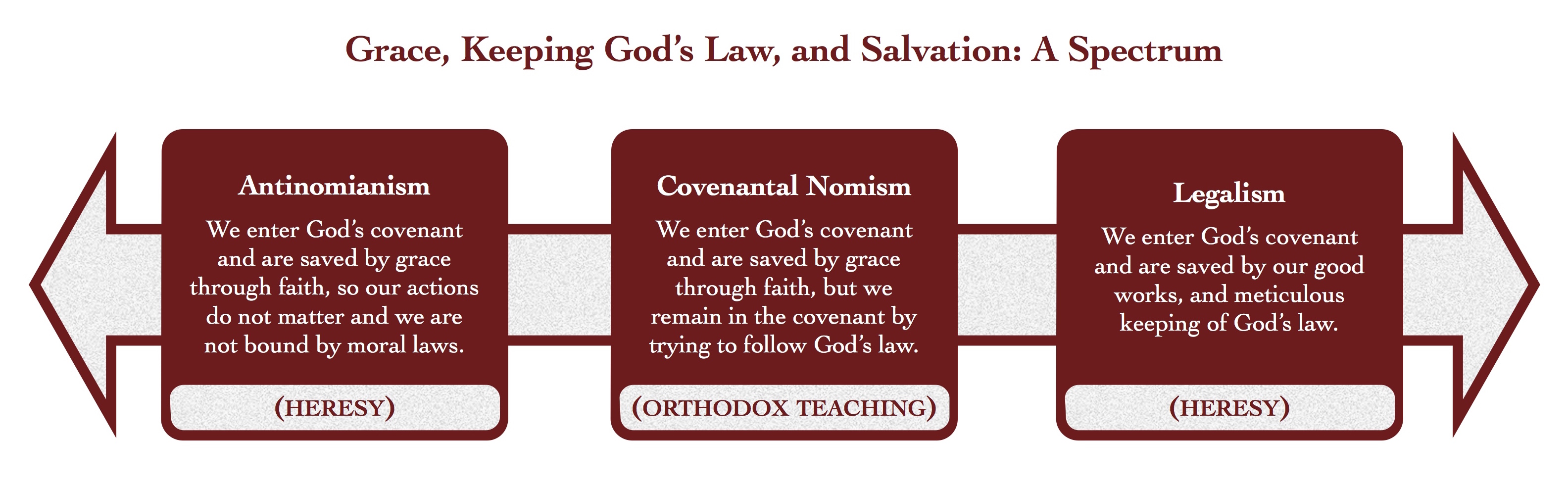
If you were to imagine a spectrum charting different ideas on grace, keeping God’s law, and salvation (see below), at the opposite end from legalism you would find antinomianism. Antinomianism is the idea that we are saved by grace through faith to the extent that our works have nothing to do with salvation at all: we are not bound to try to keep God’s moral laws (nomos is the Greek word for law, so the word really just refers to the rejection of law-keeping).

This view, the opposite extreme of legalism, is also heresy. It is not what the Bible teaches. Just think of all the passages in the New Testament that provide lists of sinful behaviors that are not in keeping with God’s law and will exclude those who practice them from God’s kingdom (Romans 1.18-31, 1 Corinthians 6.9-10, Galatians 5.19-21, Ephesians 4.17-32, Ephesians 5.3-5, 1 Timothy 1.8-11, and Revelation 21.8, to name a few). Clearly, the things we do matter to God and thus, are related to our salvation as well!

Thankfully, not many Christians are antinomians either (although, extreme proponents of the “Once Saved Always Saved” perspective come pretty close to this, in my opinion).

In between the two extremes of legalism and antinomianism is what the Bible actually teaches, and hopefully what you believe, even if you aren’t familiar with the theological term: covenantal nomism. Covenantal nomism suggests that we enter into God’s covenant and are covered by His grace through faith in Christ, but that we “stay in” that covenant by trying to do God’s will and obey His commands. 

Now, certainly we don’t do this perfectly—all of us sin and fall short from time to time. And covenantal nomism does not hold that our attempts to obey God’s commands somehow earn our salvation; salvation is by grace through faith. But covenantal nomism does hold that as Christians who have been saved by God’s grace, we should do our very best to obey His commands and live our lives as He desires. In the words of Dallas Willard, “Grace is opposed to earning, it is not opposed to effort” (emphasis mine).

Conclusion

So what’s the big deal? Why does this even matter, and why would someone spend time writing about it?

First, I think it is good general practice to use words appropriately. We live in a world where texts, tweets, and twenty second sound bites dominate communication, and where people are not particularly inclined to give people with whom they disagree a fair hearing. In that context, I think it is important that we speak with precision, and do our best to be clear and accurate in our communication. That cannot happen when we assume that words mean something other than what they actually mean.

Second, there really is a theological issue here. When you call someone a legalist, you are saying that they believe they can earn their salvation through good works. You are, in essence, calling them a heretic. That is not something to do lightly.

So the next time you encounter someone who seems overly scrupulous about a particular issue, or, from your perspective, makes a mountain of doctrine out of a molehill of opinion, take a moment to get them to explain their viewpoint, and maybe even take some time to study Scripture together on that issue. But whatever you do, please don’t dismissively call them a legalist.

*Throughout this post, I reference as examples different issues which I have heard people associate with legalism. Please understand that in this article, I am making no argument one way or the other about any of these particular issues.

« Older posts Newer posts »

© 2026 The Doc File

Theme by Anders Noren — Up ↑