The online journal of Luke Dockery

Category: Kinsley (Page 1 of 4)

Reflections on 25 Youth Ministry Summers

In August, I wrapped up my 20th year of youth ministry. When you take into account summer internships from my college days, though, that’s actually 25 years of youth ministry summers. As I am currently on sabbatical[1] from both ministry and teaching responsibilities, I have had some much-appreciated time for reflection on this ministry milestone.

What follows is, by definition, somewhat self-indulgent—these are reflections on my own life in ministry after all. I process things best by writing, though, and additionally, thought this might be of interest for those who know me, might be encouraging for others in youth ministry, and who knows, maybe my kids will read this one day!

Overview

It’s hard to believe now, but I never intended to go into ministry. My dad was a preacher when I was growing up. He was (and still is) an excellent preacher and I have the utmost respect for him, but I also saw the way that he carried stress from ministry and I didn’t want that in my life. I ignored promptings and encouragement from others to consider ministry and ultimately ended up double majoring in International Business and Spanish (I had no idea what I wanted to do). I did need work in the summer though, and the summer after my freshman year of college, I began doing youth ministry internships (the first of which I was offered based on my father’s reputation).

It’s not like I was immediately hooked on youth ministry from my first internship, and there were certainly some twists and turns in my journey, but the simplified summary is that I gradually began to discern a calling to ministry. What began as summer jobs to help me earn some money until my “real” career started actually ended up as my real career. Chronologically, that career has looked like this:

Youth Ministry Internships:

  • Farmington Church of Christ (2002)
  • Center Street Church of Christ (2003)
  • Farmington Church of Christ (2004–2006)

Youth Ministry (this is where the 20-year clock starts):

  • Farmington Church of Christ (August 2006–May 2019)
  • Cloverdale Church of Christ (June 2019–Present)

Things Change; Things Stay the Same

It’s interesting; a lot has changed in youth ministry over the last 25 years:

  • When I began, I had a flip phone, I hated teaching, I was single, my teens thought of me as a cool older brother, and I had no clue what I was doing (but didn’t realize it at the time).
  • Now, AI is trying to take over the world, teaching Bible class is one of my favorite things, I am married with three wonderful children, my teens think of me as some sort of hybrid uncle/professor/washed up athlete who is decidedly middle-aged and not-so-cool, and I know much more than I once did, but am also aware of how much I don’t know.
  • I spend less time cramming the calendar full of youth events, but the events that we have are much more focused and intentional.
  • I spend less time playing basketball with teens (though I still do!).
  • I spend more time trying to equip parents to disciple their kids.
  • I spend more time investing in younger youth ministers and college students who are training for ministry.

Other things are still very similar:

  • I still find myself sleeping on air mattresses and bunks at student retreats and weekend trips.
  • I still find myself riding roller coasters with students as part of my job (helping nervous students overcome their fear of thrill rides is something of a specialty at this point!).
  • I still find myself feeling so very privileged that I can point teens to Jesus on a regular basis and play a small part in their spiritual journeys.
  • I still love my students.
  • I still hate lock-ins.

Other Things I Might Have Done with My Life

By definition, when you spend your life doing a thing, you necessarily exclude other things that you could have done. I am a youth minister, I feel called to youth ministry, and I don’t regret the path that I have chosen (or, maybe more accurately, that I have found myself on). I have no current plan to leave youth ministry, and intend to do this as long as I believe God is calling me to do so.

At the same time, if I could clone myself, here are some other things I would have liked to do:

  • Remained as a youth minister at my first church: I worked for 13 years at the Farmington Church of Christ (not counting internships; see above), and I deeply love that church. Although our move to Searcy has been a blessing for our family in so many ways and we love the Cloverdale Church, I also wish that I could have stayed and continued this long-tenured and fruitful ministry.
  • Preaching: I used to greatly dislike preaching, but have come to enjoy it. It is such a special opportunity to plan and craft the biblical teaching that a family of believers receives on a regular basis, and it is a profound responsibility. There are aspects of the typical preaching job that are less appealing to me, and I do not currently feel called to preach, but maybe someday.
  • University Professor: It was once my life ambition to be a Bible Professor at Harding University. I now work at Harding part-time as an Adjunct Instructor of Youth Ministry, and I love the combination of doing youth ministry full-time and teaching a class on the side. But I could imagine myself as a full-time teacher in a college setting.
  • Full-Time Author/Publisher/Editor: Two significant side projects that I have devoted time to are Deeper Youth Ministry and Regnum Media. Essentially, both of these are publishing endeavors. Deeper works to provide resources and curriculum for youth ministries, while Regnum seeks to provide high-quality adult Bible class material for churches. I am humbled by the way God has used these efforts to bless so many churches, but cannot help but wonder how much greater the reach could be if I could devote myself to one or both of these efforts full-time.
  • Church Planting: By nature and personality, I tend to have strong views about the way things should be. In this regard, planting a church that I think aligns closely with biblical teaching and pulls from the best of the Christian tradition is something that has appealed to me for many years. Dispositionally, though, I think I would make a terrible church planter.
  • Associate Minister: I love congregational ministry and in addition to youth ministry or preaching, could see myself in some sort of Associate or “Third Minister” role (Education, Involvement, Administrative). In 20 years of ministry I have had opportunity to dabble in lots of different kinds of ministry and grow as an administrator. The combination of not having to leave my family for youth trips or receive the spotlight attention of preaching makes a role like this appealing.
  • Medicine/Medical Research: This is totally different from all the rest! I was always a really good student in school, but enjoyed subjects like history, geography, literature, and writing so much that I never really considered going into math or science fields. Now, having a daughter with a significant genetic illness has changed my perspective. Part of me wishes that I had stewarded the gifts God has given me differently and gone on to practice medicine or some sort of research that seeks to alleviate the suffering of people.
  • Second Baseman for the Atlanta Braves: Obviously.

A Special Summer

This summer, my 25th in youth ministry, was a special one. It was not easy, or always smooth. I like to tell my youth ministry students that some youth ministers live for the summer, and others hope to be alive at the end of the summer; I belong to the latter group! I enjoy extra time with my youth group students and some of the special things we get to do when they are out of school, but summer is also exhausting, it requires me to be absent from my family more than I would like, and it disrupts my regular routines that I have for the rest of the year (and miss when they are gone!).

It was special because we had a good summer doing the significant things that happen in a youth ministry summer: I got to work with and invest in two great interns, we got to go to camp, we got to host an outreach camp for kids in our community, we got to plug our teens into meaningful service and intergenerational connection, and we got to equip parents to disciple their own kids. All of these are great.

Additionally, there were some personal milestones this summer:

  • With my youth group, I got to summit Mt. Elbert, the tallest mountain in Colorado, and my very first 14er.
  • I learned to swim! People who know me well know that I never learned to swim as a kid, and this has brought me shame for my entire life. A youth group mom and family friend convinced me to let her give me lessons in her pool, and this was one of the greatest gifts of my life. We kept it a secret from the youth group, and surprised them at a pool party. When they saw me swim across the pool for the first time, I came up out of the water and they were all cheering—it was a special memory. (Note: I am still not good at swimming, and have a lot of work to do to improve. But I am in a fundamentally different category than I have been in for my entire life.)
  • I published another book, my first attempt at a devotional book.

Gratitude

The older I get, the more I am convinced that gratitude is the key to contentment in life. I have much to be grateful for, but as I reflect back on 25 youth ministry summers, here is a partial, imperfect list:

  • My parents, who raised me in faith and modeled a life of ministry for me.
  • A church that took a chance on an 18 year-old kid and kept inviting me back, and elders who gave me space and opportunity to grow and loved me despite my mistakes.
  • Thursday lunches in Fayetteville with my dad, Robb Hadley, and a rotation of others. I never realized it at the time, but these lunches where we would talk about life, ministry, and the challenges and frustrations of ministry (without ever a hint that we might leave ministry despite those challenges and frustrations) were a significant contributor to my longevity in ministry.
  • The excellent training I received at Harding School of Theology.
  • The two preachers I worked with at Farmington: Larry Krudwig and Mike Raine. Larry tried to convince me that I had gifts for ministry early on, but I did not have ears to hear. He also taught me how to deeply love a church. Mike is the most generous man I have ever met, and taught me so much about ministry.
  • Dear friends in Northwest Arkansas who we hated to leave.
  • My friend and current preacher, Karl McLarty, who (without me knowing it) prayed for me to come to Cloverdale to be their youth minister. The prayer of this righteous man availed much, and led to God funneling blessings in my life in new and unexpected ways.
  • My bosses at Harding who allow me to teach youth ministry.
  • The youth ministers I have helped train in class, and especially through internships and apprenticeships at Cloverdale. There are many now working in churches, and I am so proud of them.
  • Generations of youth group parents who have entrusted their kids to me.
  • Dear friends in Searcy, including old college friends that God in His grace has seen fit to bring back together, along with spiritual mentors that I didn’t know I needed.
  • An eldership that sees the value in giving sabbaticals to ministers.
  • My youth group students over the years: “I have no greater joy than to hear that my children are walking in the truth” (3 John 4). Special bonus to those students who have helped me bridge the difficult divide and have become friends in adulthood.
  • My wife Caroline, who has been my greatest encourager, supporter, rebuker, example, and co-worker. Whatever success I have had in youth ministry, she is significantly responsible for.

I have thought a lot recently about the song, “The Goodness of God.” As I reflect on the last 25 years and look at the list above (knowing that there is so much more in addition to this to be grateful for), I am overwhelmed by God’s goodness and benevolence in my life. Looking ahead, perhaps I will have another 25 youth ministry summers. Perhaps I will spend time in one or more of the other career paths I listed above. Either way, I will seek God’s leading and be thankful for His gracious provision. When has He not been faithful?


[1] At Cloverdale, ministers are eligible for sabbaticals after seven years. Our elders are also encouraged to take them. These are intended to be times of rest and renewal where we take a break from regular responsibilities and come back refreshed and ready for continued service. For ministers, we are encouraged to have a project we work on during sabbatical (it’s not just an extended vacation). In my specific case, I am using my 10-week sabbatical to do research and writing on a youth ministry textbook that I hope to publish next year.

Two Graduations: What My Special Needs Daughter Taught Me About Following Jesus

It’s June, which means that we have just completed another graduation season. As a youth minister, I go to a lot of graduations, but this year there were a couple of graduation ceremonies that were more significant to me.

First was my own graduation from Harding School of Theology. This one was a long time coming. It was an extensive program (a 78-hour degree, which is more coursework than many master’s and doctorate programs combined), and add to that the fact that I completed it while working full time, figuring out how to be a dad, and living hundreds of miles away, and I can say with only minimal chagrin that I started the program way back in 2010. Finishing a program that you have been engaged in for so long is certainly an accomplishment of sorts, and I’ve had a lot of people ask me how it feels to be done. I definitely feel grateful for all that I have learned and for all who made it possible (HST faculty and staff, my wife, my elders at church, etc.). I am also pleased to be done. But my overwhelming emotion is a little more difficult to explain, and that’s what this post is about.

About 10 days after my graduation, I went to another graduation ceremony—Kinsley’s Kindergarten graduation. I have written in different places about how the last 18 months or so have been very difficult for my little girl. Increased seizure activity has been hard to control and has led to several regressions (i.e., she has lost abilities that she once had). Nevertheless, during this past school year, she started Kindergarten in a self-contained class. Kinsley’s academic goals were made with her special needs in mind and were very modest by the standards of “typical” children, but still, due to the regressions, she didn’t hit those goals. In some sense, you could even say that her graduation from Kindergarten was something of a formality. But I can tell you this: I am far prouder of her graduation than my own.


I have always been a high achiever. I have always gotten good grades and done well in school. I was involved in a bunch of extracurricular activities to beef up my college résumé. I was a good (not great) athlete who worked hard and was, at times, pretty successful.

When I started grad school, I began to work even harder. I had become convinced that doing my best was a spiritual requirement (I still believe this, by the way), but “doing my best” easily became a justification for obsessive perfectionism. In school, I wanted every research paper to be perfect. In ministry, I wanted every teenager to be faithful and every sermon to be excellent. In my personal faith and theology, I wanted to be right on every issue and know the answer to every question. Some of this obsessive perfectionism I come by naturally (it runs in my family), but also, it was a core component of my faith. To be clear, I was never taught works righteousness growing up, or that God’s love for me was tied to my achievements and accomplishments, but somewhere along the way this became a big part of what following Jesus was for me.

When Kinsley came into my life (and more specifically, when she began to miss developmental milestones and we received her diagnosis), everything began to change for me. The reality is that I have a beautiful, wonderful daughter who, from a worldly perspective, will never achieve much of anything. And while I lament the ways in which her horrible disease has placed limitations upon her life, the reality is this: I don’t care about her achievements. I love her because she is my daughter, and I delight in her.

This realization and the implications of it have significantly affected my life. I don’t really care about achievement anymore. I don’t care about intelligence or talent. When parents talk about how clever their children are, or when friends speak of their accomplishments, I smile and try to be affirming, but it simply doesn’t matter much to me. And from that perspective, my own graduation doesn’t matter much to me either.

I still work hard, because I believe it is a spiritual imperative to do so—in all things I work as if I am working for Jesus because, really, I am. But I don’t work hard so God will love me more, or because my value is tied to my achievements. God loves me because I am His child, and that is enough.


I grew up in the church, have been a Christian for 20 years, a minister for 12, and I have a graduate degree in theology. But it was my daughter who taught me about grace simply by being her perfect, disabled self.

On second thought, that’s quite an achievement.


Honest Thoughts from a Hospital Room

I am writing from my daughter’s room at Arkansas Children’s Hospital, following her successful VNS surgery this morning. It is well after midnight; Caroline is asleep, and Kinsley is trying to be. It is an excellent time for reflection.

I am not writing the following to elicit sympathy from those who read it, nor am I seeking “cheering up”. I don’t want to come across as whiny or depressing; rather, I write in the hope that my (honest) ramblings may provide some encouragement to others.


Over the last few years, our ongoing struggles with Kinsley—learning about her brain abnormalities, receiving a diagnosis, traveling extensively to see specialists, attempting to manage her seizures, dealing with her daily special needs—have led to countless people telling us something to the effect of, “You guys are such amazing parents,” or “Your faith is such a great example to us.”

Those are kind words with kind intentions behind them, but sometimes they can be frustrating as well. You see, we didn’t ask to have the opportunity to be such wonderful parents, or to have the platform to wrestle with our faith in such a way that we can be good examples for others. And furthermore, to be frank, sometimes we really don’t feel like wonderful parents or great examples at all. We feel that we do no more than anyone else would in our shoes, we feel helpless—completely unable to do anything to help our little girl, and we feel so very, very tired—tired of seizures, tired of doctor appointments, and tired of our sweet princess having to deal with more than she should ever have to.

And yet…if God can somehow use our helpless and tired efforts to bring encouragement to someone else or to shine a ray of light into a dark world…praise the Lord. Truly, what wondrous things He accomplishes through human weakness.

What a blessing!


Although I do not find myself particularly inclined to do so, it sometimes can be tempting for those in full-time ministry to look down upon those who engage in “secular” work (you may even hear that terminology from time to time).

Over the last few years, as we have been on the receiving end of such amazing care from so many therapists (basically our favorite people ever), nurses, doctors, teachers, aides, etc., it has deeply reinforced in my own mind how sacred it is to use your vocation as a means of blessing others. God’s work is done in all sorts of places, and I am deeply grateful for those who have so clearly shown me that as we have traveled this journey.

What a blessing!


Throughout this process, there are times when I feel that I am at my wit’s end. Completely overwhelmed. Barely able to keep my head above water. Emotionally stressed. Spiritually fatigued. Physically exhausted.

Increasingly, I have come to suspect that we are sustained by prayer. Certainly our own prayers, but, in light of the spiritual fatigue I mentioned above, my prayers are not exactly great right now—they consist of a lot of sighs and pleadings and persistence and “groanings too deep for words”.

No, I believe that we are especially sustained by the prayers of others. From the beginning, it has been overwhelming to me the way that others have responded to our situation. It is beyond humbling to know that people from all over the world, including many we don’t even personally know, are praying for us. More than that, more people than I can count have told me that they pray for Kinsley and our family every day. How can I even respond to that? What a gift that is!

I am so deeply, deeply grateful. And beyond the prayers—every single kindness means so much: the kind words and messages we receive, the concerned questions people ask, the social media well-wishings, the silent hugs, the money for travel expenses slipped into a handshake—all of it. People extend us so much love so frequently, that it is all I can do to refrain from constantly bursting into tears (because that would be awkward, right?).

But those are healing tears—tears belonging to a Kingdom that seeks to restore the goodness of a broken world.

What a blessing!

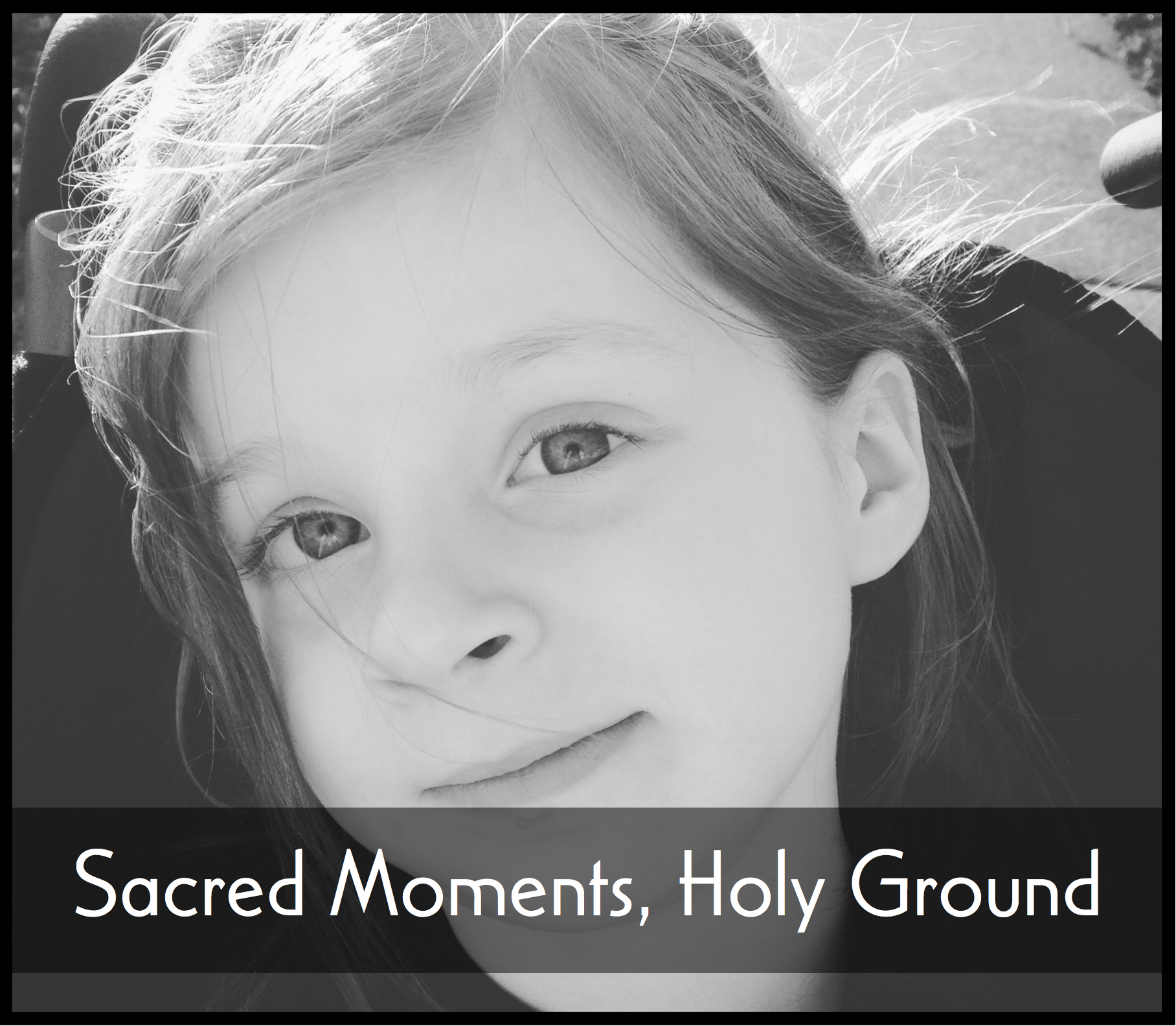
Sacred Moments, Holy Ground

In Exodus 3 we encounter the famous story of God appearing to Moses for the purpose of recruiting him to liberate the people of Israel from slavery in Egypt. One of the most interesting aspects of the story is the way that God appears to Moses: in the form of a fiery bush that is not consumed by the flames that engulf it. As Moses draws near, God tells him to remove his sandals, because he is standing on holy ground. What made the ground holy? It was not that there was something inherently special about the bush. As a shepherd, Moses spent a lot of time leading his flock in the wilderness, and I think it’s possible that he had been by this same spot before, and had maybe even seen the same bush.

There was nothing particularly holy about it at those other times, but it was different now: it was a sacred moment…it was holy ground.

God’s presence made it that way.

We have had a rough time at our house for the last several weeks. Over the last several months, Kinsley’s seizures have gotten more difficult to control, which has led us to trying additional seizure medications and a special diet (you can read more about Kinsley’s story here and here). These efforts have not led to long-term improvement, and at the same time, Kinsley has been more withdrawn: she is often lethargic, sleeps a lot, and plays and interacts with us less. It is difficult to discern if this is caused by the many medications she is on, her seizures, some other factor, or some combination of all of the above.

Even more recently, Kinsley, who has always been a champ at taking her medicine, has become very stubborn about doing so: she will hold it in her mouth for a long time, sometimes eventually swallowing it, and at other times spitting it out. Obviously, she does not get any benefit from seizure medicine that she refuses to take, so this aggravates the problem.

Last night as I was getting her ready for bed, I broke down. Kinsley again spat out one of her doses and I got incredibly frustrated and spoke to her in an exasperated tone. She just looked at me, with her beautiful, innocent, loving eyes. Immediately, my emotions changed, and I told her how truly and deeply sorry I was that she has to deal with all of the stuff and difficulties that she does, more than any little girl should ever have to.

And my nonverbal little princess, who has hardly communicated at all over the last several days, looked at me, put her hand on my chest, laid her head against me to snuggle, and reached out and held onto my arm.

What a powerful message she communicated! Even now, I can hardly write about it without becoming overwhelmed by emotion.

There we were, sitting on the floor by her bed, a place I have been countless times. But it was different now: it was a sacred moment…it was holy ground.

God’s presence made it that way: in His grace, God reached out to me and used my infirmed daughter as an instrument of healing.

P.S. We are going to Arkansas Children’s Hospital in Little Rock tomorrow to consult with a neurosurgeon about a procedure that could potentially help with Kinsley’s seizures. We would greatly appreciate your prayers as we continue to look for ways to help our little girl.

Moral Evil and Natural Evil

In this series, I am attempting to approach the topic of suffering from a variety of different angles. As I mentioned in the first post, I am using the term “suffering” to sum up the famous Problem of Evil. I talk about the Problem of Evil at length in this post on Alexander Campbell, but perhaps it would be beneficial to state the problem outright, the original statement of which is generally credited to Epicurus:

“Is God willing to prevent evil, but not able? Then He is not omnipotent. Is He able, but not willing? Then He is malevolent. Is He both able and willing? Then whence cometh evil? Is He neither able nor willing? Then why call Him God?”

So basically the issue is, if God is good and powerful, why does He allow evil and suffering to exist in the world?

Now, it’s a fair question to ask if all suffering is evil or the result of evil. As humans we admittedly have very limited perspectives, and sometimes things which are good for us certainly don’t seem good at the time they occur (think about an infant getting a vaccine, for example). Regardless, evil certainly exists in the world, and a lot of suffering occurs because of it.

Philosophers and theologians and people who discuss this topic will often distinguish between two kinds of evil: moral evil and natural evil.


Moral Evil

Generally speaking, moral evil refers to the evil acts that people choose to commit. A lot of the suffering which occurs in the world happens because people choose to do things which cause harm to one another. Fatal car accidents caused by alcohol consumption, child molestation, ISIS beheadings, and the Holocaust are all examples of moral evil. People do foolish and terrible things which cause a great deal of suffering for others.

Really, this type of evil is easier to explain, at least, if you have a robust view of human free will. As I discussed a little in this post, I think a theology which embraces the idea that God created humans with free will is important and makes the most sense of the teachings of Scripture. The basic idea is that God created people out of His love and desires that we love Him in return. Certainly God could have created us like robots who had no choice but to “love” Him, but a coerced feeling like that wouldn’t really be love at all. To enable us to choose to love Him, God also gives us the ability to reject Him, and when we abuse our freedom of will, all sorts of bad things can happen.

When it comes to moral evil, you can blame God for the way He made the world (though, based on the previous paragraph, what other options were available?), but really, the blame lies with people who make bad or evil choices.

Natural Evil

Natural evil generally refers to those “random” things which occur, not because of the actions of people, but as a result of the world “naturally” operates (I put those two words in quotations because they are loaded with some major assumptions). Hurricanes, tsunamis, tornadoes, genetic conditions and human decay and death in general are examples of natural evil.

Now, human choices can still exacerbate natural evils and make the suffering greater than it would be otherwise (certain behaviors can make illness more likely, social problems like poverty can increase the amount of suffering which comes from natural disasters, etc.), but for the most part, people have no control over natural evil—we suffer simply because we live in a world where these types of things occur.

Because of this, I think natural evil is a little harder to explain away. We can understand when negative things happen to people who deserve them, and we can understand, as horrible as it is, when people suffer because other people choose to do evil. But why do we live in a world where natural disasters kill so many unsuspecting people? Why do children get cancer and die? Did God design the world this way, and if so, why? If God didn’t design the world this way, what happened to it for everything to get so messed up?

In the next post, I’ll try to take a closer look at natural evil, and specifically, the idea of chaos: the element of randomness in life which we can’t control which has potential for unleashing great suffering. For me, as the parent of a little girl with a genetic condition, this is one of the really tough areas of examining suffering theologically.

« Older posts

© 2026 The Doc File

Theme by Anders Noren — Up ↑