The online journal of Luke Dockery

Category: Grad School (Page 3 of 11)

Reading in 2015

Somewhat ironically, right after writing a post about my intention to write more on my blog in 2016, I learned that my blog had become infected with malware and then the process of removing it took a few weeks. All of that means that it is now late January, and I have some catching up to do.

It has become a tradition on The Doc File at the beginning of each year for me to share a list of the books I read in the previous calendar year. Without further ado, here was my reading list for 2015:

  1. Take Route, by Philip Jenkins
  2. Dust and Shadow: An Account of the Ripper Killings, by Lindsay Faye
  3. The Irresistible Revolution: Living as an Ordinary Radical, by Shane Claiborne
  4. Scarred Faith, by Josh Ross
  5. Sons of Dust: The Roots of Biblical Manliness, by Chris Clevenger
  6. Gorky Park, by Martin Cruz Smith
  7. The Lunch Ladies: Cultivating an Actsmosphere, by Philip Jenkins
  8. Intergenerational Christian Formation: Bringing the Whole Church Together in Ministry, Community and Worship, by Holly Catterton Allen and Christine Lawton Ross
  9. A Parent’s Guide to Understanding Social Media: Helping Your Teenager Navigate Life Online, by Mark Oestreicher and Adam McLane
  10. Torn Asunder: The Civil War and the 1906 Division of the Disciples, by Ben Brewster
  11. Destiny of the Republic: A Tale of Madness, Medicine, and the Murder of a President, by Candice Millard
  12. I Died Last Night, by John Orr
  13. Women in the Church, by Everett Ferguson
  14. Megan’s Secrets: What My Mentally Disabled Daughter Taught Me About Life, by Mike Cope
  15. Family Ministry Field Guide: How Your Church Can Equip Parents To Make Disciples, by Timothy Paul Jones
  16. “If A Man Dies Will He Live Again?” A Study of Eternal Life, by Bobby Deason
  17. Primer on Biblical Methods, by Corrine L. Carvalho
  18. The One Minute Manager, by Kenneth Blanchard and Spencer Johnson
  19. Justification Reconsidered: Rethinking a Pauline Theme, by Stephen Westerholm
  20. Writing on the Tablet of the Human Heart, by David Carr*
  21. God’s Word in Human Words: An Evangelical Appropriation of Critical Biblical Scholarship, by Kenton L. Sparks
  22. Introduction to the Hebrew Bible, Second Edition, by John J. Collins
  23. These People Should be Dead, by Scott Bond
  24. More Than A Conquerer: The Ups and Downs of a Christian Manic Depressive, by Tom Kelton
  25. The Worldly Church, by C. Leonard Allen, Richard T. Hughes, and Michael R. Weed
  26. Bringing Heaven to Earth: You Don’t Have to Wait for Eternity to Live the Good News, by Josh Ross and Jonathan Storment
  27. A Week in the Life of Corinth, by Ben Witherington III
  28. Am I Ready to Be Baptized?, by Kyle Butt & John Farber
  29. First Corinthians: A Bible Commentary for Teaching and Preaching, by Richard B. Hays
  30. 1 Corinthians: Baker Exegetical Commentary of the New Testament, by David E. Garland
  31. Conflict & Community in Corinth: A Socio-Rhetorical Commentary on 1 and 2 Corinthians, by Ben Witherington III
  32. 2 Corinthians: An Exegetical and Theological Exposition of Holy Scripture (The New American Commentary), by David E. Garland
  33. The Pouting Preacher, by Michael Whitworth
  34. Alabama Moon, by Watt Key
  35. Renewing God’s People: A Concise History of Churches of Christ, by Gary Holloway & Douglas A. Foster
  36. Hurt 2.0: Inside the World of Today’s Teenagers, by Chap Clark
  37. Before I Go: Notes from Older Preachers, edited by Jeff and Dale Jenkins
  38. Five Minutes With God, by Rusty Hills
  39. Living & Longing for the Lord, by Michael Whitworth
  40. Leaving Behind Left Behind: The False Fear of the Rapture and the True Hope of the Return of Christ, by Omar Rikabi
  41. When Mountains Won’t Move: How to Survive a Struggling Faith, by Jacob Hawk
  42. 5 Discipleship Principles I Live By, by Neil Reynolds
  43. Beautiful, by Abbé Utter
  44. From Mule Back to Super Jet with the Gospel, by Marshall Keeble
  45. Good News of Great Joy: Daily Readings for Advent, by John Piper
  46. Gorky Park, by Martin Cruz Smith
  47. The Complete Calvin and Hobbes Book Four, by Bill Watterson
  48. Restoring New Testament Christianity, by Adron Doran

A few major observations before I talk about a couple of specific books.

In some ways, I was disappointed with my reading in 2015:

  • My total number of books dropped from 56 to 48. Ultimately, the point of reading is for learning and enjoyment rather than reading as many books as possible, but I do like to compete with myself and was a little disappointed at how my total number of books dropped. The reasons for this were understandable though. First, I read several books (commentaries, Old Testament introduction texts) that were several hundred pages long and each equivalent to 3-4 regular books. Second, I did a ton of reading of articles this year for grad school classes, and that reading is not reflected in the list above. Finally, I spent significant portions of 2015 involved in two large writing projects and two large editing projects, and those efforts (also not reflected above) took a lot of the time that would typically go to my reading.
  • I didn’t read much in 2015 that really blew me away. There were several books that I thought were interesting, or useful, or contained some good information, but not much that I thought was just outstanding.

As is typical for me, a lot of books that I read were related to the fields of Bible study, theology, and ministry. My favorite book of 2015 was probably Megan’s Secrets: What My Mentally Disabled Daughter Taught Me About Life, by Mike Cope. Mike writes as a minister from Churches of Christ and shares his experiences as the parent of a special needs child and the lessons he learned from her all-too-brief life. As the parents of a beautiful, incredible special needs daughter myself, this book hit close to home for me, and in fact, it took me about 2 1/2 years to summon up the courage to read it. I basically cried through the entire thing, but I thought it was beautiful, poignant, and important.

Another great book I read this past year was The Lunch Ladies: Cultivating an Actsmosphere, by Philip Jenkins. Though the book is primarily geared toward youth ministry, the principles apply to ministry and the work of the church in general. Succinctly put, in Lunch Ladies, Philip describes the culture of neglect that existed within the youth ministry at the church where he serves and how they went about changing that to a culture where everyone is cared for and where everyone belongs. This is the best book on youth ministry I read this year, and it has implications far beyond youth ministry; we are in the process of implementing a lot of these ideas in our youth ministry at Farmington. If you are involved in youth ministry in any way (minister, deacon, shepherd, parent, whatever), small groups ministry, or church involvement, I would highly recommend this work.

In Churches of Christ, the vigorous discussion over the role of women in the church continues on, and earlier in the year I read Women in the Church by Everett Ferguson. Ferguson’s scholarship is impeccable, and in addition to his careful exegesis of biblical texts, also brings his wealth knowledge on the practices of the early Christian church to the discussion. Perhaps most important was Ferguson’s tone and perspective, in which he frames the entire discussion by first focusing on all the ways women did serve in the early church and how vital they are to the work of the church today, before moving on to other areas in which the biblical text and early church practice limit the role of women in specific areas. Again, this is another book that I would highly recommend.

Additionally, I did read a few commentaries and works on specific New Testament books this past year which are worth mentioning.

I have written about Michael Whitworth’s books before, and have recommended them because the way he excels at balancing readability with good study and research. This year I read Living & Longing for the Lord, which is a study of 1-2 Thessalonians, and it was great. Michael is a friend of mine, and I have been blessed by his books over the last few years. I think The Derision of Heaven, Michael’s book on the the Book of Daniel, is still my favorite, but Living & Longing for the Lord might come in second place.

I took a grad school class on 1-2 Corinthians and read literally thousands of pages related to those epistles. A Week in the Life of Corinth by Ben Witherington III is a charming little book which gives the reader a good grasp of the cultural context of first century Corinth. First Corinthians: A Bible Commentary for Teaching and Preaching by Richard B. Hays, was enjoyable because of its focus on bringing points out of the text that are specifically relevant for teaching and preaching in the modern church. Conflict & Community in Corinth: A Socio-Rhetorical Commentary on 1 and 2 Corinthians by Ben Witherington III was interesting because it explored 1-2 Corinthians through the lens of ancient rhetoric, and brought a lot of historical background information into the discussion. For those interested in better understanding 1-2 Corinthians, all of these are helpful resources in my opinion.

That was my year in reading in 2015!

For comparison’s sake if you are interested, you can see my reading lists from previous years:

I have already started reading some good stuff in 2016, and I have a large number of books on my “To-Read” shelf that I am hoping to get to. What are some of the best books you read this past year?

*Books that I did not read in their entirety, but read significant portions of.

The Emergence of Ancient Israel in the Land of Canaan

Introduction

For centuries, the question of how Ancient Israel came to be in the land of Canaan was not much of a question at all: the historical reliability of the biblical accounts was simply assumed, and those accounts were taken at face value. More recently, and in light of modern critical scholarship and the discoveries of archaeology, the issue of Israel’s emergence in Canaan has become much more complicated. In fact, as one scholar puts it,

“there is no problem of biblical history which is more difficult than that of reconstructing the historical process by which the Twelve Tribes of ancient Israel became established in Palestine and northern Transjordan.”[1]

That difficulty is illustrated by the abundance of competing models that have been proposed to explain Israel’s emergence. This study will provide a broad overview of the major theories that have been suggested and seek to evaluate them based on the relevant data, including textual witnesses and archaeology. The relevant texts include the biblical accounts, the Merneptah Stele, and to a lesser degree, the Amarna Letters.

Much of the disagreement on the issue of how Israel came to be in Canaan stems from differing views on the reliability and usefulness of the biblical texts when it comes to providing historically accurate accounts. Although some minimalist scholars see the biblical accounts as very late productions with biased viewpoints and little to no historical accuracy and dismiss them accordingly, most scholars recognize the historical value of the biblical witness and the need to examine and interpret it closely. This study adopts the latter perspective, and based on a close reading of the biblical accounts and an overview of the other data, will propose an “eclectic” theory for the emergence of Ancient Israel in Canaan.[2]


The Conquest Model

Described by one scholar as the “eldest son of modern scholarship,”[3] the conquest model is the oldest of the different emergence theories, and is based on a traditional, straightforward reading of the biblical text. In this perspective, the Book of Joshua is read as the narration of a three-part military campaign (central, southern, northern) which resulted in sweeping destruction across the land of Canaan.[4] The conquest model is especially associated with William F. Albright, who supported his understanding of the basic historicity of the biblical account with archaeological finds that revealed a number of violent destructions in the thirteenth century BC in many sites throughout Canaan.[5]

As impressive as this combination of biblical narrative and archaeology might seem at first, the Albrightian model has now fallen almost entirely out of favor, because it misreads both the archaeological evidence and the biblical text. Archaeologically, despite the widespread destruction found in Canaan from the thirteenth century, it has not been demonstrated that this destruction was caused by the Israelites rather than the Egyptians or the invading Sea Peoples.[6] Furthermore, there has proven to be little correlation between sites showing archaeological evidence of destruction and those mentioned in the narrative of Joshua. Only two of the nineteen sites that have been possibly identified with sites in the Book of Joshua show evidence of destruction in the thirteenth century,[7] and other sites which do show destruction like Megiddo are not reported to be destroyed in either Joshua or Judges.[8]

Biblically, as Younger points out, “the [conquest] model was doomed from the beginning because of its literal, simplistic reading of Joshua.”[9] Rather than claiming widespread destruction by the Israelites, verses like Joshua 11.13 convey a very different perspective: “But none of the cities that stood on mounds did Israel burn, except Hazor alone.”[10] In fact, the Bible makes very modest claims about the physical destruction wrought by the invading Israelites, as the books of Joshua and Judges only describe five Canaanite cities being burned with fire: Jericho, Ai, Hazor, Jerusalem, and Laish.[11] Thus, it is clear that the archaeological quest for evidence of widespread destruction in Canaan is misguided because the Bible does not suggest such destruction ever occurred.

The Peaceful Infiltration Model

Another older theory for the emergence of Israel in Canaan is the peaceful infiltration model, first proposed by Albrecht Alt and later modified by Martin Noth.[12] Like the conquest model, this theory shares the idea that the Israelites entered Canaan from the outside, but as its name suggests, the peaceful infiltration model argues that this occurred without significant violence. According to this model, the Israelites were nomadic pastoralists who, over a period of centuries, migrated into Canaan to take advantage of seasonal grazing conditions. Over the course of this lengthy process, the theory suggests that they developed friendly relations with the inhabitants of the Late Bronze Age towns and villages, and eventually settled down peacefully in the sparsely populated hill country in order to cultivate the land.[13] They gradually grew in number and strength, expanded into more fertile areas, and only then occasionally came into violent conflict with their neighbors. These skirmishes formed the historical base for the folkloric tales that would later be presented in Joshua and Judges.[14] Politically, the Israelites were united by the worship of Yahweh, and had the shape of a twelve-tribe amphictyony.[15]

The peaceful infiltration model has been criticized on a variety of grounds. First, while the biblical witness does refer to certain areas occupied by the Israelites with no accompanying description of military conquest,[16] it is undeniable that the Bible insists that the initial occupation of the land involved an element of significant military conflict in certain areas. Also, from an anthropological perspective, this model has been criticized for the outdated assumption that, as a rule, nomadic peoples gradually evolve to settle down and become farmers over time.[17] Finally, the suggestion that the Israelites comprised a twelve-tribe amphictyony has been roundly criticized as anachronistic, as the amphictyony concept was imported from classical Greece.[18]

The Peasant Revolt Model

While the conquest and peaceful infiltration models both suggest that Israel entered Canaan from outside the land (exogenous), the peasant revolt model, first formulated by George Mendenhall,[19] differs significantly in that it holds that Israel’s emergence was endogenous, coming primarily from populations which were already inside Canaan.[20] At this time, Canaan was part of the empire of Egypt, but local Canaanite overlords exercised control over the surrounding agricultural areas. As the theory goes, this urban aristocracy oppressed the rural peasant laborers, using their forced labor to provide the needed resources to build city walls, produce weapons, and pay tribute to Pharaoh.[21] The catalyst for revolt occurred when this already unhappy peasant population was joined by a small but influential group of former slaves from the outside, who believed they had been delivered from bondage by the god Yahweh and derived their identity from their allegiance to him. For Mendenhall, this mixed group became Hebrews, or habiru, a non-ethnic term found in the fourteenth-century BC Amarna Letters and other ancient sources. Mendenhall defines habiru as groups of people “which have no legal status and have indeed severed themselves from an earlier political community.”[22] The Hebrew/habiru revolted against their Canaanite overlords, withdrawing to the hill country to establish an egalitarian society united by its devotion to a new Overlord—Yahweh.[23] For Mendenhall, the revolt was not based on ethnic differences, but on political and social ones:

“The conflict between ancient Israel and the non-Israelite population had nothing to do with ethnic identity. It was a conflict with an old political regime or system of regimes which were rightly dying out all over the civilized world because they valued power more than ethic, and valued property and wealth more than persons.”[24]

Later, Norman Gottwald argued for a modified version of the peasant revolt theory, framing it in terms of a Marxist socio-political revolution.[25] In addition to his Marxist perspective, Gottwald differs from Mendenhall in that he sees the early Israelites as being much more diverse than a group of predominantly peasants,[26] and also thinks Mendenhall overemphasized the role that Yahwism played in the revolt. For Gottwald, a more significant factor in the revolution was the supposed widespread unrest and oppression that was commonplace in Canaan during the Amarna period.[27]

Both versions of the peasant revolt model are beset by problems. To begin with, Mendenhall admits that his theory lacks “sufficient data” and that it is an “‘ideal model’ of what ought to have been the case…inevitably based upon that which is known to have been true of other times and places.”[28] Second, Mendenhall’s claim that the Israelites were the habiru of ancient writings is troublesome for most scholars, as in most cases, the habiru cannot be equated with the biblical Hebrews, and he provides no example of a case in ancient society where all the peasants withdraw to become habiru and then successfully overthrow their rulers.[29] Third, Mendenhall’s model assumes that a large number of Canaanites became followers of Yahweh, but the biblical tradition gives no trace of a mass Canaanite conversion, and in fact, the practice of mass conversion in ancient Israel was impossible prior to the second temple period.[30] Finally, both versions of the model are significantly anachronistic, projecting modern views of society, economics, politics, and religion onto an ancient society.[31]

Endogenous Evolutionary Models

Since the 1980s, a host of new models have been proposed to explain the emergence of Ancient Israel in Canaan. Although these models are distinct from one another in various ways, they do show a few broad similarities and will be treated together here.[32] First, the models in this category share a general agreement that the biblical texts are of little value in reconstructing the history of the origins of Israel. Second, because of this low view of the historicity of the biblical accounts, these models rely instead on archaeological data and texts and inscriptions from outside of Scripture. Third, these models emphasize that the emergence of Israel was not an event, but rather, an evolutionary process that gradually took place over a long period of time. This process was related to the breakdown of the Late Bronze Age international political and economic systems, which led to the movement and displacement of different groups of people and the surge in small settlements in the highlands of Canaan. Finally, based on the large degree of continuity in the archaeological record and the archaeological similarity between supposed “Israelite” sites and others throughout Canaan, there is agreement that the emergence of Israel happened from within: the Israelites were essentially Canaanites who eventually became a distinct people with distinct beliefs and practices.[33]

Two significant and related differences between the various proposals concern whether or not Israel emerges as a distinct ethnicity or simply a new political entity, and the date at which that emergence occurs. Two important types of data related to these issues are the archaeological finds from settlements in the highlands of Canaan and the inscription on the Merneptah Stele.

Archaeological excavations of the Iron I settlements in the highlands of Canaan have yielded several finds which have been tied to the emergence of Israel. Some, like the collared-rim jar and the pillared “four-room” house, were once considered to be distinctively Israelite, but have since been found in other locations and are no longer considered to be Israelite identity markers.[34] Others still seem to be significant, including the elliptical shape of many of the highland villages, the extensive use of underground silos for the storage of grain, and terraces for hillside farming.[35] One particularly suggestive find is the absence of pig bones in the Iron I settlements of the central hill country. From archaeological finds, we know that pig husbandry was practiced in Canaanite communities in the Bronze Age, so the lack of pig remains in these settlements suggests that eating pork may have been a religious taboo for the inhabitants.[36] Putting all of this together, Israel Finkelstein suggests that the emergence of Israel should be viewed in political rather than ethnic terms, and that Israel emerged as a political entity in the late eleventh century, and can be identified in these hill settlements.[37]

The Merneptah Stele

The Merneptah Stele is an inscription by the Egyptian Pharaoh Merneptah celebrating his defeat of the Libyans in the fifth year of his reign. Included in the inscription is a brief reference to Merneptah’s domination of his foes in Syria-Palestine, and among those various foes over whom the Pharaoh claims victory is Israel: “Israel is laid waste; his seed is not.”[38] This reference to “Israel” is the first that occurs outside of the biblical texts, and the inscription indicates that an entity known as “Israel” existed c. 1210 BC, but was that entity an ethnic group or a political association?

Gösta W. Ahlström believes that the reference to “Israel” refers primarily to a place rather than an ethnic distinction, but that living in that location eventually led to the people themselves being known by the same name.[39] However, scholars representing a wide range of views on Israel’s emergence disagree with this perspective, arguing instead that Merneptah’s reference to Israel refers specifically to a people group, based on the fact that the “Egyptian determinative sign preceding the word ‘Israel’ is that for ‘people’, not ‘nation/state.’”[40] Combining the archaeological finds described above with the Merneptah data, William Dever, disagreeing with Finkelstein, argues for the emergence of an Israelite ethnic group sometime just before 1200 BC:

“If these ‘Israelites’ were not our hill-country people, then who and where were Merneptah’s ‘Israelites’? And how can we account for our hill-country complex if it is not ‘Israelite’? Simple logic suggests connecting the two sets of facts…. To put it in a nutshell, we have at least as much warrant for using the ethnic term ‘Israelite’ in the early twelfth century BCE for archaeological assemblages as we do for using the terms ‘Egyptian’, ‘Canaanite’ or ‘Philistine’.”[41]

Despite the popularity of the different endogenous evolutionary models, they do possess some significant difficulties. First, all of these theories either severely discount or entirely ignore the biblical accounts. If the biblical text possesses historical value, however, as this paper has suggested, then theories that ignore biblical testimony are skewed from the beginning. Second, there seems to be a chronological problem between the attempts by several scholars in this perspective[42] to tie Israel’s emergence to hill settlements from the late eleventh century BC, while the Merneptah Stele clearly acknowledges the existence of Israel two hundred years earlier.[43] Third, these approaches fail to explain “what prompted people to subscribe to a radically different religious identity,”[44] and related to this, if food resources were limited following the supposed breakdown of the international economic systems which undergirds these theories, why would people suddenly avoid the consumption of pigs, a food source with which they were familiar and could have used to better survive?[45]

The Eclectic Model

As opposed to the specific theories described above, this paper advocates for a more eclectic approach that follows the presentation of the biblical text. This approach derives from the realization that the picture of Israel’s emergence that is presented in the Bible is actually a complex one, which contains elements from many of the various models.[46]

First off, the common notion that the Bible presents a picture of widespread destruction of the cities of Canaan must be rejected.[47] Certainly the text indicates that the Israelites were supposed to eradicate the Canaanite peoples in order to punish them for their wickedness and also to claim the territory that had been promised to Abraham’s descendants,[48] but the cities were largely supposed to be left intact, so that the Israelites could live in cities that they did not build, and houses full of good things which they did not fill.[49] From this perspective, the widespread destruction of the conquest model is overstated, but certainly there were elements of destruction, as the Book of Joshua specifically mentions the burning of the cities of Jericho, Ai, and Hazor. Archaeologically, there is good evidence for the destruction of Hazor that could coincide well with the biblical account,[50] but admittedly, there are some difficulties with Jericho and Ai in that the general archaeological consensus is that these cities were unoccupied at the time of the biblical conquest.[51] Still, Dale Manor points out some problems with this consensus, stating that in a site with significant portions to still be excavated, “it is fairer to point out that no evidence of occupation has been located at Jericho than to argue definitively that it was not occupied at the time,” and that at Ai, much of the site has not been excavated, and it seems possible that we have not yet even identified the proper location of the biblical city.[52]

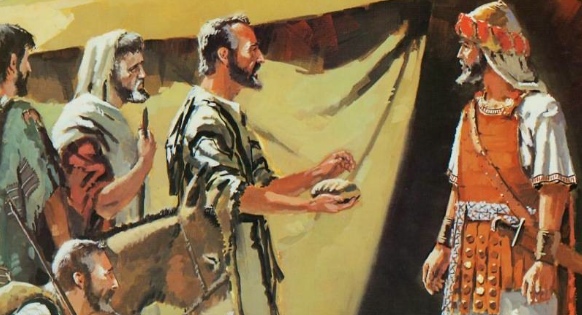
Despite the fact that the Israelites were supposed to wipe out the Canaanites, the biblical witness indicates that they did not, and thus, shares some elements in common with the peaceful infiltration theory. Rahab and her family become allies with the Israelites after her assistance in the destruction of Jericho (Joshua 2; 6.17; 6.22-23). Through a ruse, the Gibeonites tricked the Israelites into making peace with them (Joshua 9), and ultimately were made to work in the service of the tabernacle. Further, there are indications of the Israelites living peacefully in Shechem, without any references to a military battle there (Joshua 24.1, 24.32).[53]

The Gibeonites trick the Israelites

Although there are not significant elements of social unrest that would bring the biblical accounts into harmony with the peasant revolt model, the Bible does similarly suggest that the Israelites were made up of a diverse group of people. In addition to the allies mentioned above, Exodus 12.38 claims that a “mixed multitude” went up with the people of Israel with they left Egypt, and Judges 1.16 indicates that the Kenites, the descendants of Moses’ father-in-law, were also present with them.

Finally, the endogenous evolutionary models assume that the Israelites were simply Canaanites because of the high degree of archaeological continuity. However, if the Israelites were, as described above, living in houses that they did not build, archaeological continuity would only be natural. Furthermore, the idea that “every ethnic group must have a distinct, archaeologically observable culture is not well founded,” and even so, the biblical texts “attest to Israel’s West Semitic origins, similar to all Canaanites in the land.”[54] In other words, a high degree of archaeological continuity is exactly what we should expect based on the biblical testimony.

Conclusion

The emergence of Ancient Israel in Canaan was undoubtedly a complex process, and one that can best be reconstructed by paying close attention to the biblical text and to archaeological finds as well. When all of this data is considered, it seems clear that the various emergence models are accurate in some ways, and an eclectic theory presents the best approach.

The Hebrew people left Egypt as part of a “mixed multitude” that eventually entered the land of Canaan to possess it under the direction of Yahweh. This occurred through a process of military conquest and occupation, but that military occupation was incomplete to the degree that some peaceful coexistence with the Canaanite residents clearly occurred. Apart from a small number of admitted difficulties, this picture also fits well with the archaeological record, which suggests (as Scripture does) that the Israelites were similar to the Canaanites in many ways. From a theological perspective, however, that similarity was a problem, as it was indicative of an Israelite people that failed to be distinctive as Yahweh had directed, and instead mingled with and adopted the practices of their Canaanite neighbors. In the end, it would lead to the loss of the land they had been promised and had occupied in such complex fashion.


[1] George E. Mendenhall, “The Hebrew Conquest of Palestine,” Biblical Archaeologist 25, no. 3 (September 1962): 66.

[2] For minimalists, see Niels Peter Lemche, “The Origin of the Israelite State: A Copenhagen Perspective on the Emergence of Critical Historical Studies of Ancient Israel in Recent Times,” Scandinavian Journal of the Old Testament 12, no. 1 (1998): 44-63; Robert B. Coote, “Early Israel,” Scandinavian Journal of the Old Testament 2 (1991): 35-46; Keith W. Whitelam, “Between History and Literature: The Social Production of Israel’s Traditions of Origin,” Scandinavian Journal of the Old Testament 2 (1991): 60-74. Coote, 37, argues that the biblical accounts should be heavily discounted, and Whitelam, 71, describes the Hebrew Scriptures as a “danger and a distraction” for the historian, because they “…lull us into believing that they represent reality.”

For scholars who see historical value in the Bible, see Anthony J. Frendo, “Back to Basics: A Holistic Approach to the Problem of the Emergence of Ancient Israel,” in In Search of Pre-Exilic Israel: Proceedings of the Oxford Old Testament Seminar, ed. John Day (London: T & T Clark, 2004): 41-64; Hartmut N. Rösel, “The Emergence of Ancient Israel—Some Related Problems,” Biblische Notizen 114-115 (2002): 151-60. K. Lawson, Younger, Jr., “Early Israel in Recent Biblical Scholarship,” in The Face of Old Testament Studies: A Survey of Contemporary Approaches, ed. David W. Baker and Bill T. Arnold (Grand Rapids: Baker Books, 1999), 200-205, emphasizes the limitations of archaeology and the problems for scholars who try to form emergence models based solely on archaeological data. Younger also emphasizes the need to read books like Joshua and Judges better and less simplistically.

[3] Baruch Halpern, The Emergence of Israel in Canaan, Society of Biblical Literature Monograph Series, vol. 29 (Chico, CA: Scholars Press, 1983), 49.

[4] Younger, 178-79.

[5] W. F. Albright, “The Israelite Conquest of Canaan in the Light of Archaeology,” Bulletin of the American Schools of Oriental Research 74 (April 1939): 11-23. Other scholars who hold to the Conquest model include John Bright, A History of Israel, 4th ed. (Louisville: Westminster John Knox Press, 2000); Yigael Yadin, “Is the Biblical Account of the Israelite Conquest of Canaan Historically Reliable?” Biblical Archaeology Review 8, no. 2 (March 1982): 16-23.

[6] Robert Gnuse, “Israelite Settlement of Canaan: A Peaceful Internal Process—Part 1,” Biblical Theology Bulletin 21, no. 2 (1991): 58.

[7] Younger, 178. The issue of the date of the Exodus and Israel’s entrance into Canaan is beyond the scope of this paper, but is certainly related. Even among scholars who hold to the historicity of the biblical narratives regarding the Exodus, the wanderings in the wilderness, and the occupation of Canaan, there are those who argue for an early date in the fifteenth century BC, while others argue for a late date in the thirteenth century. See James K. Hoffmeier, “What is the Biblical Date for the Exodus? A Response to Bryant Wood,” Journal of the Evangelical Theological Society 50, no. 2 (June 2007): 225-47; Bryant G. Wood, “The Biblical Date for the Exodus is 1446 BC: A Response to James Hoffmeier,” Journal of the Evangelical Theological Society 50, no. 2 (June 2007): 249-58; Ralph K. Hawkins, “The Date of the Exodus-Conquest is Still an Open Question: A Response to Rodger Young and Bryant Wood,” Journal of the Evangelical Theological Society 51, no. 2 (June 2008): 245-66; Dale W. Manor, “The Emergence of Israel: The Bible and Archaeology,” ΠΝΕΥΜΑΤΙΚΑ 1, no. 1 (2013): 90-110. Needless to say, as Hoffmeier, Israel in Egypt: The Evidence for the Authenticity of the Exodus Tradition (Oxford: Oxford University Press, 1997), 34, points out, the chronology does impact the archaeological data, because if the presumed chronology is incorrect, archaeologists should not expect to find data related to destruction at the wrong time.

[8] Hoffmeier, Israel in Egypt, 33.

[9] Younger, 179.

[10] All Scripture references are taken from the English Standard Version.

[11] This list is pointed out in Manor, 96. The accounts of the destruction of these cities are recorded as follows: Jericho (Joshua 6), Ai (Joshua 7-8), Hazor (Joshua 11.11-13), Jerusalem (Judges 1.8), and Laish (Judges 18).

[12] Albrecht Alt, Essays on Old Testament History and Religion, trans. R. A. Wilson (Oxford: Basil Blackwell, 1966), Martin Noth, The History of Israel (New York: Harper, 1958). Alt originally published his theory in 1925.

[13] Ann E. Killebrew, “The Emergence of Ancient Israel: The Social Boundaries of a “Mixed Multitude,” in Canaan,” in I Will Speak the Riddles of Ancient Times, ed. Aren M. Maeir and Pierre de Miroschedji (Winona Lake, IN: Eisenbrauns, 2006), 561; Younger, 179; Gnuse, 57.

[14] Gnuse, 57; Killebrew, 561.

[15] Younger, 179: “An amphictyony is a league of tribes or cities, usually with six or twelve members, bound by common allegiance to a deity and to the god’s shrine.

[16] For example, in Joshua 24.1, 24.32, there are references to the Israelites being in Shechem, but there is no record of a military conquest of Shechem in the biblical accounts.

[17] Gnuse, 58, and Marvin L. Chaney, “Ancient Palestinian Peasant Movements and the Formation of Premonarchic Israel,” in Palestine in Transition: The Emergence of Ancient Israel, ed. David Noel Freedman and David Frank Graf (Sheffield, England: The Almond Press, 1983), 42-43, discuss this issue at length. Sometimes people groups become nomadic following a period of settled land cultivation; other groups live in an ongoing state of seasonal alternating between land cultivation and pastoralism.

[18] Younger, 180; Richard S. Hess, “Early Israel in Canaan: A Survey of Recent Evidence and Interpretations,” Palestine Exploration Quarterly 125 (July 1993): 127. Of course, this is not to deny that Ancient Israel could have been based on tribal associations (the Bible insists that it was); but it could not have been based on an amphictyony system that was developed hundreds of years later.

[19] Mendenhall, “The Hebrew Conquest of Palestine,” 66-87.

[20] Iain Provan, V. Philips Long, and Tremper Longman III, A Biblical History of Israel (Louisville: Westminster John Knox Press, 2003), 141.

[21] Hess, 129.

[22] George E. Mendenhall, The Tenth Generation: The Origins of the Biblical Tradition (Baltimore: Johns Hopkins University Press, 1973): 136-37. Mendenhall goes on to argue that David (in his “outlaw” stage), Jephthah, Abraham, and Jacob are all specific examples of habiru who operated outside of the protection of and obligation to the governing authorities in the areas in which they lived.

[23] Mendenhall, “The Hebrew Conquest of Palestine,” 75: “The subjection of individuals and groups to a non-human Overlord by covenant, the solidarity of the newly formed community meant that they could and did reject the religious, economic, and political obligations to the existing network of political organizations. By this process, they became “Hebrews.”

[24] Mendenhall, The Tenth Generation, 225.

[25] Norman K. Gottwald, “Early Israel and the Canaanite Socio-Economic System,” in Palestine in Transition: The Emergence of Ancient Israel, ed. David Noel Freedman and David Frank Graf (Sheffield, England: The Almond Press, 1983): 25-38; Norman K. Gottwald, “Israel’s Emergence in Canaan,” Bible Review 5, no. 5 (October 1989): 26-34; Norman K. Gottwald, “Religious Conversion and the Societal Origins of Ancient Israel,” Perspectives in Religious Studies 15, no. 4 (Winter 1988): 49-65.

[26] Gottwald, “Israel’s Emergence in Canaan,” 32-33. For example, Gottwald rejects Mendenhall’s equation of “Hebrew” with habiru, and argues that some of the early Hebrews were likely habiru outcasts and bandits, but many were simply disorganized peasant groups, artisans, and other groups. Elsewhere, Norman K. Gottwald, “The Hypothesis of the Revolutionary Origins of Ancient Israel: A Response to Hauser and Thompson,” Journal for the Study of the Old Testament 7 (May 1978): 46, suggests that habiru mercenaries and brigands shared their military expertise with the peasantry and thus strengthened the growing Israelite movement.

[27] Manor, 99.

[28] Mendenhall, 66.

[29] Younger, 182; Alan J. Hauser, “Israel’s Conquest of Palestine: a Peasants’ Rebellion?,” Journal for the Study of the Old Testament 7 (May 1978): 12-13. Hauser goes on to dispute Mendenhall’s examples of David and Jephthah as examples of habiru, as neither David nor Jephthah willingly chose to withdraw from their respective societies to become habiru, but rather, had that status forced upon them. This is fundamentally different from Mendenhall’s claim of a large group of peasants willingly withdrawing from the Canaanite city-state society as a matter of revolt.

[30] Jacob Milgrom, “Religious Conversion and the Revolt Model for the Formation of Israel,” Journal of Biblical Literature 101, no. 2 (June 1982): 169-76.

[31] Hauser, 7, “Finally, Mendenhall sees the Israelite revolution as he reconstructs it to be a uniquely creative experience in the socio-economic history of the ancient world. The uniqueness he describes, however, derives from the modern views of religions and revolution which Mendenhall has uncritically transplanted into the context of ancient society.” William G. Dever, “Archaeology and the Emergence of Early Israel,” in Archaeology and Biblical Interpretation, ed. John R. Bartlett (London: Routledge, 1997): 24, states that the model should be rejected “because it is too obviously a projection of modern Marxist notions of ‘class-conflict’ onto ancient Israel.”

[32] The literature published by scholars supporting a model of this type is substantial. See Dever, “Archaeology and the Emergence of Early Israel”; Israel Finkelstein, “The Emergence of Israel: a Phase in the Cyclic History of Canaan in the Third and Second Millennia BCE,” in From Nomadism to Monarchy: Archaeological and Historical Aspects of Early Israel, ed. Israel Finkelstein and Nadav Na’aman (Washington: Biblical Archaeology Society, 1994): 150-78; Israel Finkelstein, “The Emergence of Israel in Canaan: Consensus, Mainstream and Dispute,” Scandinavian Journal of the Old Testament 2 (1991): 47-59; Lemche, “The Origin of the Israelite State: A Copenhagen Perspective on the Emergence of Critical Historical Studies of Ancient Israel in Recent Times”; Coote, “Early Israel”; Whitelam, “Between History and Literature: The Social Production of Israel’s Traditions of Origin”; Gösta W. Ahlström, “The Origin of Israel in Palestine.” Scandinavian Journal of the Old Testament 2 (1991): 19-34; Robert B. Coote and Keith W. Whitelam, The Emergence of Early Israel in Historical Perspective, The Social World of Biblical Antiquity Series, vol. 5 (Sheffield, England: Almond Press, 1987); Robert B. Coote and Keith W. Whitelam, “The Emergence of Israel: Social Transformation and State Formation Following the Decline in Late Bronze Age Trade,” Semeia 37 (1986): 107-47.

[33] Diana Edelman, “Introduction.” Scandinavian Journal of the Old Testament 2 (1991): 3-6; Killebrew, 564-65.

[34] Hoffmeier, 32; Killebrew, 568; Hess, 129; Coote and Whitelam, The Emergence of Early Israel in Historical Perspective, 126.

[35] Finkelstein, “The Emergence of Israel in Canaan: Consensus, Mainstream and Dispute”; Finkelstein, “The Emergence of Israel: A Phase in the Cyclic History of Canaan”; Dever, 30; Robert Gnuse, “Israelite Settlement of Canaan: A Peaceful Internal Process—Part 2,” Biblical Theology Bulletin 21, no. 3 (1991): 111.

[36] Dever, 43. See also Mark G. Brett, “Israel’s Indigenous Origins: Cultural Hybridity and the Formation of Israelite Ethnicity,” Biblical Interpretation 11, no. 3 (2003): 404-05; Manor, 101; Younger, 195-96.

[37] Finkelstein, “The Emergence of Israel: A Phase in the Cyclic History of Canaan,” 169; Finkelestein, “The Emergence of Israel in Canaan: Consensus, Mainstream and Dispute,” 56. Coote, “Early Israel,” also prefers to think of Israel’s emergence in political rather than ethnic terms.

[38] John J. Bimson, “Merenptah’s Israel and Recent Theories of Israelite Origins,” Journal for the Study of the Old Testament 49 (February 1991): 13; Dever, 43.

[39] Ahlström, 27-29.

[40] Dever, 43. Brett, 406-07. Hoffmeier, 27-31, addresses the issue in some detail.

[41] Dever, 43.

[42] Though not Dever; see above.

[43] Bimson, 13-24.

[44] Manor, 101.

[45] Ibid.

[46] This approach is greatly influenced by the presentations of Provan, Long, and Longman, A Biblical History of Israel, and Manor, “The Emergence of Israel: The Bible and Archaeology.” See also Hess, 132, 139; Frendo, 58; Younger, 205; Hoffmeier, 43-44.

[47] Careful reading of the biblical text must account for the use of hyperbole. Joshua 10.20 states, “When Joshua and the sons of Israel had finished striking them with a great blow until they were wiped out, and when the remnant that remained of them had entered into the fortified cities….” If Joshua’s enemies had been literally wiped out, then there could be no remnant; clearly, hyperbole is involved here. See also Younger, 200-01.

[48] Manor, 90, presents a helpful understanding of the biblical ideal and the way it is connected with other theories of Israel’s emergence and his own eclectic approach: “It is vital, however, to demonstrate from the Bible what the conquest was supposed to accomplish and why it failed. In Israel’s failure to do what they were supposed to do, almost by default elements of the competing models became components to explain Israel’s emergence.”

[49] Deut. 6:11; Josh. 24:13.

[50] Provan, Long, Longman, 178-81.

[51] Manor, 94-95; Provan, Long, and Longman, 174-78.

[52] Manor, 95. For an alternative perspective on the remains of Jericho, see Bryant G. Wood, “Did the Israelites Conquer Jericho: A New Look at the Archaeological Evidence,” Biblical Archaeology Review 16, no. 2 (March 1990): 44-58. Wood, who holds to an early date for the Exodus and Conquest, believes he has found pottery evidence which indicates inhabitation at Jericho during the late fifteenth century BC.

[53] Manor, 104-05, mentions hints of other groups who may have made peace with the Israelites, at least in an informal fashion.

[54] Hess, 130. See also Ezekiel 16.3: “…Thus says the Lord God to Jerusalem: Your origin and your birth are of the land of the Canaanites; your father was an Amorite and your mother a Hittite.” This verse should probably not be pressed for literalness; but surely it denotes a similarity between the Israelites and the Canaanites.

The Shameful and Powerless Death of the Messiah

This fall, I am taking a graduate school class on the New Testament books of 1 and 2 Corinthians. I am getting to do a significant amount of reading related to those two books, and am really enjoying some of the commentaries which have been picked out for us to read, particularly, the volume on 1 Corinthians by Richard B. Hays.

What follows is the first of what I expect will be many quotations from my reading that I want to share:

“God has chosen to save the world through the cross, through the shameful and powerless death of the crucified Messiah. If that shocking event is the revelation of the deepest truth about the character of God, then our whole way of seeing the world is turned upside down. Everything has to be reevaluated in light of the cross.”

Richard B. Hays, 1 Corinthians, p. 27

Alexander Campbell and the Problem of Evil

This is another installment in a loosely-united series called A Theological View of Suffering. See more here.


Introduction

The problem of evil[1] has long bothered both believers and those who remain skeptical of the existence of God: how can the idea of a loving and powerful God be reconciled with the undeniable reality of evil and suffering in the world?[2]

Alexander Campbell

Within the Stone-Campbell Restoration Movement, no single individual has been more influential than Alexander Campbell. Campbell thought deeply on a wide variety of subjects, and as editor of popular brotherhood papers and also as a famous writer and debater, his thoughts were widely disseminated in his day and continue to influence his spiritual descendants in the 21st century.

Interestingly though, Campbell’s views on the problem of evil have not been studied significantly[3] and are not widely known. Campbell never developed a comprehensive theodicy,[4] but he did write significantly on the subject of evil and suffering in the world. In addition to being an influential thinker and a prolific writer, Campbell was also a man who was frequently battered by personal tragedy: prior to his death in 1866, Campbell buried ten of his children including his favorite son Wickliffe, who drowned at the age of ten and whose death left him devastated[5] Through an examination of his writings and his reaction to the death of his beloved son, this paper will seek to describe the ways in which Campbell reconciled his views of God’s good governance of the world with the very real presence of evil and suffering within it.

Campbell’s Views on the Providence of God

Any discussion of Alexander Campbell’s understanding of evil and suffering must be grounded in his views on how God governs the world and providentially directs the lives of mankind. Generally speaking, Campbell’s perspective on providence is characterized by a high view of God’s involvement in the world balanced with a heavy emphasis on human freedom. This middle-ground approach is illustrative of the fact that Campbell desired to distance himself on the one hand from a pervasive Calvinism which denied the reality of human freedom,[6] and a Deistic or Skeptical perspective on the other, which denied the active involvement of God in the world.[7]

In 1833, Campbell published a series of excerpts from William Sherlock’s A Discourse Concerning the Divine Providence.[8] As this work was applauded by Campbell[9] and the excerpts were chosen and published by him, they, along with his own articles, can help us understand his views on providence.

First, Campbell argued strongly for a special providence which interacts with the lives of individuals. He was frustrated by those who believed in providence but denied the individual manifestations of it:

“They who admit a general providence, and, at the same time, deny a special providence, are feeble and perverted reasoners and thinkers. A general, or universal supervision or providence, necessarily implies a special or particular providence.”[10]

For Campbell, a God who created all things but then showed interest in only a few of them would be supremely irresponsible.[11] Instead, God is directly involved in the lives of all his creatures: he governs them in a particular sense rather than simply permitting the events of their lives in a general sense.[12] In fact, “God’s government of all events is indeed so absolute and uncontrollable, that no good or evil can befall any man, but what God pleases, what he orders and appoints for him.”[13] From this perspective, “chance” simply does not exist, as seemingly random events are actually governed by God’s unseen providential hand.[14] For Campbell, a prime biblical example of this is Joseph, whose life is comprised of repeated occurrences of “fortunate” and “unfortunate” events which were actually God’s continual providential workings in his life.[15] Indeed, even the death of infants and good men, “the purest and best of our race”, do not occur outside of the providence of God, but rather happen according to his purposes.[16] In his providence, God is intricately involved in his creation, both in a general and special sense.

However, a second major component of Campbell’s understanding of providence is that none of God’s providential action impinges upon human freedom. Despite God’s providential oversight,

“…yet he lays no necessity upon human actions: men will and choose freely, pursue their own interests and inclinations, just as they would do if there were no Providence to govern them….”[17]

As free moral agents, humans have the ability to make choices for themselves; at the same time, God can use those choices to bring about his own purposes.[18] Out of this free will, men and women at times choose to commit evil. God does not order that they do so; in fact, he expressly forbids it. But, since God honors them as free moral creatures, he does permit their evil choices.[19]

Although Campbell is confident that God meticulously governs the world, he admits that there are things which simply do not make sense from a human perspective: sinful men often live full lives, while some of the purest and best are cut down in the prime of life. But Campbell is willing to chalk this up to the mysterious nature of God, asking “…why should not the scheme of a superintending Providence, or of a righteous moral government, also have its peculiar and incomprehensible mysteries?”[20]

Regardless, Campbell is content to rely on the wisdom, care, and blessing of the God who is firmly in control of his creation:

“… our lives, and all our conditions of life, are of his superintending care and providence, and not of “blind chance” or “good luck,” but of his own direction and blessing; for, indeed, in this life, many of our so-called misfortunes are the choicest blessings, and all things do work together for good to them who love God and keep his commandments.”[21]

Reconciling Evil and Suffering with a Good and Powerful God

Alexander Campbell affirmed the three components of the problem of evil—the benevolence of God, the omnipotence of God, and the existence of evil—but he did not consider those components to be mutually exclusive. In fact, as we shall see, from Campbell’s perspective it was because of God’s goodness that he created a world in which evil exists.

In The Christian System, Campbell explicitly affirms the goodness and power of God as part of his infinite and eternal qualities:

“God appears before the universe of intellectuals in the threefold attitude of Creator, Lawgiver, and Redeemer; and, although each of these involves and reveals many of his excellencies, still in each department three are most conspicuous. As Creator, wisdom, power, and goodness; as Lawgiver, justice, truth, and holiness; as Redeemer, mercy, condescension, and love. In each and all of which departments he is infinite, immutable, and eternal.”[22]

To Campbell, it was also clear that evil and suffering occur in the world. “Moral evil exists as sure as we exist,”[23] he states, and because of that evil, “We have frequently requested such reasoners to reflect that animal and mental pain existed to a very great extent.”[24]

Acknowledging the benevolence and omnipotence of God as well as the existence of evil and suffering in the world, Campbell’s primary response to the tension between these realities was his emphasis on human freedom. For Campbell, God created humanity to be free moral creatures, and he did so out of his goodness. God’s loving goal in creation was to bring about the “diffusion of bliss on the largest possible scale”,[25] and this goal could only be achieved with God functioning as the governor of the universe and his creatures choosing to obey his moral laws:

“…the knowledge of God is essential to the happiness of a rational creature, and if God had given birth to a system which in its very nature excluded the possibility of evil, it would have also excluded the possibility of his being a governor. A creator he might have been, but a governor he could not have been; and unless exhibited as a governor, no rational creature ever could have known him in that way essential to happiness.”[26]

Campbell reasoned that in order for creatures to have the ability to genuinely choose to obey God’s laws, they must also have the ability to choose to disregard them and to rebel against the divine governor.[27] When human freedom is abused in this way, evil and suffering is the inevitable result, but indeed, God could not have achieved his goals for creation without endowing humans with free will and the subsequent ability to bring evil into the world.[28]

In his view that a humanity endowed with free will provided the best option for God’s creation—indeed, the only option which would enable God to achieve his goals for creation—Campbell approximates a version of Leibnitz’s theodicy that this is the best of all possible worlds.[29] And in fact, Campbell uses similar terminology:

“…the actual state of things now existing was the best possible state in which they could exist with a reference to all final results. It may, then, in the sprit of true devotion, and genuine humility be affirmed that God could not, with a reference to all final results, give birth to a more perfect system of things than the present.”[30]

While Campbell sees moral evil as an obvious result of human freedom, he sees natural or cosmic evil as a result of the fall which occurred at the beginning of time in the Garden of Eden:

“At its birth all was good, and therefore all was happy. Before the rebellion in Eden, all was good, all was very good. In the world not a groan, not a sigh was heard, till sin was born. No gloom, no pain, no sorrow any where. But the instant man rebelled, the heavens were overcast, the Sun lost his brightness, the earth its fertility, the air its salubrity, Eden its bloom, woman her beauty, and man his crown. Nature was immediately diseased in all her members.”[31]

Adam and Eve’s sin in Eden negatively affected human nature,[32] and indeed, tainted all of creation. As explained by Thomas Campbell, Alexander’s father, in The Christian Baptist, “…physical evils are the just and proper results and consequences of the moral,” and they are used by God “…as punishments, preventives, or correctives.”[33] Thus, moral evil is made possible by free will, and cosmic evil resulted when free creatures chose to sin.[34]

Another significant aspect of Alexander Campbell’s response to the problem of evil is his insistence on humanity’s limited ability to perceive the providential purpose behind evil events. For Campbell, many of the events and happenings in life which we consider to be pointless evil may actually reflect more upon our inability to accurately perceive what is going on rather than a flaw in the way God is governing the world. Campbell was frustrated with those who argued that God should have ordered world history in such a way that seemingly gratuitous evil would not have occurred. He compared them with children who asked why ripe ears of corn did not immediately spring forth from the earth as soon as the seed was planted:

“Could not an almighty, and benevolent being, have produced the ripe ear without waiting for a sprout, stalk, leaves, blossoms, and all the other preparations of nature to form an ear of corn? We are, even in the common concerns of life, but poor judges of propriety; and it is extreme arrogance for us to arraign Omniscience at the tribunal of our reason when we cannot tell the reason why the blossom precedes the fruit.”[35]

Campbell’s point is clear: if God, in his omniscient wisdom has a reason, indecipherable by humans, for making corn grow in the way it does, it is quite possible that he also has reasons for permitting those evil events which we would rather avoid. Campbell concludes that, ultimately, speculation on the origin and purpose of evil is inessential to the Christian life: “It is not necessary that we should analyze and comprehend the origin and nature of darkness in order to enjoy the light of the sun.”[36]

A Case Study in Suffering: The Death of Wickliffe Campbell

For Alexander Campbell, the issue of evil and suffering in the world was not simply an academic one, as he was touched deeply by suffering in his personal life. Death was a frequent visitor to the Campbell home, and Alexander witnessed the deaths of his first wife and ten of his fourteen children prior to his own passing in 1866.

The death of young children was common in the nineteenth century, but of the ten children whose deaths Campbell witnessed, only three were infants. Six died of illness in their 20’s, and one, Wickliffe, drowned at the age of ten.[37]

Wickliffe Campbell

By all accounts, Wickliffe was a special child. Described in his obituary as “a boy of remarkable and peculiar character” who had “given many evidences of a precocious piety,”[38] Wickliffe’s mother, Selina, said that he was a “remarkably polite, obedient and affectionate child—always serene, always happy.”[39] Though young, Wickliffe would carry his Bible with him daily and eagerly worked to memorize scripture.[40] He enjoyed studying academic books, and also kept a scrapbook filled with poetry he had cut out of religious newspapers. [41]

Alexander was devoted to his young son, referring to him as the “choicest lamb from my flock,”[42] and it is clear that he had high hopes for Wickliffe’s future, calling him a “child of much more than ordinary promise,” and one “on whom clustered many a hope of eminent usefulness to society in coming years.”[43] Reading between the lines, many interpreters have suggested that Alexander had tabbed Wickliffe to follow in his footsteps and succeed him as a leader within the Stone-Campbell Movement.[44]

But sadly, it was not to be. In May 1847, Alexander embarked on a tour of the British Isles which lasted several months.[45] On the afternoon of September 4, while his father was still overseas, Wickliffe went swimming with two of his cousins in a creek near his home. The boys had been diving off a small skiff near a mill dam, swimming under it, and emerging on the other side. This had been done previously without incident several times, but on one attempt, Wickliffe dove underneath but failed to emerge. His cousins raised the alarm and help arrived quickly, but it took half an hour to locate Wickliffe, who had become trapped underneath the apron of the dam, and remove his lifeless body from the water. W.K. Pendleton and Robert Richardson, Alexander Campbell’s sons-in-law, worked for hours to attempt to resuscitate Wickliffe using the medical techniques of the day, but to no avail.

The death of such an exceptional child was met with exceptional grief. Pendleton wrote Wickliffe’s original obituary, mentioning the “more than ordinary bereavement” and asked the brotherhood to unite together in beseeching God to provide Alexander and Selina “both strength to bear and resignation to suffer the calamity that has befallen them.”[46]

Still traveling overseas, Alexander Campbell was unaware of the tragedy which had befallen his favorite son. Campbell experienced a “dark, troubled night” on the night of Wickliffe’s death, and the next morning at breakfast he remarked to his host that “he had been greatly troubled in his sleep, and that he was conscious that something sad had happened at home.”[47] Regardless of whatever premonitions Campbell may have felt, he did not learn the details of his son’s passing until his return to Boston on October 19, where he received a letter from home informing him of Wickliffe’s death.[48]

Although Campbell dealt with the loss with resignation,[49] it is clear that Wickliffe’s death deeply affected him. Writing to a Brother Wallis more than a month after the tragedy, Campbell states, “I could not bring myself to write to any one for some time,” and goes on to describe how despite the loss of several other children, Wickliffe’s death was particularly distressing because of the suddenness of it and the universal admiration which people felt toward him.[50] Later, Campbell states that the loss of Wickliffe “has been more oppressive than any one case or trial through which I had passed,”[51] and even confesses that he struggles to put his grief into words, saying, “My emotions may be by a few more easily imagined than I could express them.”[52] Richardson, who in addition to being Campbell’s son-in-law also served as his personal physician, remarked that Campbell appeared to Bethany “much worn and jaded” after receiving the news of Wickliffe’s death, and that it was “a number of months” before “he could be said to have regained his health.”[53]

It is also clear that Alexander Campbell’s great grief following the death of Wickliffe did not shake his trust in God’s good governance of the world. He still held that God directed the ways of man, even if he did so in ways which were difficult to understand:

“God’s ways cannot be traced….But in this case he thought good to take to himself the choicest lamb from my flock, and has not revealed to me the reason why. But he is too wise to err, and too kind causelessly to afflict the children of men.”[54]

Elsewhere, Campbell stated that the incident “has been a most afflictive, as well as a most mysterious Providence,” but maintained that “the Lord has done it for some wise and kind, though to us mysterious, purpose.”[55] Although Campbell did not claim to understand God’s purposes, he did pray that God would use the bereavement to turn his heart from the things of earth and make him more devoted to the glory of the Savior.[56] Further, he took consolation in the thought that Wickliffe “was destined for another field of action, and the Lord has taken him to himself,”[57] and that his deceased children were now with God:

“This, to us is a sovereign balm—a blest relief. Though dead to us, they live with God. May the kind Redeemer raise us up with them in his own time, and reunite us in the inheritance incorruptible, undefiled, and that fadeth not away!”[58]

Conclusion

In the course of Alexander Campbell’s long and illustrious career as an editor, writer, and debater, he discussed a wide array of subjects, including the problem of evil. Campbell’s views on evil and suffering are rooted in his understanding of a God who functions as a universal governor, using his providential power both in a general sense, and also to effect the specific events of the lives of individual men and women, though never in a way which inhibits their free will.

For Campbell, that free will is a crucial and necessary ingredient in God’s creation of the world. Unfortunately, its abuse leads to moral evil, and through the fall in the Garden of Eden, natural evil as well. Still, Campbell argues that without human freedom, there can be no true obedience to God, no relationship with him, and thus, no good or happiness.

Indeed, in his providence, God has a purpose for even those events which cause great suffering, although this purpose can be difficult to discern. This is clearly evident in Campbell’s reaction to the tragic death of his son Wickliffe: despite his great grief, Campbell clinged to his belief that God is still firmly in control, that there are aspects of the providential plan which are a great mystery to us, and that ultimately, Christian hope is grounded in the resurrection and eternal life in God’s presence.


[1] The ancient Greek philosopher Epicurus is generally credited to be the first to state the problem of evil: “Is God willing to prevent evil, but not able? Then he is not omnipotent. Is he able, but not willing? Then he is malevolent. Is he both able and willing? Then whence cometh evil? Is he neither able nor willing? Then why call him God?” John Hospers, An Introduction to Philosophical Analysis, 3rd ed. (London: Routledge, 1990), 310.

[2] “Evil” and “suffering” are not synonyms, but they are related. For the sake of this paper, “suffering” will refer to the physical and emotional pain experienced as a result of the moral and natural evil which exists in the world.

[3] Two exceptions to this statement are John Mark Hicks, “Theodicy in Early Stone-Campbell Perspectives,” in Restoring the First-Century Church in the Twenty-First Century: Essays on the Stone-Campbell Restoration Movement, ed. Warren Lewis and Hans Rollman (Eugene, OR: Wipf and Stock, 2005): 287-303, and J. Caleb Clanton, The Philosophy of Religion of Alexander Campbell (Knoxville, TN: The University of Tennessee Press, 2013), 89-117. Hicks examines Campbell’s response to evil in the context of a survey of early restoration views on the topic. Clanton looks at Campbell’s interactions with skeptics related to the problem of evil and the problem of divine hiddenness.

[4] In fact, Campbell would have had great reservations about the very idea of developing a comprehensive theodicy, as he preferred to focus on the specific teachings of scripture rather than philosophical or metaphysical speculation. See Hicks, 287, 290-91.

[5] Joseph R. Jeter, Jr. and Hiram J. Lester, “The Tragedy of Wickliffe Campbell,” Lexington Theological Quarterly 22 (July 1987): 87-89.

[6] Raised in the Scottish Presbyterian church, Campbell grew up in a Reformed context, but would come to refute aspects of this later. In Alexander Campbell, “Editor’s Reply,” Millennial Harbinger 4 (July 1833): 336, Campbell refers to his “former Calvinism”.

[7] As discussed in Richard J. Cherok, Debating for God: Alexander Campbell’s Challenge to Skepticism in Antebellum America (Abilene, TX: Abilene Christian University Press, 2008), 37ff., Campbell exercised considerable energy refuting the arguments of Skeptics and Deists. The prime example of this is Campbell’s famous debate with skeptic Robert Owen. See Alexander Campbell and Robert Owen, The Evidences of Christianity: A Debate Between Robert Owen, of New Lanark, Scotland and Alexander Campbell, President of Bethany College, Va. Containing an Examination of the “Social System” and all the Systems of Skepticism of Ancient and Modern Times, Held in the City of Cincinnati, Ohio, in April, 1829 (Bethany, VA: Alexander Campbell, 1829; reprint, Nashville: McQuiddy Printing Company, 1946).

[8] William Sherlock, A Discourse Concerning the Divine Providence (London: William Rogers, 1694; Reprint, Pittsburgh: J. L. Read, 1849). See the excerpts Campbell published in Alexander Campbell, “Sherlock on Providence,” Millennial Harbinger 4 (May 1833): 205-12, 4 (June 1833): 247-51, 4 (July 1833): 296-300, 4 (August 1833): 389-95, 4 (September 1833): 435-39.

[9] Alexander Campbell, “Reply to J.A. Waterman,” Millennial Harbinger 4 (June 1833): 243, “Your commendations of Sherlock I think are well deserved. They are not exaggerated. He is a writer of good sense….It would be well if our philosophists, who disbelieve the superintending care of the Almighty Father, would give Sherlock a candid hearing.”

[10] Alexander Campbell, “Providence, General and Special,” Millennial Harbinger 26 (November 1855): 602.

[11] Ibid., 602.

[12] Alexander Campbell, “Sherlock on Providence,” Millennial Harbinger 4 (May 1833): 206-07.

[13] Alexander Campbell, “Sherlock on Providence,” Millennial Harbinger 4 (September 1833): 437.

[14] Alexander Campbell, “Sherlock on Providence,” Millennial Harbinger (June 1833): 248-49.

[15] Campbell recounts the story of Joseph as an example of God’s providential care in both Alexander Campbell, “Chance,” Millennial Harbinger 22 (November 1851): 618-21, and Campbell, “Providence, General and Special,” 604-07.

[16] Alexander Campbell, “Mysteries of Providence,” Millennial Harbinger 18 (December 1847): 708. Campbell, 707-08, argues that God uses these departed virtuous persons to serve as his ministers in “other fields of labor.”

[17] Campbell, “Sherlock,” (September 1833): 436.

[18] Alexander Campbell, “Sherlock on Providence,” Millennial Harbinger 4 (July 1833): 300.

[19] Alexander Campbell, “Sherlock on Providence,” Millennial Harbinger 4 (August 1833): 392. Interestingly, Campbell, “Sherlock,” 393, argues that “though God orders and appoints what evils every man shall suffer, he orders and appoints no man to do the evil….And therefore we must necessarily distinguish between the evils men do and the evils they suffer. The first God permits and directs; the second he orders and appoints.”

[20] Alexander Campbell, “Mysteries of Providence,” 705.

[21] Campbell, “Chance,” 620-21.

[22] Alexander Campbell, The Christian System (Cincinnati: Standard Publishing, 1839; reprint, Cincinnati: Bosworth, Chase & Hall, 1871), 20.

[23] Alexander Campbell, “To Mr. D.—A Skeptic.—Replication.—No. III,” The Christian Baptist 4 (November 6, 1826): 24.

[24] Campbell and Owen, The Evidences of Christianity, 140.

[25] Campbell, The Christian System, 30.

[26] Alexander Campbell, “Replication.—No. 1,” The Christian Baptist 4 (August 7, 1826): 14. See also the discussion in Clanton, 92-93, and Mark Wiebe, “Letters to a Skeptic: Alexander Campbell on Rationality, Religious Belief, and Evil,” Stone-Campbell Journal 15 (Spring 2012): 32: “A world of creatures lacking the capacity to make significant moral choices would also lack this type of continuous guiding relationship with its Creator. Such a world, Campbell asserts, would be missing something vital.”

[27] Campbell, “To Mr. D.—A Skeptic.—Replication.—No. III,” 24, “Please consider, that if a rational being was created incapable of disobeying, he must, on that very account, be incapable of obeying….There are some things impossible to Omnipotence. Hills cannot be made without vallies; shadows, without substances; nor rational beings, without free agency….It is impossible to create a being that shall be capable of obeying, and at the same time, incapable of disobeying.” Emphasis in the original.

[28] Wiebe, 31, argues that Campbell here anticipates the theodicy arguments which Alvin Plantinga would make over one hundred years later.

[29] For an introduction to Leibnitz’s famous response to the problem of evil, see Susan Neiman, Evil In Modern Thought: An Alternative History of Philosophy (Princeton: Princeton University Press, 2002), 21-23.

[30] Campbell, “Replication.—No. 1,” 14. Emphasis in the original.

[31] Alexander Campbell, “History of Sin, Including the Outlines of Ancient History—No. I,” Millennial Harbinger 1 (March 1830): 108.

[32] Campbell, The Christian System, 29, describes mankind as possessing “…a fallen, consequently a sinful nature” and as “…greatly fallen and depraved in our whole moral constitution.” Emphasis in the original.

[33] Thomas Campbell, “To Mr. D, a Sceptic.—Replication No. V,” The Christian Baptist 4 (January 1, 1827): 39.

[34] The resulting human sinful nature leads to additional moral evil, which in turn leads to additional natural evil as part of a vicious cycle. For a fuller discussion of Campbell’s Augustinian understanding of evil, see Hicks, 291.

[35] Campbell and Owen, The Evidences of Christianity, 391; Clanton, 102-03.

[36] Campbell, The Christian System, 30.

[37] Jeter and Lester, 87, present a helpful chart detailing the birth and death dates of Campbell’s children.

[38] W. K. Pendleton, “Death of Wickliffe E. Campbell,” Millennial Harbinger 18 (October 1847): 596.

[39] Selina Huntington Campbell, Home Life and Reminiscences of Alexander Campbell (St. Louis: John Burns, 1882), 28.

[40] Ibid.

[41] Ibid., 32.

[42] Alexander Campbell, “Letters from Europe.—No. XXXVI,” Millennial Harbinger 19 (December 1848): 679.

[43] Alexander Campbell, “Obituary,” Millennial Harbinger 18 (December 1847): 713. See also Pendleton, 596, who calls Wickliffe “the object of special hope.”

[44] Todd M. Brenneman, “Prophet and Priest: The Redefining of Alexander Campbell’s Identity,” (master’s thesis, The Florida State University, 2005), 39-40. Jeter and Lester, 85-96, suggest that Wickliffe, exhibiting the intellectual brilliance and personable character of his father, possibly would have been able to prevent the division within the movement that happened in the early 20th century.

[45] The accounts of Wickliffe’s death are found in Selina Campbell, 27-30, and Pendleton, 595-96.

[46] Pendleton, 596.

[47] Selina Campbell, 35. Emphasis in the original.

[48] Campbell, “Letters from Europe,” 679.

[49] Thomas W. Grafton, Alexander Campbell, Leader of the Great Reformation of the Nineteenth Century (St. Louis: Christian Publishing Company, 1897), 199. Douglas B. Skinner, “Restoration Church History and a Theology of Suffering,” Leaven 10 no. 3 (2002): 130, refers to Campbell’s “theologically controlled grief,” and argues that he “seems to skirt the edges of grief.” It is hard to be certain so many years after the fact, but I would argue that for a man like Campbell who was considerably more comfortable with reason and logic than emotion, the degree to which he shares his emotions and disappointments following Wickliffe’s death indicates the extent to which he grieved.

[50] This letter is quoted in Selina Campbell, 37-38.

[51] Quoted in Robert Richardson, Memoirs of Alexander Campbell, vol. 2. (Cincinnati: R. W. Carroll & Co. Publishers, 1872), 575.

[52] Campbell, “Letters from Europe,” 679.

[53] Richardson, 573. Indeed, some interpreters question if Campbell ever truly recovered from the tragedy, and trace a supposed decline in his mental capacity to this event. See Grafton, 222, Jeter and Lester, 92, and Richard T. Hughes, Reviving the Ancient Faith: The Story of the Churches of Christ in America (Grand Rapids: William B. Eerdmans Publishing Company, 1996), 44.

[54] Campbell, “Letters from Europe,” 679.

[55] Campbell, quoted in Selina Campbell, 37-38.

[56] Richardson, 574-75.

[57] Ibid., 575. When Campbell wrote in “Mysteries of Providence,” 708, that God often takes the purest and best to use in his service in other arenas of his “vast dominion,” it seems very likely that he specifically had Wickliffe in mind. “Mysteries of Providence” appears in the Milliennial Harbinger only a few pages before Campbell’s own obituary for Wickliffe, and it would only be natural for him to think of the latter while writing the former.

[58] Alexander Campbell, “Conclusion of Volume V.—Series III,” Millennial Harbinger 19 (December 1848): 717.


Reading and Walking in 2014

Back in April 2013, I began walking laps around the auditorium in the church building while doing reading for grad school, or in sermon or lesson preparation. I also tend to walk laps when studying Greek or Hebrew vocabulary words, and also while talking on the phone. People like to joke with me about this, but I enjoy doing it because I know the exercise is good for me and also because it helps me read better—if I read in my chair or while lying on the couch in my office I start to nod off.

Each lap around the auditorium is approximately 74 yards. In 2013 I walked a total of 5,608 laps, which amounts to a total distance of 235.8 miles. As I mentioned in my report at the start of 2014, that is basically the equivalent of traveling from Fayetteville, Arkansas to Kansas City, Missouri on foot.

I was excited to see how many laps I could amass in a full year in 2014 (remember, I just started the practice in April 2013 so I missed about 1/4 of the year), and without further ado, here are my results:

Total Laps in 2014: 10,497

Distance per Lap: approximately 74 yards

Total Distance: 441.4 miles

So, if in 2013 I walked from Fayetteville, Arkansas to Kansas City, Missouri, in 2014, I headed toward Chicago, Illinois and almost got there, stopping just short of Joliet (you should be able to click through on the map pictured above for a better look).

Over 10,000 laps! That is a lot! It will be interesting to see if I can accumulate another 10,000 in 2015.

« Older posts Newer posts »

© 2026 The Doc File

Theme by Anders Noren — Up ↑