The online journal of Luke Dockery

Category: Grad School (Page 6 of 11)

Walking to Kansas City

Back in April, I mentioned here on the blog that I had begun the practice of walking laps in the church auditorium while doing reading for grad school or preparation for Bible classes, sermons, etc. Once I started taking Hebrew in the fall, I realized that this also worked well for memorizing vocabulary words, and I continued to walk quite a few laps each week.

I have gotten some jokes about ruining the carpet in the auditorium or wearing grooves into the floor, but I have kept at it, partially because I know the exercise is good for me, and partially because it helps me stay alert and read better (than if I’m reclining in my chair or lying on my couch).

Being the person that I am, I kept meticulous records of the number of laps I walked each day, and man, it is amazing how it all adds up! Keep in mind that I didn’t start doing this until April and therefore missed out on 1/4 of the year:

Total Laps in 2013: 5608

Distance per Lap: approximately 74 yards

Total Distance: 235.8 miles

What all of this means is that in 2013, while at work (and while actually doing work), I did the equivalent of traveling from Fayetteville, Arkansas, to Kansas City, Missouri on foot. Pretty cool.

I am excited to see how many laps I can accumulate in a full year!

Be Subordinate for the Lord’s Sake: An Exegesis of First Peter 2.13-17

Introduction

The epistle of First Peter was written to instruct and encourage Christians who were living in difficult circumstances in Asia Minor. Throughout the letter, Peter[1] consistently encourages his audience to live good and holy lives despite the persecution and suffering they are experiencing. This paper will look closely at the text of 1 Peter 2:13-17, where Peter instructs believers how to live in relation to their governing rulers and surrounding society.

The Background of First Peter

The believers to whom Peter writes find themselves in difficult circumstances, the victims of persecution at the hands of the society in which they live.[2] That persecution is a dominant theme of Peter’s letter is undisputed, but the nature of that persecution is less obvious and has been frequently debated over the years. In the past, it was commonly believed that this was an official persecution sponsored by Rome,[3] but most scholars today have rejected this view.[4] There is no specific reference to state-sponsored persecution in 1 Peter,[5] and what seems to be described instead are persecutions that were “…sporadic, generally mob-incited, locally restricted, and unsystematic in nature.”[6] In the face of this persecution, Peter writes to encourage his readers to stand firm,[7] and to instruct them on how they should simultaneously live as members of society and faithful members in the community of God.[8]

The Context of 1 Peter 2.13-17

Having considered the historical background of 1 Peter and the purpose for which it was written, we now shift focus to 1 Peter 2:13-17, which occupies a central place in the letter, offering specific instruction as to how believers should live in society and interact with those who rule over them. These verses are generally grouped within a larger segment that extends from 2:11-3:12,[9] and are considered by many scholars to comprise Peter’s version of a haustafel.[10] Although the groups of slaves, wives, and husbands are addressed in this section, Peter is addressing the entire Christian community, and these specific groups are used as illustrative examples of the kind of behavior Peter is commanding.[11]

The Text of 1 Peter 2.13-17

First Peter 2:13-17 instructs the community of faith concerning the proper relationship to the governing authorities (vv. 13-14), a rationale for doing good in society (v. 15), a description of Christian freedom (v. 16), and then concludes with four brief statements which summarize the Christian’s responsibility to all people, the brotherhood, God, and the emperor (v. 17).

2:13a “Be subject for the Lord’s sake…”[12]

The Greek verb rendered “be subject” in the ESV is υποταγητε,[13] a form of υποτασσω,  which can be translated “subject oneself”, “be subordinated”, or “obey”,[14] but a majority of scholars seem to agree that “be subordinate” is the preferred translation because it emphasizes the recognition of one’s proper place in the established order of society[15] rather than an “absolute, slavish, uncritical obedience to the state.”[16] This command to be subordinate is justified not on the basis of the authority of the state, but as part of the Christian faith, regardless of whether δια τον κυριον refers to God or to Jesus Christ.[17]

2:13b “…to every human institution…”

To whom is Peter’s audience instructed to be subordinate? The words ανθρωπινη κτισει are translated here as “human institution,”[18] but this rendering seems to be called for more by the context of governmental authority than by the word itself, and most scholars suggest that a better translation would be “human creature.”[19] In addition to being a more natural translation of the word, “human creature” also provides a subtle judgment against any notion that the Roman emperor was divine—according to Peter, the emperor was a human creature; God is the creator.[20]

2:13c “…whether it be to the emperor as supreme…”

Following the introduction of the general idea of human creatures, Peter now goes on to give his readers specific examples. Bασιλει frequently means “king”,[21] but is sometimes used to refer to the Roman emperor as well, and this is clearly who Peter has in mind.[22] He is “supreme” in the sense that, “in the Roman world of the first century, the Roman emperor was the highest instance of human authority.”[23]

2:14 “…or to governors as sent by him to punish those who do evil and to praise those who do good….”

Of course, in an empire the size of Rome, the emperor did not rule over everything directly, so authority was delegated to provincial governors and magistrates who presided over the daily governing of the people.[24] Peter’s readers would be much more likely to come into contact with these public officials, and they are commanded to be subordinate to them as well.[25] As part of the responsibilities of rule, these governors have the task of keeping order by punishing those who do evil and violate the law and rewarding those who “do good.” In modern society, we are quite aware of the government’s role in punishing evil, but the idea of governing authorities giving “praise to those who do good” is less familiar to us.[26] To what does this refer?

One suggestion is that the praise talked about in 2:14 refers to the long established practice of governors bestowing public recognition on benefactors, or those whose good works benefitted the city in which they lived in some public way.[27] Those who disagree with this perspective argue that few of the Christians in Peter’s audience would have been in the social or economic position to practice public benefaction.[28] While this may be so, it does seem that “do good” must mean more than private acts of piety (which would have been unknown to public officials) or simple obedience to the laws of the land (which would have been taken for granted by officials and hardly deemed worthy of praise).[29] Peter was not instructing his readers to pull back from the world around them, but rather to perform good works in their lives in tangible ways that would have been readily observed and appreciated by their neighbors.[30]

2:15 “For this is the will of God, that by doing good you should put to silence the ignorance of foolish people.”

Continuing the thought from the previous verse, Peter provides additional justification for the public doing of good, and once again grounds his commands in God’s will.[31] Here, he suggests that the sorts of good deeds he has described will put a stop to one form of persecution they are facing, which is the slander of their foolish neighbors.[32]

2:16a “Live as people who are free…”

In the Greek text 2:13-16 is all combined as one long sentence with υποταγητε from 2:13 serving as the main verb. Thus, it would be preferable to repeat the main verb (“be subordinate”) rather than supply a verb (“live”) that is not actually present in the Greek text as the ESV does.[33] It is possible that the freedom discussed here is civil freedom,[34] but it seems more likely that Peter is referring to the freedom from sin, law, and the ignorance of paganism that believers enjoy in Christ.[35]

2:16b “…not using your freedom as a cover-up for evil, but living as servants of God.”

In the Greek text, the construction of three parallel clauses beginning with ως in 2:16 (“as people who are free”; “as a cover-up for evil”; “as servants of God”) serves to emphasize that the freedom discussed at the beginning of the verse is limited by the conditions given later on.[36] In other words, the freedom enjoyed by Peter’s audience was neither a liberty without bounds nor was it to be used as an excuse for lawlessness; rather it was precisely their status as servants of God that ensured their subordination to the state.[37] Ultimately, they had “…been set free from human rulers by acceptance of another Ruler. But that Ruler wants them to submit to human rulers insofar as they do not demand disobedience to his will.”[38]

2:17 “Honor everyone. Love the brotherhood. Fear God. Honor the emperor.”

This verse provides an excellent summary to 2:13-17, but scholars are divided as to how exactly it should be structured in English.[39] The first command in the verse (τιμησατε) is an aorist imperative while the final three (αγαπατε, φοβεισθε, τιματε) are all present imperatives, and the disagreement stems from whether or not this shift in tense was intended to convey some particular meaning. One perspective holds that the first clause, “honor everyone,” represents the main idea that is then more specifically explained by the following three commands.[40] Contrary to this perspective, most commentators hold that the verse is best rendered as four distinct short sentences as in the ESV.[41] This seems to make more sense in summarizing the passage as a whole,[42] and furthermore, these four statements form a chiasm which serves to place prominence on the relationships that Christians are supposed to have with other believers and God.[43]

Regardless of the correct punctuation of the verse, its overall message seems clear: Christians are supposed to honor the emperor[44] as they are to honor all men, and they are supposed to love their fellow Christians, but only God is to be shown reverent fear.[45]

Conclusion

The first epistle of Peter was written to believers who were facing persecution, but 1 Peter 2:13-17 allows no opportunity for Christians to use their suffering as an excuse for bad behavior. On the contrary, they are commanded to be subordinate for the Lord’s sake to those who are in authority over them, recognizing that those authorities have a role to play in maintaining societal order (2:13-14). This subordinate behavior, characterized by good deeds, will serve to earn the praise of those who are in authority while simultaneously silencing those who foolishly accuse them of wrongdoing (2:14-15). The Christians to whom Peter writes have been set free from sin, but they have willingly declared themselves to be servants of God (2:16), and he wills that they honor and respect all people including the emperor, while loving their fellow believers and reserving reverent fear for him alone (2:17).

The overriding message of the passage is clear. God is the ultimate authority, and to a significant extent, he wants his servants to also be servants of the society in which they live. They are to do good, to honor all people, and to be subordinate to their rulers, as long as that subordination does not place them in violation of his will.


[1] The authorship of 1 Peter is a much-debated topic, but is beyond the scope of this paper. I assume that Peter was the author, and write accordingly in this paper.

[2] See Allen Black and Mark C. Black, 1 & 2 Peter (Joplin, Mo: College Press, 1998), 18-19, Paul J. Achtemeier, 1 Peter: A Commentary on First Peter, Hermeneia (Minneapolis, Minn: Fortress Press, 1996), 33-36, and John H. Elliott, 1 Peter, The Anchor Bible, vol. 37B (New York: Doubleday, 2000), 98-100.

[3] Elliott, 98, lists several proponents of this view, who, as a result of this idea, try to date 1 Peter sometime during the reign of Nero, Domitian, or Trajan. However, as Elliott points out, “…the first worldwide persecution of Christians officially undertaken by Rome did not occur until the persecution initiated by Decius (249-251 CE) in 250 CE.”

[4] Ibid., 100, lists a host of commentators who share the perspective that the persecutions of 1 Peter were not state-sponsored. Instead, these commentators tend to believe that the persecution came at the hands of the believers’ neighbors and surrounding community who made accusations against them.

[5] Black, 19.

[6] Elliott., 98. Karen H. Jobes, 1 Peter (Grand Rapids, MI: Baker Academic, 2005), 9, concurs with this view: “In general, the specific persecution referred to throughout the book seems limited to verbal slander, malicious talk, and false accusations (1:6; 2:12, 15; 3:9, 16; 4:12, 16).” On the other hand, just because the persecutions of 1 Peter were not state-sponsored does not mean that they were not widespread. David G. Horrell, 1 Peter (New York: T & T Clark Ltd, 2008), 53, arguing from 1 Peter 5:9, states that similar suffering was experienced by Christians throughout the world, making the persecution described in 1 Peter “no local aberration.” Achtemeier, 34, concurs.

[7] Black, 19.

[8] The exact nature of the strategy that Peter suggests for daily living in society is a topic of fierce debate. David L. Balch, Let Wives be Submissive: The Domestic Code in 1 Peter, Society of Biblical Literature Monograph Series no. 26 (Chico, CA: Scholars Press, 1981), 81, 87, suggests that Peter was urging his readers to accommodate to the norms of the surrounding Greco-Roman culture in order to reduce the suffering they were experiencing and improve the quality of their lives. Edgar Krentz, “Order in the “House” of God: The Haustafel in 1 Peter 2:11-3:12,” in Common Life in the Early Church: Essays Honoring Graydon F. Snyder, ed. Julian V. Hills et al. (Harrisburg, PA: Trinity Press International, 1998), 285, concurs, saying “Peter urges conduct that will make the nascent Christian community survive, even thrive, in the social structure of the time.” On the other hand, Elliott, 510, argues that such accommodation “endangers exclusive commitment to God, Christ, and the brotherhood and obliterates the distinctive identity and boundaries of the Christian community.” For Elliott, the entire point of 1 Peter is that, rather than conforming to society, Christians are to practice “holy nonconformity” (509). Horrell, 94-95, takes a helpful middle ground between the two extremes of conformity and resistance, stating that Christians should be “willing to be good and obedient citizens as far as possible, but [draw] a clear line of resistance at certain points.”

[9] Elliott, 484-85, takes the standard viewpoint that 1 Peter 2:11-3:12 should be treated as a unit and states that this passage shifts the focus “from an affirmation of the dignity and favored status of the believing community before God (1:3-2:10) to the conduct of the community in society and its interaction with hostile outsiders. Further, he delineates 2:13-17 as a self-contained unit (485). Krentz, 281-82, offers a helpful summary of different ways in which this section of 1 Peter has been divided, one of which is exemplified by Balch, 125, who believes that there is no shift after 3:12 and that the entire section ranges from 2:11-4:11. Eugene M. Boring, 1 Peter, Abingdon New Testament Commentaries (Nashville: Abingdon, 1999), 102-03, and Mary H. Schertz, “The Easter Texts of 1 Peter,” Word & World 24 (Fall 2004): 431-32, both support the separation of 2:11-3:12 as a distinct segment, and identify a chiasm contained in those verses which emphasizes the innocent suffering of Christ as an example for all Christians.

[10] Haustafeln, or “household codes”, were prevalent in the Hellenistic world and contained instructions for living and duties within the domestic setting. Boring, 105-06, states that this section of 1 Peter was likely composed and read in light of the prevalence of such codes, and lists Pauline haustafeln in Eph 5:22-6:9; Col 3:18-4:1; 1 Tim 2-3; 5:1-6:3; and Titus 2:1-10. See also J. Ramsey Michaels, 1 Peter, Word Biblical Commentary, vol. 49 (Waco, TX: Word Books Publisher, 1988), 121-23. Other sources which take for granted that 2:11-3:12 is a haustafel include Mary H. Schertz, “Nonretaliation and the Haustafeln in 1 Peter,” in The Love of Enemy and Nonretaliation in the New Testament, ed. Willard M. Swartley (Louisville, KY: Westminster/John Knox Press, 1992), 258-86, and J. de Waal Dryden, Theology and Ethics in 1 Peter: Paraentic Strategies for Christian Character Formation, (Tübingen, Germany: Mohr Siebeck, 2006): 152-56. In opposition to this idea, Elliott, 504-05, rejects the theory that 2:11-3:12 is a haustafel because it “fails to explain the close relation of instruction concerning both civil and domestic duties.” See also Reinhard Feldmeier, The First Letter of Peter: A Commentary on the Greek Text (Waco, TX: Baylor University Press, 2008), 156, “…[O]ne is not dealing here with a “Haustafel” in the normal sense.”

[11] Boring, 106-07.

[12] The text cited here for 1 Peter 2:13-17 comes from the English Standard Version.

[13] Greek citations come from the United Bible Society Greek New Testament.

[14] Walter Bauer, A Greek-English Lexicon of the New Testament and Other Early Christian Literature, 3rd ed., rev. and ed. Frederick W. Danker (Chicago: University of Chicago Press, 2000), 1042; KJV, NASB, NIV (2011) “Submit”; NLT “Respect”.

[15] Achtemeier, 182; Elliott, 486-87; Boring, 108-09; John W. Kleinig, “Ordered Community: Order and Subordination in the New Testament,” Lutheran Theological Journal 39 (August and December 2005): 198-200; Raúl Humberto Lugo Rodríguez, ““Wait for the Day of God’s Coming and Do What You Can to Hasten It…” (2 Peter 3:12): The Non-Pauline Letters as Resistance Literature,” in Subversive Scriptures: Revolutionary Readings of the Christian Bible in Latin America, ed. Leif E. Vaage (Valley Forge, PA: Trinity Press International, 1997), 200-01. Norman L. Geisler, “A Premillennial View of Law and Government,” Bibliotheca Sacra 142 (July-September 1985): 262, sees a significant difference between submission and subordination: “[Christians] can be insubmissive, but they must not be insubordinate. Even when a believer cannot submit to the law he must be willing to submit to the consequence of that law.”

[16] Arnold T. Monera, “The Christian’s Relationship to the State according to the New Testament: Conformity or Non-Conformity,” Asia Journal of Theology 19 (April 2005): 121. See also Boring, 108, “What is called for here is not mindless robotic obedience or servile cowering that denies one’s own identity and sense of worth….”

[17] Elliott, 489, and Achtemeier, 182, both hold “Lord” here to be referring to God as creator, but Michaels, 124, noting that o kυριον ”refers to Jesus quite consistently in 1 Peter,” sees it as a reference to Christ, and that it anticipates the words about Jesus in 1 Peter 2:21-25. Peter H. Davids, The First Epistle of Peter, The New International Commentary on the New Testament (Grand Rapids: Eerdmans, 1990), 99, agrees. Although the argument that κυριον refers to Christ rather than God the Father seems better to me, ultimately, either viewpoint leads to the same conclusion: the subordination commanded to Christians is based on authority from heaven, not from the state.

[18] This translation is supported by BDAG, 573.

[19] Black, 71-72. Mark Dubis, 1 Peter : A Handbook on the Greek Text (Waco, Tex: Baylor University Press, 2010), 65, “Elsewhere in the NT, κτισiV refers to the world or beings that God has created. Here it is frequently rendered as “institution”… although evidence is lacking for this usage in ancient Greek literature.” Michaels, 124, “[T]he examples immediately introduced—the emperor and the local magistrates—are persons not power structures.” See also Achtemeier, 182; Elliott, 489. On the other hand, Edward Gordon Selwyn, The First Epistle of St. Peter: The Greek Text with Introduction, Notes and Essays (London: Macmillan, 1955), 172, supports “institution.”

[20] Elliott, 489, “In contrast to devotees of the imperial cult who render obeisance to the emperor as “Lord and God”…Christians respect the emperor and his representatives only as human creatures….” See also Achtemeier, 182-83; Black, 72. Related to this idea, Elliott, 492-93, Boring, 116, and Davids, 100-01, are representative of many commentators who feel the need to distinguish between Peter’s thoughts on government here and those of Paul in Romans 13.1-7, specifically in the sense that Paul refers to governing authorities as “God’s servants” while Peter makes no such explicit claim. Ultimately, though, 1 Peter 2:13-17 is more like Romans 13:1-7 than it is different. After all, Peter describes human rulers as being tasked to keep societal and moral order, which can be assumed to be what God desires. Is this so very different than Paul calling them “God’s servants” in Romans 13? Black, 70-71, recognizing the similarities between the passages, states that both “should be understood as general truths: on the whole governing authorities are a good thing, and Christians should submit to them.”

[21] BDAG, 169-70.

[22] Davids, 101; Black, 72. Michaels, 125, notes that basileuV ”applied both to world monarchs…and to kings and princes of more limited domain,” but that only the emperor would be a basileuV both to Peter in Rome and his scattered audience.

[23] Elliott, 490.

[24] Black, 72.

[25] See Davids, 100, “Since [governors] at times had a direct effect on daily life and since their various evils were often well known, they would be much harder to submit to than the distant unknown Emperor,” and also Michaels, 125, “It is often easier to honor the emperor from a distance than to respect the authority of his local representatives.” This notion is also supported by the biblical account of Pontius Pilate, who would be an example of the type of “governor” mentioned by Peter here.

[26] Achtemeier, 184.

[27] Bruce W. Winter, “The Public Honouring of Christian Benefactors,” Journal for the Study of the New Testament 34 (October 1988): 87-103, clearly establishes that it was common practice in Greco-Roman culture to publicly honor the benefactor of a city through public inscriptions. This provided both a reward for the benefactor, and also an incentive for would-be benefactors to do good deeds. Winter’s assertion that Peter is referring to this practice in 1 Peter 2:14 is more tenuous.

[28] See especially Elliott, 491-92. BDAG, 3, finds some support for αγαθοποιων referring to a benefactor in some extra-biblical materials, but suggests the more general “one who does good” or “is a good citizen” as better alternatives for the meaning in 2:14.

[29] Jobes, 175-76.

[30] See also Davids, 100-01.

[31] Cf. 1 Peter 2:13, “for the Lord’s sake.”

[32] Davids, 101. Geoffrey Wainwright, “Praying for Kings: The Place of Human Rulers in the Divine Plan of Salvation,” Ex Auditu 2 (1986): 119. Related to the earlier discussion on the persecution suffered by the recipients of 1 Peter, the indication here seems to be that if Christians were accused of wrongdoing and brought before the magistrates, their case would be improved if they had lived in such a way that they were praised for their good deeds. See also Davids, 101; Achetemeier, 185; Elliott, 495.

[33] Black, 73. Michaels, 128, translates 2:16 as modifying what follows in 2:17, but most commentators including Dubis, 68, and Achtemeier, agree with the explanation presented above. Achtemeier translates 2:16, “…(be subordinate) as free men and women…” to emphasize the connection to 2:13.

[34] Elliott, 496.

[35] Black, 73; Michaels, 128.

[36] Dubis, 68, “The recipients are free with respect to governing authorities, but their freedom has certain bounds determined by the ethical norms of the will of God, to whom they are ultimately subservient.”

[37] Selwyn, 174, “Christian freedom rests not on escape from service, but on a change of master.”

[38] Black, 73.

[39] Jobes, 177, has a more detailed analysis of the opposing viewpoints than is provided here.

[40] This is the reading found in the NIV. Scot Snyder, “1 Peter 2:17: A Reconsideration,” Filologia Neotestamentaria 4 (November 1991): 211-15, holds to this interpretation, and argues that the first part of the verse should not be rendered “honor everyone,” but rather, “give due honor to everyone,” and then goes on to describe what type of honor is due different groups and individuals in the next three commands (brotherhood, God, emperor).

[41] Ernst Bammel, “The Commands in I Peter II.17,” New Testament Studies 11 (April 1965): 279-80; Dubis, 69-70; Elliott, 497; Davids, 102-03; Michaels, 130-31; Wainwright, 117.

[42] If “everyone” is a general term which is then fully explained by the sub-categories of “brotherhood,” “God,” and “emperor,” then 2:17 leaves out the “foolish people” previously discussed in 2:15. What makes more sense is that “everyone” is a general category which covers those left out by the other terms. Literally, everyone is addressed by 2:17.

[43] Bammel, 280-81; Dubis, 69-70; Elliott, 497; Michaels, 102-03. The chiasm is marked by the repetition of timaw in the first and last clauses, and thus possesses an a-b-b’-a’ structure. Specifically on the last two commands, many commentators suggest that Peter is alluding to Proverbs 24:21 here (“My son, fear the Lord and the king…”), but intentionally changes verbs to emphasize that God alone and not the king is to be feared. See Davids, 103-04; Michaels, 131; Boring, 116; Achtemeier, 188; Feldmeier, 165.

[44] Warren Carter, “Going All the Way? Honoring the Emperor and Sacrificing Wives and Slaves in 1 Peter 2.13-3.6,” in A Feminist Companion to the Catholic Epistles and Hebrews, ed. Amy-Jill Levine and Maria Mayo Robbins (Cleveland: The Pilgrim Press, 2004), 14-33, makes the argument that in order to truly “be subordinate” and “honor the emperor,” believers would almost have to take part in imperial cult worship, and that without doing so, it would be impossible for them to be considered good citizens or to earn respect from their neighbors or praise from their rulers. This notion is a minority viewpoint, and seems to completely contradict 1 Peter’s emphasis on the ultimate authority of God. For arguments that the subordination and honor discussed in 2:13-17 was never to be in violation of God’s will, see Achtemeier, 185; Black, 73; Monera, 122-23; Davids, 99. For the specific argument that Christian faith required believers to withdraw from the very activities that Carter suggests they must have continued to participate in, see Boring, 103-04.

[45] Achtemeier, 188; Monera, 123; Boring, 116; Davids, 104; Horrell, 87.

The End of Greek

So, as you may have noticed, it has been a rough semester of blogging for me.

I always have to carve time out of my schedule for blogging between the demands of work, grad school, and family, and this semester an even heavier-than-normal school schedule has simply left me with little leftover time.

Having said that, I hope things will improve in the near future, as just this week, I finished one of my classes. That, in and of itself, probably isn’t worthy of a blog post, but this was my last Greek class!

I have enjoyed studying Greek in many ways over the last two and a half years and have learned a lot that will be helpful for me as I continue to study, teach, and preach from the New Testament. At the same time, I must confess that it will be nice to cease my formal study of the language.

Of course, in one sense, my most difficult task with regard to Greek will begin now, which is trying to keep up my Greek skills without being in a class that is forcing me to do so. Those who have studied languages before know how challenging this can be.

Okay, that’s all for now—I need to go study for a Hebrew exam.

Friday Summary Report, October 4

Next week I am on fall break from school, which is awesome. The combination of the Hebrew and Greek classes that I am taking this semester is a heavy load (and has led to particularly infrequent posting here). It will be nice to have a week off from intensive study and to “just” focus on full-time ministry.

Here are a few links for your Friday reading:

  • This is an outstanding article from a youth minister friend of mine. Faith is more than just following a list of rules, it is placing ourselves within God’s story. And thus, teaching and training others in the faith is more about sharing that story than simply providing a list of Do’s and Don’ts.
  • Here is another great blog post that focuses on living in such a way that our future is better than our past. Here’s one brief excerpt: “We must see today as a starting point—a time to make good choices instead of bad ones (that’s part of what repentance is). Once we make the right decisions instead of ones we know to be wrong, we can finish without regret, without nostalgia, and without a desire to go back to now.”
  • Earlier in the week, I shared my review of a really good book. You can check that post for some good quotes, or better yet, get the book yourself!

I hope you have a blessed and relaxing weekend. On my end, I will be holding out hope that the Braves and Razorbacks are able to pull off some upsets!

The Best Prayers Are Short Prayers

Obviously, the title of this post is not comprehensively true—there are certainly times when long, extended prayers are appropriate and necessary. The Bible teaches that, at times, Jesus went out and prayed for hours on end (Luke 6.12; Luke 22.39-46), and if He felt it was necessary to do so on occasion, how much more should we?

At the same time, I think we sometimes feel that brief prayers are less meaningful or less useful, and this certainly is not what the Bible teaches. In Matthew 6.7, Jesus says, “And when you pray, do not heap up empty phrases as the Gentiles do, for they think that they will be heard for their many words.” He then goes on to provide a prayer as model which is not lengthy at all.

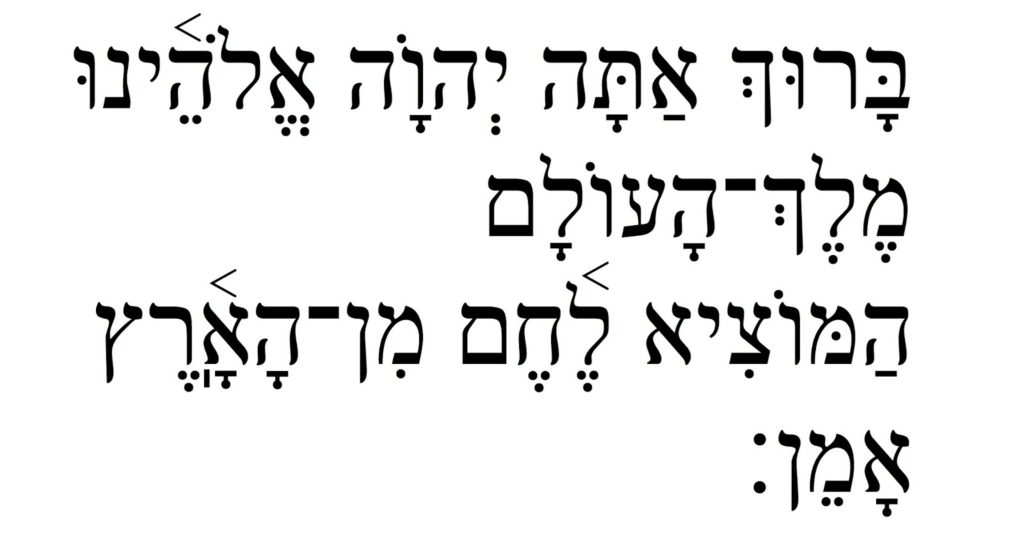
I mentioned that I am studying Hebrew this semester, and in class, my teacher shared with us the words pictured above, which comprise a Hebrew Table Prayer (i.e., a prayer that would be said before a meal by an observant Jewish family).

Translated, the prayer goes something like this (words in [ ] convey additional meaning implied in the Hebrew):

Blessed are you, O LORD [God of covenant] 

Our God, [God of creation]

King of the universe [eternal king]

Who brings forth bread [food]

From the earth.

Amen.

As this illustrates, the briefest of prayers can convey great meaning, and simplicity can possess great power:

As the God of covenant, we are reminded that God desires relationship with his people, and that it is through our relationship with him that all spiritual blessings come. As the God of creation, we are reminded that everything which exists exists because God made it—we owe Him our very existence. As the eternal King of the universe, we are reminded that God’s dominion and authority extends over all things, and throughout (and beyond) all times. And as the One who brings forth food from the earth, we are reminded that we are dependent on God for our daily survival; He is our Sustainer as well as our Creator.

Some very important reminders in just a few simple words. Don’t sell short the power of a short prayer; it can convey the deep truths of life and faith!

« Older posts Newer posts »

© 2026 The Doc File

Theme by Anders Noren — Up ↑