The online journal of Luke Dockery

Category: Ministry (Page 4 of 17)

Raising Up Ministers: Six Unhelpful Trends in Churches of Christ

If you pay any attention to these sorts of things, by now you are well aware that there is a ministry crisis in churches: there are far more churches seeking ministers than there are ministers seeking churches. This is a widespread phenomenon in churches (of various groups and denominations) within the United States, as indicated by a much-discussed Barna study. Looking more specifically at Churches of Christ, The Christian Chronicle has covered this multiple times. I even blogged about it myself in a roundabout way last year.

Despite all of the attention given to this very real problem, much of the focus has been on reasons why people leave ministry. An examination of those reasons is really important, but I think we also need to examine reasons why we are not training nearly as many ministers as we once did. There are groups out there that are working hard to encourage and train young people who have an interest in ministry (Harding’s Kerusso Experience is a great example of that; Lads to Leaders/Leaderettes and Leadership Training for Christ ostensibly do this as well), but I think a key aspect in this discussion—at least within the context of Churches of Christ—is for us to acknowledge some trends that have developed over several decades that are working against us when it comes to instilling interest in ministry in people at a young age.

So, why is it that we don’t train as many ministers as we once did? I’m sure there are lots of reasons, and what I am about to suggest is not intended to be an exhaustive list, but it is a start. For each trend I discuss, I’ll offer a question to prompt reflection on how we might respond, in light of these trends.

To be clear, I am not suggesting that these trends are inherently negative in and of themselves. They have had the effect, however, of making the practice of raising up ministers within the local congregation more difficult. 


1. Transitioning Away from a Small Church Fellowship

Historically, Churches of Christ have been a small church fellowship. As of 2015, nearly 90% of congregations within Churches of Christ had less than 200 members (see chart below).
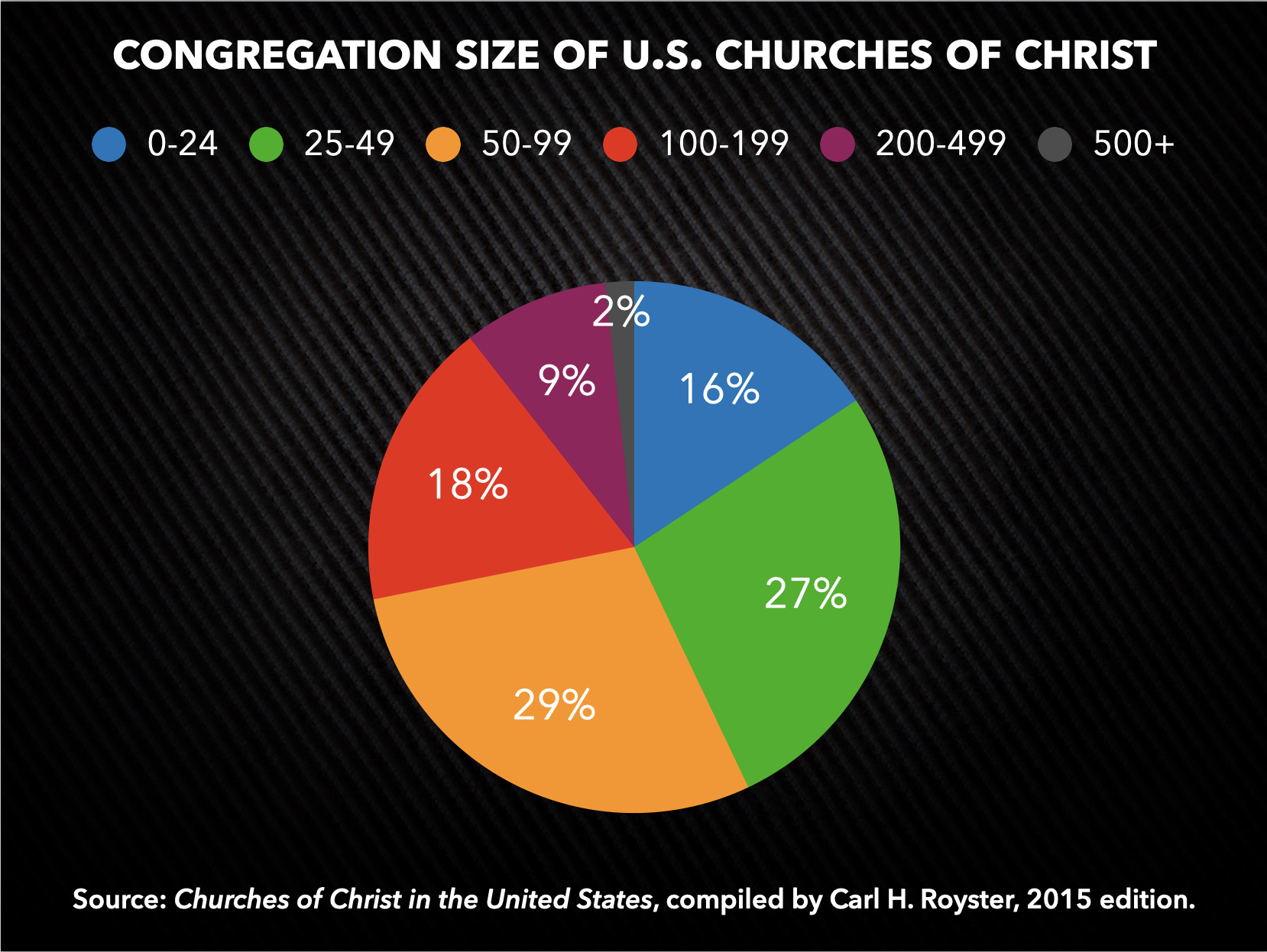
Over time, though, this trend is slowly changing. The United States is becoming increasingly urbanized, where small towns shrink and dry up as people move off for other opportunities, and as this happens, the small churches in those small towns dwindle as well. You probably hear statistics about “X number of churches close their doors every week/month/year….” Well, those churches are overwhelmingly small churches. It’s not that all of the Christians are disappearing and it’s certainly not that all of our churches are growing larger, but there is a shift that is occurring of members from smaller churches consolidating with larger ones as they move to cities, or as their previous congregations shrink beyond the point of sustainability.

Why does trend matter? Because small churches produce a disproportionate amount of preachers. This occurs because it is in small churches where young men receive opportunity to serve and lead. This comes out of necessity—there are jobs to be done and tasks to be performed, and no one else to do them. On the other hand, at larger churches, there are many more people willing to serve and lead, and you actually have to look for opportunities to get young people involved.[1]

In a context where more of our churches are larger, how can we create spaces for young people to have opportunities to lead in worship?

2. The Transformation (or Elimination) of Sunday Nights

I do not know the full history of the traditional Sunday night worship services in Churches of Christ. I know that for many years, it was essentially a carbon copy of what we did on Sunday mornings, but that they also tended to be less formal: men were less likely to wear suits, women were less likely to wear dresses, men who didn’t normally make it into the Sunday morning rotation got to lead singing, and in many churches, you would have occasional singing nights or youth worship nights where young men would have opportunity to serve. At the previous congregation where I worked, we had a monthly Youth-Led Worship where we would meet early to help young men practice and prepare, and then kids and teens would lead the entire service (prayers, songs, Lord’s Table, lesson, etc.).

Over the course of my lifetime, though, I have increasingly become aware of churches moving away from a traditional Sunday night service. Some churches have moved from a combined worship service to a small group model, and meet in members’ homes. Other churches have moved from a worship service to a Bible class format. Others have canceled evening services and replaced them with service projects. Others have canceled them and replaced them with nothing.

And, anecdotally, I would say that larger churches (i.e. the ones that already struggle to give young people a place to lead and be trained in leading worship) tend to be the most likely to abandon the traditional Sunday night service (removing yet another opportunity for training).

These Sunday night changes might be quite beneficial on the whole for the congregations in which they are occurring, but realistically, it still represents a lost venue for young people to have opportunity to lead.

In a context where the Sunday night service is disappearing, when and where can young people have opportunities to lead in worship?

3. Transition from Sect to Denomination: the Loss of Confidence and Importance

These next two trends have been developing for decades, but are helpful, I believe, in understanding so many things about Churches of Christ, especially in the 20th century and beyond.[2] First, a couple of definitions:

Sect: A religious organization that insists that it—and it alone—constitutes the entirety of the kingdom of God. Typically, a sect stands in judgment both on other religious organizations and on the larger culture in which it exists.

Denomination: In the American context, a church that recognizes it is only a part of the universal body of Christ. A denomination has typically made its peace with the dominant culture in which it exists.[3]

In other words, a sect is a group that emphasizes distinction: the call is to be radically different from the world, and to view other religious groups somewhat antagonistically. A denomination, on the other hand, tends to emphasize (or at least accept), being part of a larger whole: one “type” of Christianity amongst others, living in the context of the world.

This is a sociological description rather than a theological prescription: I’m not making the claim that this is a good development, but rather, that it is an accurate description of what has largely (not universally) happened within Churches of Christ over the last 100 years.[4] There was a time that Churches of Christ largely believed that “they were the only ones going to heaven” and that other believers, while they may be sincere, were sincerely mistaken, and not “true Christians.”[5] That still exists, but is much less prevalent than it once was. There are many in Churches of Christ today who have little to no appreciation of Restoration history or theology and would broadly claim that one church is as good as another. Others would hold strongly to certain doctrinal teachings, but still show a greater degree of both self-critique and approval of other groups than was true in the past. All of this reflects the shift from sect to denomination described above.

This is relevant to the issue at hand, I think, because this transition reflects a shakiness in our self-understanding: at one point, we were convinced that we taught the truth, while others were in error. This gives confidence in the importance of the preaching task: not only do we need to let the unchurched know about Jesus; but we also need to let the incorrectly churched know the truth about the importance of baptism, acceptable worship, and proper church governance. Virtually everyone is in error and, thus, in trouble, and we know the answer. This confidence and importance provide great motivation for dedicating a life to preaching.

On the other hand, if we are less confident in the rightness of our belief, and maybe many of our neighbors in other Christian groups don’t really need us to straighten them out, a life of preaching seems less important and less desirable.

In a context where we are less certain of our exclusive access to the truth, how can we still convey the value of preaching and other forms of ministry?

4. Transition from Sect to Denomination: at Home in the World

The other part of this transition is a feeling of comfort and belonging the world. In the early 20th century, this did not describe Churches of Christ. The early 1900s witnessed the growing split between the less educated, lower class, and theologically conservative Churches of Christ and the more educated, higher class, theologically liberal Disciples of Christ. As the split spread and then formalized, the Disciples often found themselves with the nice church buildings (now adorned with pianos) and standing in society, while the Churches of Christ were left with little in capital, real estate, and social standing.

Most members of Churches of Christ were not wealthy, and had no expectation of being so. This began to change in the economic boom following World War II, as wealth increased across virtually all demographics in the United States. Economic blessings led to nice, new church buildings, prestige in society, and changing expectations.

Those in ministry will tell you that a common barrier to young people entering ministry is discouragement from their parents because of financial concerns. The feeling is that ministry does not pay well (often true), and parents will often emphasize financial security over God’s call. My suspicion is that this parental discouragement stems from this broader transition to affluence: back when all of us were poor, being poor as a preacher was no worse than anything else. As our bank accounts have swelled, the desirability of preaching has diminished.

In a context where we value and respect financial security, how can we better compensate those in ministry so it is a more desirable option? How can we disciple all of our people to place less value upon financial security?

5. Secularization and the Loss of the Minister’s Prestige

Another major transition that has been going on in our society for a long time is increasing secularization. We have increasingly carved out spaces where God is not allowed (physically and metaphorically), a higher percentage of people no longer claim faith of any kind, and even people who are Christians increasingly view the world through secular lenses.[6]

In our increasingly post-Christian society, being a preacher (or some other type of minister) doesn’t bring the same sort of respect and prestige that it once did. In frontier America, where formal education was sparse, people tended to be self-taught, and many were illiterate, the preacher was often the most educated person in the community. It was naturally assumed that this was a person who had done some serious learning, and had something to say that was worth listening to.

This is no longer widely assumed. Many people are highly educated, and have access to tools that allow them to study Scripture in sophisticated ways. More than that, in a highly-secularized society, a minister may be well-educated, but the assumption may be that his or her education is fundamentally not valuable: if the Christian faith is ultimately a fairy tale, why should we be impressed that you are well-versed in it?[7]

In a context where ministers are not respected within society, how can we raise the level of respect they are shown in our churches? How can we disciple all of our people to place less value on the opinions of others?

6. Disquiet around Gender Roles

You are likely aware that the debate about gender roles is raging in Churches of Christ. This is certainly not unique to us, but what is relatively distinct is our practice of congregational autonomy: there is no denominational hierarchy dealing out an official position on female inclusion in church leadership, so individual churches have the task of interpreting the teachings of Scripture and applying them in their own contexts. In practice, this means that Churches of Christ are kind of like the wild west, where different churches have their own rules and understanding. Thus, you can find a variety of practices within Churches of Christ, ranging from full egalitarianism to full patriarchalism to all sorts of shades and variations in between.

Historically, this was not the case. Until fairly recently, for a long time, the broad consensus was that church leadership was for men, and the concept of “church leadership” was defined in such a way that it included any sort of up-in-front role during the worship assembly. Things are much different now: you really can’t assume where a given church is on this issue without doing some research, and honestly, a lot of churches themselves aren’t sure where they are on the issue.

My goal here is not to adjudicate this issue or tell you what you should think about it; rather, I am simply acknowleding that the landscape of Churches of Christ is much more confusing in this area than it once was, and I think it has ramifications for our actual topic at hand, helping to plant the seed of ministry within young people in our churches.

For churches that are clear about their positions on this (at one end of the spectrum or the other), it’s not really a problem, but for the large (and growing) number of churches that are somewhere in the middle and are trying to figure out what is permissable and what isn’t, it becomes a lot more complicated, and special worship services led by young people tend to bring a controversial issue front and center.[8]

In a context where gender roles are such a controversial topic, how can we seek to train young people in a way that doesn’t foster division and strife?


[1]This is easier said than done: we get nervous in front of people, and the larger the group of people, the more nervous we tend to get. So a young man who might be willing to present a lesson in front of 50 people will likely be less willing to do the same lesson in front of 500 people. Expectations of quality and professionalism tend to increase in larger congregations as well, placing a greater burden and barrier on young people who are inherently inexperienced and less skilled.

[2]What I present here will naturally be simplified and reductive. For fuller expositions on this topic, see David Edwin Harrell, “Emergence of the “Church of Christ” Denomination” (1972), and Richard T. Hughes, Reviving the Ancient Faith: The Story of Churches of Christ in America (Abilene, TX: ACU Press, 1996). Harrell and Hughes are two of the most respected historians within the Stone-Campbell Restoration Movement. Theologically, they were at different ends of the theological spectrum of Churches of Christ, but their sociological analyses of the transition of Churches of Christ from sect to denomination are closely in sync.

[3]These definitions come from Hughes, Reviving the Ancient Faith, xii-xiii.

[4]Indeed, I would argue that both of these categories fall short of how Jesus would have citizens of His kingdom envision themselves.

[5]There is good reason to argue that this sort of sectarianism betrayed the unifying vision of the early leaders of the Stone-Campbell Restoration Movement, but that is beyond the scope of this article. The point is simply that there was a time when this was a widespread and common belief amongst those in Churches of Christ.

[6]As famously argued in Charles Taylor’s A Secular Age.

[7]It should be added that some of the loss of respect felt toward those in ministry is self-inflicted: the constant drumbeat of those in various forms of ministry, across denominational affiliation and the theological spectrum, who abuse that position through sexual sin, financial dishonesty, or other types of abusive behavior have greatly diminished the public trust in those in ministry.

[8]This may seem counterintuitive to some readers: why would it be problematic to have a youth-led worship service that reflected the same gender roles that a regular worship service would have in that context? I understand the question, but it does seem to make a difference, for at least three reasons. First, young people, especially teens, tend to be more rebellious and push the envelope more than those of older generations. So, you might have lots of women who are very comfortable in traditional gender roles in the church, but that doesn’t mean that teenage girls are. Second, you may have parents who are generally okay with the ways things are for themselves, but feel the need to advocate for greater opportunities for their daughters. Third, there are some people who are fine listening to a sermon from a well-trained male preacher but start to ask questions when listening to a 12-year-old boy offer a fairly shallow (and sometimes theologically heterodox) lesson.


A Reminder for Task-Oriented Ministers

I am a very task-oriented person. I begin each day with a (fairly lengthy) to-do list of objectives to complete, projects to inch forward, and emails to send. This seems to be bound up in all sorts of instincts and characteristics that are, apparently, inherent in my personality:

  • As an introvert, I draw energy from accomplishing tasks alone rather than being around others.
  • As a conscientious person, I want to do a good job and be productive, and desire tangible evidence of that.
  • As someone inclined toward certain compulsive behaviors, making and checking off lists feels very satisfying.

So, yesterday was a challenging day for me. It was a day that was literally filled with meetings (with groups or individuals) from 9 AM until after 4 PM. Meetings are hard for me, and a day of meetings even more so—I am drained from the constant interaction with others, and also left to feel frustrated by the fact that I haven’t accomplished anything “productive.” As I was leaving the office yesterday afternoon, a sense of gloom hovered over me as I thought about how I had “wasted the whole day.”

As I was chewing on these feelings, though, I was reminded of the following words from Practical Wisdom for Youth Ministry by David Fraze (the book is about youth ministry, but the words apply to ministry in general):

People over programs. There will always be interruptions in a youth minister’s day. Yes, your time, planned and otherwise, should be managed appropriately. However, when faced with a decision to set aside working on an upcoming event for the sake of ministering to a person, the person wins. This phrase reminds me to focus on the reason I do what I do as a youth minister. It is the people, not the program.[1]

I was easily reminded of these words because I had read them aloud the previous night to the students in the college youth ministry class I am teaching! People are at the center of ministry, and while my projects, objectives, and tasks are all intended to help people (albeit, often in an abstract, long-term sort of way), these things cannot be prioritized over actual relationships with other people.

So, from a different perspective, yesterday was one of the more productive days I’ve had in a while:

  • I met and prayed with fellow staff members, talking about the blessings and struggles of our lives, praying about those things, and discussing our shared work at the Cloverdale church.
  • I got to share a meal with a good friend in ministry; we shared plans and frustrations, and I got to invest in the ministry of a younger minister.
  • I met with other youth ministers from the Searcy area. We debriefed a recent combined event, began making plans for next year, and grew closer together as a group.
  • I studied Scripture and prayed with my youth ministry apprentice, made plans for a mid-week youth group praise night, and I tried to pass on a couple of lessons to him that I had gleaned from my many years in youth ministry.

There were some projects that I would have liked to work on yesterday that I didn’t get to, but from the proper perspective, it was a good day, because it was a day spent around people. It was a reminder that this very task-oriented minister needed.

Photo by Glenn Carstens-Peters on Unsplash


[1] David Fraze, Practical Wisdom for Youth Ministry: The Not-So-Simple Truths that Matter (Abilene, TX, Leafwood Publishers, 2018), 217.

New Projects

I have not written as much recently here on The Doc File as I would like, largely because I have been busy with other things:

To this list, most recently I have added a new project: my good friend Kevin Burr and I launched Regnum Media, a publishing house that will produce scholarly-yet-accessible Bible studies that are primarily intended for use in adult Bible classes as well as personal study. Regnum Media will be operating in partnership with the Center for Christian Studies, and will serve as the publishing imprint for CCS. CCS seeks to provide “scholarship for the church,” and has been doing this in excellent fashion already through video teaching modules and a scholarly journal that is released three times per year. We are excited to partner with CCS in this good work.

From the CCS press release about our partnership, here is a quotation from yours truly:

In our years of congregational ministry, both Kevin and I have become keenly aware of the need for quality Bible class resources that are trustworthy, scholarly, and engaging, and it was with this need in mind that Regnum Media was formed.

Regnum is the Latin word for ‘reign’ or ‘rule,’ and from the beginning it has been our goal to work for the good of the Kingdom, using our humble efforts to help the reign of God come more fully on earth as it is in heaven. We believe that quality biblical teaching that leads to discipleship in the local church is a key ingredient of that, and we are thrilled with the opportunity to partner with the good work that CCS is already doing in this regard.

We are planning to release four titles in 2023, including a version of my Ecclesiastes material specifically geared toward adults. You can follow our Facebook page to keep up to date on news and releases.

I still remain fully committed to all of the various roles and projects listed above, and intend to keep writing in this space as well. There are busy days ahead, but my hope is that God can use my humble efforts in the advancement of His kingdom.

Staying In Ministry (My “Keep Going” File)

I have a horizontal file cabinet in my office, filled with files on old youth group events, study materials, elders’ meeting minutes, tax receipts, and all sorts of other things. I have one file labeled, “Keep Going.”


You may or may not be aware of this, but there is somewhat of a ministry crisis in churches: there are more churches seeking ministers than there are ministers seeking churches. This was likely true before the pandemic, but the last two years have only accelerated the problem, as more and more people are checking out of full-time youth ministry:

  • Somewhat famously, Barna released a study in late 2021 where 38% of ministers in US said they had given “real, serious consideration to quitting being in full-time ministry within the last year.”[1]
  • I regularly hear about new churches looking for ministers, and it seems to me that youth ministers are particularly in demand.
  • When I moved to Searcy 2.5 years ago, there were eight other youth ministers in area Churches of Christ. All of them had been in their positions for at least four years; some more than ten. Now, six of the eight are no longer in their positions.[2]
  • Jim Martin, Vice President at Harding School of Theology and someone who has a good awareness of the status of things in Churches of Christ, recently said, “I don’t know of another time in my lifetime when this many ministers have left full-time ministry during such a period of time.”[3]

Serving as a minister is an honor. From my perspective, ministry is wonderful in so many ways. I feel so privileged to be paid to devote significant time to studying Scripture, theology, and ministry and share what I learn with my students and church family. Furthermore, it is such a blessing to be able to work alongside teenagers, watch them grow and change, and seek to help them mature as disciples of Jesus. 

Serving as a minister is also a burden. Teaching comes with great responsibility (James 3.1). Working with teenagers and their parents can present all sorts of challenges. Ministers are easy targets for criticism from a variety of angles. Some criticism is valid and some is not, but almost all of it hurts, at least somewhat. When people choose to leave the church where you work, it is hard not to take it personally. Leading through conflict and controversy is tiring, and especially over the last couple of years, there has been no shortage of controversy (politics, COVID-19, racial issues, etc.). 

To be honest, sometimes it seems more like a burden than an honor, and although it always makes me sad when I hear that someone is leaving ministry, it doesn’t really surprise me. Ministry is great, but it is hard.


In my early days as a youth minister, I didn’t know much about what I was doing.[4] I didn’t originally intend to go into ministry, and I didn’t study ministry in college. I was also embarrassingly arrogant, and so I thought that I knew much more than I actually did. It is a little surprising, then, that I decided to read my first book on youth ministry: Things They Never Taught You About Youth Ministry That You Really Need To Know.[5] I actually didn’t love the book, but I value it greatly for two reasons. First, it represents the first small step in what became a massive shift toward me becoming a lifelong learner and student of youth ministry. Second, it taught me about the importance of a “Keep Going” File.[6]

There is nothing particularly profound about the idea, but it has certainly been powerful in my own life in ministry. Basically, the idea is this: every time someone writes you an encouraging note, keep it and add it to the file. Maybe someone tells you they really appreciated your sermon, or that you have had a major impact on their lives. Perhaps they thank you for your work in a specific effort, or maybe a simple note of general appreciation. Whatever it is, keep it and put it in the file. And then, when you have one of those days (or weeks, or seasons) where ministry feels more like a burden than an honor, pull out the file and read what you have collected.

Several weeks ago, I was discouraged about something (or, more accurately, several somethings), and I pulled out my Keep Going File. I read through comments from a wide array of folks from my past and present. I smiled as I read, and maybe even shed a tear or two. I put away the file, encouraged by what I had read, and determined to Keep Going.

Because ministry can be a burden, but it is also a great honor.


This post is written largely to fellow ministers to share a practice that I have found helpful. I realize, though, that many of my readers are not ministers, so here is a word directed to that crowd: encourage your ministers. Encourage is such a great word. When others are struggling and lacking in courage, we can instill courage within them by the things we say (or, we can rob them of what courage they have remaining). Write a card to show your ministers that you appreciate them; it may have far more value than you would ever expect.


[1] Of course, as this article points out, that doesn’t mean that 2/5 of Christian ministers are about to walk away. Just because you give serious consideration to something doesn’t mean you do it, and I think the percentage of those walking away from ministry is far less than 38%. At the same time, I suspect it is far higher than the 3% suggested in the linked article above.

[2] Of the six, two transitioned to different ministry positions within their same congregations, one left for a youth ministry position at a different congregation, and three are no longer in congregational ministry. I am not claiming that these transitions were caused by the pandemic, but they all occurred during it.

[3] Jim Martin, et al., “Pastoral Care in the Pandemic,” Journal of Christian Studies 1 (January 2022): 75.

[4] This is a sentiment that prepared me well for doing youth ministry in a pandemic, when I never felt like I knew what I was doing.

[5] Todd Clark, Things They Never Taught You About Youth Ministry That You Really Need To Know (Joplin, MO: 1996).

[6] Ibid., 109-110. Doug Fields, Your First Two Years In Youth Ministry (Zondervan: 2002), 57-58, makes the same suggestion, but calls it an “Affirmation File.”

Jesus Loves the Little Children

I am a youth minister, and the central task of my ministry is helping young people develop a mature faith in Jesus Christ that will last throughout their lives. The Bible has a lot to say about that, and over and over teaches that two groups—the physical family and the faith family—share the responsibility for passing faith to the next generation. The Bible also talks about Jesus interacting with children, and I think those interactions also provide some theological foundations for the way we should treat young people in our families and in our churches.

The gospel writers go out of their way to tell a similar story time and time again.[1] People bring their children to Jesus so that He can bless them. The disciples assume that kids are beneath the notice of a great rabbi, and so they try to turn them away. Jesus, however, rebukes the apostles, and uses the situation as a teaching opportunity.

There are a few principles that we can glean from these situations:

Children are really important to Jesus. In ancient cultures, children (especially sons) were valued as heirs, but generally speaking, they were not valued as individuals until they reached adulthood. The apostles thought that Jesus was too busy to be bothered by children, but Jesus turned that thinking on its head by stopping whatever He was doing and receiving the kids who were brought to Him. Clearly, Jesus thought that children were important and of great value.

The kingdom of heaven belongs to children. Repeatedly, Jesus makes the point that His disciples must become like little children in order to enter His kingdom. Just as children are vulnerable and trustingly dependent on their parents, so we as disciples of Jesus Christ need to acknowledge our ultimate helplessness and totally depend on our Heavenly Father. This is an especially counter-cultural message for those of us who live in a society that holds up self-sufficiency and independence as virtues to be emulated.[2] Instead of these values, Jesus says that citizens of the Kingdom should rely entirely upon the King.

Treating children well is connected to treating Jesus well. As mentioned above, children did not occupy an enviable position in ancient cultures. They were the least important and least powerful members of their communities. Repeatedly, though, Jesus emphasizes the upside-down values of His kingdom, where those who give up their lives for His sake are saved, and those who humbly serve and welcome the weak and powerless are considered to be great. Furthermore, Jesus goes on to say that to welcome people like this, including children, is the same as welcoming Him and His Father.

These principles should cause us to pause and ask ourselves some important questions:

Do we treat our children like they are important to us? In a society in which youth is idolized and parents often live vicariously through the athletic accomplishments of their kids, this may seem like a ludicrous question at first, but hear me out. As parents, are we willing to interrupt our busy schedules, stop what we are doing, and deliberately focus on passing faith onto our kids? As churches, are we willing to alter the things we are doing in order to build lasting faith in our kids, even if it is harder and less efficient than entirely outsourcing their spiritual training to a youth minister?

Do we include our children in God’s kingdom? It is common to hear well-meaning Christians talk about young people as the “church of tomorrow”. I understand what is meant by that statement, and certainly we do want our children to be active leaders in the church of tomorrow. At the same time, I think it reveals some faulty thinking, because a key part of building faith in young people is for them to be active in the life of the church now. Do we enable and encourage our kids to be active in the worship, service, training, and fellowship of God’s kingdom now, while they are young, or do we make them wait until they are adults before we include them?

Do we enable and encourage our kids to be active in the worship, service, training, and fellowship of God’s kingdom *now*, while they are young, or do we make them wait until they are adults before we include them? Share on X

Are we treating Jesus well by treating His children well? No one likes to be accused of not treating their children well. Having said that, if, as a physical family or as a faith family, we are engaged in practices that make it less likely that our kids will develop a lifelong faith, can we really claim to be treating our children well? And based on the words of Jesus Himself, if we aren’t treating our children well, what does that suggest about how we are treating Him?

Based on the words of Jesus Himself, if we aren’t treating our children well, what does that suggest about how we are treating Him? Share on X

I think all of these questions bring us to the idea of stewardship. God has entrusted us—both in our physical families and in our church families—with His children. We tend to think of them as ours, but truly, ultimately, they are His. “Our” children belong to God. Jesus’ interactions with children in Scripture and the questions above call us to reflect upon our roles as stewards: how are we taking care of God’s kids?


[1] See Matthew 18.1-6; 19.13-15; Mark 9.35-37; 10.13-16; Luke 9.46-48; 18.15-17.

[2] Stephen W. Dixon, “What’s So Special About Children? A Reconsideration of the Use Made of Scriptures such as Matthew 18:1-5 in Advocating the Importance of Children for the Church,” Journal of Childhood and Religion 5, no. 1 (January 2014): 28, 33.

The image above comes from Season One, Episode Three of The Chosen, “Jesus Loves the Little Children”. It is a beautiful episode which, I believe, does an excellent job of conveying the special concern that Jesus had for children and the attention he paid to them.

« Older posts Newer posts »

© 2026 The Doc File

Theme by Anders Noren — Up ↑