The online journal of Luke Dockery

Category: Ministry (Page 8 of 17)

Reading in 2014

Those who have followed this blog for a while know that I keep track of the reading I do and then at the beginning of each new year, post the list of the previous year’s reading. For some reason, this is something I enjoy doing, and others seem to enjoy it as well.

Here is my reading list for 2014:

  1. The Complete Calvin and Hobbes Book Two, by Bill Watterson
  2. In the Name of Jesus: Reflections on Christian Leadership, by Henri Nouwen
  3. The Gospel for Teenagers: An Old Message for Young Hearts, by Scott Bond
  4. Fit For The Pulpit: The Preacher & His Challenges, edited by Chris McCurley
  5. Social Media Quick Design: Instagram, by Lauren Hunter
  6. Sticky Faith: Everyday Ideas to Build Lasting Faith in your Kids, by Kara E. Powell and Chap Clark
  7. How Great Is Our God: What God Wants Us To Know About Him, by Justin Morton
  8. The Knight of the Lion, by Constance Hieatt
  9. Yolo: You Only Live Once, by Scott Bond
  10. Basics of Biblical Hebrew Grammar, by Gary D. Pratico and Miles V. Van Pelt
  11. Surprised By Hope: Rethinking Heaven, the Resurrection, and the Mission of the Church, by N.T. Wright
  12. George MacDonald, by C.S. Lewis
  13. Red Square, by Martin Cruz Smith
  14. Esau’s Doom, by Michael Whitworth
  15. An Introduction to the New Testament: Contexts, Methods & Ministry Formation, by David A. deSilva
  16. Headed to the Office: How Teens Become Real Men and Elders in the Church, by Glenn Colley
  17. Backgrounds of Early Christianity, by Everett Ferguson
  18. An Outline of New Testament Introduction, by Allen Black
  19. A Grief Observed, by C.S. Lewis
  20. Harry Potter and the Sorcerer’s Stone, by J.K. Rowling
  21. Star Wars: In the Shadow of Yavin, by Brian Wood and Carlos D’anda
  22. Harry Potter and the Chamber of Secrets, by J.K. Rowling
  23. Harry Potter and the Prisoner of Azkaban, by J.K. Rowling
  24. The Treasure Chest of Grace, by Wes McAdams
  25. Bethlehem Road, by Michael Whitworth
  26. Evil in Modern Thought: An Alternative History of Philosophy, by Susan Neiman
  27. Heaven on Earth: Realizing the Good Life Now, by Chris Seidman and Joshua Graves
  28. Growing True Disciples, by George Barna
  29. Seven Congregations in a Roman Crucible: A Commentary on Revelation 1-3, by Richard E. Oster Jr.
  30. Jasper Jones, by Craig Silvey
  31. Scribbles and Sketches, No. 1, by Ruby Jobey
  32. Tyranny of the Urgent!, by Charles E. Hummel
  33. Perspectives on the Doctrine of God: 4 Views, by Paul Helm, Bruce A. Ware, Roger E. Olson, and John Sanders
  34. Harry Potter and the Goblet of Fire, by J.K. Rowling
  35. Not Off Limits: Questions You Wish You Could Ask at Church, by Ross Cochran
  36. Hodge Podge: Powerful Proverbs, by Charles Hodge
  37. Who Is My Brother? Facing A Crisis Of Identity & Fellowship, by F. LaGard Smith
  38. Hurting With God: Learning to Lament with the Psalms, by Glenn Pemberton
  39. As I Remember It: An Autobiography, by Jack P. Lewis
  40. Harry Potter and the Order of the Phoenix, by J.K. Rowling
  41. If I Be Lifted Up, by Batsell Barrett Baxter
  42. The Shack: Where Tragedy Confronts Eternity, by William P. Young
  43. Meeting God at the Shack: A Journey into Spiritual Recovery,by John Mark Hicks
  44. Prophet and Priest: The Redefining of Alexander Campbell’s Identity, by Todd M. Brenneman
  45. What Shall We Say? Evil, Suffering, and the Crisis of Faith, by Thomas G. Long
  46. I Now Pronounce You _________: How Our Identity in Christ Informs Our Role As Husbands, by Jeff Grisham
  47. One Tree Hill: A Resurrection Message,  by Michael Whitworth
  48. Yet Will I Trust Him: Understanding God In a Suffering World, by John Mark Hicks
  49. Harry Potter and the Half-Blood Prince, by J.K. Rowling
  50. Creation Untamed: The Bible, God, and Natural Disasters, by Terence E. Fretheim
  51. The Complete Calvin and Hobbes Book Three, by Bill Watterson
  52. Four Views on Divine Providence, by Paul Kjoss Helseth, William Lane Craig, Ron Highfield, and Gregory A. Boyd
  53. The Copper Scroll, by Joel C. Rosenberg
  54. An (Extra)ordinary Christmas: 25 Days of Devotions for Christmas/Advent, by Stephen Ingram
  55. Harry Potter and the Deathly Hallows, by J.K. Rowling
  56. ESV Single Column Journaling Bible

In 2014, I continued reading eBooks on occasion (something I hadn’t done much before 2013), and I also increased the frequency with which I listened to audiobooks. Also, a lot of my list (38 of 54 I think), centered on theology, Christian living, ministry, Bible study, and church history. Given my vocation and studies, this is not surprising.

First, I read through the ESV Single Column Journaling Bible this year. I wrote about this bible earlier in the year, and I really couldn’t be more pleased with my decision to do my personal Bible reading out of it in 2014. It is a great product: the ESV is a good translation, the strap is handy for keeping it closed and tucking a pen in for taking notes, there is ample space for writing, and there is a good reading plan in the back. I have a ton of notes I made and insights I recorded in the margins, and even though I fell behind in blogging some of this, I know my journal notes will be helpful to me for years to come.

Backgrounds of Early Christianity by Everett Ferguson is a classic in its field, and I can see why. Ferguson writes clearly and with great scholarship, and provides invaluable background information on the context and culture of the early church. I wrote a review of Seven Congregations in a Roman Crucible: A Commentary on Revelation 1-3, by Richard Oster. I thought it was an outstanding book, and mention it in conjunction with Ferguson’s book because Seven Congregations also excels at providing background information which helps the reader to better understand the context of the Book of Revelation.

N.T. Wright’s Surprised By Hope: Rethinking Heaven, the Resurrection, and the Mission of the Church is well-known, and I was glad that I finally got around to reading it. Wright is brilliant, but is able to write in an easy-to-understand way. I shared a couple of quotations from the book which I enjoyed. Overall, I thought Wright had a lot of good things to say, but I wish we would have done a little more work grounding his view of a renewed and transformed earth as the location of “heaven” (I know he does that elsewhere, but I wish he would have spent more time on it in Surprised By Hope as well).

A couple of books related to doctrinal issues and Christian fellowship which I really appreciated were Ross Cochran’s Not Off Limits: Questions You Wish You Could Ask at Church, and F. LaGard Smith’s Who Is My Brother? Facing A Crisis Of Identity & Fellowship. I thought the greatest strength of Cochran’s book was his tone: as we address controversial issues in our churches, it is vital that we recognize that sometimes there are multiple possible interpretations on a given issue, and that even people with whom we disagree can be sincere people who are doing their best to understand and follow the Bible. The big takeaway from Smith’s book is his proposal for different levels of fellowship: I don’t agree with all of his conclusions, but on the whole I thought his approach was very insightful.

I took a class this fall on Providence and Suffering, and read a lot of books related to that topic. Yet Will I Trust Him: Understanding God In a Suffering World by John Mark Hicks (who, incidentally, was also my professor) was a really good look at the issue of suffering in the world. I think I would have enjoyed the book even more if I had read it straight through; instead, I ended up reading it in chunks as they were assigned in class. Hurting With God: Learning to Lament with the Psalms by Glenn Pemberton was perhaps the best book I read this year. It focuses on lament in Scripture, specifically in the Book of Psalms, and makes the argument that in our modern churches we have largely lost the ability to lament and, as a result, superficialized our relationships with one another and with God and, therefore, weakened our faith. I loved the book, have preached from it, and hope to share some quotations from it later. Also, for that same class, I re-read William Young’s The Shack. I had originally read it back in 2009, and posted some thoughts after doing so. Interestingly, I don’t really disagree with those thoughts, but on the whole, I appreciated The Shack much more this time than I did back in 2009. Perhaps my life experience since that time and the contact with suffering I have had has something to do with that.

For books in no way related to ministry or theology, the highlight of my reading year was definitely the Harry Potter series. For years I have had people (specifically my wife) tell me that I should read these books, but I knew that there were seven of them, that the last ones were very long, and I simply did not have the time (I am very busy and don’t have a lot of spare time for pleasure reading). However, one segment of my day that I always felt was wasted was the time I spend driving in my car. Caroline suggested that I try listening to the Harry Potter books in audio format, and I did that this year. The books are entertaining and well-written, and it made driving much more enjoyable for me. I’m actually sad that the series is over and am looking for something else to listen to in the car.

My overall book total increased from 50 in 2013 to 56 in 2014. I really did not expect to exceed my total from last year. Last year I had pushed to get 50 and since it stressed me out a little, I decided this year I would just read and let the total be what it may. Interestingly, with this approach I still ended up with more.

I got some great books for Christmas, and I have a long to-read shelf filled with books I am excited about. What were your favorite books from 2014?

For comparison’s sake, you can see the books I read in 2013, 2012, 2011, 2010, 2009, and 2008.
Where I’ve Been

It has been almost two months since I have written anything on The Doc File, and that is, admittedly, a long time. Not surprisingly, that absence has corresponded with a significant busyness in my life—some increased ministry responsibilities, a tough grad school class, and additional writing projects (to be announced at a later date) have taken any free time I would have had to write here.

So, sorry to those who have been looking for new posts and finding…nothing.

Hopefully, that will change in the coming days and weeks. This past semester I studied the providence of God and the problem of evil and suffering in the world, which has generated a lot of thoughts in my head that I’d like to get out in this, my online journal. And of course, also a lot of other random stuff which I enjoy writing about.

All of that to say: don’t give up on me. New stuff is coming.

Unity and Extremism

I live, work, and worship within the fellowship of Churches of Christ. Many of the readers of my blog do as well, though some do not. This post is primarily for those who do, but perhaps there will be something of use for those who do not.

Recently, it has (again) become apparent to me how strained (fractured?) that fellowship is. I should be clear up front that I am not writing this post in response to one specific event. Rather, it has been prompted by many things: in events I have witnessed, discussions I have had, and blog posts I have read, it seems evident to me that there are many within our fellowship—on both the right and the left—who are ready to throw up their hands and have nothing to do with those with whom they disagree. And that makes me sad…and thoughtful.

And as I was thinking, it became clear to me that there are two facts about me, two determinations about myself that I wanted to affirm.

First, I am determined to be biblical in my views. I do not claim any of the terms which people frequently use to label themselves. I do not desire to be conservative. I do not desire to be liberal. I do not desire to be traditional. I do not desire to be progressive. I really, really desire to be biblical though. I bet that means that sometimes I’ll hold views that some might consider to be “conservative”, and sometimes I’ll hold views that might be thought of as “liberal”. But my standard will always be what Scripture teaches, not what a labeled position is.

Secondly, in my relationship to my brothers and sisters in Christ, I do not desire to camp out on an extreme somewhere; I am determined to be a centrist. This position of moderation is not made out of apathy, but out of passion: it seems to me that it is only from the center that unity can occur; only from the center can I reach out to those on either side of me and try to understand and love them. In religious (and secular) history, the dangers of extremism have been seen time and time again, and I think the Bible teaches the importance of balance in our lives in many places and in many different ways (see, for example, Ecclesiastes 7.16-18; Luke 2.52; Matthew 23.23, etc.).

Of course, that second determination will still be governed by the first: I’ll make decisions based on the teachings of Scripture rather than what the “centrist” position would be, but a substantial amount of the time, I think those two ideals line up very well.

Unity is a messy thing. A lot of times, it involves compromise, and it means we don’t always get what we want. But I think it’s important to God that His children strive for unity, and so it should be important to us as well. But I don’t think it can be achieved through extremism—from either side.

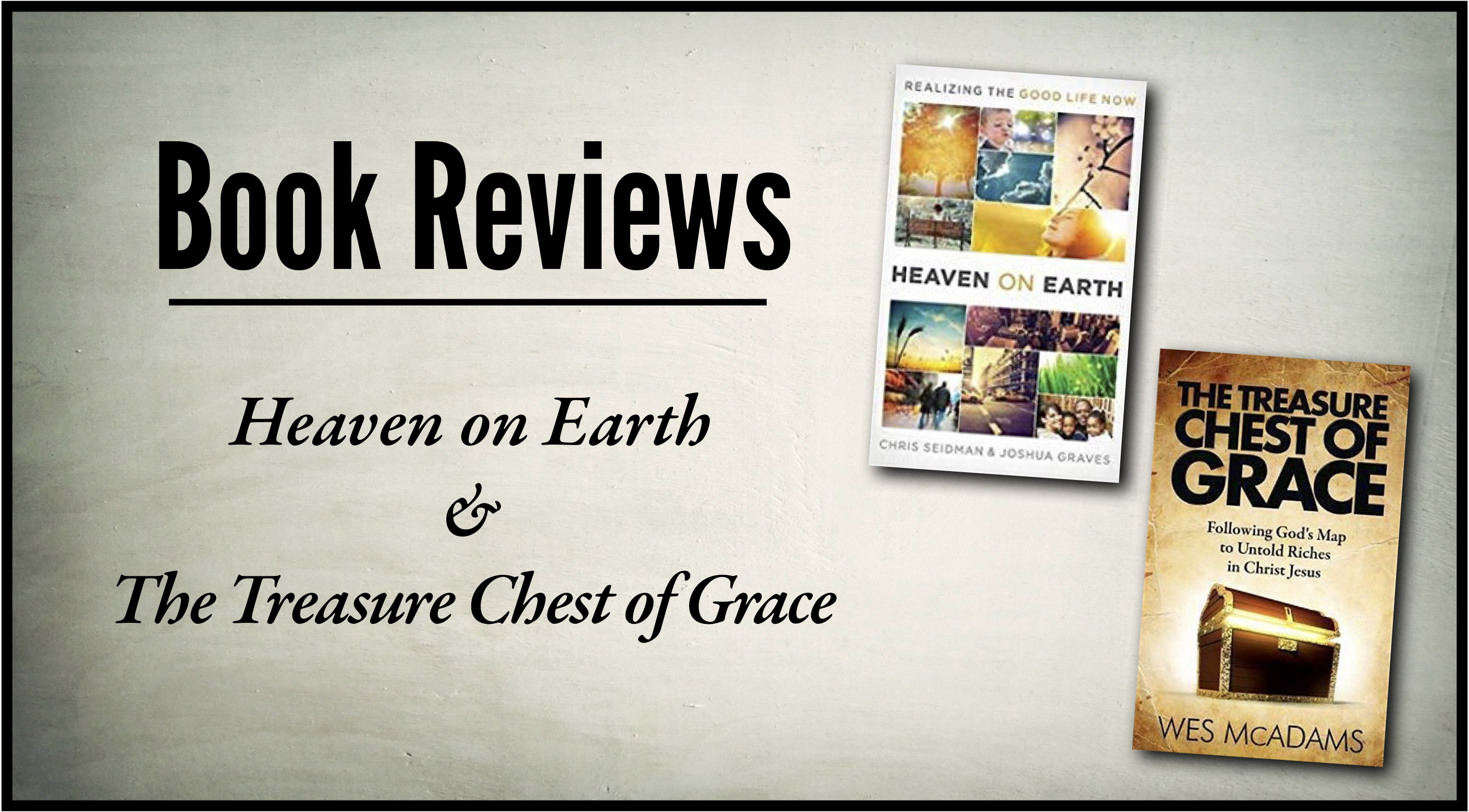
Two for One Book Reviews: Heaven on Earth and The Treasure Chest of Grace

I enjoy reading and sharing helpful things that I read with others. I like to read lots of different kinds of books, but as a minister and a theology students, a lot of what I read tends to focus on those areas.

As a part of my schooling, I read widely across the spectrum of Christianity. This invariably means that I read a lot of things I disagree with, but also that I am challenged to think about what the Bible teaches and what I believe frequently. That’s a good thing, I think.

Over the last several years, I have noticed a marked increase in the number of books being put out by ministers and thinkers within Churches of Christ. This is also a good thing, I think, and I have made an effort to read some of those books when I get the chance (and in the process, have come across some very good material). Having said all that, I wanted to offer some quick reviews of a couple of those books: Heaven on Earth: Realizing the Good Life Now, by Chris Seidman and Joshua Graves, and The Treasure Chest of Grace: Following God’s Map to Untold Riches in Christ Jesus, by Wes McAdams.

Heaven on Earth

Heaven on Earth was good, although it was not what I expected. The book is actually a careful examination of Jesus’ Beatitudes at the beginning of the Sermon on the Mount, and how living those out makes a difference in the here and now (while also identifying us as the kind of people who will be with Jesus eternally).

The subtitle, “Realizing the Good Life Now”, could potentially mean a lot of things, but basically, the authors assert that living this way (according to the Beatitudes) constitutes living the “good life”, and helps us to establish the ideals of God’s Kingdom on earth (to be clear, there are no hints of prosperity gospel nonsense in this book about how God wants us to be happy and therefore will shower us with material blessings if we are faithful to Him).

Each chapter covers a Beatitude, and discusses what it means as well as illustrating it with an abundance of real-life examples, mostly from modern day. The two authors do not write together, and instead, take turns writing different chapters. This is probably my main criticism of the book, as I think it gives it a choppiness in thought and style that wouldn’t be present if either writer was working entirely on his own.

Here are some good quotes:

“The good life is only possible in so far as God is involved. Experiencing the good life is more about what God has done and is doing that what we have done or are doing.” (xi)

“For Jesus, the kingdom of heaven had everything to do with life on this side of the grave while many of us are inclined to think it mostly has something to do with life on the other side. Consequently , we think of Jesus’ proclamation of the kingdom of heaven coming near as meaning through Jesus we now have access to the pace of heaven after we die. Even though this is one aspect of the context, it is not the entire context.” (3)

“The longer Paul dwelled in the kingdom of light the more aware he became of the darkness in his own life.” (16)

“Mourning is a pure vision of the large gulf between how things could be versus how things actually are.” (28)

“How do we respond to the pain and suffering that haunts us? Something’s amiss. Is life beautiful? Yes. But just on the horizon of its inherent beauty is a wild storm, waiting to tear everything to pieces, total destruction. Life is beautiful. But life is also deadly, depressing, and full of pain.” (33)

“Doing the right thing—whether individually (righteousness) or collectively (justice)—is always a primary interest of God in the prophets, because a life is the totality of choices made for the individual and the community.” (57)

“The person you are setting free when you reconcile is yourself.” (99)

“The most dangerous believers in the world to the kingdom of darkness are the ones who live as though they have nothing to lose.” (109)

“Faith is about seeing the world as God sees it. Not simply seeing the world for what it is—in all its paradox of beauty and death—but also seeing the world for what it will one day become.” (131)

The Treasure Chest of Grace

The Treasure Chest of Grace focuses on the fact that we have been saved by grace—nothing we have done or can do on our own has any bearing on salvation apart of the gracious acts of God on our behalf—and then sets about determining what conditions we must meet in order to become recipients of that grace. This is where the “map” of the subtitle comes in: the pages of Scripture reveal to us what we must do in order to come into contact with God’s grace.

This book differs significantly from Heaven on Earth in that McAdams uses no stories or modern-day examples to prove his points; he only uses Scripture. This is by design: “I have made every effort in this book to prove every point with Scripture, and only Scripture. No quotations of man are used to prove any point, only words inspired by God” (8). I understand his reasoning and certainly agree with him at the core (we should base our religious beliefs on Scripture, not something else), but I think the writing suffered somewhat as a result: a short book peppered with hundreds of Scripture references and no other illustrations or examples is harder to read. My other gentle critique is a subjective one: I don’t like really short chapters. The main body of the book is 144 pages long, and those pages are divided into 25 chapters, rendering the average chapter as a little less than six pages long. Constantly shifting from chapter to chapter gives the reader the impression that some thoughts haven’t been well developed (which I don’t think is true, I just think that many of the “chapters” would function better as sections within longer chapters).

Anyway, on to the quotes:

“Man is utterly incapable of earning the things we receive from God. This does not mean, of course, that we are incapable of obeying Him, pleasing Him, honoring Him, glorifying Him; but we must remember that by doing so, we have earned nothing.” (16)

“When people try to save themselves, they are communicating to God that they have no need for His grace.” (25)

“If there were nothing man had to do to receive salvation, there would be none who were lost.” (46)

“Too often people have assumed that because God freely gives grace, He gives it without conditions.” (78)

“Unfortunately many in the religious world have tried to sever the biblical ties between salvation and baptism” (97)

“Man is not saved because he obeys the gospel; he is saved when he obeys the gospel. The gospel itself, not the obedience of man, is the reason man is saved.” (106)

“Your salvation lies at the lace where His “amazing grace” meets your “trust and obey”.” (152)

“Do not mistake the emphasis on baptism to mean that it is more significant than it really is. Nor should you make the mistake of assuming baptism is meaningless or insignificant. Because it is a part of God’s plan to redeem man, it has great importance. But without the blood of Christ, baptism is nothing more than a glorified bath.” (155)

I thought both of these books were short, easy-to-read, helpful treatments of two very biblical ideas: what living the Beatitudes means for us as citizens of God’s Kingdom, and how God’s grace and our obedient faith work together in the act of salvation. I was thankful to have read both.

Dynamic Deacons

I haven’t been blogging much lately, which is usually an indication that I have been especially busy with other things. That is certainly the case right now—I am trying to finish up a challenging research paper, I have begun my fall class, and some ministry projects are requiring a good deal of time as well.

Briefly though, I wanted to offer a report on a seminar we had at our church over the weekend called Dynamic Deacons. Facilitated by Dr. Aubrey Johnson, the minister of the Peachtree City Church of Christ near Atlanta, this Friday-Saturday seminar was made up of five sessions which focused on the role, requirements, responsibilities, relationships, and rewards of serving as a deacon in the Body of Christ. The sessions were a combination of lecture and group discussion and were very practical.

Aubrey was a kind and engaging facilitator, and his love for the local church and his commitment to the importance and value of deacons was clear. I took notes throughout the weekend, and he also said a lot of wise things which I thought I would share:

Dynamic deacons always find a way forward.

Great churches are a consequence of great deacons.

When we do selfless acts that no one sees, God smiles.

God is not indifferent about indifference.

The most important thing you can do for God is to be the man your family needs.

Problems are often providence in disguise.

There are not enough jobs for everyone in the congregation, but there are enough teams for everyone to get on a team.

If you don’t have a real conversation, I don’t think you’re going to get a real commitment.

People do about as well as they’re led.

The congregation can’t be more united than its elders and deacons are.

To multiply your value to the church, build an incredible marriage.

I know that our deacons finished the weekend feeling encouraged and energized, and I am hopeful that some of the things that were discussed will lead to some positive, lasting changes. You can read more about Aubrey’s work, and schedule for him to come to your church, by going to his website; I certainly recommend his Dynamic Deacons seminar.

« Older posts Newer posts »

© 2026 The Doc File

Theme by Anders Noren — Up ↑