The online journal of Luke Dockery

Category: Books (Page 15 of 27)

Full Calendars, Empty Souls

We live in a busy and hectic world where the never-ending list of things to get done often crowds out other things which are really important. In Family Ministry Field Guide: How Your Church Can Equip Parents to Make Disciples, Timothy Paul Jones touches on this idea. Specifically, he describes how our focus (obsession?) on making our children happy and successful betrays our lack of perspective.

Read these good and convicting thoughts (emphasis is mine):

If children were nothing more than a gift for this life, a single-minded focus on children’s happiness and success might make sense. As long as the family’s frantic schedule secures a spot for the child in a top-tier university, forfeiting intentional spiritual formation for the sake of competitive sports leagues and advanced placement classes would be understandable—if children were a gift for this life only. Perhaps working around the clock would be plausible provided that your children’s friends are visibly impressed with the house you can barely afford. If children were a gift for this life only, maybe it would make sense to raise them with calendars that are full but souls that are empty, captives of the deadly delusion that their value depends on what they accomplish here and now.

But children are far more than a gift in this life. They are bearers of the gospel to generations yet unborn. In God’s good design, your children and mine will raise children who will in turn beget more children. How we mold our children’s souls while they reside in our households will shape the lives of children who have yet to draw their first gasp of air (Ps.78:6-7).

Your children and mine are also eternal beings whose days will long outlast the rise and fall of all the kingdoms of the earth. They and their children and their children’s children will flit ever so briefly across the face of this earth before being swept away into eternity (James 4.14). If our children become our brothers and sisters in Christ, their days upon this earth are preparatory for glory that will never end (Dan. 12:3; 2 Cor. 4:17—5:4; 2 Pet. 1:10-11). That’s why our primary purpose for these children must not be anything as small and miserable as success. Our purpose should be to leverage our children’s lives to advance God’s kingdom so that every tribe, every nation, and every people group gains the opportunity to respond in faith to the rightful King of kings.

“For what does it profit a man to gain the whole world and forfeit his soul?” Jesus asked his first followers (Mark 8:36, ESV).

When it comes to our children, we might ask a similar question: What does it profit our child to gain a baseball scholarship and yet never experience consistent prayer and devotional times with us, the parents? What will it profit our child to succeed as a ballet dancer and yet never know the rhythms of a home where we are willing to release any dream at any moment if we become too busy to disciple one another? What will it profit the children all around us in our churches to be accepted into the finest colleges and yet never leverage their lives for the sake of proclaiming the gospel to the nations? What will it profit pastors to lead the largest churches with the greatest discipleship programs if they don’t disciple their own households?

There is no profit in such endeavors—no real or lasting profit, anyway—but the costs are painful, infinite, and eternal.

These are sobering thoughts, but thoughts which I think Christian parents desperately need to hear.

Reading in 2014

Those who have followed this blog for a while know that I keep track of the reading I do and then at the beginning of each new year, post the list of the previous year’s reading. For some reason, this is something I enjoy doing, and others seem to enjoy it as well.

Here is my reading list for 2014:

  1. The Complete Calvin and Hobbes Book Two, by Bill Watterson
  2. In the Name of Jesus: Reflections on Christian Leadership, by Henri Nouwen
  3. The Gospel for Teenagers: An Old Message for Young Hearts, by Scott Bond
  4. Fit For The Pulpit: The Preacher & His Challenges, edited by Chris McCurley
  5. Social Media Quick Design: Instagram, by Lauren Hunter
  6. Sticky Faith: Everyday Ideas to Build Lasting Faith in your Kids, by Kara E. Powell and Chap Clark
  7. How Great Is Our God: What God Wants Us To Know About Him, by Justin Morton
  8. The Knight of the Lion, by Constance Hieatt
  9. Yolo: You Only Live Once, by Scott Bond
  10. Basics of Biblical Hebrew Grammar, by Gary D. Pratico and Miles V. Van Pelt
  11. Surprised By Hope: Rethinking Heaven, the Resurrection, and the Mission of the Church, by N.T. Wright
  12. George MacDonald, by C.S. Lewis
  13. Red Square, by Martin Cruz Smith
  14. Esau’s Doom, by Michael Whitworth
  15. An Introduction to the New Testament: Contexts, Methods & Ministry Formation, by David A. deSilva
  16. Headed to the Office: How Teens Become Real Men and Elders in the Church, by Glenn Colley
  17. Backgrounds of Early Christianity, by Everett Ferguson
  18. An Outline of New Testament Introduction, by Allen Black
  19. A Grief Observed, by C.S. Lewis
  20. Harry Potter and the Sorcerer’s Stone, by J.K. Rowling
  21. Star Wars: In the Shadow of Yavin, by Brian Wood and Carlos D’anda
  22. Harry Potter and the Chamber of Secrets, by J.K. Rowling
  23. Harry Potter and the Prisoner of Azkaban, by J.K. Rowling
  24. The Treasure Chest of Grace, by Wes McAdams
  25. Bethlehem Road, by Michael Whitworth
  26. Evil in Modern Thought: An Alternative History of Philosophy, by Susan Neiman
  27. Heaven on Earth: Realizing the Good Life Now, by Chris Seidman and Joshua Graves
  28. Growing True Disciples, by George Barna
  29. Seven Congregations in a Roman Crucible: A Commentary on Revelation 1-3, by Richard E. Oster Jr.
  30. Jasper Jones, by Craig Silvey
  31. Scribbles and Sketches, No. 1, by Ruby Jobey
  32. Tyranny of the Urgent!, by Charles E. Hummel
  33. Perspectives on the Doctrine of God: 4 Views, by Paul Helm, Bruce A. Ware, Roger E. Olson, and John Sanders
  34. Harry Potter and the Goblet of Fire, by J.K. Rowling
  35. Not Off Limits: Questions You Wish You Could Ask at Church, by Ross Cochran
  36. Hodge Podge: Powerful Proverbs, by Charles Hodge
  37. Who Is My Brother? Facing A Crisis Of Identity & Fellowship, by F. LaGard Smith
  38. Hurting With God: Learning to Lament with the Psalms, by Glenn Pemberton
  39. As I Remember It: An Autobiography, by Jack P. Lewis
  40. Harry Potter and the Order of the Phoenix, by J.K. Rowling
  41. If I Be Lifted Up, by Batsell Barrett Baxter
  42. The Shack: Where Tragedy Confronts Eternity, by William P. Young
  43. Meeting God at the Shack: A Journey into Spiritual Recovery,by John Mark Hicks
  44. Prophet and Priest: The Redefining of Alexander Campbell’s Identity, by Todd M. Brenneman
  45. What Shall We Say? Evil, Suffering, and the Crisis of Faith, by Thomas G. Long
  46. I Now Pronounce You _________: How Our Identity in Christ Informs Our Role As Husbands, by Jeff Grisham
  47. One Tree Hill: A Resurrection Message,  by Michael Whitworth
  48. Yet Will I Trust Him: Understanding God In a Suffering World, by John Mark Hicks
  49. Harry Potter and the Half-Blood Prince, by J.K. Rowling
  50. Creation Untamed: The Bible, God, and Natural Disasters, by Terence E. Fretheim
  51. The Complete Calvin and Hobbes Book Three, by Bill Watterson
  52. Four Views on Divine Providence, by Paul Kjoss Helseth, William Lane Craig, Ron Highfield, and Gregory A. Boyd
  53. The Copper Scroll, by Joel C. Rosenberg
  54. An (Extra)ordinary Christmas: 25 Days of Devotions for Christmas/Advent, by Stephen Ingram
  55. Harry Potter and the Deathly Hallows, by J.K. Rowling
  56. ESV Single Column Journaling Bible

In 2014, I continued reading eBooks on occasion (something I hadn’t done much before 2013), and I also increased the frequency with which I listened to audiobooks. Also, a lot of my list (38 of 54 I think), centered on theology, Christian living, ministry, Bible study, and church history. Given my vocation and studies, this is not surprising.

First, I read through the ESV Single Column Journaling Bible this year. I wrote about this bible earlier in the year, and I really couldn’t be more pleased with my decision to do my personal Bible reading out of it in 2014. It is a great product: the ESV is a good translation, the strap is handy for keeping it closed and tucking a pen in for taking notes, there is ample space for writing, and there is a good reading plan in the back. I have a ton of notes I made and insights I recorded in the margins, and even though I fell behind in blogging some of this, I know my journal notes will be helpful to me for years to come.

Backgrounds of Early Christianity by Everett Ferguson is a classic in its field, and I can see why. Ferguson writes clearly and with great scholarship, and provides invaluable background information on the context and culture of the early church. I wrote a review of Seven Congregations in a Roman Crucible: A Commentary on Revelation 1-3, by Richard Oster. I thought it was an outstanding book, and mention it in conjunction with Ferguson’s book because Seven Congregations also excels at providing background information which helps the reader to better understand the context of the Book of Revelation.

N.T. Wright’s Surprised By Hope: Rethinking Heaven, the Resurrection, and the Mission of the Church is well-known, and I was glad that I finally got around to reading it. Wright is brilliant, but is able to write in an easy-to-understand way. I shared a couple of quotations from the book which I enjoyed. Overall, I thought Wright had a lot of good things to say, but I wish we would have done a little more work grounding his view of a renewed and transformed earth as the location of “heaven” (I know he does that elsewhere, but I wish he would have spent more time on it in Surprised By Hope as well).

A couple of books related to doctrinal issues and Christian fellowship which I really appreciated were Ross Cochran’s Not Off Limits: Questions You Wish You Could Ask at Church, and F. LaGard Smith’s Who Is My Brother? Facing A Crisis Of Identity & Fellowship. I thought the greatest strength of Cochran’s book was his tone: as we address controversial issues in our churches, it is vital that we recognize that sometimes there are multiple possible interpretations on a given issue, and that even people with whom we disagree can be sincere people who are doing their best to understand and follow the Bible. The big takeaway from Smith’s book is his proposal for different levels of fellowship: I don’t agree with all of his conclusions, but on the whole I thought his approach was very insightful.

I took a class this fall on Providence and Suffering, and read a lot of books related to that topic. Yet Will I Trust Him: Understanding God In a Suffering World by John Mark Hicks (who, incidentally, was also my professor) was a really good look at the issue of suffering in the world. I think I would have enjoyed the book even more if I had read it straight through; instead, I ended up reading it in chunks as they were assigned in class. Hurting With God: Learning to Lament with the Psalms by Glenn Pemberton was perhaps the best book I read this year. It focuses on lament in Scripture, specifically in the Book of Psalms, and makes the argument that in our modern churches we have largely lost the ability to lament and, as a result, superficialized our relationships with one another and with God and, therefore, weakened our faith. I loved the book, have preached from it, and hope to share some quotations from it later. Also, for that same class, I re-read William Young’s The Shack. I had originally read it back in 2009, and posted some thoughts after doing so. Interestingly, I don’t really disagree with those thoughts, but on the whole, I appreciated The Shack much more this time than I did back in 2009. Perhaps my life experience since that time and the contact with suffering I have had has something to do with that.

For books in no way related to ministry or theology, the highlight of my reading year was definitely the Harry Potter series. For years I have had people (specifically my wife) tell me that I should read these books, but I knew that there were seven of them, that the last ones were very long, and I simply did not have the time (I am very busy and don’t have a lot of spare time for pleasure reading). However, one segment of my day that I always felt was wasted was the time I spend driving in my car. Caroline suggested that I try listening to the Harry Potter books in audio format, and I did that this year. The books are entertaining and well-written, and it made driving much more enjoyable for me. I’m actually sad that the series is over and am looking for something else to listen to in the car.

My overall book total increased from 50 in 2013 to 56 in 2014. I really did not expect to exceed my total from last year. Last year I had pushed to get 50 and since it stressed me out a little, I decided this year I would just read and let the total be what it may. Interestingly, with this approach I still ended up with more.

I got some great books for Christmas, and I have a long to-read shelf filled with books I am excited about. What were your favorite books from 2014?

For comparison’s sake, you can see the books I read in 2013, 2012, 2011, 2010, 2009, and 2008.

Book Review: Seven Congregations in a Roman Crucible

While on vacation, I was glad to be able to read Seven Congregations in a Roman Crucible: A Commentary on Revelation 1-3 by Richard Oster.

Dr. Oster is one of the professors at Harding School of Theology, and is known for his extensive knowledge of New Testament backgrounds, particularly through the study of ancient inscriptions, artwork, and numismatics (coins). In Seven Congregations, Oster does a masterful job of using that knowledge to help better explain John’s letters to the seven churches of Asia in the early chapters of the Book of Revelation.

Oster’s commentary focuses on the Asian congregations, and the challenges they faced as they were forced to choose between faithfulness to Christ and assimilation to the surrounding Roman culture. Interpretatively, Seven Congregations emphasizes the relevance of Revelation to the churches to whom it was written, rather than being a series of predictions of what would happen some 2,000 years in the future (which is exactly how far too many people read it). In addition to this emphasis and the fascinating background information, one of my favorite things about the book is the way in which Oster does not shy away from presenting ideas that are a part of Revelation but are not popular in today’s culture (you’ll see some of this reflected in the excerpts below).

I’ve selected some quotations which I enjoyed and which I think provide a good feel for the book (I have bolded certain parts for emphasis):

“As surprising as it might seem in light of centuries of mistaken emphasis, a careful examination of these six specific verses reveals that there is in fact no explicit reference to a temporary millennial enthronement of Christ in Revelation (20:4, 6). Furthermore, if this traditional view were true, then this millennial interregnum of Christ would stand in clear contradiction to the teachings of the rest of the New Testament regarding Christ’s cosmic enthronement.” (p.11)

“…The prophetic message of John is not designed only to comfort the afflicted. John’s words were also clearly written to afflict those Christians who were guilty of assimilation to idolatry, immorality, and emperor worship, either in the present or future. Without doubt the letters destined for the seven churches of Asia contain the promise of blessings to the faithful, the overcomes, but with equal clarity they contain the assurance of divine punishment and retribution for those believers who surrendered themselves to the pressures of the surrounding culture and its mores.” (21)

“The christophany of Rev 1:12-16…contains powerful and horrific imagery and does not portray a Jesus into whose lap one can sit and be cuddled.” (21)

“Indeed, the relevance of prophetic books lies in their specific connection with their own historical setting and not in their predictions about remote history and the end of humankind.” (24)

“Although it might initially sound strange to some futurists, this mention of Jesus’s “coming with the clouds” is one of the few references to Christ’s Second Coming in the entire book of Revelation. Most of the references to impending punishment in Revelation are either against the seven churches or are plagues, bowls of wrath, and the like, against the Roman Empire. Rarely in Revelation is the wrath of God and the Lamb directed against the entire planet with all its inhabitants.” (64)

“Specifically, John’s sectarian outlook considers all synagogue attending Jews who did not accept the messiahship of Jesus as no longer the true Jews…Thus Revelation agrees with other New Testament writings in its support of a modified replacement understanding of Israel and the Christ based congregation (cf. 1 Cor 3:11) of God…According to John, identification as a real Jew is determined on the basis of devotion to the Lamb rather than upon traditional Jewish criteria, e.g., birth and upbringing, adherence to Jewish statues and ceremony.” (124)

“Even though spiritual intolerance is currently the “unforgivable sin” in most areas of contemporary culture, both sacred and secular, this prevailing Western perspective does not represent the outlook revealed to John by Christ.” (148)

“…Christ’s kingdom is always subversive and has appeared explicitly to destroy alternative nations, empires, and their values, until “the kingdom of the world has become the kingdom of our Lord and of his Messiah, and he will reign forever and ever” (11:15).” (158)

“…This scene presented to the Laodicean congregation is patently not a prototype of the evangelical “sinner’s prayer” where Jesus is invited into the heart of the unregenerate sinner.” (191)

“…The meaning of repentance in Scripture is to change the direction of one’s life, not merely changing elements of intellectual assent.” (192)

“Unless intercession is only artificial role playing, then God’s future actions may be altered by the intercession of his people.” (207)

The commentary is 276 pages including notes and appendices, and though very scholarly, is still written in an engaging way (I was able to read it in a few days). I think the background information Seven Congregations provides is invaluable, and I look forward to reading the next volume.

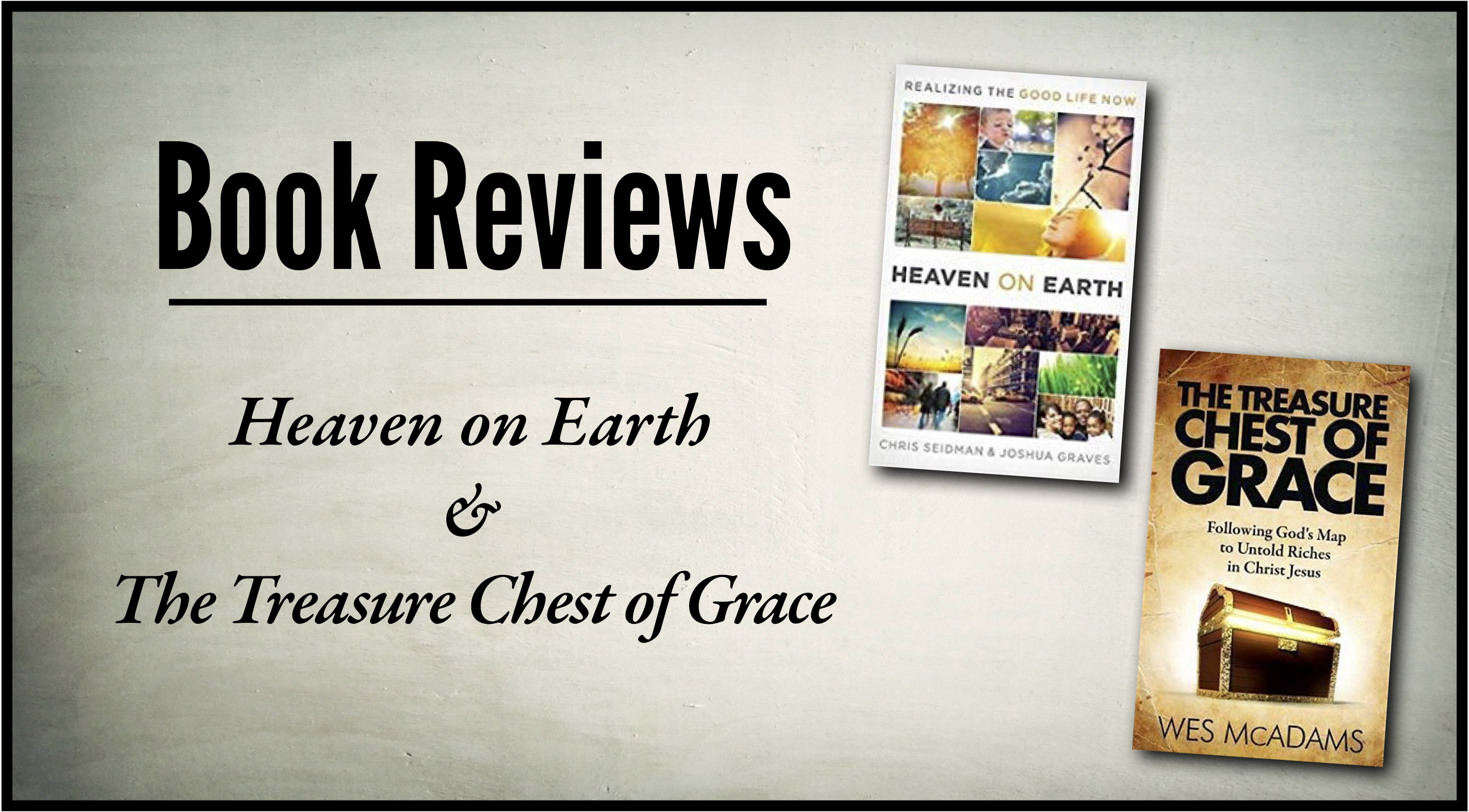
Two for One Book Reviews: Heaven on Earth and The Treasure Chest of Grace

I enjoy reading and sharing helpful things that I read with others. I like to read lots of different kinds of books, but as a minister and a theology students, a lot of what I read tends to focus on those areas.

As a part of my schooling, I read widely across the spectrum of Christianity. This invariably means that I read a lot of things I disagree with, but also that I am challenged to think about what the Bible teaches and what I believe frequently. That’s a good thing, I think.

Over the last several years, I have noticed a marked increase in the number of books being put out by ministers and thinkers within Churches of Christ. This is also a good thing, I think, and I have made an effort to read some of those books when I get the chance (and in the process, have come across some very good material). Having said all that, I wanted to offer some quick reviews of a couple of those books: Heaven on Earth: Realizing the Good Life Now, by Chris Seidman and Joshua Graves, and The Treasure Chest of Grace: Following God’s Map to Untold Riches in Christ Jesus, by Wes McAdams.

Heaven on Earth

Heaven on Earth was good, although it was not what I expected. The book is actually a careful examination of Jesus’ Beatitudes at the beginning of the Sermon on the Mount, and how living those out makes a difference in the here and now (while also identifying us as the kind of people who will be with Jesus eternally).

The subtitle, “Realizing the Good Life Now”, could potentially mean a lot of things, but basically, the authors assert that living this way (according to the Beatitudes) constitutes living the “good life”, and helps us to establish the ideals of God’s Kingdom on earth (to be clear, there are no hints of prosperity gospel nonsense in this book about how God wants us to be happy and therefore will shower us with material blessings if we are faithful to Him).

Each chapter covers a Beatitude, and discusses what it means as well as illustrating it with an abundance of real-life examples, mostly from modern day. The two authors do not write together, and instead, take turns writing different chapters. This is probably my main criticism of the book, as I think it gives it a choppiness in thought and style that wouldn’t be present if either writer was working entirely on his own.

Here are some good quotes:

“The good life is only possible in so far as God is involved. Experiencing the good life is more about what God has done and is doing that what we have done or are doing.” (xi)

“For Jesus, the kingdom of heaven had everything to do with life on this side of the grave while many of us are inclined to think it mostly has something to do with life on the other side. Consequently , we think of Jesus’ proclamation of the kingdom of heaven coming near as meaning through Jesus we now have access to the pace of heaven after we die. Even though this is one aspect of the context, it is not the entire context.” (3)

“The longer Paul dwelled in the kingdom of light the more aware he became of the darkness in his own life.” (16)

“Mourning is a pure vision of the large gulf between how things could be versus how things actually are.” (28)

“How do we respond to the pain and suffering that haunts us? Something’s amiss. Is life beautiful? Yes. But just on the horizon of its inherent beauty is a wild storm, waiting to tear everything to pieces, total destruction. Life is beautiful. But life is also deadly, depressing, and full of pain.” (33)

“Doing the right thing—whether individually (righteousness) or collectively (justice)—is always a primary interest of God in the prophets, because a life is the totality of choices made for the individual and the community.” (57)

“The person you are setting free when you reconcile is yourself.” (99)

“The most dangerous believers in the world to the kingdom of darkness are the ones who live as though they have nothing to lose.” (109)

“Faith is about seeing the world as God sees it. Not simply seeing the world for what it is—in all its paradox of beauty and death—but also seeing the world for what it will one day become.” (131)

The Treasure Chest of Grace

The Treasure Chest of Grace focuses on the fact that we have been saved by grace—nothing we have done or can do on our own has any bearing on salvation apart of the gracious acts of God on our behalf—and then sets about determining what conditions we must meet in order to become recipients of that grace. This is where the “map” of the subtitle comes in: the pages of Scripture reveal to us what we must do in order to come into contact with God’s grace.

This book differs significantly from Heaven on Earth in that McAdams uses no stories or modern-day examples to prove his points; he only uses Scripture. This is by design: “I have made every effort in this book to prove every point with Scripture, and only Scripture. No quotations of man are used to prove any point, only words inspired by God” (8). I understand his reasoning and certainly agree with him at the core (we should base our religious beliefs on Scripture, not something else), but I think the writing suffered somewhat as a result: a short book peppered with hundreds of Scripture references and no other illustrations or examples is harder to read. My other gentle critique is a subjective one: I don’t like really short chapters. The main body of the book is 144 pages long, and those pages are divided into 25 chapters, rendering the average chapter as a little less than six pages long. Constantly shifting from chapter to chapter gives the reader the impression that some thoughts haven’t been well developed (which I don’t think is true, I just think that many of the “chapters” would function better as sections within longer chapters).

Anyway, on to the quotes:

“Man is utterly incapable of earning the things we receive from God. This does not mean, of course, that we are incapable of obeying Him, pleasing Him, honoring Him, glorifying Him; but we must remember that by doing so, we have earned nothing.” (16)

“When people try to save themselves, they are communicating to God that they have no need for His grace.” (25)

“If there were nothing man had to do to receive salvation, there would be none who were lost.” (46)

“Too often people have assumed that because God freely gives grace, He gives it without conditions.” (78)

“Unfortunately many in the religious world have tried to sever the biblical ties between salvation and baptism” (97)

“Man is not saved because he obeys the gospel; he is saved when he obeys the gospel. The gospel itself, not the obedience of man, is the reason man is saved.” (106)

“Your salvation lies at the lace where His “amazing grace” meets your “trust and obey”.” (152)

“Do not mistake the emphasis on baptism to mean that it is more significant than it really is. Nor should you make the mistake of assuming baptism is meaningless or insignificant. Because it is a part of God’s plan to redeem man, it has great importance. But without the blood of Christ, baptism is nothing more than a glorified bath.” (155)

I thought both of these books were short, easy-to-read, helpful treatments of two very biblical ideas: what living the Beatitudes means for us as citizens of God’s Kingdom, and how God’s grace and our obedient faith work together in the act of salvation. I was thankful to have read both.

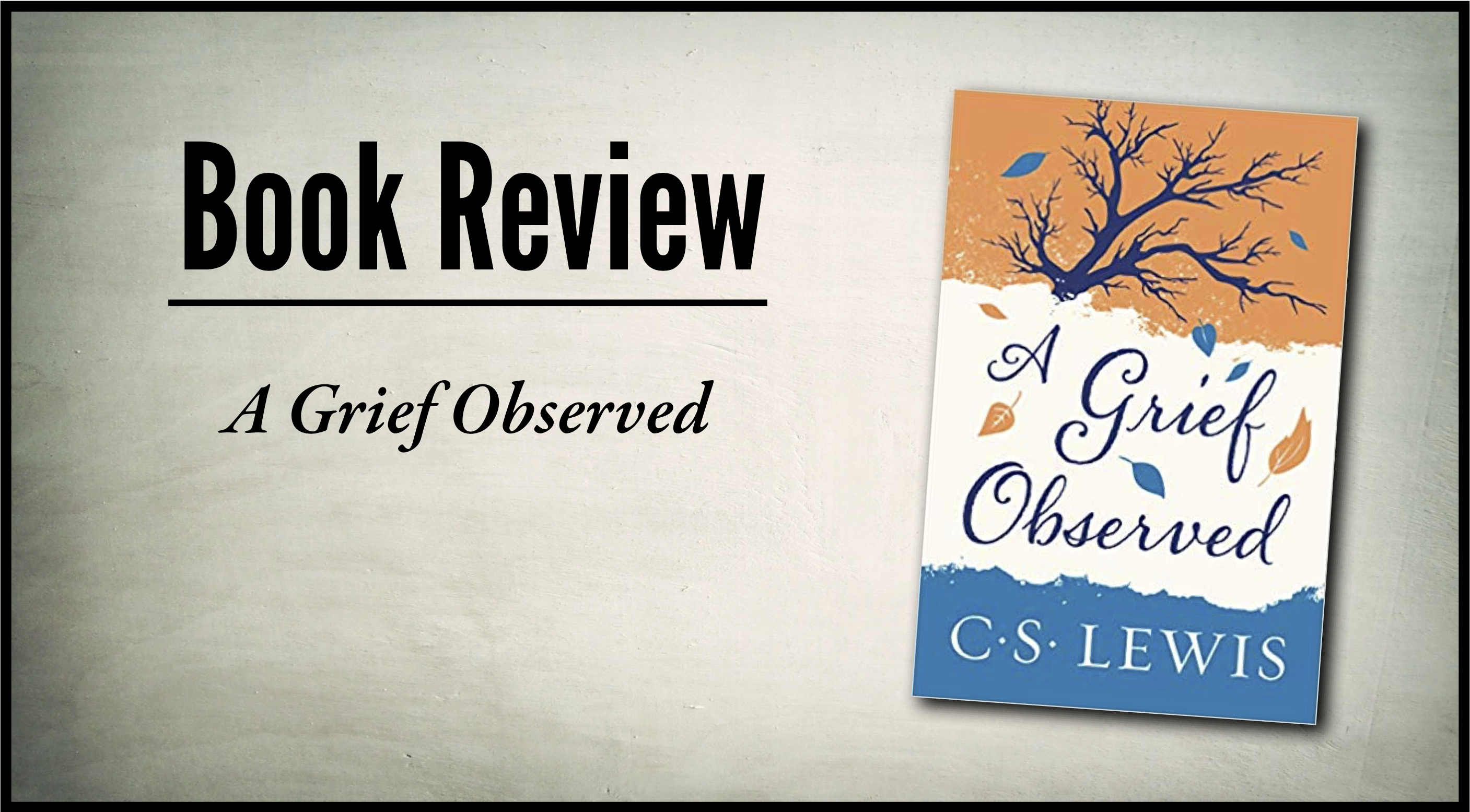
Book Review: A Grief Observed

I recently finished reading A Grief Observed by C.S. Lewis. Basically the book comes from journaling done by Lewis following the death of his wife and the grief he experienced following that event.

One thing that is interesting about the book is that it was written late in Lewis’s own life. To me, that makes his questions and frustrations that much more real, because this is after Lewis was already well-known as a Christian apologist and theologian (i.e. even C.S. Lewis struggled with grief).

I enjoyed this little book because I found it to be very personal and honest in the way it dealt with grief. Lewis didn’t try to explain his grief away or wrap it up in a neat package. This isn’t Lewis’s only book on this topic: The Problem of Pain addresses the issue of suffering in a more general, scholarly, and intellectual way; A Grief Observed is a more specific, personal, and raw treatment of the issue.

Here are some quotations I found to be helpful or insightful:

I not only live each endless day in grief, but live each day thinking about living each day in grief. (10)

Aren’t all these notes the senseless writings of a man who won’t accept the fact that there is nothing we can do with suffering except to suffer it? (33)

What’s wrong with the world to make it so flat, shabby, worn-out looking? Then I remember. (36)

What do people mean when they say, ‘I am not afraid of God because I know He is good’? Have they never even been to a dentist? (43)

You can’t see anything properly while your eyes are blurred with tears. (45)

We want to prove to ourselves that we are lovers on the grand scale, tragic heroes; not just ordinary privates in the huge army of the bereaved, slogging along and making the best of a bad job. (53)

Sorrow, however, turns out to be not a state but a process. (59)

My idea of God is not a divine idea. It has to be shattered time after time. He shatters it Himself. He is the great iconoclast. Could we not almost say that this shattering is one of the marks of His presence? The Incarnation is the supreme example; it leaves all previous ideas of the Messiah in ruins. (66)

I know the two great commandments, and I’d better get on with them. (69-70)

When it comes to grief and grieving, I find that people are very different, and thus, some books “work” better for some people than others. On the whole, I’m not sure if A Grief Observed was a powerful book for me, but I think it would certainly be very beneficial for some who were coping with grief.

« Older posts Newer posts »

© 2026 The Doc File

Theme by Anders Noren — Up ↑