The online journal of Luke Dockery

Category: Reading (Page 32 of 33)

Youth Ministry and The Catcher In The Rye

A while back, I finished reading The Catcher In The Rye. Once the most censored and challenged books in America, The Catcher In The Rye is a common staple in high school English classes, and by today’s standards, is really fairly tame (which I guess is sad, but I digress).

I think the book is pretty good, but not brilliant, and if it hadn’t been so widely censored and criticized, I doubt it would be nearly as popular and well thought of as it is. Nevertheless, I do like the passage in the book that generates the title.

One of the main themes of the book is the loss of innocence, and the main character, Holden Caulfield, is distressed by the idea of children growing up and becoming “phony.”

In one scene, he imagines himself saving them from that:

“Anyway, I keep picturing all these little kids playing some game in this big field of rye and all. Thousands of little kids, and nobody’s around—nobody big, I mean—except me. And I’m standing on the edge of some crazy cliff. What I have to do, I have to catch everybody if they start to go over the cliff—I mean if they’re running and they don’t look where they’re going I have to come out from somewhere and catch them. That’s all I do all day. I’d just be the catcher in the rye and all. I know it’s crazy, but that’s the only thing I’d really like to be.”

As a youth minister, I can sympathize with his feelings. Part of being a youth minister is encouraging kids to stay away from stuff that’s not good for them, physically and spiritually.

But unfortunately, as Holden realizes, you can’t catch kids before they fall off the cliff. They’re going to be exposed to things you were wish they weren’t and they’re going to fail and make poor decisions.

The key then is to prepare them to be the kind of people who make good decisions more often than not, and to try to “catch” them until then.

That’s good youth ministry, I think.

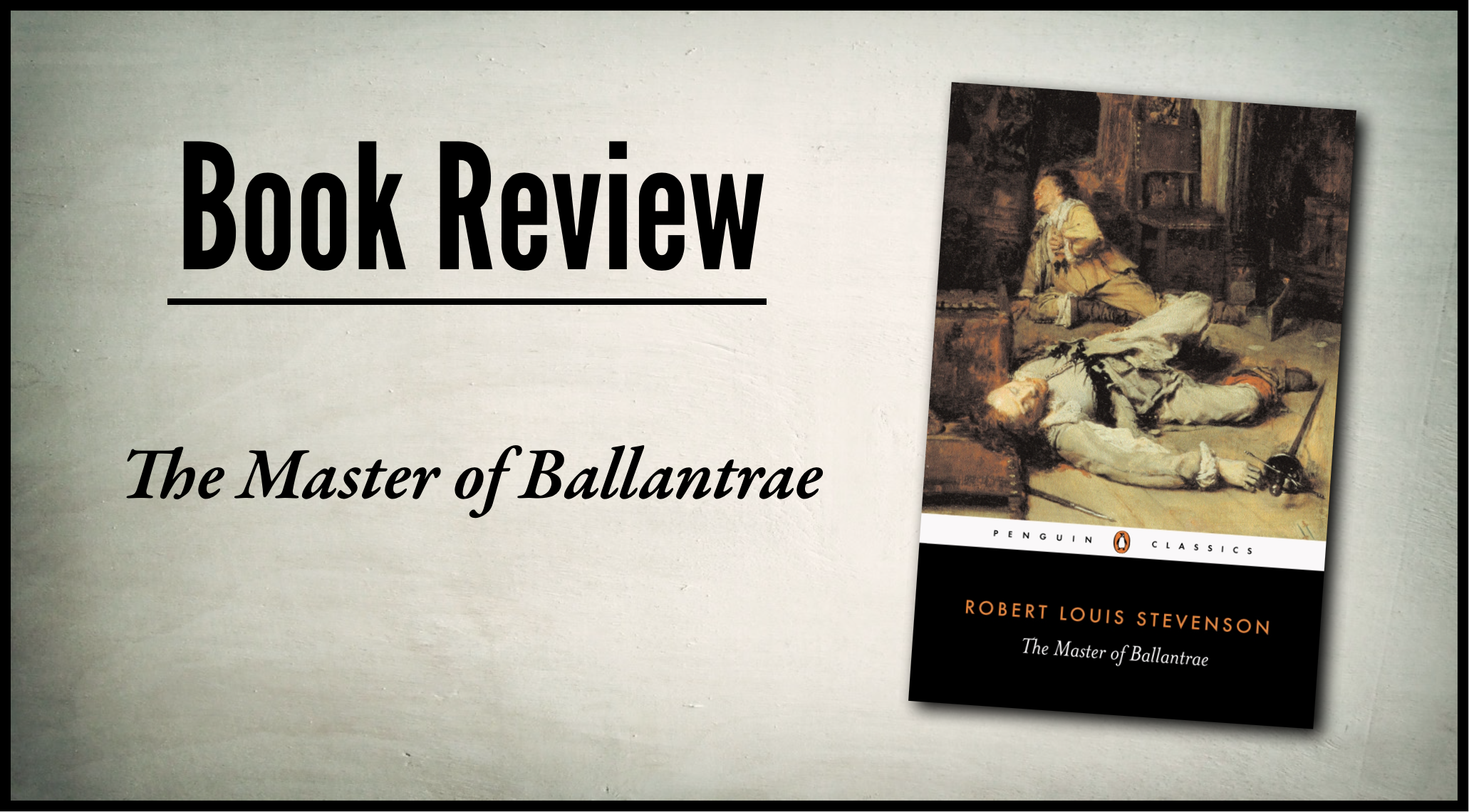
Book Review: The Master Of Ballantrae

Sunday night, I finished Robert Louis Stevenson’s The Master of Ballantrae.

I’m a fan of Stevenson—I’ve written before how much I appreciate his work, and The Strange Case of Dr. Jekyll and Mr. Hyde is one of my all-time favorite works of fiction—but I was a little disappointed in this one.

The Master of Ballantrae is a tale of two brothers of noble Scottish birth, and is also somewhat of a retelling of the Biblical story of Jacob and Esau, with the rivalry and conflict between the two brothers being the central plot of the story.

Parts of the book read very slowly, but there is a lot to keep the reader interested as well: the setting jumps all over the place, with events unfolding in Scotland, the High Seas, India, and, finally, colonial America, and as with other Stevenson stories, multiple narrators are used which helps to give different perspectives on events.

Perhaps most interesting of all is the character of the older brother, The Master of Ballantrae himself, who is the antagonist of the story. Stevenson thoroughly investigated the nature of evil in the character of Mr. Hyde, but in The Master of Ballantrae, the idea is a little more complex. Speaking of his villain, Stevenson said, “The Master is all I know of the devil,” and indeed, the Master’s intelligence, powers of manipulation, and seductive charm greatly resemble the malevolent force described in the Bible, and distinguish him from a Mr. Hyde type of evil.

Unfortunately, for me, all of these good aspects of the book were wasted to some degree by an incredibly disappointing climax.

If you’re a big Robert Louis Stevenson fan, The Master of Ballantrae might be worth reading, but otherwise, skip it—he has much better stuff to offer.

The Jungle on Jesus

Towards the end of Upton Sinclair’s The Jungle, a Socialist ex-preacher rails on the way a capitalist society has twisted the character of Jesus:

“And why should Jesus have nothing to do with his church—why should his words and his life be of no authority among those who profess to adore him? Here is a man who was the world’s first revolutionist, the true founder of the Socialist movement; a man whose whole being was one flame of hatred for wealth, and all that wealth stands for—for the pride of wealth, and the luxury of wealth, and the tyranny of wealth; who was himself a beggar and a tramp, a man of the people, an associate of saloon-keepers and women of the town; who again and again, in the most explicit language, denounced wealth and the holding of wealth: ‘Lay not up for yourselves treasures on earth!’—‘Sell that ye have and give alms!’—‘Blessed are ye poor, for yours is the kingdom of Heaven!’—‘Woe unto you that are rich, for ye have received your consolation!’—‘Verily, I say unto you, that a rich man shall hardly enter into the kingdom of Heaven!’ Who denounced in unmeasured terms the exploiters of his own time: ‘Woe unto you, scribes and Pharisees, hypocrites!’—‘Woe unto you also, you lawyers!’—‘Ye serpents, ye generation of vipers, how can ye escape the damnation of hell?’ Who drove out the business men and brokers from the temple with a whip! Who was crucified—think of it—for an incendiary and a disturber of the social order! And this man they have made into the high-priest of property and smug respectability, a divine sanction of all the horrors and abominations of modern commercial civilization! Jewelled images are made of him, sensual priests burn incense to him, and modern pirates of industry bring their dollars, wrung from the toil of helpless women and children, and build temples to him, and sit in cushioned seats and listed to his teachings expounded by doctors of dusty divinity…” (emphasis mine)

Capitalism isn’t the great problem of the world as Sinclair might suggest, and socialism isn’t the great solution, but I think he’s hit upon a lot of truth here.

How Christians (myself included) get so mixed up about wealth is beyond me.

Ordinary Men

Sometime last month I finished reading Ordinary Men: Reserve Police Battalion 101 and the Final Solution in Poland by
Christopher Browning, and the experience was disturbing enough that it sent me running to the comforts of Star Wars books for the next couple of weeks.

Ordinary Men is an in-depth study of German Reserve Police Battalion 101, and the way it was used to massacre and round up Jews for deportation to death camps in Poland during World War II.

It isn’t exactly an easy read—long sections of (necessary) background information explaining Nazi policy and wartime police organization plagued by unfathomably long German words are juxtaposed with matter-of-fact accounts of the commission of unspeakable atrocities. But Ordinary Men succeeds in making its point.

That point—that ordinary people placed in unusual circumstances are capable of doing terrible things—is not an unusual one (think Lord of the Flies or Heart of Darkness), but it’s a point that is driven home with more force than usual because this time, it clearly is rooted in historical fact.

Browning argues that the men of Reserve Police Battalion 101 weren’t your stereotypical uber-Nazis. For the most part, they were middle-aged men, rejected by the army and without Nazi party affiliation who were old enough to remember when Nazis weren’t in power and Nazi ideals weren’t the norm. As a whole, they weren’t especially racist, they hadn’t been thoroughly indoctrinated with Nazi propaganda, and they weren’t battle-hardened. They were just ordinary men.

And yet, the vast majority of them found it easier to kill Jews than to stand out from the group.

As Browning concludes:

“…The collective behavior of Reserve Police Battalion 101 has deeply disturbing implications.

There are many societies afflicted by traditions of racism and caught in the siege mentality of war or threat of war. Everywhere society conditions people to respect and defer to authority, and indeed could scarcely function otherwise. Everywhere people seek career advancement. In every modern society, the complexity of life and the resulting bureaucratization and specialization attenuate the sense of personal responsibility of those implementing official policy. Within virtually every social collective, the peer group exerts tremendous pressures on behavior and sets moral norms.

If the men of Reserve Police Battalion 101 could become killers under such circumstances, what group of men cannot?”

It’s a chilling question to consider. After all, I’ve always considered myself to be fairly ordinary.

Book Review: The Teammates

Baseball has not been quite as appealing to me this year.

The steroid sagas of Clemens and Bonds have left me a bit cynical, the season-ending injury to John Smoltz and Atlanta’s inability to win one-run games has left me depressed, and TBS’s decision to no longer broadcast Braves games has left me out of touch.

But two things have kept me interested: Chipper Jones’ impressive run at .400 (maybe I’ll write about that later), and one of the best baseball books I have ever read, The Teammates, by David Halberstam.

The Teammates tells the story of four Boston Red Sox icons—Ted Williams, Dominic DiMaggio, Bobby Doerr and Johnny Pesky—the years they played together and the friendship they shared, which spanned 50 years.

In October of 2001, when Williams fell ill and his friends knew it was near the end, they traveled 1,300 miles by car to see him one more time.

Much of the book focuses on Ted Williams, the leader of the group, and possibly the greatest hitter in baseball history. On the relationship between Williams and Joe DiMaggio, Ted’s rival as the other dominant player of the 30s and 40s, Halberstam writes:

“The two had not been close when they played. Joe DiMaggio was the most aloof of men; he held out genuine warmth of friendship not even to his younger brother or his long-time teammates, let alone to Ted Williams, the one baseball player against whom he was constantly measured. Ted, by contrast, was far more open, far more generous, and far more volatile. After they quit playing his only real connection to Joe, other than through his admiration for him and his love of Joe’s younger brother, was the fact that for some 50 years they stood together atop the same pedestal of excellence, honored and celebrated at countless baseball dinners, posing for a seemingly endless number of photographs reflecting baseball’s royalty from an earlier age.

Because they had shared so much of an era, even if they had shared nothing else, their mortality was in some curious way a shared one; if they were linked in life by greatness then they would surely be linked in their obituaries. If Joe, who was nearly four years older than Ted, was dying, then Ted’s mortality was at stake as well. The imminent death of Joe DiMaggio meant that an era that belonged to Ted, as much as it did to Joe, was coming to an end. Thus when Joe’s health began to fail badly in the fall of 1998, and when it became clear that he was dying, Ted was deeply moved and his regular phone calls to Dominic started, always at the same time of day. As soon as the phone rang, Dominic knew it was Ted calling about Joe, wanting to know how he was, whether he was doing any better, asking what the doctors were saying. When Joe died, Ted took it, his friends realized with surprise, like a death in his extended family.”

Halberstam had interviewed Williams before for another book, and had come to know him pretty well:

“I have this view of him now, and it was beginning to form back then, that…he was not a modern man, had always gone his own way, always outside the bounds of contemporary society, and had been so absolutely true to himself. He did not wear ties to tie-certified events. He had crash-landed his plane in Korea once because he thought that there was a better chance to preserve his body that way than if he parachuted out, which might have been harder on his legs. It was a bet, and he had won. He always, if you think about it, bet on himself. He did not go around doing things that would make him popular; instead, even when there were things about him that were appealing, he tended to keep them to himself. He was always his own man.

I think in that sense the .406 is special and defining, not that he was the last man to accomplish it, but much more important was the way he did it. On the last day of the season, Boston faced the Philadelphia Athletics in a doubleheader and Ted’s averaged rounded out to .400 and Joe Cronin offered him the day off. But Ted Williams did not round things out, and he had played, gotten six hits, and taken the average up to .406.”

On the journey of three men who are desperate to see Williams one last time:

“The voyage of Dominic, John, and Dick Flavin from Marion to Hernando took three full days. All three men in the car were proud that they never turned the radio on, not once. Dominic loved the opera and had brought along a few tapes, and on occasion they played one, mostly Pavarotti and Domingo. But never the radio. There was just too much to say, too much to reminisce about, and they knew they would never be together again like this. This was the last time.”

Ted was in awful shape by the time his friends arrived, but just being with them again brought about a change in him, and for a while, again made everything as it should have been:

“Now, in his wheelchair, Ted was suddenly in charge again. It was fascinating to watch him become stronger by the minute with the arrival of his friends. He had to take charge, of course, because that was the natural order of things and that was what his friends wanted.”

I thought The Teammates was an amazing book, sometimes humorous, often poignant, and always interesting. Halberstam truly is a poet, and uses the story of four old-time ballplayers to talk about the things that are really important in life.

« Older posts Newer posts »

© 2026 The Doc File

Theme by Anders Noren — Up ↑