The online journal of Luke Dockery

Category: Sports (Page 14 of 16)

Bound for the Hall


Forty-year-old John Smoltz pitched seven shutout innings tonight to give the Braves a 2-1 victory over the Mets, bringing Atlanta within a game and a half of the New York in the NL East.

The win was Smoltz’s seventh of the season, which leads the National League, but more importantly, was the 200th of his illustrious career.

Smoltz became the 106th pitcher in Major League history to reach the 200 win mark, but is the first pitcher ever to get 200 wins and save at least 150 games.

Although milestones probably shouldn’t be such a big deal statistically, they are a big deal in the minds of Hall of Fame voters, and Smoltz almost certainly cemented his place in the Hall with his victory tonight.

I’ve always been a Smoltz fan, partially because he’s the only player who has been around for Atlanta’s entire run of 14 division titles but also because he is one of the nicest players in the game, and I’m glad that he is getting the recognition and acclaim that he deserves.

The Worst Team Ever

Because I am a fairly opinionated person, and because I generally consider my opinions to be pretty much on-target, I’ve decided to start a semi-regular series of blog posts entitled Best and Worst.

Every week/month/undetermined random period of time, I’ll crank out one of these little jewels which will describe the best or worst of all time in a given category.

The first post in the series centers on one of my favorite topics of baseball history: the Worst Team Ever, the 1962 New York Mets.

A brand new team in 1962, the New York roster was a perfect storm of inexperienced and untalented youth, incompetent utility players and over-the-hill stars who united to amass an appalling record of 40-120, the worst in Major League history.

Just how bad was this team?

Sit back and enjoy.

Starting catcher Harry Chiti was acquired from Cleveland in a trade for a player to be named later. Chiti proved so inept at handling pitchers and a baseball bat (he hit only .195) that he was sent back to Cleveland after 30 days—the first player in Major League history to be traded for himself.

Clarence “Choo Choo” Coleman served as Chiti’s replacement at catcher, and while he proved to be a marginal offensive improvement (Choo Choo hit .250 in 1962), he also struggled behind the plate, and according to baseball writer Roger Angell handled outside curves “like a man fighting bees.”

The manager was Hall of Famer Casey Stengel, but by 1962, Stengel was in his 70s and routinely fell asleep on the bench during games.

Outfielder Richie Ashburn was a bright spot; he led the team with a .306 average. Unfortunately, he was also 35 and retired at season’s end.

The Mets’ top three starters combined for a 26-63 record.

But of all the Mets’ players, perhaps no story better illustrates their hapless plight than that of shortstop Elio Chacón. An eager 25-year old from Venezuela, Chacón kept running into the outfield and knocking down center fielder Richie Ashburn as he was about to catch a fly ball.

Chacón didn’t speak any English, so fellow outfielder Joe Christopher explained to Ashburn that if he was going to catch a fly ball and saw Chacón coming out to get it, all he had to say was “¡Yo la tengo!” (“I’ve got it!”), and Chacón would pull up.

So Ashburn practiced the phrase and memorized it, and a game came along where a shallow fly ball was hit towards him. As Chacón came sprinting out, Ashburn shouted “¡Yo la tengo, yo la tengo!” and put his hands up to catch the ball—and was bowled over by Frank Thomas, his left fielder.

Stengel summed it all up this way, “Come and see my amazin’ Mets. I been in this game a hundred years, but I see new ways to lose I never knew existed before.”

Honorable Mention: The 1994-95 Happy Hollow Tomahawk 6th grade basketball team went 0-9 with two losses of at least 40 points. We had a chance at victory in the last game of the season, but I missed a layup as time expired. Oops.

Sources for this post include Baseball-Reference and Ken Burns’ Baseball.

Guts Enough Not To Fight Back: Jackie Robinson

As a general rule in college and professional sports, teams retire the jersey numbers of the all-time greats who played for them. For example, no Chicago Bull can wear number 23, because that was Michael Jordan’s number and it has been retired. No New York Yankee can wear number 3, because that was Babe Ruth’s number and it has been retired. If you play Major League Baseball, regardless of what team you play for, you can’t wear the number 42, because that was Jackie Robinson’s number, and it is the only number to be retired by Major League Baseball.[1]

Sixty years ago yesterday, on April 15, 1947, Jackie Robinson donned that number 42 Brooklyn Dodgers jersey and appeared in his first regular-season Major League game, breaking baseball’s racial color barrier.[2]

Robinson’s Hall of Fame career and the way he handled himself on and off the field opened doors for other black athletes in professional sports (and ultimately many other fields as well), and it has been said that only Dr. Martin Luther King Jr. accomplished more for the American Civil Rights Movement than did Jackie Robinson.
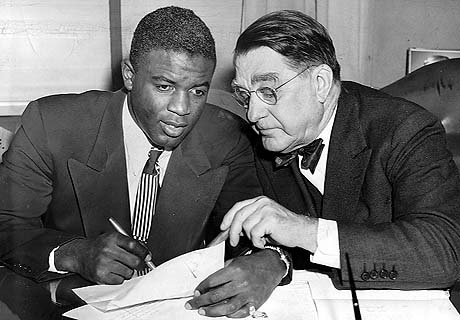
Jackie Robinson and Branch Rickey

Before he signed a contract to play for the Dodgers, Robinson was called into the office of Team President and General Manager Branch Rickey. To give him a taste of what it would be like to be the only black player in the Big Leagues, Rickey spent three hours taunting and insulting Robinson, calling him every racial slur he could think of. Rickey then told Robinson that this is what he would face every day on the field and that if he wanted it to work out, he would have to promise not to fight back or respond to insults of any kind for the first three years of his career.

Robinson, who possessed a fiery temperament and was very outspoken (he was actually court marshaled for refusing to sit at the back of a military bus), was put off by this and asked, incredulously, “Mr. Rickey, are you looking for a player who is afraid to fight back?”

Branch Rickey replied, “No, I want someone with guts enough not to fight back.”

After some deliberation, Robinson agreed to Rickey’s terms, and he lived up to them on the field. When opposing baserunners tried to spike him when sliding into second base, he didn’t fight back. When fans and players yelled and cursed at him and even questioned his very humanity, he showed them how wrong they were by taking the moral high ground.

He had the guts not to fight back.

What Branch Rickey told Jackie Robinson reminds me of Jesus’ words in The Sermon on the Mount in Matthew 5:

“But I tell you, do not resist an evil person. If someone strikes you on the right cheek, turn to him the other also. And if someone wants to sue you and take your tunic, let him have your cloak as well. If someone forces you to go one mile, go with him two miles.”

The world tells us to stand up for ourselves when we are treated unjustly. It tells us to have the courage to fight back and not let others push us around. On the other hand, Jesus tells us to have the courage to show that we are different from the world because we don’t fight back, and He tells us to forgive others when they mistreat us.

Jesus wants followers with guts enough not to fight back.


[1] Major League Baseball has established the practice of temporarily lifting this prohibition on April 15 to commemorate the anniversary of Robinson’s first game as a Dodger, as representatives from each Major League team wear number 42 in his honor.

[2] Contrary to popular belief, Robinson was not the first African-American to play in the Major Leagues. That honor goes to Moses Fleetwood Walker, who played for the Toledo Blue Stockings in 1884. Regardless of this, Robinson was the first African-American to play Major League Baseball in the 20th century, and it was his breaking of baseball’s color barrier that led to the permanent integration of the Major Leagues.

From the Vault


I was going through my iPhoto library the other day and came across the logo for my first ultimate frisbee team, the Fighting Crackers. It is hard for me to believe that it was a little over five years ago that the team was founded…

It was at a time when a lot of schools and professional teams were getting in trouble for having mascots that were supposedly derogatory towards Native Americans, and since we were a bunch of white guys, I came up with the name “Fighting Crackers” as a parody. And I liked the idea of a scowling, pugilistic Saltine.

As a bunch of freshmen, the Fighting Crackers shocked everyone by winning the first ever intra-school ultimate tournament at Harding, and the following fall semester, we became more ethnically diverse with the addition of a half-Asian, half-Italian defensive specialist.

Overall, we were a pretty dominant team, winning two of the four tournaments we played in and finishing second in the other two, with a combined record of something like 16-3.

Some people were jealous, and others resented us (cough, Justin Bland, cough), but playing for the Fighting Crackers was my first real experience of ultimate as a team sport, and was instrumental in the later foundation of Harding’s official ultimate team.

I’m sure if I went back now and watched us play, I’d be embarrassed at how bad we were, but I miss those days.

We did wear some pretty hideous socks though.

Pictured above (L-R): Ty Gentry, Will Dockery, Mike McCubbin, Jonathan Towell, Sam Travaglini. Bent over in exhaustion (L-R): Luke Dockery, Colby Blaisdell. Not pictured: Jason Crawford, Michael Graves, Dave Pritchett, Patrick Williams.

Blast From The Past

Kendrick Davis was Stan Heath’s first recruit as the head coach of the Arkansas Razorbacks.

Davis was not heavily recruited, but he was a capable scorer who had a couple of big games and, along with Jonathan Modica and Eric Ferguson, was one of the three freshmen who accounted for the bulk of the Razorback offense during the 2002-2003 season.

In 2003-2004, Stan Heath made the woeful decision that Ferguson would develop into a useful SEC player (hindsight is 20/20; at one point I thought E-Fergie would be good too). That, along with the arrival of big-time recruits Ronnie Brewer and Olu Famutimi, led to a drastic reduction in Davis’ minutes and consequently, in his point production (10.3 to 5.4).

Davis saw the handwriting on the wall, and transferred after the 2003-2004 season to North Texas, where he had to sit out a season. Davis has been a star for the Mean Green, averaging 16.8 points per game last season, and 13.8 per game this year despite battling through a hand injury early in the season.

Tonight, North Texas beat Arkansas State 83-75 in the finals of the Sun Belt Conference Tournament, giving the Mean Green an automatic bid to the NCAA Tournament, their first since 1988.

I was never a huge fan of Kendrick Davis when he played for Arkansas. He was pretty one-dimensional, and even as a scorer, was fairly inconsistent. But he was willing to take a risk and be the first player to sign on to a UA program that was reeling after the stormy departure of Nolan Richardson, and I always thought it wasn’t fair that he was cut out of the picture for other players who were perceived to be better.

Who would’ve thought when Kendrick transferred after the 2003-2004 season that he would end up appearing in the same number of NCAA Tournaments as Brewer and Ferguson, and would win at least as many tournament games?

I guess things worked out pretty fairly after all.

« Older posts Newer posts »

© 2026 The Doc File

Theme by Anders Noren — Up ↑







