The ARK Retreat is one of our big youth group events which occurs each spring. Over the last few years it has steadily grown in size and scope and it has actually become a pretty neat event as youth groups from six area congregations spend a weekend playing, fellowshipping, and worshipping with one another.
For some of the teens, it is one of the high points of the year, and despite all the work and effort that goes into planning the ARK each year, that makes it all worth it.
The theme for the ARK for this year was “Shake Up The World,” and we heard several good lessons on that idea throughout the weekend. It was my task to introduce that theme on Friday night, and you can read a summary of my thoughts below:
I want to explain this year’s theme by telling you two stories.
The Man Who Shook Up The World
The first story is a boxing story, and for it to make sense, you have to realize that boxing used to be a really big deal. Today, if I asked you to name the heavyweight champion of the world, probably very few of you would know the answer. But if you lived, say, 50 years ago, you would’ve known because boxing was a big deal back then. And that’s when our story takes place, almost 50 years ago, in 1964, when two men squared off with the heavyweight championship on the line.
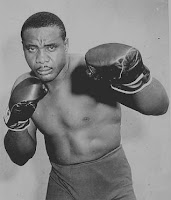 |
| Sonny Liston |
The first man was the reigning champion. His name was
Sonny Liston, and he was terrifying. He was 35-1 for his career, and he hadn’t lost a fight in almost 10 years. He had defeated the previous heavyweight champion twice, both times via knockout in just over 2 minutes. If that wasn’t intimidating enough, he was also known to have connections with criminals and gangsters.
The second man was young, at 22 years old, not much older than some of you. His name was Cassius Clay, and he was somewhat well-known himself, because he had won an Olympic Gold Medal in boxing four years earlier. After turning professional, he had won 19 fights in a row without a single loss, and he had become the top-rated challenger. Despite this, no one gave him a chance in this fight, and the odds were 7-1 in favor of Liston winning.
But although Liston was regarded as the more powerful fighter, Clay was much quicker, and he used his quickness to duck and dodge most of Liston’s devastating punches, while landing a lot of his own. That was the difference in the fight. Liston didn’t come out to fight the 7th round, saying that he had a shoulder injury, Cassius Clay was declared the heavyweight champion of the world, and at 22, was the youngest boxer to ever take a heavyweight title from a reigning champion.
After the fight, speaking to the press who had doubted that he could win, Clay
shouted, “I am the greatest…I shook up the world…I shook up the world!”
Eighteen months later, he defeated Sonny Liston again, and by this time, he had changed his name to name that most people know him by—
Muhammad Ali, considered by most people to be the greatest boxer of all time.
Certainly, that’s one way of “Shaking up the world”—doing something amazing and then immediately letting everyone know just how amazing it was—but there’s another way to shake up the world, and that’s what we want to focus on this weekend…
The Men Who Turned The World Upside Down
The second story is about two other guys who shook up the world in a different way, and they lived a long time before Sonny Liston and Muhammad Ali. Their names are Paul and Silas and we read about them in the Book of Acts in the New Testament.
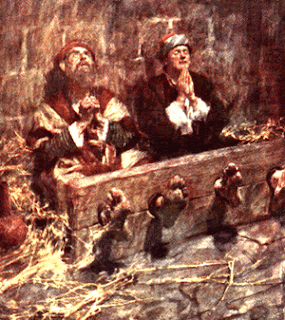 |
| Paul and Silas in prison |
Paul and Silas were missionaries—they traveled around telling people about the life, death, and resurrection of Jesus. In
Acts 16, Paul and Silas are thrown into prison because people are upset by their preaching, but while in prison, they spend their time praying and praising God in song and they end up baptizing their jailer!
In
Acts 17, after being released from prison, Paul and Silas travel to another city called Thessalonica, and there they continue preaching. As was his custom when entering a new city, Paul went to the local synagogue, and there he used the Scriptures (what would be our Old Testament) to show the Jews in Thessalonica that the Messiah of prophecy would have to suffer and then be raised from the dead, and that Jesus of Nazareth was the Messiah that the Scriptures talked about.
When many of the people believed the words of Paul and began to follow Christ, it made some of the Jews jealous, and they formed a mob and sought Paul and Silas at the home of Jason, a local Christian leader.
“And when they could not find them, they dragged Jason and some of the brothers before the city authorities, shouting, ‘These men who have turned the world upside down have come here also, and Jason has received them, and they are all acting against the decrees of Caesar, saying that there is another king, Jesus.’ And the people and the city authorities were disturbed when they heard these things.”
Did you catch what the jealous and evil men said about Paul and Silas? “These men who have turned the world upside down have come here also…” They could’ve said, “These men who shook up the world….”
The men who said this about Paul and Silas didn’t mean it as a compliment! They’re saying that Paul and Silas have ruined everything—they’ve messed everything up! That seems hard for us to understand though—what were Paul and Silas doing that was so terrible? After all, they were just Christians, doing their best to follow Christ.
What About Us?
And that makes me think: maybe, just maybe, when Christians live like they’re really supposed to, when they really
take up their cross daily and follow Jesus, maybe
that shakes the world up! If Paul and Silas turned the world upside down by living for Christ, you would think that Christians today would be doing the same thing. But here’s the problem: when you look at Christianity today, do you really see a group of people who turn the world upside down? People who shake up the world? For the most part, I don’t think so.
Why is that? Unfortunately, I think it is because a lot of the time (especially with teenagers), it seems like we dumb down what it means to be a Christian until we basically have a list of do’s and don’ts:
- Don’t have sex before marriage.
- Don’t do drugs.
- Don’t cuss.
- Do come to church and youth group activities.
- Do pray to God and read your Bibles.
And let me be clear, all of that stuff is true—as a Christian, there are certain things that you shouldn’t do and other things that you should do. But this weekend, we want to suggest to you that being a Christian—living as Jesus Christ called us to live—means a lot more than a list of do’s and don’ts.
Being a Christian doesn’t mean that you’re basically like everyone else around you except that you just happen to spend an hour on Sunday morning in a church building. Being a Christian does mean being radically different from your peers and consciously and intentionally denying yourself and sacrificing your life and the things you want to do on a daily basis in order to instead use your life to glorify God.
If you do that, you’ll shake up the world.









