The online journal of Luke Dockery

Category: Theology (Page 28 of 58)

Grace, Law, and Salvation: What “Legalism” Does Not Mean

I confess that I write this post with a little bit of an axe to grind, so I’ll state it up front: it bothers me the way that people cavalierly toss around the word legalism and its variations (legalist, legalistic, etc.) in religious or theological discussions. This is a great example of a word that has been used so imprecisely that it has largely been divorced from its actual meaning.

I don’t know how many times I have heard someone who is very strict on a certain issue—whether or not it is permissible for a Christian to drink alcohol, what the corporate worship of the church should look like, whether or not it is okay to celebrate Christmas as a religious holiday*—be written off as a legalist by someone who is less strict. But that is not what the word means. It is nothing more than an ad hominem attack, and a lazy refusal to actually engage the person’s views on the issue at hand.

I think it is important that we be more careful with our words in this case, because as we will see, the idea of legalism is directly tied to salvation. And that makes it a big deal.

The Definition of Legalism

Put simply, in theology, legalism is works righteousness: it is the idea that we can somehow earn our salvation by the things that we do. To be clear, that idea is heresy. It is false doctrine. It is not what the Bible teaches.

It’s also not something that very many Christians believe. Now, I’m sure that if you look hard enough, there are Christians out there who feel like they earn salvation by their good deeds, whether by abstaining from liquor, worshiping correctly, feeding the poor, reading their Bibles, or whatever else. Really though, this idea is more of a perversion of Christianity as understood by the culture at large (i.e. “Good people go to heaven when they die”), than it is an actual belief of most Christians. The vast majority of Christians are absolutely aware that they are sinners who are incapable of saving themselves, and are saved by God’s grace through faith. This is what the Bible teaches.

Thus, a legalist is someone who believes he or she can earn their salvation through their good behavior; it is not someone who has very strict or rigid views on a particular doctrinal or moral issue.

So, for example, unless the person who strictly believes that it is wrong to eat in a church building actually believes that avoiding that practice saves them, you cannot accurately call that person a legalist. You can disagree with their viewpoint and believe that it is biblically or theologically unsound, but you can’t dismiss it as “legalistic” because that simply is not what the word means. 

Terms Related to Legalism

If you were to imagine a spectrum charting different ideas on grace, keeping God’s law, and salvation (see below), at the opposite end from legalism you would find antinomianism. Antinomianism is the idea that we are saved by grace through faith to the extent that our works have nothing to do with salvation at all: we are not bound to try to keep God’s moral laws (nomos is the Greek word for law, so the word really just refers to the rejection of law-keeping).

This view, the opposite extreme of legalism, is also heresy. It is not what the Bible teaches. Just think of all the passages in the New Testament that provide lists of sinful behaviors that are not in keeping with God’s law and will exclude those who practice them from God’s kingdom (Romans 1.18-31, 1 Corinthians 6.9-10, Galatians 5.19-21, Ephesians 4.17-32, Ephesians 5.3-5, 1 Timothy 1.8-11, and Revelation 21.8, to name a few). Clearly, the things we do matter to God and thus, are related to our salvation as well!

Thankfully, not many Christians are antinomians either (although, extreme proponents of the “Once Saved Always Saved” perspective come pretty close to this, in my opinion).

In between the two extremes of legalism and antinomianism is what the Bible actually teaches, and hopefully what you believe, even if you aren’t familiar with the theological term: covenantal nomism. Covenantal nomism suggests that we enter into God’s covenant and are covered by His grace through faith in Christ, but that we “stay in” that covenant by trying to do God’s will and obey His commands. 
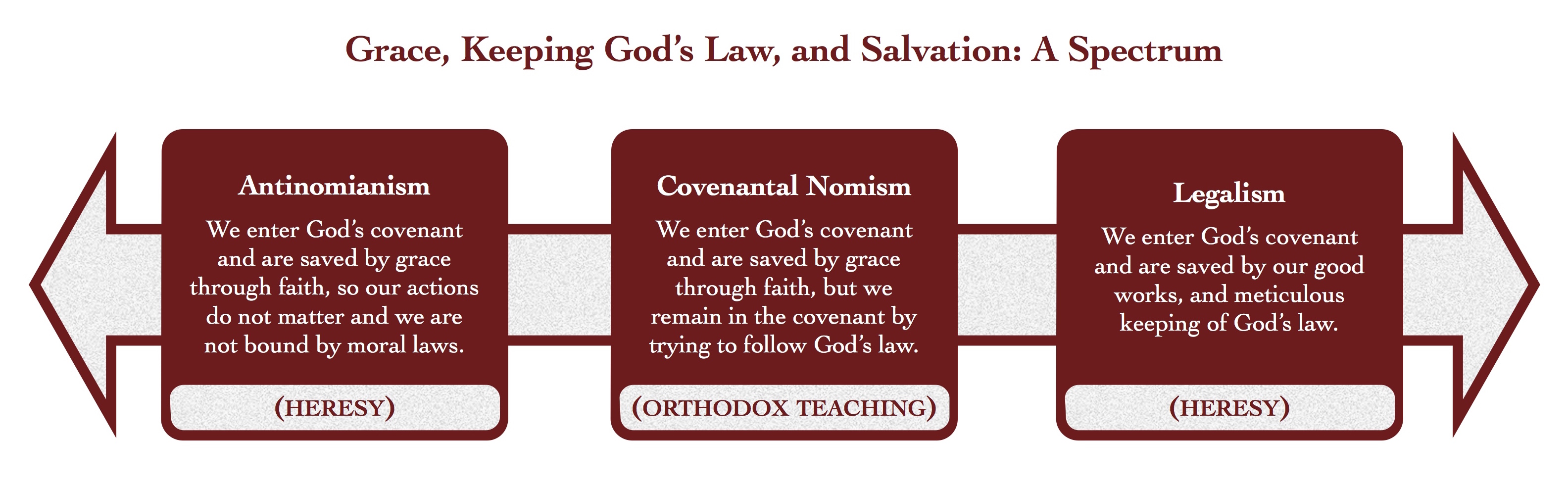
Now, certainly we don’t do this perfectly—all of us sin and fall short from time to time. And covenantal nomism does not hold that our attempts to obey God’s commands somehow earn our salvation; salvation is by grace through faith. But covenantal nomism does hold that as Christians who have been saved by God’s grace, we should do our very best to obey His commands and live our lives as He desires. In the words of Dallas Willard, “Grace is opposed to earning, it is not opposed to effort” (emphasis mine).

Conclusion

So what’s the big deal? Why does this even matter, and why would someone spend time writing about it?

First, I think it is good general practice to use words appropriately. We live in a world where texts, tweets, and twenty second sound bites dominate communication, and where people are not particularly inclined to give people with whom they disagree a fair hearing. In that context, I think it is important that we speak with precision, and do our best to be clear and accurate in our communication. That cannot happen when we assume that words mean something other than what they actually mean.

Second, there really is a theological issue here. When you call someone a legalist, you are saying that they believe they can earn their salvation through good works. You are, in essence, calling them a heretic. That is not something to do lightly.

So the next time you encounter someone who seems overly scrupulous about a particular issue, or, from your perspective, makes a mountain of doctrine out of a molehill of opinion, take a moment to get them to explain their viewpoint, and maybe even take some time to study Scripture together on that issue. But whatever you do, please don’t dismissively call them a legalist.

*Throughout this post, I reference as examples different issues which I have heard people associate with legalism. Please understand that in this article, I am making no argument one way or the other about any of these particular issues.
Bruce Jenner and the Multi-Faceted Transgender Discussion

A lot of (digital) ink has been spilled the last few days concerning the story of Bruce Jenner and his decision to undergo treatments and surgeries in an effort to live life as a woman, and a lot of discussion has been generated.

With so many different voices competing for time and space, it can be a chore to sift through it all. It is also worth mentioning that this is a multi-faceted discussion, and what I mean by that is that it spills over into the arenas of politics, culture, medicine, psychiatry, religion, theology, pastoral care, and probably others which I am not thinking about.

Generally speaking, I don’t like to write a lot about topics of which I am relatively ignorant, and so it is not my intention to try and compose a comprehensive thought essay on this topic. What I would like to do is share some articles I have read which I think shed some light on the issue or should cause some pause for reflection.

From a medical and psychiatric perspective, I thought this was a very helpful piece. Written over ten years ago, it is remarkably relevant, and is written by someone whose training and experience makes him far more qualified to weigh in than many people who have rushed to do so.

From a political and cultural perspective, this article’s discussion on the contradictory messages on gender norms from the political/cultural left was, I thought, enlightening. There really is a point of contention here that a lot of people are ignorantly missing or intentionally blurring: either “gender” matters or it doesn’t; you cannot have it both ways.

And from a pastoral perspective, this very personal (anonymous) article was worth reading. There are people in our churches who are struggling with feelings like this, and they need more than immediate condemnation and more than a hearty approval for them to indulge those feelings. From the author:

As someone who has spent his life wrestling with these feelings, what happens when you chase them and they don’t fill the void? What happens when they don’t take the brokenness away? As followers of Jesus we are supposed to know better, that the solution for the brokenness comes from only one place. It doesn’t come from marriage or children or being able to love whomever we want to love or identify in the way that fits you best. The only hope for our brokenness is Jesus Christ.

I am still looking for an article that I think really nails the issue from a theological perspective, but in the meantime, I recently came across a particular church whose motto was very appropriate to this situation (and many others as well):

“Always the truth. Always in love.”

May we doggedly hold to both standards in this, and every, discussion.

Strife and Contention: A Message from Habakkuk

O Lord, how long shall I cry for help, and you will not hear?

Or cry to you “Violence!” and you will not save?

Why do you make me see iniquity, and why do you idly look at wrong?

Destruction and violence are before me; strife and contention arise.

So the law is paralyzed, and justice never goes forth.

For the wicked surround the righteous; so justice goes forth perverted.”

(Habakkuk 1.2-4, ESV)

Tucked away near the end of the Old Testament is the Book of Habakkuk. Habakkuk appears as a prophet who speaks to God for the people, rather than a prophet who speaks for God to the people. Habakkuk voices his lament—his call of frustration and despair—to God, on behalf of his people.

We don’t know much about Habakkuk. We know he lived and worked during the reign of the wicked King Jehoiakim in the last days of the kingdom of Judah. Judah had prospered during the reign of the righteous King Josiah, but Josiah was killed in battle, and his son Jehoiakim did not follow in his footsteps.

Instead, Jehoiakim was one of the most godless, selfish, and tyrannical kings ever to rule over Judah. We can actually learn quite a bit about Jehoiakim’s reign from the Book of Jeremiah, as Jeremiah also prophesied in Judah at this time. From that book, we know that Jehoiakim’s reign was characterized by violence and injustice (Jeremiah 22.13-17). People were not treated fairly and the wealthy took advantage of those who were less fortunate. We also know that Jehoiakim was antagonistic toward God’s prophets who tried to direct him to a better path. Jehoiakim ordered the death of the prophet Uriah (Jeremiah 20.20-24) and refused to listen to the warnings of Jeremiah, even burning one of his scrolls (Jeremiah 36).

The Book of Habakkuk dates to approximately 610-605 B.C. Around this time, Nebuchadnezzar had defeated the combined forces of Egypt and Assyria at the Battle of Carchemesh and asserted Babylon as the dominant world power. The threat of Babylon lay like a shadow over the land of Palestine.

And it is in this context that the prophet Habakkuk speaks out. In agony, Habakkuk looked around at a struggling and imperfect world filled with heartbreak and suffering and violence and injustice and he cried out, “Don’t you care, Lord? Why do You let this go on?”

Yahweh was the God who made a covenant with Abraham and his descendants and who taught them what justice and righteousness was, and it is to Him who Habakkuk cries out because of the injustice and unrighteousness he saw surrounding him. As he struggled to make sense of it all, he lamented to God.


With a little reflection, I think we can see how Habakkuk’s ancient questions are also modern questions which are very relevant to us.

The stories on the news unsettle us. They remind us not of how far we have come, but of how far we still have to go. They remind us of a great racial divide that exists in our country between black and white.

The stories are not the same, but they have similarities: black men dying at the hands of white police officers following some sort of run-in with the law. Sometimes those officers are not indicted for their actions, and unhappy citizens take to the streets and protests and riots occur. We have heard the names of Michael Brown, Eric Garner, Walter Scott, and Freddie Gray. We have seen the footage of protests in places like New York City and South Carolina, and riots in Ferguson and Baltimore.

I claim neither the knowledge of the facts of these specific cases nor the sufficient wisdom to know whose fault it was in each case, or where or how much blame should be placed. It is hard for me to know if justice has been served or not.

It is a delicate situation:

  • I don’t want to condemn police officers. Law enforcement officials fulfill a vital role in our society, and the vast majority of them selflessly do a good job. That doesn’t change the fact, however, that we clearly have some officers who exercise very poor judgment with tragic results.
  • I don’t want to excuse the behavior of those who, when confronted by an officer, resist arrest or run away or attempt to fight back. Neither do I believe, though, that such behavior should merit an immediate death sentence.
  • I don’t want to excuse violent protests and rioting in the streets. Neither do I want to suggest that there is nothing to protest and be upset about.

Regardless of whether or not justice was served in these individual cases, I do know that injustice exists in our country. I know that African Americans are incarcerated in this country at a much higher rate than Caucasians. I know that African Americans are more likely to experience poverty, and that there is a high correlation between poverty and crime. Thus, African Americans are also more likely to be involved in and to be victims of violent crime than are their white counterparts. That is unjust.

Further, I know that many black people have no trust in this nation’s justice system, nor in the officers who are supposed to uphold the laws of this country and protect its citizens. The statistics suggest that there is some reason to be concerned about this, and yet, I also know that there are many white people who refuse to even consider that there might be some validity to these concerns and conclusions.

And I know that in many environments, whether on talk shows, or social media, or in churches, or amongst friends, we are unable to even discuss these issues in a productive fashion because the divide is so great.

And in the midst of it all, I don’t know what to do other than to cry out to God, with language similar to Habakkuk’s…

Violence abounds in our society, in our world. It seems that destruction and violence are ever before us. When we cry “Violence!”, God, why do you not save?

The very systems we put in place to uphold order and limit violence seem to fail us. At times, it seems that the law is, in fact, paralyzed, and that justice never goes forth. Instead, justice is perverted.


God responds to Habbakuk. He doesn’t rebuke Habakkuk for his questions or frustrations. God is bigger than our emotions or our questions; He desires that we bring these before Him.

But God does respond (Habakkuk 1.5-11). Indeed, God is aware of all that is going on. He has seen the injustice and oppression, and He is going to act: He will use the Babylonians to punish Judah for their wickedness.

This revelation prompts additional lament from Habakkuk, who doesn’t understand why God would punish evil Judah with the even-more-evil Babylonians (Habakkuk 1.12-2.1). Those who were to be punished were more righteous than the ones who were to do the punishing!

God assures Habakkuk that He is in control of these events, and that the Babylonians will also be punished in time (Habakkuk 2.2-20).

The Book of Habakkuk concludes with a prayer of Habakkuk’s confident trust in God (Habakkuk 3.1-19). He has unburdened his heart and turned his doubts and fears over to God, he has heard God’s response, and now he expresses confidence that God will act, and bring about what is best.


While there are no easy answers, the Book of Habakkuk helps us to think more clearly about the problems and injustices in our own society.

(1) As we look around and see these heartbreaking tragedies and we are reminded of the inequities of our society, we cannot claim specific knowledge for why God allows these things to continue. But Habakkuk reminds us that God sees these things, and that He is sovereign over them. As people of faith, we trust in that sovereignty. We know that God is in control of the world, and that He works in all situations—even terrible ones—to bring about His good purposes.

(2) Also, Habakkuk and the other Old Testament prophets remind us to consider our own place in society: If destruction and violence are all around us, to what degree do we allow those things to continue? If the law is paralyzed and justice never goes forth, to what degree are we responsible for that paralysis and injustice? In the words of Dietrich Bonhoeffer, “Silence in the face of evil is itself evil: God will not hold us guiltless. Not to speak is to speak. Not to act is to act.” If the evidence suggests that an entire subset of our population is suffering injustice and we, in our privilege, refuse to work to address the problem or even acknowledge that there is a problem, we become complicit in it.

(3) And finally, Habakkuk reminds us of the appropriateness of lament. It is right for us to be distressed, and to bring that distress before God. In His sovereignty, He is the one who can do something about it. And while we lament, we yearn for a day when justice will roll down like waters, righteousness like an ever-flowing stream, and when God shall wipe every tear from our eyes.

Creation, Chaos, and Suffering

Introduction

In the last post of this series, I talked about the Problem of Evil, and the two categories of evil which philosophers and theologians usually talk about: moral evil and natural evil. Generally speaking, moral evil refers to the evil acts that people choose to commit which lead to the suffering of others, while natural evil refers to those seemingly random (or, chaotic) things which occur as a result of the way the world works which bring about suffering. A man killing his wife would be classified as moral evil, while a tornado destroying a house and killing the family inside would be natural evil.

If you take the idea of free will seriously (which I certainly do), moral evil is pretty easy to explain: bad things happen because people abuse the freedom of will which they have been given. We might not like it when a terrorist blows up a building, and we might even wish that God would have taken the terrorist’s free will away in order to prevent the horrific act, but ultimately, we know that people should be blamed for the bad things to do.

Natural evil is tougher to explain away, though. It is clear that we live in a world where chaotic things occur and leave great destruction in their wake: hurricanes, tornados, tsunamis, cancer, genetic diseases. They question is, Why does our world work like this? People do not cause these things to happen—did God design the world to be like this? And if so, why?

There are, I think, four basic perspectives on the idea of creation, chaos, and suffering:

Chaos as the Result of Sin

The traditional view (also called the Augustinian view) is that God created the world perfect, without sin or chaos anywhere. Living in a perfect garden, eating from the Tree of Life, Adam and Eve did not have to worry about tornados or skin cancer (which is a good thing, since they didn’t wear any clothes).

But then sin entered the world through their disobedience, and as a result, creation itself was cursed (Genesis 3.17-19). No longer was the earth the ideal home for mankind which God had intended it to be. Sin had far-reaching consequences, including death and chaotic destruction.

Until very recently, this was the view I held, but as you’ll see below, I think it needs to be nuanced a little.

Chaos as part of the Design of Creation

At the opposite extreme from the Augustinian perspective is the argument that chaos (and suffering) were always present, and were simply a part of the way God made the world. This is the argument set forth by Terence E. Fretheim in Creation Untamed: The Bible, God, and Natural Disasters.

Fretheim points out that God created the world good; He did not create it perfect. In other words, God created an earth that suited His purposes; not one that was necessarily flawless or without chaos present in any way.

Furthermore, man is given the task of keeping and tending the garden (Genesis 2.15). This suggests that creation was not a perfect, finished product, but something which required the keeping and ordering of Adam. Is that not a suggestion of a certain level of chaos?

And finally, what is the presence of the serpent in the garden if not an element of chaos? If creation was absolutely perfect, why would it contain a tempter? Instead, the doorway to sin which the serpent provided and the possible ramifications of that sin strongly suggest a chaotic element in creation even from the beginning.

Having said that, I think Fretheim goes too far. In my mind, it is a huge leap from the hints of chaos listed above to the claim that volcanoes, tsunamis, and genetic conditions were present from the beginning (a claim that Fretheim makes many times in the book).

Chaos Outside of the Garden

The last two perspectives are basically hybrids; midpoints between the two viewpoints already described above.

It is possible that the Garden of Eden was an environment free from chaos, but that the rest of creation was not. When Adam and Even sinned, they were cast out of the Garden (Genesis 3.23-24) and forced to live in the “real world.” Outside of the special haven God had prepared for them, Adam and Eve and their descendants had to live with the harsh realities of the world which included natural disasters and disease.

This perspective is intriguing because it marks a clear distinction between the Garden and the rest of creation (and Scriptures seems to do that as well), but I think it has the same problems as the first viewpoint because as Fretheim points out, there do seem to be some elements of chaos in the description of the Garden

Chaos in Creation but Intensified by Sin

This last option is also somewhere in the middle of the spectrum, and best describes my current understanding of the relationship between creation and chaos.

It seems to me that chaos was always present to an extent, but was intensified and multiplied after Adam and Eve sinned. As the “Chaos as Result of Sin” view accurately points out, creation itself was cursed because of Adam and Eve’s sin, and that fundamentally altered the way things worked.

Water is a chaotic thing, and always had the potential for danger (I would suggest that even in the Garden, if Adam’s lungs filled with water he would have drowned), but after the Fall, hurricanes and tsunamis and the true destructive power of water was unleashed. In the Garden, Adam and Eve grew hungry, and if they had refused to eat, they would have died. But after the Fall, they had to grow their food by the sweat of their brow, and sometimes the ground would fail to yield properly. Famine and suffering result.

Concluding Thoughts

I don’t think it is wise to be too dogmatic about this, because the Bible doesn’t explicitly lay out the relationship between chaos and creation. There is a lot we don’t know and thus, our conclusions can never be certain.

Still, it seems to me that there are a few conclusions that we can draw with relative certainty:

(1) From the beginning, there was a degree of chaos. Creation was good, not perfect. Satan slithered around. The Garden needed to be tended and kept.

(2) That chaos was intensified by the Fall. After Adam and Eve sinned, a curse was placed on creation. It is only logical that this made conditions worse. I do not see natural disasters and devastating illness in the chaos of the Garden, but it is easy for me to see them in a chaos intensified and magnified by the Fall.

(3) Outside of the Garden, life involved suffering. Regardless of the amount of chaos that occurred in the Garden, the Garden also possessed the Tree of Life, and presumably, the fruit of that tree would counteract any illness. In fact, it was access to this tree and the immortality to offered which directly led God to banish Adam and Eve from the Garden (Genesis 3.22).

For us, the reality is that we have to navigate life in a world which is filled with chaos. Outside of the Garden, we suffer. Modern technology has revolutionized health care, and yet there are illnesses and diseases against which we are powerless. Modern technology has allowed us to predict dangerous storms with increasing accuracy, and yet people still die.

As Christians, we look forward to when suffering ceases, chaos is conquered, and Christ returns.

Come, Lord Jesus!

Moral Evil and Natural Evil

In this series, I am attempting to approach the topic of suffering from a variety of different angles. As I mentioned in the first post, I am using the term “suffering” to sum up the famous Problem of Evil. I talk about the Problem of Evil at length in this post on Alexander Campbell, but perhaps it would be beneficial to state the problem outright, the original statement of which is generally credited to Epicurus:

“Is God willing to prevent evil, but not able? Then He is not omnipotent. Is He able, but not willing? Then He is malevolent. Is He both able and willing? Then whence cometh evil? Is He neither able nor willing? Then why call Him God?”

So basically the issue is, if God is good and powerful, why does He allow evil and suffering to exist in the world?

Now, it’s a fair question to ask if all suffering is evil or the result of evil. As humans we admittedly have very limited perspectives, and sometimes things which are good for us certainly don’t seem good at the time they occur (think about an infant getting a vaccine, for example). Regardless, evil certainly exists in the world, and a lot of suffering occurs because of it.

Philosophers and theologians and people who discuss this topic will often distinguish between two kinds of evil: moral evil and natural evil.


Moral Evil

Generally speaking, moral evil refers to the evil acts that people choose to commit. A lot of the suffering which occurs in the world happens because people choose to do things which cause harm to one another. Fatal car accidents caused by alcohol consumption, child molestation, ISIS beheadings, and the Holocaust are all examples of moral evil. People do foolish and terrible things which cause a great deal of suffering for others.

Really, this type of evil is easier to explain, at least, if you have a robust view of human free will. As I discussed a little in this post, I think a theology which embraces the idea that God created humans with free will is important and makes the most sense of the teachings of Scripture. The basic idea is that God created people out of His love and desires that we love Him in return. Certainly God could have created us like robots who had no choice but to “love” Him, but a coerced feeling like that wouldn’t really be love at all. To enable us to choose to love Him, God also gives us the ability to reject Him, and when we abuse our freedom of will, all sorts of bad things can happen.

When it comes to moral evil, you can blame God for the way He made the world (though, based on the previous paragraph, what other options were available?), but really, the blame lies with people who make bad or evil choices.

Natural Evil

Natural evil generally refers to those “random” things which occur, not because of the actions of people, but as a result of the world “naturally” operates (I put those two words in quotations because they are loaded with some major assumptions). Hurricanes, tsunamis, tornadoes, genetic conditions and human decay and death in general are examples of natural evil.

Now, human choices can still exacerbate natural evils and make the suffering greater than it would be otherwise (certain behaviors can make illness more likely, social problems like poverty can increase the amount of suffering which comes from natural disasters, etc.), but for the most part, people have no control over natural evil—we suffer simply because we live in a world where these types of things occur.

Because of this, I think natural evil is a little harder to explain away. We can understand when negative things happen to people who deserve them, and we can understand, as horrible as it is, when people suffer because other people choose to do evil. But why do we live in a world where natural disasters kill so many unsuspecting people? Why do children get cancer and die? Did God design the world this way, and if so, why? If God didn’t design the world this way, what happened to it for everything to get so messed up?

In the next post, I’ll try to take a closer look at natural evil, and specifically, the idea of chaos: the element of randomness in life which we can’t control which has potential for unleashing great suffering. For me, as the parent of a little girl with a genetic condition, this is one of the really tough areas of examining suffering theologically.

« Older posts Newer posts »

© 2026 The Doc File

Theme by Anders Noren — Up ↑







