The online journal of Luke Dockery

Category: Theology (Page 34 of 58)

Biblical Faith: Obedient Action

This is the final post in our series on biblical faith. Contrary to the way “faith” is typically defined in current conversation, I have tried to paint a more biblical picture of what the word means. Here are links to the previous entries in this series, in case you missed them or for review:

Biblical Faith: An Introduction

Biblical Faith: A Reasonable Leap

Biblical Faith: Trust

The Problem with Mental Assent

A lot of times, you’ll hear people say something like, “I believe that Jesus is God’s Son,” or “I believe what the Bible says,” but it becomes clear that those beliefs don’t really impact their daily lives in any real way: they don’t have anything to do with the church, they live their lives by their own moral code rather than that of the Bible they claim to believe in, they spend their lives chasing after the accumulation of material possessions, etc.

For people like this, what they really mean by believe is mental assent: “in my mind, I agree with the idea that Jesus is God’s Son,” or “I agree with the idea that the Bible is accurate in its claims.”

And to be fair, mental assent is one appropriate definition of the word “believe.” In fact, mental assent is exactly what I mean when I say something like, “I believe the 1927 Yankees were the greatest baseball team of all time.” I’m saying something like, “based on the information I have, I agree with the claim that the 1927 Yankees were the greatest baseball team of all time.”

But this idea of mental assent is not what the Bible is talking about when it talks about believing in something. It certainly involves agreeing with something (i.e. Jesus is God’s Son), but it involves much more than that: “Since I believe that Jesus is God’s Son, I will live my life according to his teachings and commandments.”

Biblical faith goes well beyond mental assent.

Faith vs. Works or Faith + Works?

Christians of different backgrounds have argued for hundreds of years over whether people are saved by faith or by works. To me, that’s an unfortunate argument, because the people who tend to dig their heels in around either element to the exclusion of the other are, well, wrong.

Look, the Bible teaches over and over again that we are incapable of saving ourselves through our good works. Isaiah 64.6 says that our righteous deeds are like filthy rags before God, and even bigger than that, if our salvation was accomplished by the good things we do, then there would have been no need for the atoning death of Christ in the first place.

It was in response to this erroneous viewpoint that the Reformers developed the mantra of “Faith Only”: we are saved by our faith in Jesus Christ, and nothing we do has anything to do with that.

But once again, this is not the biblical perspective. Biblical faith, by definition, includes works. Consider the following verses (emphasis added):

“What good is it, my brothers, if someone says he has faith but does not have works? Can that faith save him? If a brother or sister is poorly clothed and lacking in daily food, and one of you says to them, “Go in peace, be warmed and filled,” without giving them the things needed for the body, what good is that? So also faith by itself, if it does not have works, is dead.

But someone will say, “You have faith and I have works.” Show me your faith apart from your works, and I will show you my faith by my works.”

(James 2.14-18)

Or this passage from Ephesians 2, which is a favorite of faith-only types:

“For by grace you have been saved through faith. And this is not your own doing; it is the gift of God, not a result of works, so that no one may boast. For we are his workmanship, created in Christ Jesus for good works, which God prepared beforehand, that we should walk in them.”

(Ephesians 2.8-10)

Both of these passages fundamentally link faith to action. Are we saved by faith? Absolutely! But in the Bible, the very idea of faith includes works! Biblical faith involves taking action and obeying God’s commandments. If you take away the works, you’re left with something other than what the Bible commands.

Biblically, it is unthinkable to talk about faith separate and apart from the actions that result because of that faith.

Or in other words, if you say that you believe in Jesus but you don’t actually obey his teachings or attempt to follow his example in your life, then you don’t really have faith at all. At least, not in a biblical sense.
Biblical Faith: Trust

In our series on faith, last week’s post discussed how biblical faith is not a blind leap based on no evidence; neither is it a certainty which can be proven. Instead, it is a reasonable faith, somewhere in the middle of those two extremes.

Today I want to discuss another characteristic of biblical faith: trust.

Teens and Youth Events

I am a youth minister, which means that I spend a good amount of time putting together a calendar of activities for my teens—youth rallies, service projects, retreats, summer trips, etc.—and then encouraging them to go on those events. With some students, it’s always a struggle to get them to go, while other students will eagerly sign up for any event as soon as they hear about it.

I have one student in particular who signs up for everything, but if it’s a new activity that we haven’t done before, he always wants to know beforehand as much information about it as possible: Where will we be staying? How many people are going to be there? Where will we eat? Who will be speaking? What will we be doing all day? What kinds of activities are planned? Why are we supposed to bring _____ with us?

This is one of my favorite kids I’m talking about, and it’s a part of who he naturally is: he wants to be informed and he wants to know what is going to happen. And usually I try to answer his questions. But once not too long ago, after a barrage of his questions, I took a different approach:

Luke: Over the years, in your experience with me and on all the trips you’ve taken with me, have I ever given you a reason not to trust me?

Student: Well…no.

Luke: Then you should be able to trust that I’ll tell you the information that you need to know and the rest of it you’ll just have to wait and see, and it will be okay, right?

Student: Well…yeah…I just wanted to know.

Luke: I understand that you want to know everything; I want you to realize that you don’t have to know everything, and that you can trust that I know what’s going on and that it will be alright.

Student: Well…okay.

At this point, I don’t even remember what the event was or what we did, but it turned out fine.

And then it occurred to me that this example illustrates what biblical faith is all about.

Learning to Trust

The word used for believe or faith in the New Testament is the Greek verb πιστευω (pisteuo). In many places, that word is indeed translated as “believe” or “faith” (if it is a noun) in our English Bibles, but in many, many places it is also translated as “trust”, because the Greek word conveys both meanings.

So, without getting too technical, the point that I’m trying to make is that in the New Testament, the ideas of “believe” and “trust” are linked very closely, in a way that is not immediately apparent in English: faith is inherently tied to trusting in God. 

One author puts it this way: when it comes to understanding faith, “…every decision, every thought, and every action comes down to this: in whom do I place my trust? Do I trust my instincts, my desires, my convictions, or do I trust in Christ?”[1]

In the winding road of life, there are a lot of things that happen pretty much as we expect, and then there are the curveballs that life throws at us when we expect them the least. We find ourselves in situations we didn’t choose, we are uncertain as to how we should proceed, and we worry and obsess about what is going to happen and what we should do.

And a lot of times, we think that if we could just know exactly what was going to happen and how everything would turn out, then we’d be okay. Or, to put it in other words, if we could just have all of the details of the upcoming youth trip, then we could look forward to it and put our minds at ease.

But God is not in the business of giving us detailed itineraries of our futures; instead, he asks us to trust that he will take care of our futures.

The old church hymn by Ira Stanpill sums it up perfectly:

“Many things about tomorrow I don’t seem to understand;

But I know who holds tomorrow, And I know who holds my hand.”

There are a lot of things in my life that I don’t understand and about which I am inclined to worry. But God doesn’t ask me to understand it all, and he certainly doesn’t ask me to worry.

But he does ask that I trust him to take care of it. Because trusting God is what biblical faith is all about.


[1]Kara E. Powell and Chap Clark, Sticky Faith: Everyday Ideas to Build Lasting Faith in Your Kids (Grand Rapids: Zondervan, 2011), 34.

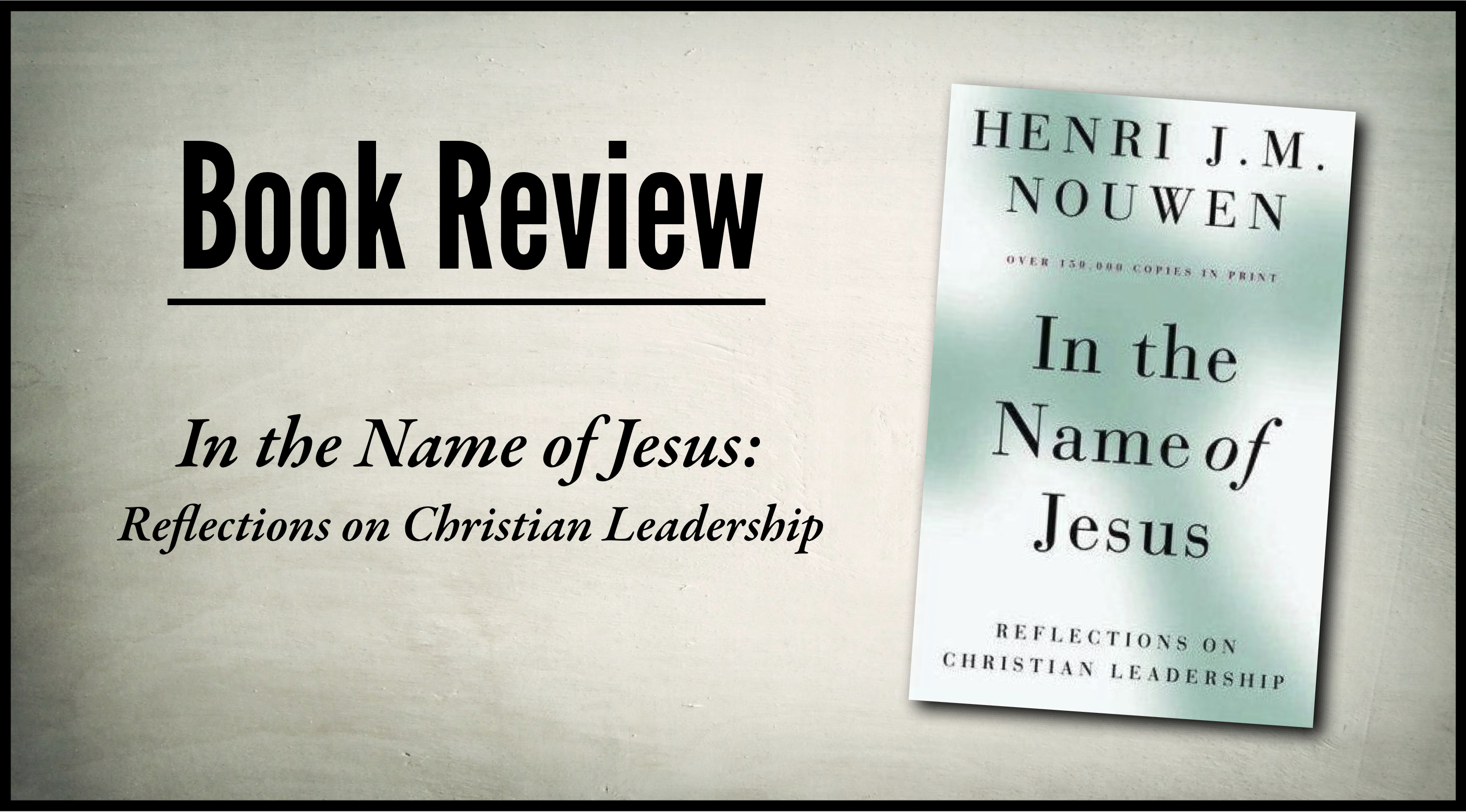
Book Review: In the Name of Jesus

Last month I posted my reading list for 2013, and in the comment section an old college friend recommended In The Name of Jesus: Reflections on Christian Leadership by Henri Nouwen. I was interested, because (a) it was on leadership, and (b) Nouwen, a Catholic priest, was a well-known writer whom I had never read before.

Furthermore, I was interested to read what he had to say because of what I assumed would be an interesting perspective. Nouwen was a respected professor at Notre Dame, Yale, and Harvard, but he chose to leave that behind to live and work with developmentally disabled people.

And I was correct—he did have an interesting perspective. In the Name of Jesus offers some radical views on Christian leadership, and by that, I mean that it takes seriously the things that Jesus says in Scripture.

Here are some quotations [my comments in brackets]:

“I am deeply convinced that the Christian leader of the future is called to be completely irrelevant and to stand in this world with nothing to offer but his or her own vulnerable self. That is the way Jesus came to reveal God’s love. The great message that we have to carry, as ministers of God’s word and followers of Jesus, is that God loves us not because of what we do or accomplish, but because God has created and redeemed us in love and has chosen us to proclaim that love as the true source of all human life.” (p. 18) [The message of irrelevance is hard to hear in our success-driven society. But to the degree that we emphasize and prop up our successes, how much do we alienate ourselves from the downtrodden who are most in need of God’s Good News?]

“Indeed, whenever we minister together, it is easier for people to recognize that we do not come in our own name, but in the name of the Lord Jesus who sent us.” (p. 36)

“We are not the healers, we are not the reconcilers, we are not the givers of life. We are sinful, broken, vulnerable people who need as much care as anyone we care for. The mystery of ministry is that we have been chosen to make our own limited and very conditional love the gateway for the unlimited and unconditional love of God.” (p. 37) [I love that—“the mystery of ministry.” As someone who is very aware of my own faults, I have certainly been struck by that irony before.]

“The way of the Christian leader is not the way of upward mobility in which our world has invested so much, but the way of downward mobility ending on the cross.” (p. 50) [Wow. Gut check.]

“Powerlessness and humility in the spiritual life do not refer to people who have no spine and who let everyone else make decisions for them. They refer to people who are so deeply in love with Jesus that they are ready to follow him wherever he guides them, always trusting that, with him, they will find life and find it abundantly.” (p. 50) [This is a helpful perspective: the Christian is not called to be listless or apathetic, but so trusting in God that we can appear to be unconcerned at times.]

“The task of future Christian leaders is not to make a little contribution to the solution of the pains and tribulations of their time, but to identify and announce the ways in which Jesus is leading God’s people out of slavery, through the desert to a new land of freedom.” (p. 54)

This was an easy read (only about 80 pages including a delightful personal story that was woven throughout the book), but it was also very challenging. There are a lot of leadership books out there, but not many of them follow the model of our Leader, who emptied Himself and became lowly on our behalf.

Biblical Faith: A Reasonable Leap

As I mentioned last week, I want to spend the next few Mondays looking at biblical faith, because even though “faith” is a popular topic in today’s society, I’m not sure that it’s understood all that well (even by some Christians).

Today, I want to get a better idea of what biblical faith is by looking at a couple of things that it isn’t.

Biblical Faith Is Not Blind Faith

I think a lot of people who are not believers seem to have the idea that, in order to be a Christian, you have to be incredibly gullible or foolish. Basically, they think that you have to have blind faith, that you’re willing to accept anything that Christianity claims without any evidence at all. For people like this, being a Christian and having faith in God makes about as much sense as believing in unicorns or leprechauns.

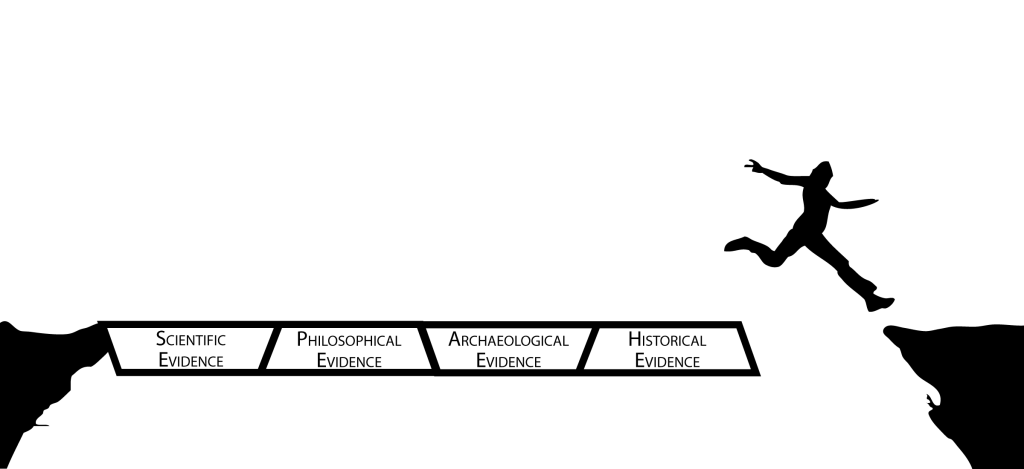
To illustrate this kind of faith, you might imagine two cliffs facing each other with a vast chasm in between. In order to get from one side to the other, a massive leap of blind faith is required.

If that was what the Bible required of me—blind faith—then I would have a hard time accepting the claims of Christianity myself.

But that’s not what biblical faith is. Biblical faith is something that comes about in conjunction with evidence.

When God appeared to Moses to enlist him to free the Israelites from Egypt, He appeared to him in the form of a bush which was on fire but was not burning up. This miraculous appearance gave Moses evidence that God was who He said He was.

When God called Gideon in Judges 6 to free the Israelites from under the yoke of Midian, Gideon is hesitant at first. And maybe that makes sense when you realize that Gideon was apparently raised in a household of Baal worshipers. By asking for the sign of the fleece, Gideon is basically asking for evidence that God is who He says He is. And God has no problem providing that evidence.

In Jesus’ earthly ministry, He was constantly going around performing astounding miracles. Of course, He did this because He loved people and wanted to help them, but He also did it in order to provide evidence that He was who He said He was (cf. John 20.30-31).

Over and over again in the Bible, we see that God didn’t expect people to respond in blind faith, and that He was perfectly willing to provide evidence to support their belief.

And the same is true for us today—there is plenty of evidence which supports the claims of Christianity. It is a reasonable faith—you don’t have to park your brain in order to be a Christian! I don’t want to derail the purpose of this post with a foray into Christian evidences, but there are multiple arguments and evidences from a variety of fields—science, philosophy, archaeology, history, and others—which lend credence to the truth of Christianity.

Biblical faith is not blind faith; it’s a faith which is informed by evidence.

Biblical Faith Is Not Absolute Certainty

If on one extreme you have people who claim that Christians are gullible people who have blind faith without any evidence at all, on the other extreme, you have some Christians who claim that faith is an absolute certainty and have the misconception that we can go about proving our faith to people.

Going back to our metaphor of the two cliffs, this perspective would require no leap at all; you’d just have a bridge which would carry you effortlessly across the chasm.

The problem with this notion is that biblical faith is not absolute certainty. You see, when you talk about something being absolutely certain, you remove any element of doubt, and any element of hope. And at that point, you’re no longer talking about faith, you’re talking about sight. But as Paul says in 2 Corinthians 5.7, “…we walk by faith, not by sight.”

I think the story of Thomas in John 20 really illustrates this point. After Jesus’ resurrection, He appears to the apostles but Thomas is not with them when He comes. So the other disciples try to tell Thomas about it but he doesn’t believe and says he won’t believe until he can see Jesus for himself and touch his wounds.

Eight days later, the apostles are together again and this time, Thomas is with them. Jesus appears to them and basically says to Thomas, “Here I am Thomas, what do you think?” Thomas answers, “My Lord and my God!” Jesus gives Thomas a mild rebuke: “Because you have seen Me, have you believed? Blessed are they who did not see, and yet believed.”

Jesus is not looking for us to prove Him; He’s not looking for us to never have any doubts or any questions. He is looking for us to have faith in Him despite whatever doubts or questions we may have. He’s looking for us to walk by faith, and not by sight!

A Reasonable Faith

There’s nothing wrong with studying Christian evidences and using that evidence to strengthen our faith. In fact, those types of things are a big part of my faith; they help me to see that Christian faith makes sense and is reasonable. But the evidence we have never reaches the point of proof, and at some point, we still have to make a leap of faith.

Returning one more time to our cliff metaphor, biblical faith would not require a blind leap across a vast chasm, but neither would it be an easy trot across a bridge. Instead, it’s something like the image below: evidence bridges much of the gap and makes the remaining distance manageable, but at some point, you still have to make the leap of faith.

So that leaves us with a picture of reasonable faith: the Bible does not demand that we base our lives on myths and fairy stories; neither does it offer certainty free from doubt (nor condemn us when doubts arise).

As Christians, we struggle through a world of difficulty and doubt, but we are confident that one day, when Jesus returns, we will see him for ourselves.

Biblical Faith: An Introduction

If you were to ask virtually anyone who identifies himself or herself as a Christian, you would likely hear about how central faith is to Christianity. And that’s certainly a biblical notion as well—consider the following well-known verses:

“For God so loved the world, that he gave his only Son, that whoever believes in him should not perish but have eternal life.”

(John 3.16)

”For by grace you have been saved through faith. And this is not your own doing; it is the gift of God, not a result of works, so that no one may boast.”

(Ephesians 2.8-9)

The problem is, I think that in our modern vocabulary, we have come to define the word faith to mean something different than what it means in Scripture. And that leads to all kinds of problems: from people who claim to believe in Jesus as God’s Son and yet fail to pay any attention to his commandments, to others who obsessively try to prove their faith (a contradiction in terms, really) to other “people of faith” who live lives characterized by worry, fear, and a lack of trust in God.

So, for the next few Mondays, I’d like to take a look at biblical faith. I don’t claim that this will be an exhaustive study on the subject, but I do hope to highlight some characteristics of biblical faith that are often overlooked in our culture today (and by Christians as well).


« Older posts Newer posts »

© 2026 The Doc File

Theme by Anders Noren — Up ↑