The online journal of Luke Dockery

Category: Theology (Page 4 of 58)

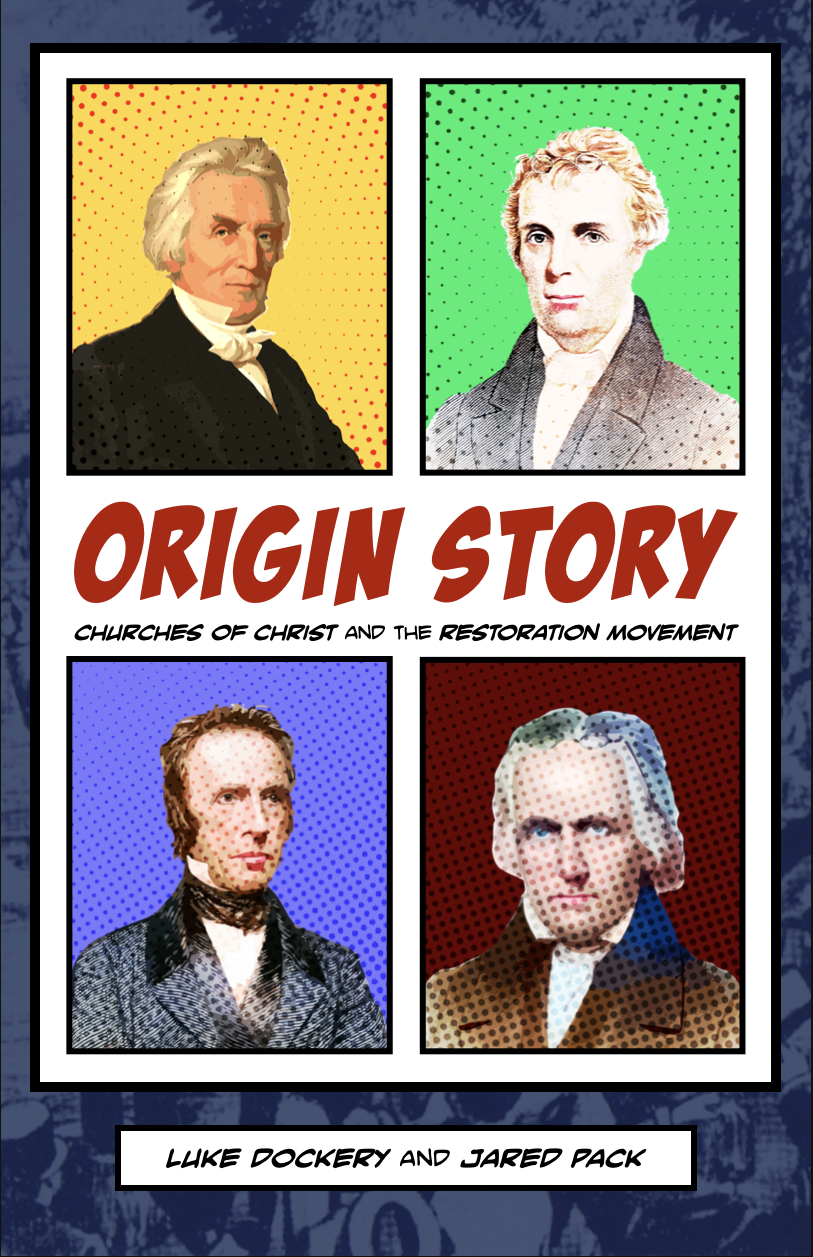
Origin Story: Churches of Christ and the Restoration Movement

I wrote a while back that I had taught a series of lessons to the students in my youth group regarding the Stone-Campbell Restoration Movement and how it affects our heritage and identity in Churches of Christ. I am pleased to announce that this study has now been compiled and formatted as a book that is now available in print and digitally. I won’t go into detail here why I think a study like this is need (I did that in the previous post), but I do want to say a couple of things and share some more detail about the book, before concluding with the summary information from the back cover.

First, this is a special project to me because it was done in conjunction with my good friend Jared Pack, and in many ways represents our friendship and the fruitful years of ministry we shared together. Jared is a historian by training and serves as Associate Professor of History and Chair of the History Department at York University in York, NE. I am a youth minister by trade and am decidedly not a trained historian, but I am an amateur enthusiast of Restoration History. Early in our friendship, Jared and I discovered a similar interest in the Restoration Movement and how it affects us today, and we co-taught a class together with our young adults group at the Farmington Church of Christ. Later, after I had moved to work with my current congregation, Jared taught the class again and added and expanded it. When I taught the material to my own students last year, I refined it further.

What all of that means is that this current product truly represents our combined work over a decade. Jared and I work so well together and think so similarly in many ways that with much of this book, at this point we are not sure who wrote which part! In many ways, this book is a perfect representation of and tribute to our friendship.

Second, this was a challenging project because I really was trying to push my creativity. Sadly, most teenagers do not find history to be an enthralling subject, and so I worked hard to make these lessons engaging. One way I sought to do this was by providing relevant discussion questions throughout the lessons to break up the lecture portions, but also, as the title suggests, I tried to tap into the notion of the origin story, a motif that has become very well understood in our society over the last twenty years with the proliferation of various movie franchises that center characters with remarkable abilities and comparing backstories (think MCU, the Harry Potter series, Star Wars, etc.). With this idea being central, Origin Story very much has the feeling of a comic book, completed with AI-generated images of the authors as superheroes!


Here is the Table of Contents, to give you an idea of the layout of the series:

Series Introduction

(1) Why Study the Restoration Movement?

(2) Background: Early Church to Reformation

(3) Background: European and American Influences

(4) The Big Four

(5) Unity and Division

(6) Churches of Christ after the Split

(7) Restoration Movement Slogans and Theology

(8) The Restoration Plea and Legacy

Appendix A: A Brief Overview of Calvinism

Appendix B: A Brief Overview of Millennialism


Purchase the Book

Paperback: Amazon $12.99

Digital: Deeper Youth Ministry $10


You can see the cover below, as well as some sample pages to give you a feel for the book (including the silly image of me as a superhero!).


From the back of the book:

Origin stories provide the background narrative that explains why characters are the way they are. When you know a character’s origin story, you also know important things about their feelings and motivations for why they do what they do. Churches of Christ have historical roots in the Stone-Campbell Restoration Movement, but teens in Churches of Christ tend to be largely ignorant about any of this history. This is a problem, because in a real sense, if we don’t know our history, we don’t know who we are.

The early Restoration leaders desired to bring about unity among God’s people by adhering to the clear teachings of Jesus and the apostles and the practices of the early church. In a world of bitter division and incredibly shaky notions of truth, that is a compelling idea, and one that is worth communicating to teenagers.

Origin Story is an eight-lesson series written specifically for teens.

“Teaching Restoration Movement history is tricky business, especially in church contexts. How best can we communicate the ups and downs, the successes and shortcomings, of our religious predecessors in a way that deepens rather than destroys faith? A lack of accessible educational resources for young Christians only compounds the problem. Fortunately, Luke Dockery and Jared Pack demonstrate both ministerial concern and scholarly acumen in this short volume which will help anchor the youth of the Churches of Christ more fully in their religious heritage and, even more importantly, point them back to the cross.”

—John Young, Associate Professor in the Turner School of Theology at Amridge University and historian of the Stone-Campbell Movement

Linking Heaven and Earth: Jacob’s Ladder and Jesus

The Gospel of John is one of my favorite books in the Bible, and one of its special characteristics is that, more than any other, it emphasizes the divinity of Jesus. This is done over and over again and in many different ways, but one interesting way it does so is through an allusion in John 1.47-51.

Here, Jesus calls Philip to follow Him, and then Philip subsequently goes and recruits a man named Nathanael as well. Nathanael is skeptical that Jesus, from the lowly town of Nazareth, could be the Messiah whom Moses and the prophets had proclaimed, and so Philip invites him to go and see Jesus for himself:

47 Jesus saw Nathanael coming toward him and said of him, “Behold, an Israelite indeed, in whom there is no deceit!” 48 Nathanael said to him, “How do you know me?” Jesus answered him, “Before Philip called you, when you were under the fig tree, I saw you.” 49 Nathanael answered him, “Rabbi, you are the Son of God! You are the King of Israel!’’

(John 1.47-49)

Although Nathanael was really impressed that Jesus knew what he had been doing before they had even met, Jesus basically told him that he hadn’t seen anything yet:

50 Jesus answered him, “Because I said to you, ‘I saw you under the fig tree,’ do you believe? You will see greater things than these.” 51 And he said to him, “Truly, truly, I say to you, you will see heaven opened, and the angels of God ascending and descending on the Son of Man.”

(John 1.50-51)

If you know are familiar with the narratives of Genesis, then the imagery of heaven opening up and angels ascending and descending is probably very familiar to you, and it almost certainly would have been familiar to Nathanael. It is most likely an allusion to Genesis 28, where Jacob, while on a journey to Haran to stay with his uncle Laban (and ultimately get married), stops to sleep for the night, using a stone for a pillow:

12 And he dreamed, and behold, there was a ladder set up on the earth, and the top of it reached to heaven. And behold, the angels of God were ascending and descending on it!

(Genesis 28.12)

At the top of the ladder, the LORD appears, and basically reaffirms to Jacob the same promises that He had previously made to Abraham and Isaac. When Jacob awakens from his sleep, he realizes that something significant has happened:

16b “‘Surely the LORD is in this place, and I did not know it.’ And he was afraid and said, ‘How awesome is this place! This is none other than the house of God, and this is the gate of heaven.’”

(Genesis 28.16b)

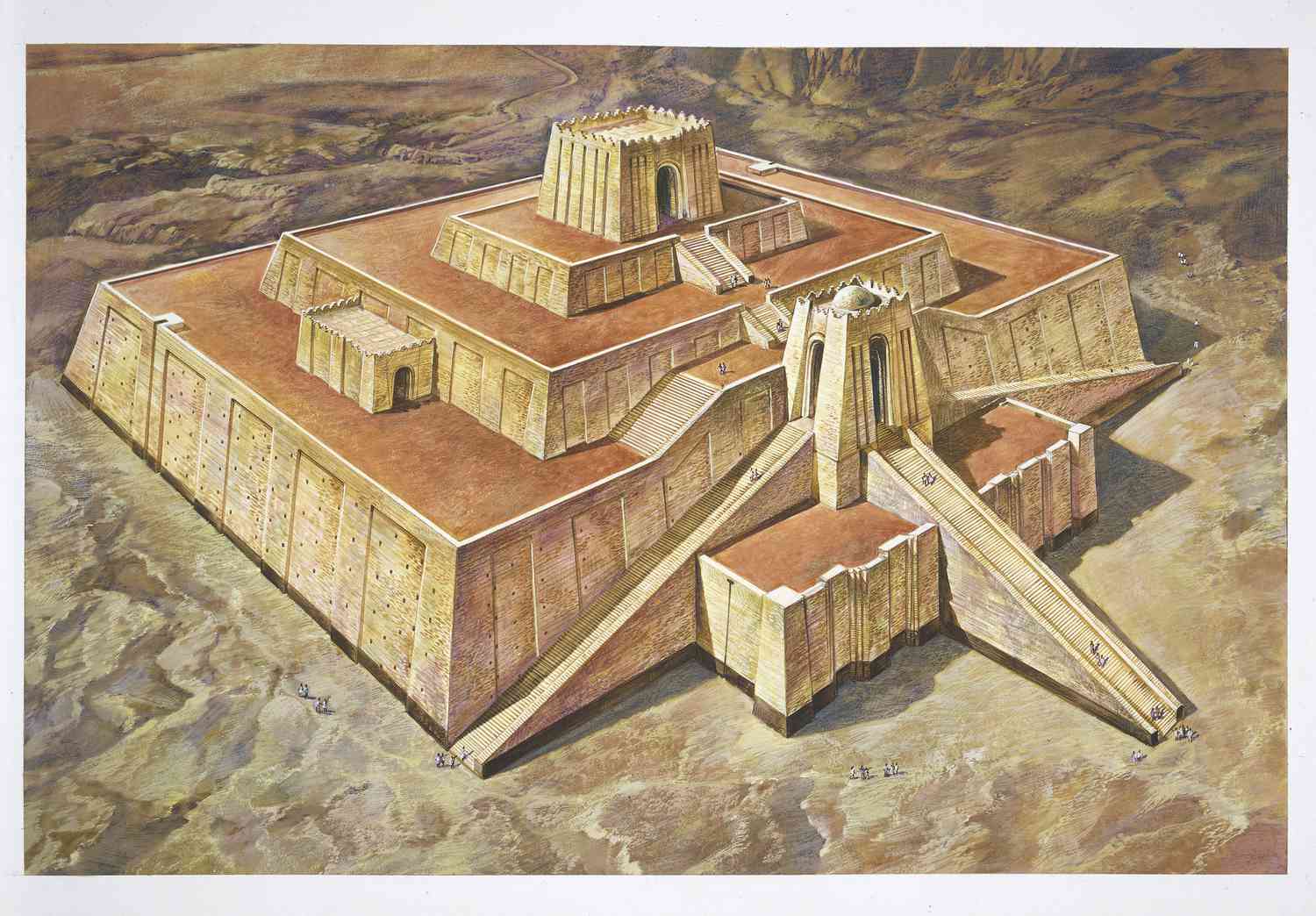
The next morning Jacob takes his stone pillow and sets it up as a monument, naming the place “Bethel,” which means “house of God.” This approximates temple language, and likely gives us a better picture of what Jacob’s dream looked like. Scholars suggest that what Jacob saw was not a “ladder” as we think of it, but a ziggurat, a Mesopotamian step-pyramid/temple.[1] In the cosmology of the ancient world, temples were overlapping spaces that linked heaven and earth, God’s space and human space. Ziggurats, in particular, had extensive staircases that were designed to connect divine space with human space and enable gods to “come down” to their temples.

Ancient ziggurats had extensive steps, ideal for the ascending and descending that Jacob witnessed in his dream.

As already suggested above, the language of Genesis 28.12 and John 1.51 is so similar that it seems clear that Jesus was intentionally alluding to Jacob’s dream. So what does the connection mean?

In Jacob’s dream, a “ladder” connected earth (where Jacob is) and heaven (where the LORD is), and angels ascend and descend upon the ladder. Jacob is awed by what he sees. In John 1, Jesus paints a similar picture for Nathanael: the heavens open, and the angels of God are ascending and descending. The difference is that now, instead of ascending and descending upon a ladder, the angels are doing so upon the Son of Man—Jesus Himself.

The implication is that Jesus is the new “ladder”, the New Bethel, the new house of God. 

This is the greater thing that Nathanael will get to see: just as Bethel was the place where the heavens were connected to earth, so Jesus is the medium through which heaven and earth, God and man, are brought together.[2]

Just as Bethel was the place where the heavens were connected to earth, so Jesus is the medium through which heaven and earth, God and man, are brought together. Share on X

The Gospel of John affirms here—as it does elsewhere—that Jesus was absolutely unique. As the Son of God, His roots were in heaven, but as a human, He also put down roots on earth. This is the wonderful mystery of the Incarnation, the Word becoming flesh, and is what enabled Him to carry out the work of reconciling creation to its Creator (cf. 2 Corinthians 5.18-19).


In this loose series of Scripture Reflections, I am sharing brief thoughts spurred on by my Bible reading. By way of reminder, my goal for these brief posts is two-fold:

(1) To remark on aspects of the biblical text that I find to be of interest that the reader may or may not have thought about previously.

(2) When possible, to point to the work and person of Jesus Christ. I believe the Bible is a unified story that points to Jesus, which means that He is frequently alluded to or foreshadowed in some way throughout the biblical canon.


[1] For example, see Scott Aniol, “What Was Jacob’s Ladder?”, By the Rivers of Babylon, October 9, 2024.

[2] F. F. Bruce, The Gospel of John, (Grand Rapids: Eerdmans, 1983), 62: “In this application of Jacob’s vision, however, the union between earth and heaven is effected by the Son of Man: he is the mediator between God and the human race.”

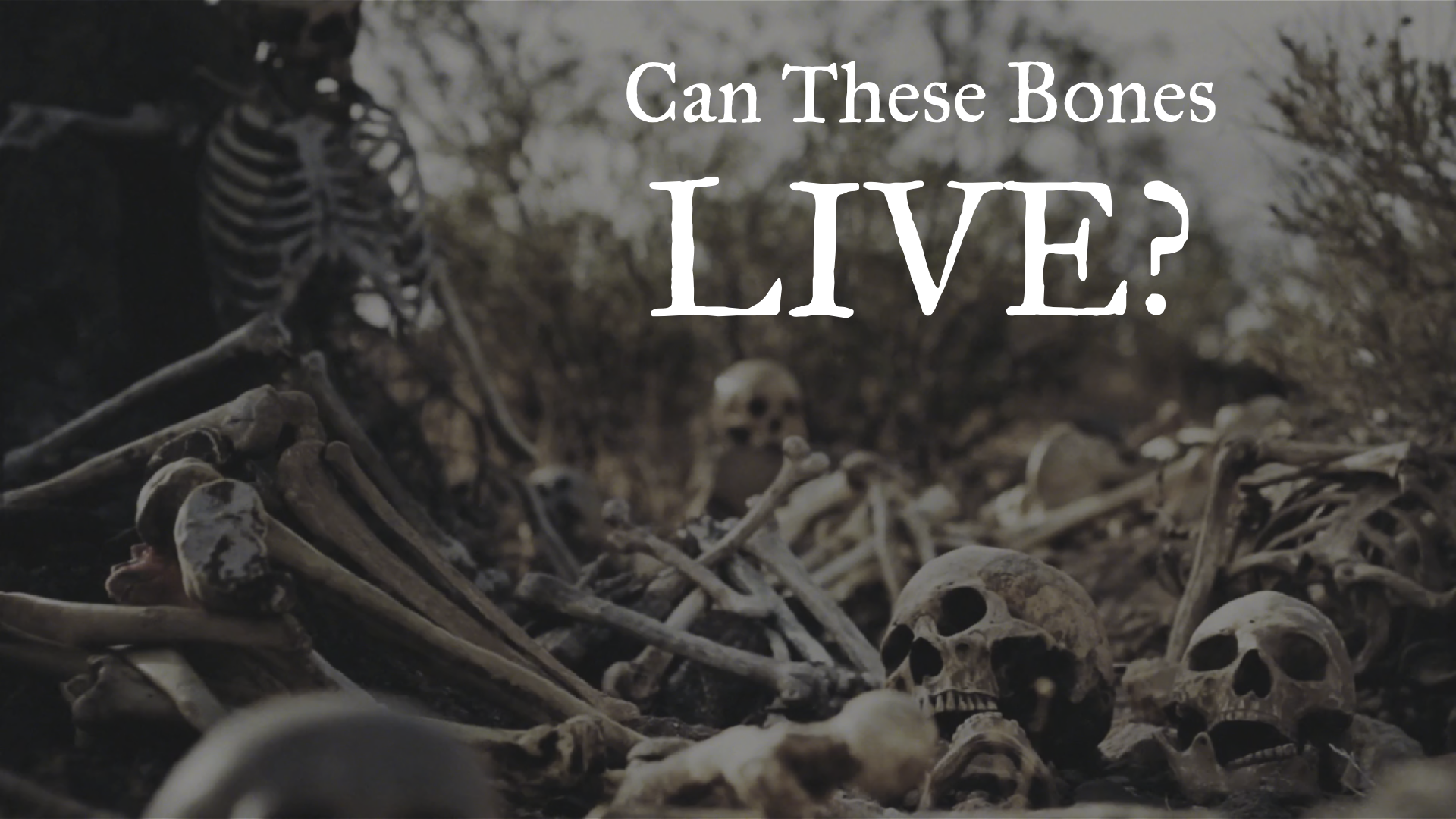
Can These Bones Live?

Ezekiel 37 recounts what must be one of the creepiest stories in the entire Bible:

1 The hand of the Lord was upon me, and he brought me out in the Spirit of the Lord and set me down in the middle of the valley; it was full of bones. 2 And he led me around among them, and behold, there were very many on the surface of the valley, and behold, they were very dry. 3 And he said to me, “Son of man, can these bones live?” And I answered, “O Lord God, you know.” 4 Then he said to me, “Prophesy over these bones, and say to them, O dry bones, hear the word of the Lord. 5 Thus says the Lord God to these bones: Behold, I will cause breath to enter you, and you shall live. 6 And I will lay sinews upon you, and will cause flesh to come upon you, and cover you with skin, and put breath in you, and you shall live, and you shall know that I am the Lord.”

7 So I prophesied as I was commanded. And as I prophesied, there was a sound, and behold, a rattling, and the bones came together, bone to its bone. 8 And I looked, and behold, there were sinews on them, and flesh had come upon them, and skin had covered them. But there was no breath in them. 9 Then he said to me, “Prophesy to the breath; prophesy, son of man, and say to the breath, Thus says the Lord God: Come from the four winds, O breath, and breathe on these slain, that they may live.” 10 So I prophesied as he commanded me, and the breath came into them, and they lived and stood on their feet, an exceedingly great army.

11 Then he said to me, “Son of man, these bones are the whole house of Israel. Behold, they say, ‘Our bones are dried up, and our hope is lost; we are indeed cut off.’ 12 Therefore prophesy, and say to them, Thus says the Lord God: Behold, I will open your graves and raise you from your graves, O my people. And I will bring you into the land of Israel. 13 And you shall know that I am the Lord, when I open your graves, and raise you from your graves, O my people. 14 And I will put my Spirit within you, and you shall live, and I will place you in your own land. Then you shall know that I am the Lord; I have spoken, and I will do it, declares the Lord.”

(Ezekiel 37.1-14)

This is a crazy story, but it’s actually quite fitting for Ezekiel’s crazy life: taken into captivity in Babylon, Ezekiel experiences frequent visions, is called to radical forms of preaching to a people who he knows will not listen or repent, and suffers great personal loss. And then, after all this, Ezekiel gets the news that Jerusalem has fallen—Babylon has conquered the city and destroyed the Temple.

This is the context for the creepy story in Ezekiel 37: Ezekiel is out in the middle of nowhere in a valley filled with dry, scorched bones. He is commanded to preach to them (which, by this point, probably doesn’t even seem that strange to him!) and the bones begin to rattle around and then come together, joined by ligaments, tendons, and muscles, and are covered with flesh. Then the breath of the wind comes upon them and they become living people. 

These dry bones in Ezekiel 37 are a metaphor for Israel’s spiritual state: exile and death, yes, but God’s Spirit is coming to bring His people back to life. It recalls the story in Genesis 2 where God creates humans out of dirt and breathes life into them with His Spirit. And the rest of the book of Ezekiel continues with a message of hope. Earlier, judgment was the emphasis: the people have been unfaithful, they haven’t loved God and other people, they won’t listen to correction, they have hard hearts of stone, and there will be consequences for their wickedness: Babylon is going to conquer them.

But now there is an emphasis on hope, because exile is not the end. The dry bones can live again. God is going to restore Israel, a new Israel with a new heart, He’s going to defeat evil in the nations, and He’s actually going to redeem all of creation as well. The book of Ezekiel ends with a vision of a new temple with a stream flowing out from it that becomes a mighty river that flows into the Dead Sea Valley—a desert place of barrenness where nothing can live in the water because it’s so salty—and it turns it into a lush paradise, a new garden of Eden called, “The Lord is there.”

And that’s how Ezekiel ends.

This story of dry bones coming to life in Ezekiel 37, a story of judgment and hope, exile and return, death and new life, is really a powerful summary of the whole story of the Bible. This is the story of Scripture over and over again. God asks Ezekiel, “Son of man, can these bones live?” and the answer is a resounding Yes!

  • Yes, when humans rebel and get kicked out of the garden, God promises to enact a plan to bring them back!
  • Yes, there is life and freedom after slavery in Egypt!
  • Yes, there is a return after exile in Babylon!
  • Yes, after the sinless Messiah is betrayed, arrested, beaten, and crucified, there is an empty tomb and a resurrected life!

And this isn’t just the story of the Bible, it’s our story too. Yours and mine. “Son of man, can these bones live?” Yes! 

  • Can a damaged friendship, a broken relationship, a betrayed marriage—can these come back to life? Is there any hope? Can these bones live? With God’s help, yes they can!
  • Can a church that is beset by controversy, quarreling, or just indifference, a church that dwindles and shrinks—is there any hope for such a church? Can these bones live? Yes, they can!
  • Can the sin that keeps you in bondage, the sin that enslaves you, that you say over and over that you won’t do it again and yet you keep coming back to it—can you ever be free of that? Can these bones live? Yes, they can!
  • As we go through this life filled with difficulties and delights, and as we march relentlessly toward the death that awaits all of us…is there anything for us beyond the grave? Can these bones live? Quite literally, yes they can!

Our story connects to God’s story. That’s part of what Paul talks about in Romans 6. There, he describes how when we are baptized into Christ, we die to sin. The old person we were who was enslaved to sin dies, and a new creation replaces that. This has implications for the present because right now, in our lives as parts of God’s new creation, we live differently, set free from sin. But it also has implications for the future because “if we have been united with Christ in a death like his, we shall certainly be united with Him in a resurrection like his” (Romans 6.5).

Christ died and was placed in a tomb, and then rose again to new life, not as some sort of spirit or ghost floating around, but with a new body. After His resurrection, Jesus specifically says that He’s not a ghost, that He has flesh and…bones.

One day you and I, if Jesus doesn’t return before then, will die. It may happen soon in a surprising way, or it may happen many years from now as our bodies age and weaken, we grow sick and feeble, and we pass away. Then our bodies will be buried in the ground and slowly begin to decompose. And eventually, we will be nothing more than dry bones.

Son of man, can these bones live?

If you belong to Jesus, the answer is Yes! Our bodies, which were “planted” in the ground corruptible and perishable, will be raised incorruptible and imperishable (1 Corinthians 15.42-44). God’s Spirit will breathe into them, and we will be alive again, suitable and prepared, ready for an eternity in God’s presence, in that new garden of Eden paradise that Ezekiel talked about: “The Lord is there.”

Son of man, can these bones live? The answer is Yes! This is God’s story, and it can be our story too.


In this loose series of Scripture Reflections, I am sharing brief thoughts spurred on by my Bible reading. By way of reminder, my goal for these brief posts is two-fold:

(1) To remark on aspects of the biblical text that I find to be of interest that the reader may or may not have thought about previously.

(2) When possible, to point to the work and person of Jesus Christ. I believe the Bible is a unified story that points to Jesus, which means that He is frequently alluded to or foreshadowed in some way throughout the biblical canon.


Do Not Be Anxious about Your Life

This is an edited version of a sermon that I recently preached at Cloverdale Church of Christ.

I think that some people are naturally inclined toward worry, and I confess that I am one of those people. For as far back as I can remember, I have always struggled with worrying about things. This is still true today. In fact, over the last several months (with brief interludes), I have been stressed about a lot of different things and worried about fulfilling all of the commitments that I’ve made. And, of course, I know it’s not healthy to carry so much stress, so at times I worry about that too! I’m stressed out about how much stress I have! What an ironic and annoying cycle that is.

I suspect that I’m not the only one who struggles with this. Not the only person who feels stressed out and overstretched, not the only person who worries about people I love, not the only person who is uncertain about the future and the world in which we live, not the only person who is tempted to be anxious about a lot of things. I suspect that because we live in anxious times.

Anxious Times

Social psychologist Jonathan Haidt recently published a book, The Anxious Generation, that chronicles the alarming state of mental health among Generation Z, those individuals roughly between the ages of 10-25. By virtually any measure of mental health—psychological disorders, diagnoses of anxiety and depression, instances of non-fatal self-harm, and suicide rates—Gen Z is in a rough spot. Haidt ties this significantly to smartphones and social media because it was around 2010—when smartphones with social media apps became prevalent—that all of these measures began to spike upward. But there are other correlating factors too: drastically reduced amounts of sleep (which basically makes every aspect of life worse), breakdown of real-life interpersonal relationships, and certain parenting trends. An additional factor that I would add, which Haidt (who is not religious) leaves out: research consistently indicates a wide array of positive traits (including positive mental health outcomes) related to religious faith, but we live in a rapidly secularizing society where faith is on the decline. That is certainly part of the picture as well.

And while Haidt’s research focuses on Generation Z, these spikes in anxiety and depression are present in other generations as well. The spikes may not be quite as severe, but they’re there and they are significant. 

What sorts of things make you anxious?

  • Maybe it’s financial issues: will your paycheck stretch enough to be able to last for the whole month? Are you putting enough aside to live on when you retire? Is retirement even an option? 
  • Forget about retirement: maybe you’re anxious simply about the prospect of being able to get a job that will support a family. Maybe you’re worried about all of the schooling that lies between you and that job and all of the stress that comes with it.
  • Maybe it’s relational: maybe you are concerned about your relationship with your spouse, or your boyfriend or girlfriend, or your roommate, or your boss, or your co-workers, or your parents, or your children, or you adult children.
  • Maybe you are concerned about the health of a family member, or your own health—a recent diagnosis.
  • Maybe you’re worried about the upcoming election season—the direction of our country, the future of our nation.

We live in anxious times, and there is so much that can drive us to anxiety and worry if we let it. But Jesus has something to say about this. He has counsel for us to consider. Before we get into that, there are two things I want to mention briefly, just so you can be sure of what I’m not trying to say:

  • I don’t believe that Jesus’s teaching about anxiety means that you are a deficient Christian if you struggle with this or that it is wrong for you to seek help from a licensed counselor. Not at all. If you have an anxiety disorder, going to get help with that disorder is an exercise in actually trying to obey what Jesus says here. 
  • Also, not all worries and concerns are the same. The Bible actually speaks positively about Paul’s anxiety for the churches (2 Cor 11.28) and Timothy’s anxiety for the welfare of the Philippians (Phil. 2.20). Some issues are more worthy of our concern than others. But even in those areas, I think what Jesus says here is still helpful.

What Jesus Wants Us to Remember in Anxious Times

22 And he said to his disciples, “Therefore I tell you, do not be anxious about your life, what you will eat, nor about your body, what you will put on. 23 For life is more than food, and the body more than clothing. 24 Consider the ravens: they neither sow nor reap, they have neither storehouse nor barn, and yet God feeds them. Of how much more value are you than the birds! 25 And which of you by being anxious can add a single hour to his span of life? 26 If then you are not able to do as small a thing as that, why are you anxious about the rest? 27 Consider the lilies, how they grow: they neither toil nor spin, yet I tell you, even Solomon in all his glory was not arrayed like one of these. 28 But if God so clothes the grass, which is alive in the field today, and tomorrow is thrown into the oven, how much more will he clothe you, O you of little faith! 29 And do not seek what you are to eat and what you are to drink, nor be worried. 30 For all the nations of the world seek after these things, and your Father knows that you need them. 31 Instead, seek his kingdom, and these things will be added to you.

32 “Fear not, little flock, for it is your Father’s good pleasure to give you the kingdom. 33 Sell your possessions, and give to the needy. Provide yourselves with moneybags that do not grow old, with a treasure in the heavens that does not fail, where no thief approaches and no moth destroys. 34 For where your treasure is, there will your heart be also.

(Luke 12.22-34)

In this passage, beginning in Luke 12.22, Jesus tells His disciples, “Do not be anxious about your life, what you will eat, nor about your body, what you will put on.” It’s probably worth noting up front that Jesus is very aware that there are things in life that will prompt us to worry.

Look at the life of Jesus: did He experience financial insecurity? Of course: He was essentially homeless during His public ministry, and had to rely on the generosity of others or the occasional coin from the mouth of a fish to cover His expenses. Did He have relational problems? His brothers thought he was crazy, his cousin John was murdered, and one of His followers betrayed Him. Did he carry a lot of stress related to work? Well, His job was to be the Savior of the entire world, so yes, I think you could say that there was stress involved in work of that magnitude. 

Jesus wasn’t sheltered from the anxiety we feel. He lived in anxious times, too.

From Luke 12, here’s what Jesus wants us to remember in anxious times:

(1) Your Father knows, and He loves you.

We need to note that Jesus addresses this entire section of teaching to disciples—people who know God as their Father and are seeking to entrust Him with their lives. I say this because, if you don’t know God as your Father, I do genuinely believe that there is a lot to be worried about. Not just because of your eternal destination, but on a fundamental level, without God as your Father, you basically believe that it’s all up to you. You’re on your own in this life and you have to figure out your troubles yourself. 

But if we are disciples of Jesus, it should be different. God provides for the ravens, and He values us much more than they—we shouldn’t worry about our food. God clothes the lilies of the field and makes them beautiful, and values us much more than they—we shouldn’t worry about our clothing.

Jesus says in Luke 12.30 that “the nations of the world”—the Gentiles, those who don’t know God—they worry about these things. And that makes sense: they don’t know God as their Father. But it doesn’t make sense for those of us who claim God as our Father to worry about these things. If we are believers, we shouldn’t live like atheists. 

God is our Father. He knows what we need, and He loves us.

(2) Worrying doesn’t help.

Jesus asks in Luke 12.25, “Which of you by being anxious can add a single hour to his span of life?” Jesus is underscoring here the impotence, the powerlessness of worry—which of your problems can you solve by worrying about them?

A lot of the time we worry about things that are cloaked in the uncertainty of the future: an important meeting or presentation that is coming up, a difficult conversation that you are dreading, or the results from a medical scan that might change your life. But really, worrying about the future is just a way for us to increase the amount of trouble we have without solving anything. After all, if what we are worried about doesn’t come to pass, then we have worried for no reason. If the thing we are worried about does come to pass, we’ve robbed ourselves of peace of mind without positively affecting the situation in any way.

Worrying doesn’t help things. 

(3) Seek first God’s kingdom. 

Instead of being preoccupied with the worries and concerns of this world, we should instead seek God’s kingdom (Luke 12.31). Another way we could say this as disciples of Jesus is that we should emulate His way of life and make His priorities our priorities. 

And if we do that, Jesus says, all of these other things that we need will be added to us. And, by the way, don’t think that this emphasis on the kingdom means that we should add the kingdom to the list of things that plague us with anxiety—that kind of misses the point. Instead, we should seek the kingdom knowing that it is our Father’s “good pleasure to give it to us” (12.32).

We live in anxious times. But remember, Jesus says: your Father knows and He loves you, worrying doesn’t help, seek first God’s kingdom, and the other things will be added to us.

Where Do We Go From Here?

As we seek to apply Jesus’s teaching to our lives, here are a few things to consider:

(1) Take your worries to your Father.

Anxieties will come. We live in anxious times and there’s much to worry about if we indulge those impulses. When you feel the burdens and stresses of life weighing you down, when you feel the stress and anxiety spiking your blood pressure, take it to God in prayer.

Earlier I mentioned the experience of Jesus and the anxieties He must have felt, but generally speaking, He never let it show. But that changed on the night He was betrayed, in the Garden of Gethsemane—it all seemed to come crashing down. Jesus was clearly anxious as He anticipated the horrendous death that was approaching. So what did He do? He took it to the Father, and in so doing, received the strength He needed to face what was coming.

It has been true in my life that I tend to worry less when I pray more.

(2) Count your blessings, not your concerns.

I don’t know about you, but one of the hardest times for me can be at night, lying awake, worrying about all the things I need to get done, all the problems I need to solve, all the people I need to fix (ha!). 

As I am tempted to just lay there, doom cycling through all of my concerns, I’ve found that a helpful practice instead is to focus on my blessings rather than my worries. Sometimes I’ll work my way through the alphabet, thinking of a blessing in my life that begins with each letter. 

This accomplishes multiple purposes: it distracts me from the things I was obsessively worrying about, it reminds me of blessings that I may have otherwise overlooked, and it shifts my focus from the things in life that I think I have to take care of to the Father who takes care of me. (And it puts me to sleep, which is an added bonus!)

It has been true in my life that I tend to worry less when I thank God more.

(3) Freely give of your money, possessions, and time.

Jesus especially focuses on material possessions when talking about things that we shouldn’t worry about. It is no coincidence that right before this, we have the Parable of the Rich Fool, who tries to hoard wealth in an effort to provide peace and security for his life, and at the end of this passage, beginning in 12.33, Jesus says, “Sell your possessions, and give to the needy. Provide yourselves with moneybags that do not grow old, with a treasure in the heavens that does not fail, where no thief approaches and no moth destroys. For where your treasure is, there will your heart be also.”

If our lives revolve around the acquisition of wealth, comfort, status, and security, then that’s where our hearts will and we will be consumed by anxiety for those things. But if our lives revolve around God’s kingdom, then we will freely give those things away and in the process, they will lose their hold over us. Where your treasure is, there will your heart be also.

It has been true in my life that I tend to worry less when I give more.

Jesus says, “Do not be anxious about your life.” He says that not to shame you, but to save you.

Jonah Naps in a Boat

The importance of Bible reading was impressed upon me from a young age, so I had the benefit of reading through the entire Bible several times before I graduated from high school. Of course, this is a good practice, but reading the Bible for yourself can be an unsettling experience. When you read Scripture for yourself, you learn that there are parts of the Bible that are rough around the edges, parts that are entirely foreign to modern ideas, and parts that are certainly not meant for young readers. Furthermore, you learn that a lot of biblical characters who are often presented as heroes in children’s storybooks and Sunday school classes aren’t very heroic at all!

I remember the first time I read the book of Jonah for myself as a kid and moved beyond a storybook understanding of Jonah. Far from the simplistic “good guy makes a mistake but then repents and obeys God” storyline, Jonah is a more complex book, and Jonah himself is a less likable character than what is often assumed. I find this book to be fascinating, and I have actually written about Jonah several times over the years.

As I was reading through Jonah again recently, I was struck by this episode, which occurs after Jonah ignores God’s command to preach to Nineveh and instead boards a ship bound for Tarshish:

4 But the Lord hurled a great wind upon the sea, and there was a mighty tempest on the sea, so that the ship threatened to break up. 5 Then the mariners were afraid, and each cried out to his god. And they hurled the cargo that was in the ship into the sea to lighten it for them. But Jonah had gone down into the inner part of the ship and had lain down and was fast asleep. 6 So the captain came and said to him, “What do you mean, you sleeper? Arise, call out to your god! Perhaps the god will give a thought to us, that we may not perish.”

(Jonah 1.4-6)

What made this stand out to me was how closely it parallels with a similar event from the life of Jesus, where Jesus is on a boat with His disciples on the Sea of Galilee when a storm comes up (Matthew 8.23-27; Mark 4.35-41; Luke 8.22-25). Jesus’s disciples are alarmed, but Jesus takes a nap…just like Jonah did![1]

It’s easy to just dismiss these details as coincidence, but as I have written before, the Bible is a literary masterpiece, and we should should be suspicious of these seeming coincidences: usually, the author is trying to tell us something. In this case, there are many points of comparison between the two events. The following table comes from Kevin Youngblood’s excellent commentary, Jonah: God’s Scandalous Mercy:[2]

Jonah boards a ship bound for Tarshish in order to run away from God’s call to preach to Nineveh; Jesus appears to get on a boat in order to avoid the crowds pressing around Him. While on board their respective boats, both Jonah and Jesus fall asleep while violent storms threaten to sink them. The pagan sailors on board with Jonah and Jesus’s disciples both fear for their lives and awaken them to alert them of the danger and seek their assistance. Both of the protagonists know what to do in order to calm the storm and take appropriate action: Jonah has his shipmates toss him into the sea, while Jesus orders the waves to submit to His authority. Both sets of shipmates are awestruck by the divine power they have witnessed.

What are we to make of these similarities? Well, we should begin by noting that in the gospels, Jesus compares Himself to Jonah in multiple places. Here is one example:

38 Then some of the scribes and Pharisees answered him, saying, “Teacher, we wish to see a sign from you.” 39 But he answered them, “An evil and adulterous generation seeks for a sign, but no sign will be given to it except the sign of the prophet Jonah. 40 For just as Jonah was three days and three nights in the belly of the great fish, so will the Son of Man be three days and three nights in the heart of the earth. 41 The men of Nineveh will rise up at the judgment with this generation and condemn it, for they repented at the preaching of Jonah, and behold, something greater than Jonah is here.

(Matthew 12.38-41)

Jesus highlights a comparison, indicating that Jonah’s three days and nights in the “tomb” of the great fish is a foreshadowing of His own three days and nights in the tomb. But He also emphasizes a contrastin that, despite His greatness compared to Jonah, the generation to which He is preaching will not repent as the Ninevites did for Jonah.

With this in mind, the deep sleep that comes over Jonah and Jesus on their boats symbolizes the “death” and return that both will soon experience, and in the gospels, this episode paves the way for Jesus’s later teaching on the sign of Jonah.[3]

But the carefully crafted narrative is not just about emphasizing the similarities between Jesus and Jonah; the distinction between the two is of paramount importance. Jonah is sleeping on a boat ultimately as a symptom of his determination to escape God’s calling for his life. God wants to use Jonah as an instrument of His astounding mercy, and Jonah wants no part of that. He runs away, hides in sleep, and ultimately, calls his shipmates to throw him into the sea, confident that he will die, but that death would be better than preaching to the hated Ninevites.

Jesus, on the other hand, embraces His calling rather than seeking to escape it. Rather than whip up the popular fervor of the crowds and harness that frenzied energy into a typical messianic rebellion, Jesus leaves and boards a ship with his disciples. There, He is able to be calm, not only because He is the Master of raging tempests, but also because He knows His death is already set. It will not come in a boat, but rather will be characterized by three days in a tomb followed by a return (as with Jonah).

As Jesus awakens and calms the storm, His disciples are awestruck, asking one another, “Who is This?” (Mark 4.41). Jesus has just given them a key data point in their assessment of His identity and mission. Their ongoing journey to discover who Jesus is will be a winding and stumbling one, and they will only come to fully understand His identity after His death and resurrection. This is what the Father had called Him to do, and indeed, his calling and identity were fundamentally linked.[4]

And so they are for God’s people. We are defined by the calling that God places upon our lives to live as disciples of His Son and agents of reconciliation in His world. But there is a choice to make: like Jonah, we can ignore that calling and seek to escape it, or like Jesus, we can embrace that calling and become who we were always intended to be.


In this loose series of Scripture Reflections, I am sharing brief thoughts spurred on by my Bible reading. By way of reminder, my goal for these brief posts is two-fold:

(1) To remark on aspects of the biblical text that I find to be of interest that the reader may or may not have thought about previously.

(2) When possible, to point to the work and person of Jesus Christ. I believe the Bible is a unified story that points to Jesus, which means that He is frequently alluded to or foreshadowed in some way throughout the biblical canon.


[1] I think this is a wonderful narrative from which we can learn much, and have written on it in the past. See, “Why Are You Afraid?” and “Asleep in the Storm.”

[2] Kevin J. Youngblood, Jonah: God’s Scandalous Mercy, Hearing the Message of Scripture Commentary Series (Grand Rapids, MI: Zondervan, 2013), 90.

[3] Youngblood, 90.

[4] Youngblood, 91.

« Older posts Newer posts »

© 2026 The Doc File

Theme by Anders Noren — Up ↑