The online journal of Luke Dockery

Category: Youth Ministry (Page 21 of 24)

Controlling the Flames of our Tongues

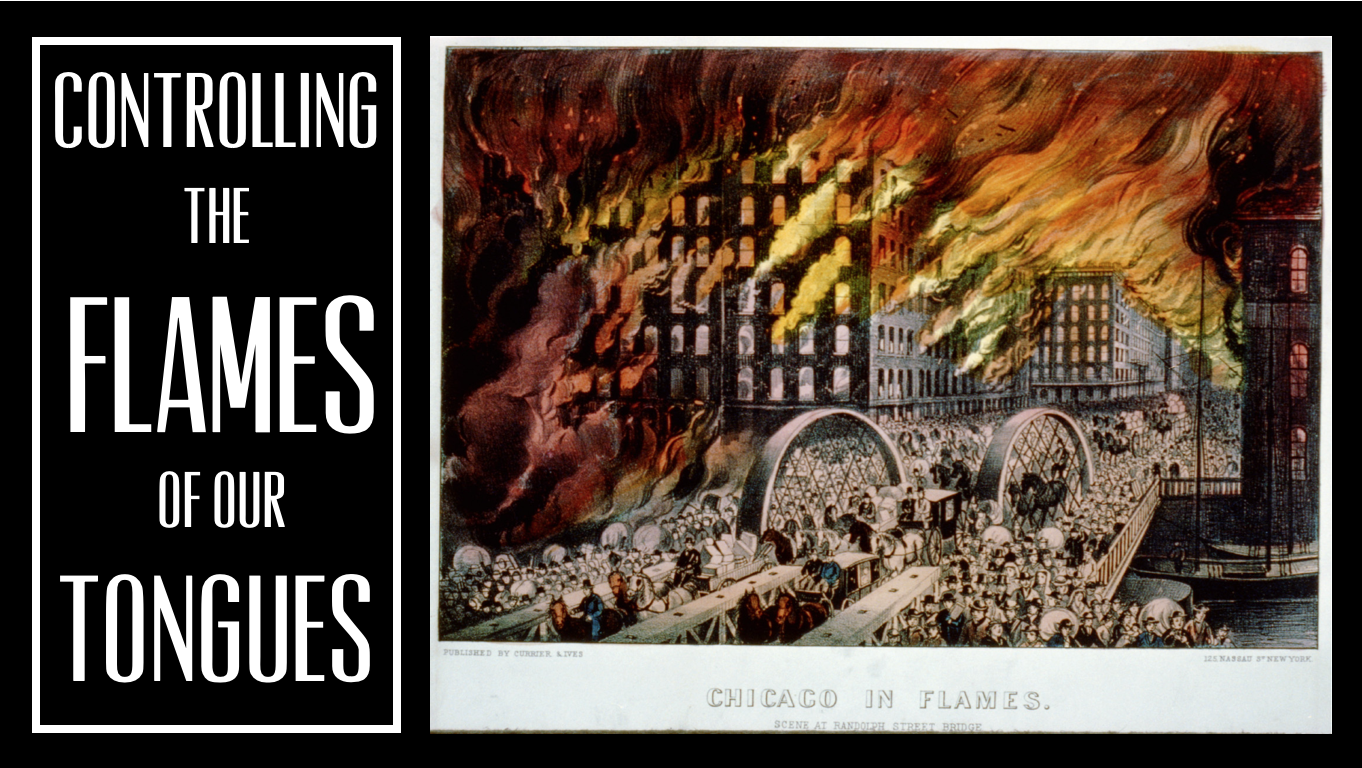
On Sunday, October 8, 1871, a fire broke out in Chicago, Illinois. It started in a small shed (no one really knows how) and quickly spread throughout the city. The heavy use of wood for construction at that time, a drought that had occurred prior to the fire, strong winds from the southwest that carried burning rubble toward the heart of the city, and poor reaction by city officials and citizens all combined to create a devastating inferno. The fire burned for two days, but even when it was over, the smoldering remains were still too hot for a survey of the damage to be completed for days.

Eventually, the vast destruction from the fire was determined:

  • An area four miles long by three-quarters of a mile wide, or more than 2,000 acres
  • More than 73 miles of roads and 120 miles of sidewalks
  • 17,500 buildings
  • $222,000,000 in property, which was about 1/3 of the city’s total value
  • Of 300,000 inhabitants, 90,000—30% of the city’s population—were left homeless
  • 200-300 people were killed

What began as such a small flame was transformed into a catastrophe.

In James 3.5-10, James compares the human tongue to a raging fire:

“Likewise the tongue is a small part of the body, but it makes great boasts. Consider what a great forest is set on fire by a small spark. The tongue also is a fire, a world of evil among the parts of the body. It corrupts the whole person, sets the whole course of his life on fire, and is itself set on fire by hell. All kinds of animals, birds, reptiles and creatures of the sea are being tamed and have been tamed by man, but no man can tame the tongue. It is a restless evil, full of deadly poison. With the tongue we praise our Lord and Father, and with it we curse men, who have been made in God’s likeness. Out of the same mouth come praise and cursing. My brothers, this should not be.” 

James compares the tongue to fire because just like fire, if our tongues are out of control, they can cause a great deal of damage. Gossiping, talking behind people’s backs, saying hurtful things, putting others down, spreading falsehood…all of these actions of the tongue can cause far-reaching damage. When we’re careless with our words, we can destroy a friendship or a reputation.

A lot of times when we talk about moral problems, especially with teens, we tend to focus on the “big” issues: things like drinking, drugs, sex, etc. Those issues need to be talked about, but the harm we do with what we say is a much more common problem—I hear people using their fiery tongues all the time (even in church!) with little regard for the collateral damage they could be causing.

Read James 3.9-10 again:

“With the tongue we praise our Lord and Father, and with it we curse men, who have been made in God’s likeness. Out of the same mouth come praise and cursing. My brothers, this should not be.” 

Our speech can be a problem or it can be pleasing to God. What’s it going to be for you? Your tongue can be as dangerous and destructive as a fire. Use it carefully.

Hashtag Media: A Creative Solution to a Common Problem (Curriculum Confusion Part 2)

Yesterday I talked about the difficulty that youth ministers and others face who have the task of choosing Bible class curriculum for teenagers. I discussed three different common approaches to finding curriculum, but also mentioned that each of these has significant drawbacks.

Today I want to write a little about Hashtag Media, which is a new effort that I see as a creative solution to the problems I talked about yesterday.

If you’re a regular reader of this blog, you may remember me talking about the Hashtag Youth Series, which was a free video-based youth summer series that was released last year. Hashtag Media was launched in early October as a companion project to the Youth Series, and proceeds from Hashtag Media’s resources are reinvested in future Youth Series and other projects.

All of this is pretty exciting because the products that Hashtag Media have released so far have virtually all of the advantages I talked about yesterday from the different curriculum types without any of the drawbacks:

  • The material is created by youth ministers from churches of Christ, which means that distinctive doctrines aren’t ignored—I don’t have to worry that the significance of baptism will be diminished or that the lessons will implore teens to come to salvation through a Sinner’s Prayer method that isn’t talked about in Scripture.
  • Written by professional ministers also means that the content of the lessons is high quality.
  • The material is created to be Christ-centered, which means it still has a “big picture” focus that is very important for teens.
  • The lessons are fundamentally biblical; the current series we are studying is from the Book of Ephesians and uses an expository verse-by-verse approach which encourages the students to really dig into the text (it is excellent).
  • More than just the content of the lesson, the overall product is very good: the graphic design is excellent, and the lessons come with starter activities and illustrations which help bring the biblical message to life.
  • It is affordable. The longer quarter-length series are only about $50, and they have recently rolled out the option of buying a year’s subscription which means that you can get all the new material which comes out in 2013 for only $200. These prices are very competitive (read: cheap), and knowing that all of the proceeds go toward creating more material makes it even easier to justify.
  • The creators of Hashtag want to increase the size of their curriculum library, and solicit the help of others who would be interested in submitting Bible class series to them. I appreciate the collaborative spirit of this project and will likely send them some of my own material at some point.

The only drawback I really see at this point is that currently, Hashtag’s offerings are a bunch of stand-alone class series which aren’t connected as part of a larger curriculum plan. To me that isn’t a huge problem (right now I am just using Hashtag products to fill in the gaps of other curriculum plans that I have), but perhaps as this project continues, they will put more thought in this direction.*

On the whole, I am really excited about the potential of Hashtag Media, and am grateful to the team of youth ministers behind its creation. If you are a youth minister or the person at your church in charge of selecting Bible class material for teens, I would encourage you to take a look at what they have to offer.

*Also, all of Hashtag Media’s resources are exclusively in an electronic, PDF format. Some people might see this as a drawback, but I don’t: you can get the resources immediately through email once you order them, and everything is going digital anyway. Before we know it, “class books” will be a thing of the past.

Curriculum Confusion Part 1: Different Approaches to Bible Class Material for Teens

If you are in youth ministry or are involved with organizing Bible class curriculum at church, you are likely aware of how difficult it is to select quality Bible class material for teenagers (in fact, I’ve actually written a bit about this before). If you find yourself in this situation, you basically have three different options:

The “Do It Yourself” Model

This option is actually pretty self-explanatory: you want Bible class curriculum for your teens? Write it yourself.

There are several advantages to this approach:

  • Theoretically, you should know your teens pretty well, so you ought to have a good idea of what they need to study, and on what level they need to study it (generally speaking, 12th graders are completely different than 7th graders and need to be taught differently).
  • If you are producing the material, you can be confident in the content—you don’t have to worry about something being taught that you disagree with or think is unbiblical.
  • This is a cheap way to go about acquiring Bible class material—aside from the small cost of making copies of handouts, basically the only cost is your time.

But there are significant problems to this as well:

  • It is very time-consuming to write every lesson for your teenagers from scratch. I have written lots of Bible class material for my youth group and invariably, it takes a lot of time. If you happen to have a lot of excess time, that’s great, but I don’t: realistically, with other ministry responsibilities, grad school, and family concerns on my plate, there are only a few quarters a year when I have time to produce original Bible class material.
  • Your Bible class material will only be as good as you are. What I mean is that if you are great at doing research, writing lessons, and putting together attractive powerpoint presentations, then your students will be in for a treat…but if this just isn’t one of your strengths, then subjecting your students to quarter after quarter of mediocre material is less than ideal. 

The “Least Common Denominator” Model

This option involves purchasing curriculum from a large company which specializes in producing it. I use the term “Least Common Denominator” because usually, in an effort to appeal to as many potential customers as possible, this material presents a very generalized, inter-denominational Christianity that offends no one.

Purchasing material from a large company like this does have its advantages:

  • Curriculum like this is written by professionals, and is usually well planned and very professional. It will usually come with supplemental materials like activities related to the Bible lesson or videos for your students to watch.
  • Sometimes it will be planned so well that it integrates with children’s and adults’ curriculum as well; it is a neat thing to have everyone in the church studying the same lessons at the same time.
  • By its inter-denominational nature, this approach it tends to focus on “big picture” biblical themes that everyone basically agrees with (Jesus, grace, sin, etc.) and which really do need to be emphasized to and understood by teens.

Although this is a very popular model, it comes with multiple problems as well:

  • It is usually very expensive: a quarter’s worth of material could cost hundreds of dollars, and if you follow an entire curriculum plan, it could be thousands of dollars each year. A lot of churches (mine included) simply don’t have the education budget to afford this year-round.
  • There are a lot of disagreements within Christianity (about things like salvation, the relationship between faith and works, the way the Bible should be read, the way we should worship, etc.), but the Least Common Denominator approach tries to ignore all of them by presenting a simplified Christianity that few find objectionable. Maybe that sounds idyllic, but ultimately, a diet of only this type of material produces students who haven’t thought deeply about (and potentially aren’t even aware of) any of these issues. To me, that’s a significant problem.
  • Also (and related to the last point), going along with the Least Common Denominator approach, oftentimes these studies are topical rather than textual, and focus on moral issues that virtually all Christians agree about: the dangers of drinking, drugs, premarital sex, etc. While these topics are important and need to be discussed, too much focus on them leads to the already-too-prevalent idea (among teenagers and the church as a whole) that being a Christian is nothing more than following a particular moral Do’s and Don’ts List rather than living a redeemed life as part of the Kingdom of God. In other words, curriculum should focus on the Gospel, which includes, but is much bigger than, the fact that Christians should behave in a certain way.

The “Brotherhood Material” Model

The third option is to purchase material from within your particular religious fellowship. In churches of Christ, we don’t like being referred to as a “denomination”, so we tend to refer to publications put out by members or companies affiliated with churches of Christ as “brotherhood material”.

Advantages to this approach include:

  • Theoretically, getting material from within your own fellowship should mean that it is doctrinally agreeable.
  • Usually, the cost for this type of curriculum is considerably less than the Least Common Denominator model.

But once again, there are multiple problems:

  • A lot of times, these materials are produced by smaller companies, and frankly, the quality is sometimes lacking.  In my experience, I have found this to be especially true on the presentation side (i.e., it doesn’t look that good), but it can also be weak on content as well.
  • Even “brotherhood” publishing companies want to make money and sell lots of their products, so they too can fall victim to the temptations to publish very general material that appeals to as many people as possible. When this happens, it is subject to the same problems as the Least Common Denominator model mentioned above.

So each of these models, although possessing strengths, is also characterized by significant disadvantages. I guess the major takeaway from all of this analysis is this: it is a challenge to find quality Bible class material for teens. So what is the solution? More on that in the second half of this discussion…

Getting Students Into the Word: A New Bible Class Approach (At Least, For Me)

In my years of youth ministry, one of the most alarming trends I have noticed is how little most teenagers actually know about the Bible. Sure, they’ll know some major characters and a few significant doctrines, but on the whole, it isn’t pretty.

And this is a big deal, because how can we claim to live by the Bible (which we do), if we don’t know what it says?

I haven’t done extensive research, but I suspect that there are several reasons for this trend:
  • Kids don’t actually read anymore. Seriously. Between TV, game consoles, the Internet, and iPhones, most young people find plenty to occupy their time without ever picking up a book.
  • Christian parents do less Bible study and teaching in the homes with their children. Families have busy schedules between school events, sports, and TV shows, and family devotional time tends to get squeezed out. Besides, what’s the point of having a youth minister if he isn’t going to teach our kids?
  • More and more, Bible class curriculum tends to be topical rather than textual. This isn’t always a bad thing, but taken to the extreme, all your students get are a lot of words on morality and only a little of the Word.
  • A significant portion of church members and families don’t even bother going to Bible class in the first place (this varies from church to church, but at our congregation, roughly 1/4 to 1/3 of our people don’t attend Bible class on Sunday morning).

All of that to say, this issue is something that I’ve become very convicted about over the years, and as a result, I have put a lot of emphasis on and effort into teaching the Bible to my youth group kids and getting them to read Scripture for themselves. This past quarter, we tried something a little different on Sunday mornings which actually turned out quite well, and I just wanted to share it very quickly.

I got the idea from a friend in youth ministry, who pointed me to a new rendering of the NIV translation of the Bible that has the chapter and verse numbers removed to make the text more readable. Of course, the original manuscripts of the Bible didn’t come with chapter and verse markers; those were added later to help organize the material and make it easier to reference. Without the chapter and verse numbers, I found the text much less choppy, and it read much more like a story. Biblica, the company which released this new format, provided a free sample of the books of Luke and Acts, and this is what we studied over the past quarter.

Using the free PDF download of Luke-Acts, I worked up a cover, an introduction to our study, and a reading schedule for our students, and bound them as individual books (they were about 100 pages long). Then for the whole quarter, our Bible class consisted of us talking about the things they read from the previous week (Bible stories and events they had never read before, things they liked, things they didn’t understand, things that bothered them).

Obviously, for this class format to be successful, the students actually needed to have read ahead of time. Especially since my youth group is currently skewed toward younger ages, I was a little concerned about them remembering to actually do the weekly reading assignments. To encourage this, I kept track of those who had done their reading assignments from week to week, and promised that we would take a reward trip at the end of the quarter for those who had done their homework throughout (yes, I absolutely believe in rewarding people for good behavior).

On the whole, I was pleased with the results. I had six students (out of 15-20) who read their assignments almost every week and qualified for the trip, and several others who missed the cut but still read about half the time. The quality of our class discussions fluctuated based on how many people had read, but on the whole, the students had a lot to talk about, as many of them were reading these chapters in depth for the first time (if that seems surprising to you, re-read my lamentations at the beginning of this post).

Currently, I don’t think this is a sustainable class model year round, as the level of readership tended to decline as the quarter progressed and the freshness wore off. Still, I think it’s something that I’ll try for at least one quarter a year.

Our group at the Oklahoma Aquarium as part of the reward for doing their Bible reading.

Winter Retreat Recap: SHINE

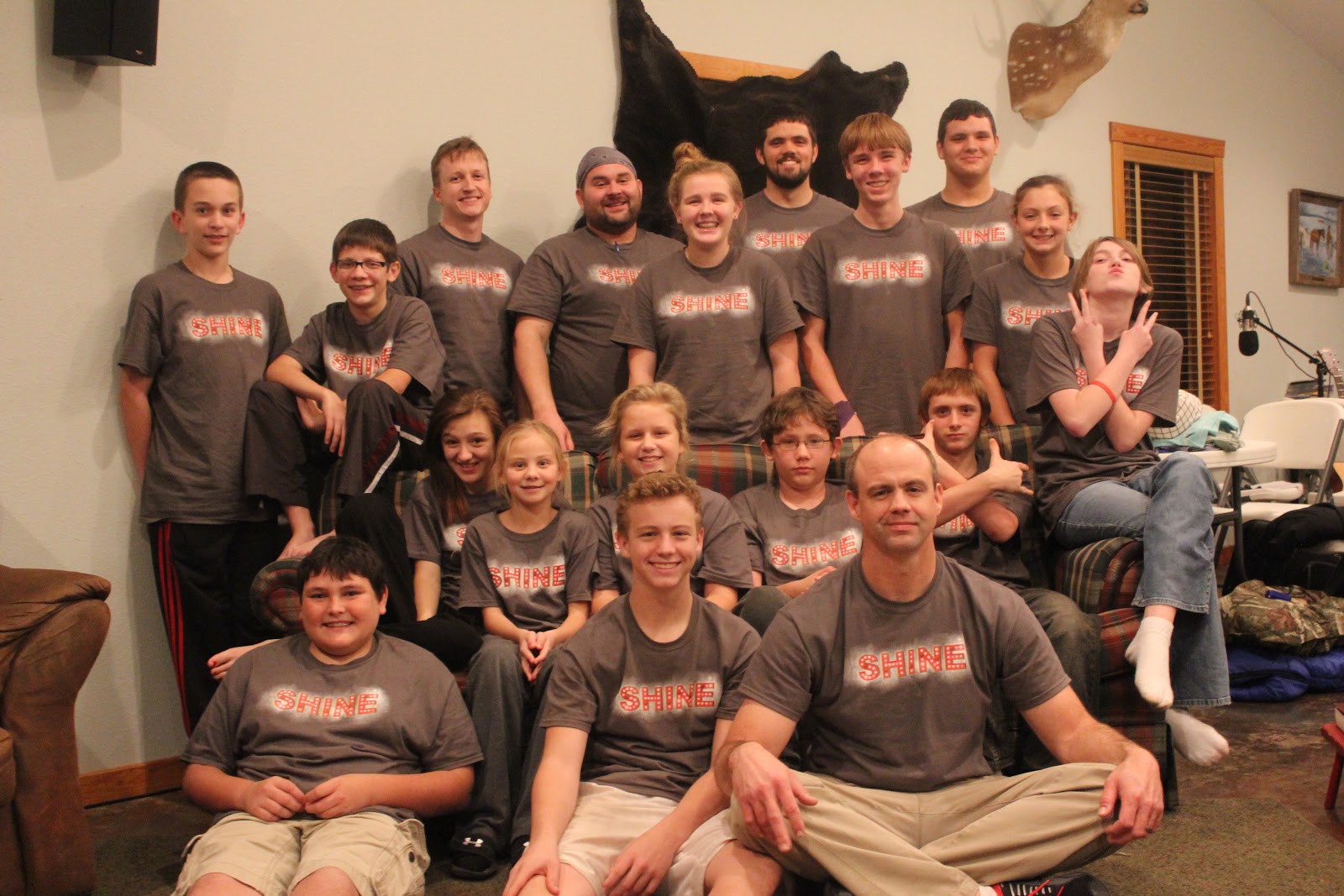
This past weekend was our annual youth group Winter Retreat. This is one of my favorite youth group events of the year, because we are able to take a break from our regular schedules for a weekend and focus on other things instead. It is always a time where the kids in our group grow closer together, get spiritually re-engergized, and have a ton of fun.

This year, the theme of our retreat was “SHINE,” and we talked about light and darkness from a spiritual perspective. Throughout Scripture, God is consistently portrayed using the metaphor of light, and as followers of God, Christians are to be people of light as well.

Our teachings on this topic were organized around three lessons which showed the progression of the theme throughout the weekend:

(1) The Shining Face of Moses (Exodus 33.18-23; Exodus 34.28-35). After Moses leads the people out of Egypt, he spends 40 days and 40 nights with God on Mt. Sinai while God gives the Law to him. Moses is protected in the crevice of a rock, and is only able to see the back of God’s glory as He passes, but the glory of God is so bright that it leaves Moses with a face that literally shines. He even wears a veil to cover his face. Being in the presence of God changes us.

(2) The Shining Light Comes to Earth (John 1.1-14; The Nativity Story). With the birth of Jesus, God reveals His glory and brings His Light to the earth in a new and special way. Jesus was fully God and fully man at the same time, and this means that the life of Jesus gives us the perfect example of how we can live in our dark world and still shine God’s Light.

(3) Shining God’s Light to Others (John 8.12; John 9.5; Matthew 5.14-16; Philippians 2.14-15; 1 John 1.5-7). After talking about the greatness of God’s glory and how that glory was brought to earth in a special way through the Incarnation of Jesus Christ, our last lesson brought all this together, and focus on our main task as Christians: shining the light of God into our dark world.

Instead of presenting this material in a traditional lecture format, our teens were broken into discussion groups based on age, and processed and learned the material that way. We then combined the separate groups for a larger group discussion, which (hopefully) helped to reinforce the material.

It was a great weekend! We had a lot of fun, and I am optimistic that the teens learned a lot as well.

« Older posts Newer posts »

© 2026 The Doc File

Theme by Anders Noren — Up ↑