The online journal of Luke Dockery

Tag: Baptism (Page 1 of 2)

Crusaders, Incomplete Baptisms, and the Parts We Keep from God

There is a legend that before going into battle, Crusaders would be baptized, pledging their lives to Jesus. But, as the legend goes, as they marched through the baptismal waters, they would hold their swords above their heads as they plunged into the water. It’s as if they were keeping that part of themselves from God—their weapon hands needed to be kept free from divine interference so they could do their killing properly.

I’m not sure if the legend is true. It can be easy to pick on those involved in the Crusades, which are often condemned as a sort of Christian holocaust. Actual historical study of the Crusades paint a more nuanced and complex picture, but the fact remains that the Crusades don’t represent a highpoint in Christian history. Furthermore, I’ve read another version of the legend that has Charlemagne doing this with his troops before battle, and he lived a few hundred years before the First Crusade. Perhaps the multiple attestation gives credence to some Christian soldiers doing this at their baptisms at some point in time. It seems quite possible to me, because it is just the sort of thing that people would do.

As John Mark Comer says in reference to this legend in his book, Live No Lies:

Legend or history, the imagery is piercing. We all do this. We might not hold up a sword; for us it could be a debit card, a relationship, a sexual ethic, a wound, an entertainment habit, a political or even a theological position. It could be anything. But how often do we say, if not in a word, then by our actions, Not this Jesus. Not this.[1]

I don’t know how that strikes you, but for me, it was a punch in the gut. It’s easy to look at the story of someone holding a sword hand out of the baptismal waters and see the clear hypocrisy, the deficient discipleship, but what about our own lives? As Comer points out, there are a lot of parts of ourselves that we can be tempted to try to keep from God and hold onto ourselves. That’s the problem, though: Christ must be Lord of all, or He is Lord of nothing. Following Jesus only when it is convenient isn’t really following Him at all.

Christ must be Lord of all, or He is Lord of nothing. Following Jesus only when it is convenient isn’t really following Him at all. Share on X

Lord, let me keep nothing back from You. Help me to give it all.


[1] John Mark Comer, Live No Lies (USA: WaterBrook, 2021), 250. This was one of my Top 10 books from this past year.

Celebrating Resurrection With My Youth Group

This past weekend (Friday evening through Saturday night) was our youth ministry’s Spring Retreat. Spring Retreat is our biggest event of the semester and, from my perspective, perhaps our most important event of the year, because of the cohesion and togetherness it gives to our group.

You may be thinking that Easter weekend is not the ideal time to schedule a youth retreat, and I would agree with you, but this was the only weekend we could make it work with my seniors’ schedules, and we still managed to have a really good turnout. And, since we happened to be meeting together on Easter weekend, I decided to theme the retreat around the resurrection of Jesus.

Really, the timing almost seemed providential. Currently, on Wednesday nights we are doing a series on doubt. A common misconception is that having doubts or questions in our faith is somehow sinful or shows that our faith is deficient, when the reality is that doubt is simply a part of the journey of faith. According to research, though, teenage Christians typically don’t have a space where they feel comfortable talking about their doubts, and they try to ignore them hoping they will go away. This is actually really detrimental to faith, though, as openly discussing doubts and questions during teenage years is correlated with long-term faithfulness.

Having said all that, while we want to be able to discuss our doubts and not be threatened by them, even more we want to trust God in our doubts, and also be confident in our faith.

Enter the resurrection.


Our theme for the weekend was “Out of the Grave,” and we examined the resurrection in three different sessions:

(1) Resurrection on Trial

Occasionally you will hear from people who consider themselves to be Christians, but reject the idea that Jesus physically rose from the grave. They believe that Jesus was a good man, a great teacher, that He had some great ideas,  that in some sense He spiritually “saves” us and mystically “lives through us” but that whether or not He rose from the grave doesn’t really matter.

That’s not what Paul says, though. After describing the resurrection as “of first importance” in 1 Corinthians 15, Paul goes on to get even more specific. He says:

 “…If Christ has not been raised, then our preaching is in vain, your faith also is vain…if Christ has not been raised, your faith is worthless; you are still in your sins…if we have hoped in Christ in this life only, we are of all men most to be pitied.”

(1 Corinthians 15.14,17,19).

What Paul is saying here is that you can’t have it both ways. You can’t hedge your bets. When it comes to the resurrection, there are only two choices:

  1. Jesus was not raised from the dead. If this is true, then all of us are, according to Paul, pathetic people who are wasting our time—we’re following someone who won’t lead us anywhere. If this is true then Jesus was a man, just like us, not unique in any way. He may have been a good man with great insight who people like to quote, but He is also someone who doesn’t have the answers to life’s questions and has no right to tell people how to live.
  2. Jesus was raised from the dead. If this is true, then it is the single most important fact in history. It means that Jesus was different; He was unique. He has power over life and death, He has the answers to life’s questions, He has the right to tell us how to live, and nothing in life is more important than following Him.

It is important, then, that we get this right, because the stakes are really high. Fortunately, though, there’s actually an abundance of evidence for the resurrection, and we put the resurrection “on trial” in our first session. We discussed the Physical Evidence of the empty tomb and the grave clothes of Jesus, we talked about the Eyewitness Accounts and reasons why the eyewitnesses could be considered reliable, and we discussed the Circumstantial Evidence of the sudden spread of Christianity and the change in the lives of both disciples and skeptics.

These different types of evidence all agree: after being crucified, Jesus of Nazareth was raised from the dead on the third day. And this is good, good news. The best news of all: it means that Jesus has power over life and death, the answer to life’s questions, and nothing in life is more important than following Him! Jesus Christ is the foundation of the Christian faith, and we shouldn’t build our faith or our lives on anything less than Him!

(2) Sharing in Resurrection

In our second session, we focused on the words of Paul in Romans 6.1-14, where he says that baptism is the time when we participate in the death and resurrection of Jesus. Jesus died, was then buried, and rose again, and Paul says here that, as Christians, we are buried in the act of baptism—we go under the water—and when that happens, our old self dies, and we are raised to walk a new life.

In the act of baptism, we unite our history and our destiny with Christ. Paul says that if we have been united with Christ in a death like His (by being buried in baptism), then we will also be united in a resurrection like His (v. 5). 

In the act of baptism, we unite our history and our destiny with Christ. Share on X

Of course, Jesus died a literal death, and then was raised, bodily, to a new life, and would then never die again, because death no longer had dominion over him (v.9). Our death at baptism is not a literal death, but rather a death to sin. Baptism represents a fresh start and a new life. No longer are we enslaved to the power of Satan, sin, and death; now, we have received God’s grace and God’s Spirit, and sin no longer is our master:

“So you also must consider yourselves dead to sin and alive to God in Christ Jesus.”

(Romans 6.11)

Of course, this doesn’t just happen automatically. Sin can continue to be a problem in our lives, and we must fight against it:

“Let not sin therefore reign in your mortal body, to make you obey its passions. Do not present your members to sin as instruments for unrighteousness, but present yourselves to God as those who have been brought from death to life, and your members to God as instruments for righteousness.”

(Romans 6.12-13)

Christ’s death and resurrection, and our sharing in His death and resurrection through baptism, provide us with the opportunity for a new life and a fresh start, but we still have to determine to live that way. It’s a fight and a struggle; we must present our bodies and our lives not to sin, but to God, not as instruments of righteousness. We are never going to be able to live the Christian life without effort. It’s going to require determination, struggle, and sacrifice.

But here’s the really important thing: what was once an impossible task—because sin was our master—is now possible! Because, through baptism, we have been united with Christ in His death and resurrection, we are now new creations. We have received God’s grace and His Spirit, and now, it’s actually possible for us to resist the temptation of sin. 

We won’t do this perfectly, but we are given this promise:

For sin will have no dominion over you, since you are not under law but under grace.

(Romans 6.14)

Sin no longer has dominion; it is no longer our master. And in those times, when we struggle with sin and we fail, God’s grace is there, amazingly, to wash away that sin. We are new creations. We have died to sin, and been raised to a new life, like Jesus.

(3) Resurrection Hope

Finally, we looked at the rest of 1 Corinthians 15 and talked about the Christian hope that when Jesus returns, we will experience bodily resurrection.

It is clear from 1 Corinthians that the church in Corinth had a lot of problems, and one of the things they seemed to be struggling with was the idea of resurrection from the dead. Why did they struggle with this? Well, for the same reason people today struggle with it! People in the ancient world were not stupid or gullible, and they were much more familiar with death than we are today (where we do everything we can to distance and insulate ourselves from the reality of death). All sorts of illnesses and medical conditions that we can treat today were death sentences in the ancient world, so people saw a lot of death, and they knew that dead people stay dead and that dead bodies rotted.

This is what was so controversial about the claims of Christianity. It wasn’t controversial to say that people continue to exist in some way after death, or that our spirits leave the body at death and have an eternal existence somewhere—Greeks and Romans believed that already! But the Christian claim that Jesus rose from the dead and that His followers would be raised from the dead as well in their bodies was a shocking claim. 

Paul taught about the resurrection in Athens, and people thought he was crazy (Acts 17). Apparently some of the Christians in Corinth did too.

But Paul emphasized that this matters—if Jesus was not raised from the dead, then our faith is useless, and we are still in our sins. But…

“But in fact Christ has been raised from the dead, the firstfruits of those who have fallen asleep.”

(1 Corinthians 15.20)

We can be confident in the resurrection of Jesus (see above), and Paul says that His resurrection is the “firstfruits” of our own. Firstfruits are the beginnings of a crop that point to a larger harvest later. What Paul is saying here is clear: If Jesus Christ was not raised from the dead, then our faith is useless, but if Jesus Christ was raised from the dead, then we will be raised too.

If Jesus Christ was not raised from the dead, then our faith is useless, but if Jesus Christ WAS raised from the dead, then we will be raised too. Share on X

Later, Paul anticipates the question that he will get in response to teaching that our bodies will be raised: “How are the dead raised? With what kind of body will they come?” How can these dead, decaying bodies come back to life? Because they will be changed.

In this passage, Paul compares our physical bodies to a seed that is sown. This highlights a connection between our current bodies and our resurrection bodies, but also a change. Seeds are not the same as the wheat they produce, but they are closely related: they are made of the same “stuff”, and one has the necessary DNA for the production of the other. 

Paul says that those who are in Christ will be raised with “spiritual bodies.” We need to think about both of these words. The Christian hope is not to be disembodied spirits floating around in a non-material existence, but neither is the Christian hope to have the same old bodies that we have right now, which are “natural” or “fleshly”.

Paul is clear in these verses that there are some major differences between our current bodies, and our future, resurrection bodies (15.42-44):

  • Our current bodies are perishable, while our future bodies will be imperishable
  • Our current bodies are dishonorable, while our future bodies will be glorious
  • Our current bodies are weak, while our future bodies will be powerful
  • Our current bodies are natural, while our future bodies will be spiritual

When Paul says “spiritual body,” the emphasis is on what provides the driving force for the body—it is powered by God’s Spirit. Just as the Holy Spirit raised Jesus from the dead, it will be God’s Spirit that raises us up from the dead and gives power and life to our resurrection bodies. The resurrection is not about us being freed from our bodies to live as spirits; it is about our bodies being transformed into something glorious that is both similar to and different from our current bodies, like seeds are both similar to and different from the plants that they produce.

This is the Christian hope: Just like Jesus, we too will come out of the grave!

Our bodies will be changed. They will be sown perishable, but raised imperishable; sown dishonorable, but raised glorious; sown in weakness, but raised in power; sown natural, but raised spiritual. Our resurrection bodies will be suited for an eternal existence with God.


We had a great weekend! We studied, discussed, worshiped, meditated, played, laughed, ate and even slept.

Most importantly, though, we thought about and celebrated the central claim of the Christian faith. The reality is that there are things that I struggle with and have questions about, but at the end of the day, I believe that Jesus was dead…and then He wasn’t. And if the resurrection is true, then that’s something that I can build my life on, and even though there are things that I don’t understand, those things don’t unsettle my faith because the truth is…Jesus came out of the grave.

The reality is that there are things that I struggle with and have questions about, but at the end of the day, I believe that Jesus was dead…and then He wasn’t. Share on X

Church Camp Baptisms and Mountaintop Christianity

Note: this post is a little more disjointed than much of what I write, but it accurately reflects the way in which I have been wrestling with this topic back-and-forth for some time.

Church camp is a significant part of the yearly youth ministry calendar, and a pretty standard feature of church camp (at least in my experience) are camp baptisms. The next statement I make may be jarring to some of you, and I want to clearly state that if you were baptized at church camp and had your sins washed away and hold to that moment as the time when you committed your life to Jesus, that is great, and I applaud you. Having said that, here comes the (perhaps) jarring statement: I am not a huge fan of camp baptisms.

There are several reasons for this:

  1. Camp baptisms usually happen away from the presence of the camper’s parents, and since parents are the primary spiritual influencers of their children, not having them present for such a major step is not ideal.
  2. Camp is an emotionally-charged environment, and it can be easy to get caught up in the camp experience and make a decision that no longer seems so pressing or important a few weeks later when camp is over and the emotional experience has faded.
  3. Many times camp baptisms happen in clusters: several kids from one cabin or one friend group will all decide to get baptized together or within a couple of days of one another and the question arises: do these students really want to give their lives to Christ, or are they just doing what all of their friends are doing?
  4. The purely pragmatic reason: personal experience shows that a lot of time these baptisms don’t really “stick” in the sense that they are often false starts that don’t lead to a life of faithfulness (probably because of some combination of reasons 1-3).

At this point, youth ministry veterans are likely reflecting on these reasons and nodding in agreement—they have seen it all before, too many times to count!

Having acknowledged all this, I now want to push back against what I have just said.


A few years ago, I was talking to a young man (out of college, in his 20s) who was questioning his baptism largely for the reasons mentioned above. He did it at church camp when he was young and he didn’t know a lot at the time—what if he was just caught up in the emotions of the moment and decided to get baptized because other people were?

And, of course, these are some of my own concerns.


Churches of Christ are spiritual descendants of the Stone-Campbell Restoration Movement, a primitivist, back-to-the-Bible movement whose aim was to bring about unity among followers of Jesus by simply trying to be the church that we read about in the Bible. At the same time, that Movement developed in a specific time and place, and was certainly influenced by that historical context. For the sake of this post, that influence can be seen in at least two ways.

First, it was a movement that prized logic and reason. Intellectually and philosophically, the early leaders of the Stone-Campbell Movement were greatly influenced by the Enlightenment. This doesn’t mean that they universally condemned emotion, but rationality and clear thinking were highly valued.

Second, as a product of the American frontier, the Stone-Campbell Movement also valued the rugged individualism that was so characteristic of American society. People were free to read the Bible and interpret it for themselves, and should base their beliefs on Scripture rather than the teachings of some priest or state church.

Against such a backdrop, is it any wonder that I am immediately suspicious of decisions to follow Jesus that seem to be largely influenced by emotion and the influence of what other people are doing?


My favorite thing about my spiritual heritage is that the Stone-Campbell Movement is, fundamentally, a back-to-the-Bible movement, so as I was talking to my friend who was questioning his own baptism, I immediately thought of Scripture, and specifically, the Book of Acts, where we have so many accounts of people giving their lives to following Jesus.

One of the prime examples is in Acts 2, where Peter preaches to a large crowd on Pentecost, basically telling them that the Jesus they had crucified was the Messiah and Son of God, and that He had been raised from the dead and was sitting at the right hand of God:

37 Now when they heard this they were cut to the heart, and said to Peter and the rest of the apostles, “Brothers, what shall we do?” 38 And Peter said to them, “Repent and be baptized every one of you in the name of Jesus Christ for the forgiveness of your sins, and you will receive the gift of the Holy Spirit. 39 For the promise is for you and for your children and for all who are far off, everyone whom the Lord our God calls to himself.” 40 And with many other words he bore witness and continued to exhort them, saying, “Save yourselves from this crooked generation.” 41 So those who received his word were baptized, and there were added that day about three thousand souls.

(Acts 2.37-41)

Two details pertaining to our present conversation that jump out of this text: (1) Peter’s audience was cut to the heart, and (2) 3,000 responded and were baptized. In other words, in this biblical example of conversion, those who made the decision to be baptized were clearly influenced by emotion and almost certainly by the example of others as well.


The issue of church camp baptisms is clearly tied to what might generally be referred to as “Mountaintop Christianity”, the idea that we have mountaintop experiences—intense, emotional events where we encounter God in a powerful way.

Traditionally, youth ministry has largely been structured around mountaintop experiences and scheduling these sorts of events—mission trips, youth rallies, spiritual retreats, and, yes, church camp—throughout the year. The idea is to provide meaningful spiritual experiences and hope that they will contribute to lifelong discipleship. For example, just last week, I spent a week camping, hiking, and climbing a literal mountain with some of my students. It was a wonderful week characterized by deepened relationships with one another and with God.

The problem, of course, is that you cannot live on the mountain. At some point, you have to come back down to real life, and just like the fading glory of Moses’s face after he spent time with God on Sinai, over time, the spiritual clarity and closeness experienced at church camp or on the mission trip begins to fade. Students are left to limp along until their next spiritual fix at the next mountaintop experience—unless, of course, they have graduated and had their last such experience. It seems likely to me that this is another reason that teens struggle with faithfulness after high school.


So what should we do? The experience you get on the mountaintop clearly isn’t sustainable; should we eliminate such emotional experiences altogether? When kids want to get baptized at church camp, should we prevent them from doing so?

I don’t think so.

Let’s remember, God is the Originator of the mountaintop experience! His encounters with Moses left him fundamentally changed. In the New Testament, Peter, James, and John were blown away by their own mountaintop experience when Jesus was transfigured before them.

And perhaps most fundamentally of all, God mandated mountaintop experiences in the communal life and yearly rhythms of the people of Israel with the pilgrimage feasts of Passover, Pentecost, and Tabernacles. Three times per year, they were to travel to Jerusalem; you think traveling with thousands of your fellow Israelites to visit the Temple in Jerusalem and commemorate great events in your national history would constitute a mountaintop experience? Would it stir up your spiritual devotion and strengthen your identity as part of God’s people? Surely it would.

But, when you returned home, would the feeling fade away after a while? Would it be difficult to go back to normal life?


So, what are we to make of all this? Sometimes, church camp baptisms seem to be decisions made on the spur of the moment, driven by emotion and the influence of others. All too often, the conviction behind the decision fades away once camp is over. And yet, we undoubtedly have biblical conversion accounts driven by emotion and the influence of others.

Similarly, a spiritual diet of mountaintop binges offset by long periods of famine seems to be unsustainable and, likely, spiritually damaging. And yet, we see the principle of spiritual highs in Scripture, even established by God Himself.

I am not sure what to make of it all, but here are a few ideas:

  1. We should emphasize discipleship over conversion. I truly believe that a large part of our struggle is that we have focused too much on converting people and not enough on discipling them. Conversion may occur in hyper-emotional mountaintop experiences, but discipleship occurs every day, on the mountains, in the valleys, and in the monotony of the plateaus as well. In the example of 3,000 being baptized on the Day of Pentecost (Acts 2.41), that mountaintop experience was followed by the habitual practices of teaching, fellowship, the breaking of bread, praising God, and prayers (Acts 2.42, 46-47). These are practices of discipleship. When I talk to young people who are considering baptism, increasingly, I focus on the cost of discipleship and the demands of following Jesus long term, after the water has dried and the emotions have faded.
  2. We don’t want to manipulate people, but we should seek to minister to the whole person, including the emotions. In other words, I don’t believe that we should always be carefully crafting events and experiences in order to trigger an emotional response, but neither should we ignore the emotional aspect of people or dismiss it as irrelevant. God created us as whole persons, emotions included.
  3. We should rejoice when people are influenced for good by the community of faith. When you stop to think about it, this is kind of a no-brainer. As parents, we want our kids to be surrounded by good influences who will point them to Jesus. As a dad, minister, and Christian in general, I am very mindful of the influence I have on others and want to point them to Jesus. Of course I don’t want to coerce people into becoming followers of Jesus, but I absolutely want to influence others in that direction. When that occurs, it should be cause for rejoicing, not for questioning the motives of the convert.
  4. We shouldn’t eliminate the mountains in life, but should use those experiences to enlighten the valleys. Spiritual mountaintop experiences are not the problem; indeed, as we saw, they are biblical. The problem is the expectation that all of life will be a mountaintop. Rather than eliminate these experiences, we should embrace them, but we should also prepare students for the times when things are not as easy or inspiring. The spiritual truths and spiritual vibrancy that we learn and experience on the mountain can give us clarity for the more difficult times in life.
  5. We should provide mountaintop experiences for adults too. If going from a regular diet of mountaintop experiences in youth group to never having them as adults is jarring (it is), but mountaintop experiences themselves are biblical and beneficial (they are), then the solution isn’t to get rid of them; it is to include them in adult life as well. One of the great personal blessings of youth ministry is that, as an adult, I still regularly get to participate in things like this. Whether it is participating in church-wide retreats, mission trips, attending lectureships, or volunteering to serve at a summer camp, these experiences provide needed spiritual encouragement for adults just as they do with teenagers.

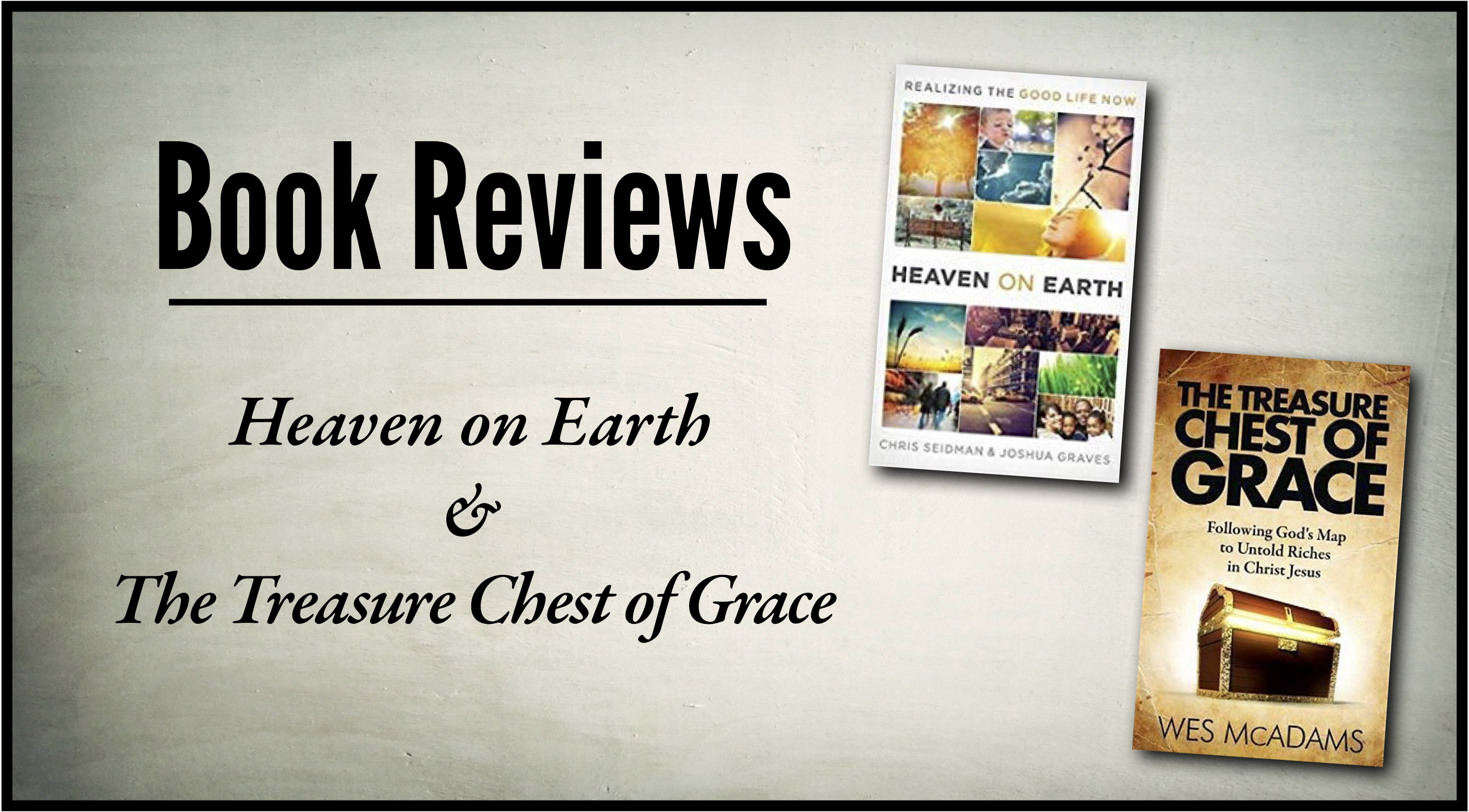
Two for One Book Reviews: Heaven on Earth and The Treasure Chest of Grace

I enjoy reading and sharing helpful things that I read with others. I like to read lots of different kinds of books, but as a minister and a theology students, a lot of what I read tends to focus on those areas.

As a part of my schooling, I read widely across the spectrum of Christianity. This invariably means that I read a lot of things I disagree with, but also that I am challenged to think about what the Bible teaches and what I believe frequently. That’s a good thing, I think.

Over the last several years, I have noticed a marked increase in the number of books being put out by ministers and thinkers within Churches of Christ. This is also a good thing, I think, and I have made an effort to read some of those books when I get the chance (and in the process, have come across some very good material). Having said all that, I wanted to offer some quick reviews of a couple of those books: Heaven on Earth: Realizing the Good Life Now, by Chris Seidman and Joshua Graves, and The Treasure Chest of Grace: Following God’s Map to Untold Riches in Christ Jesus, by Wes McAdams.

Heaven on Earth

Heaven on Earth was good, although it was not what I expected. The book is actually a careful examination of Jesus’ Beatitudes at the beginning of the Sermon on the Mount, and how living those out makes a difference in the here and now (while also identifying us as the kind of people who will be with Jesus eternally).

The subtitle, “Realizing the Good Life Now”, could potentially mean a lot of things, but basically, the authors assert that living this way (according to the Beatitudes) constitutes living the “good life”, and helps us to establish the ideals of God’s Kingdom on earth (to be clear, there are no hints of prosperity gospel nonsense in this book about how God wants us to be happy and therefore will shower us with material blessings if we are faithful to Him).

Each chapter covers a Beatitude, and discusses what it means as well as illustrating it with an abundance of real-life examples, mostly from modern day. The two authors do not write together, and instead, take turns writing different chapters. This is probably my main criticism of the book, as I think it gives it a choppiness in thought and style that wouldn’t be present if either writer was working entirely on his own.

Here are some good quotes:

“The good life is only possible in so far as God is involved. Experiencing the good life is more about what God has done and is doing that what we have done or are doing.” (xi)

“For Jesus, the kingdom of heaven had everything to do with life on this side of the grave while many of us are inclined to think it mostly has something to do with life on the other side. Consequently , we think of Jesus’ proclamation of the kingdom of heaven coming near as meaning through Jesus we now have access to the pace of heaven after we die. Even though this is one aspect of the context, it is not the entire context.” (3)

“The longer Paul dwelled in the kingdom of light the more aware he became of the darkness in his own life.” (16)

“Mourning is a pure vision of the large gulf between how things could be versus how things actually are.” (28)

“How do we respond to the pain and suffering that haunts us? Something’s amiss. Is life beautiful? Yes. But just on the horizon of its inherent beauty is a wild storm, waiting to tear everything to pieces, total destruction. Life is beautiful. But life is also deadly, depressing, and full of pain.” (33)

“Doing the right thing—whether individually (righteousness) or collectively (justice)—is always a primary interest of God in the prophets, because a life is the totality of choices made for the individual and the community.” (57)

“The person you are setting free when you reconcile is yourself.” (99)

“The most dangerous believers in the world to the kingdom of darkness are the ones who live as though they have nothing to lose.” (109)

“Faith is about seeing the world as God sees it. Not simply seeing the world for what it is—in all its paradox of beauty and death—but also seeing the world for what it will one day become.” (131)

The Treasure Chest of Grace

The Treasure Chest of Grace focuses on the fact that we have been saved by grace—nothing we have done or can do on our own has any bearing on salvation apart of the gracious acts of God on our behalf—and then sets about determining what conditions we must meet in order to become recipients of that grace. This is where the “map” of the subtitle comes in: the pages of Scripture reveal to us what we must do in order to come into contact with God’s grace.

This book differs significantly from Heaven on Earth in that McAdams uses no stories or modern-day examples to prove his points; he only uses Scripture. This is by design: “I have made every effort in this book to prove every point with Scripture, and only Scripture. No quotations of man are used to prove any point, only words inspired by God” (8). I understand his reasoning and certainly agree with him at the core (we should base our religious beliefs on Scripture, not something else), but I think the writing suffered somewhat as a result: a short book peppered with hundreds of Scripture references and no other illustrations or examples is harder to read. My other gentle critique is a subjective one: I don’t like really short chapters. The main body of the book is 144 pages long, and those pages are divided into 25 chapters, rendering the average chapter as a little less than six pages long. Constantly shifting from chapter to chapter gives the reader the impression that some thoughts haven’t been well developed (which I don’t think is true, I just think that many of the “chapters” would function better as sections within longer chapters).

Anyway, on to the quotes:

“Man is utterly incapable of earning the things we receive from God. This does not mean, of course, that we are incapable of obeying Him, pleasing Him, honoring Him, glorifying Him; but we must remember that by doing so, we have earned nothing.” (16)

“When people try to save themselves, they are communicating to God that they have no need for His grace.” (25)

“If there were nothing man had to do to receive salvation, there would be none who were lost.” (46)

“Too often people have assumed that because God freely gives grace, He gives it without conditions.” (78)

“Unfortunately many in the religious world have tried to sever the biblical ties between salvation and baptism” (97)

“Man is not saved because he obeys the gospel; he is saved when he obeys the gospel. The gospel itself, not the obedience of man, is the reason man is saved.” (106)

“Your salvation lies at the lace where His “amazing grace” meets your “trust and obey”.” (152)

“Do not mistake the emphasis on baptism to mean that it is more significant than it really is. Nor should you make the mistake of assuming baptism is meaningless or insignificant. Because it is a part of God’s plan to redeem man, it has great importance. But without the blood of Christ, baptism is nothing more than a glorified bath.” (155)

I thought both of these books were short, easy-to-read, helpful treatments of two very biblical ideas: what living the Beatitudes means for us as citizens of God’s Kingdom, and how God’s grace and our obedient faith work together in the act of salvation. I was thankful to have read both.

Friday Summary Report, September 7

I don’t have anything too exciting to report on this Friday morning, but here are some interesting/good/important links from around the worldwide web:

  1. First, a story from Louisiana, where, in the aftermath of Hurricane Isaac, a father and son teamed up to rescue 120 people over a 12-hour period with boats. Jesse Shaffer, the father, insisted that he and his son are not heroes, but their neighbors would disagree. A great story, and a glimpse of what Jesus meant by “Love thy neighbor.”
  2. Here’s a cool story (with picture) about Clemson wide receiver DeAndre Hopkins getting baptized after football practice.
  3. The last couple of weeks have been dominated by politics, with both the Republican and Democratic National Conventions taking place. I am not a fan of politics, in large part because it takes place in some weird twilight zone where the truth neither matters nor is really expected. I heard a ton of people raving about President Clinton’s speech, but was it accurate? Similar articles could probably be (and probably have been) written about every other speech that was given at either convention.
  4. Matt Dabbs wrote a really good blog post on the heinousness of abortion. The fact that abortion has been relegated to the political arena and has been turned into a mere talking point by both parties shows how warped and skewed our society has become. I mentioned this in the comments section of the blog I linked to above, but I’ll repeat it here: I am convinced that the legalized genocide against our own unborn is the greatest evil of our society. It is all too often discounted as ‘just another political issue’, but it far transcends politics. I sometimes wonder how long a nation that shows such little value for life will be allowed to continue.
  5. For those who are involved in youth ministry, here is a great post with some very practical suggestions for ways to get your students involved as leaders within your youth group. As Joseph points out, student leadership doesn’t have to be part of some big, elaborate, complicated program.
« Older posts

© 2026 The Doc File

Theme by Anders Noren — Up ↑