
There is an infographic that has been making the rounds on social media regarding the problem of kids leaving the church after they turn 18, and steps that can be taken to prevent this from happening.
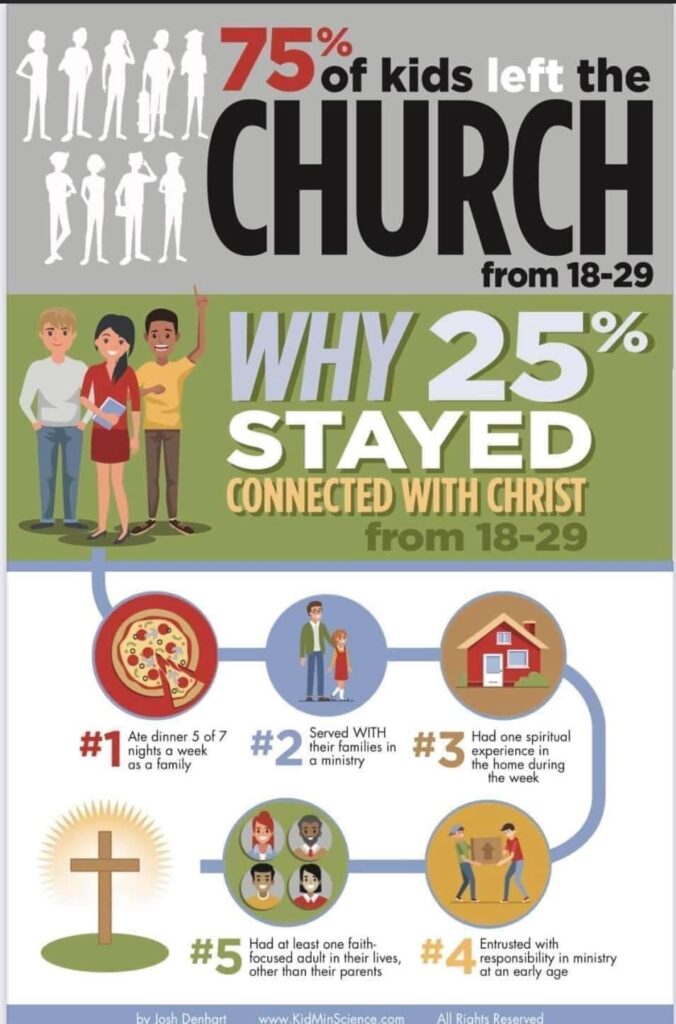 I have felt very conflicted when I have seen this shared over and over again, but have refrained from saying anything publicly about it until now. In short, I do have some significant concerns with this infographic the way it is presented, and because of that, it is not something I would share.
First, I want to acknowledge the good aspects of it. Young people leaving the church after high school is a major problem, and I appreciate that the creator of this is calling attention to that. I have written and spoken a lot about the same phenomenon—I literally wrote a book on it—so I am obviously aware of this problem and sympathetic toward the need to address it.
Furthermore, there is an abundance of research out there that would affirm that the five practices listed all correlate with long-term faith outcomes in adolescents to one degree or another (for example, Soul Searching by Smith and Denton, Sticky Faith by Powell and Clark, Growing Young by Powell, Mulder, and Griffin, and Hurt 2.0 by Clark, among others).
Having said that, I think there are some significant issues with the way this is presented that make it misleading.
First, there is no citation of anything. I would love to see verification of the 75% figure, which is significantly higher than, well, any of the valid studies I have seen. The 18-29 age range is also a red flag to me, as this comprises a wide range of development and, thus, it is unusual to see data for this group. What is possible is that this is based on survey results of young people who are tracked over time at various ages, but again, we just don’t know without any sort of citation. The only sort of citation given is a website address at the bottom of the graphic, but when you visit that site, you do not find verification of this, but rather a promotional site for using science in ministry and for selling a science-based VBS.
Second, “leaving the church” does not exactly equate with disconnecting from Christ, especially in the current cultural context. I will affirm the importance of belonging to a local church as loudly as anyone, but the church is not Christ; the church is the Bride of Christ. I do believe that involvement in the church is crucial to our connection with Christ, but we have to acknowledge in the present context that there are Christians who are not currently connected to a local church. That happens for a wide variety of reasons. In some places in the world where persecution is rampant, it is simply not possible to meet with other Christians. Some people became disconnected from church due to shutdown during COVID, and have struggled to reconnect (this is true of some who have been Christians for decades; how much more for those who are still young in their faith!). Some cling to a faith in Christ but struggle with church due to trauma from past experiences. Some have work situations that prevent involvement in the local church. Some are, well, lazy. The list goes on and on. None of these situations are ideal, and, again, we should always affirm the importance and centrality of the church in God’s plan for His people. Furthermore, it is right to mention connection to church as a measure of one’s spiritual vitality and connection to Christ. But, equating Christ and the church, as this graphic does, is theological error.
Finally, the five practices this graphic mentions are all helpful and supported by research that I have read. It is good for parents to do these things with their kids and for youth ministries to reinforce these same values and practices. But, this graphic gives the impression that these are steps to take on a guaranteed path to faithfulness. The reality is that there are no guarantees. Children are not robots to be programmed; they have their own minds and will make their own choices. I am aware of so many scenarios where children are raised in identical contexts (with all of the practices mentioned in the graphic above) who make very different choices and, thus, have very different faith outcomes.
That doesn’t mean we should ignore the things suggested by the graphic—they are still wise practices with some degree of research-based support and we would do well as parents and church leaders to follow them—but we should acknowledge that we are not in control of things. We desperately want to be in control, and it is comforting to think that if we just follow a certain formula, we are guaranteed that our children will have spiritual success. It’s not that easy, though. The reality is that, as parents and churches who are responsible for raising God’s kids, we do the best we can and seek to be faithful in passing faith on to our children while acknowledging that they are individuals created in God’s image who make their own choices. We bathe the process of parenting in prayer, asking God to help our kids be faithful, and to work through our own feeble efforts toward that end.
We bathe the process of parenting in prayer, asking God to help our kids be faithful, and to work through our own feeble efforts toward that end. Share on X I do a lot of reading and research on issues related to youth ministry, teenagers, the development of young people, parenting, etc., and I like to share helpful information that I come across.







