The online journal of Luke Dockery

Tag: Color Barrier

Larry Doby and the Importance of Forgettable Excellence

1951 Bowman Larry Doby

Over the years, I’ve written a lot on this blog about Jackie Robinson, who has long been one of my heroes. In 1947, Robinson broke Major League Baseball’s color barrier, making it possible for African Americans to play big league baseball, and actually making baseball what it had long claimed to be—the national pastime.

Robinson was a great baseball player, and was the perfect choice as the pioneer who would integrate baseball. He was determined to succeed on the field, and his considerable skills helped. He was a good line drive hitter, a versatile fielder, and an absolute terror with his legs. His daring maneuvers on the base paths thrilled fans, and brought a new style of playing to the conservative Major League circuit. He was great off the field as well: good-looking, articulate, and poised. 

But probably, you know a lot about Jackie Robinson already, because he has gotten a lot of fanfare over the years.

You might not know as much about Larry Doby.

Larry Doby was Jackie Robinson’s American League counterpart. In July 1947, Doby broke the color barrier in the AL when he cracked the lineup for the Cleveland Indians for the first time. In his first appearance he struck out, but he would go on to have a great career of his own as a 7-time All-Star and an eventual Hall of Famer. By some measurements, he even had a better career than Robinson did.

But Robinson came first; Doby was only second. Robinson was the flashier player; Doby was more in the background. Robinson has become an honored figure, a hero to millions; Doby has been forgotten by most people.

So it goes.

But I guess the point I want to make in this post is how incredibly important the Larry Dobys of the world are. As great as Jackie Robinson was, if Larry Doby and a bunch of other African American players behind him weren’t ready to come in and prove that Robinson wasn’t a fluke, it all would have been for nothing. A lot of those players have been forgotten, but their impact and legacy lives on.

And I think about the example of Larry Doby and how it applies to other areas of life, and especially to God’s Kingdom, because when you think about all the parts of Christ’s Body, not too many people get to be Jackie Robinson. Certainly, there are a few—immensely talented, flashy, charismatic, known and admired and remembered by all—but not many.

On the other hand, there are a lot of Larry Dobys—talented in their own right, but not as flashy, not as well-known. Just committed disciples who live lives of dogged, forgettable excellence for the cause of Christ. And who change the world in the process.

Praise God for the Larry Dobys!
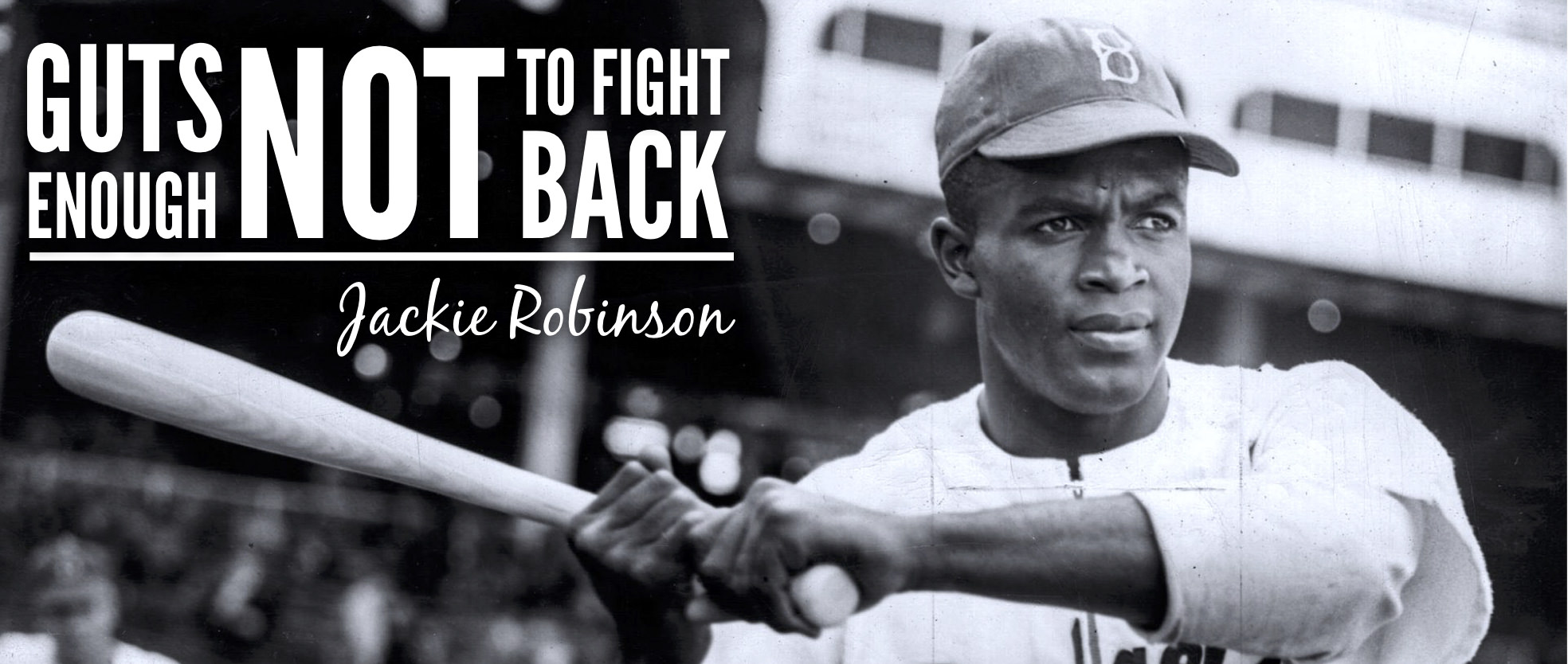
Guts Enough Not To Fight Back: Jackie Robinson

As a general rule in college and professional sports, teams retire the jersey numbers of the all-time greats who played for them. For example, no Chicago Bull can wear number 23, because that was Michael Jordan’s number and it has been retired. No New York Yankee can wear number 3, because that was Babe Ruth’s number and it has been retired. If you play Major League Baseball, regardless of what team you play for, you can’t wear the number 42, because that was Jackie Robinson’s number, and it is the only number to be retired by Major League Baseball.[1]

Sixty years ago yesterday, on April 15, 1947, Jackie Robinson donned that number 42 Brooklyn Dodgers jersey and appeared in his first regular-season Major League game, breaking baseball’s racial color barrier.[2]

Robinson’s Hall of Fame career and the way he handled himself on and off the field opened doors for other black athletes in professional sports (and ultimately many other fields as well), and it has been said that only Dr. Martin Luther King Jr. accomplished more for the American Civil Rights Movement than did Jackie Robinson.

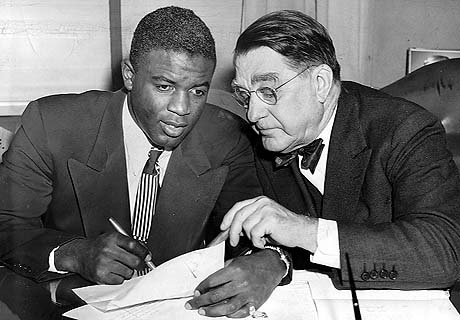
Jackie Robinson and Branch Rickey

Before he signed a contract to play for the Dodgers, Robinson was called into the office of Team President and General Manager Branch Rickey. To give him a taste of what it would be like to be the only black player in the Big Leagues, Rickey spent three hours taunting and insulting Robinson, calling him every racial slur he could think of. Rickey then told Robinson that this is what he would face every day on the field and that if he wanted it to work out, he would have to promise not to fight back or respond to insults of any kind for the first three years of his career.

Robinson, who possessed a fiery temperament and was very outspoken (he was actually court marshaled for refusing to sit at the back of a military bus), was put off by this and asked, incredulously, “Mr. Rickey, are you looking for a player who is afraid to fight back?”

Branch Rickey replied, “No, I want someone with guts enough not to fight back.”

After some deliberation, Robinson agreed to Rickey’s terms, and he lived up to them on the field. When opposing baserunners tried to spike him when sliding into second base, he didn’t fight back. When fans and players yelled and cursed at him and even questioned his very humanity, he showed them how wrong they were by taking the moral high ground.

He had the guts not to fight back.

What Branch Rickey told Jackie Robinson reminds me of Jesus’ words in The Sermon on the Mount in Matthew 5:

“But I tell you, do not resist an evil person. If someone strikes you on the right cheek, turn to him the other also. And if someone wants to sue you and take your tunic, let him have your cloak as well. If someone forces you to go one mile, go with him two miles.”

The world tells us to stand up for ourselves when we are treated unjustly. It tells us to have the courage to fight back and not let others push us around. On the other hand, Jesus tells us to have the courage to show that we are different from the world because we don’t fight back, and He tells us to forgive others when they mistreat us.

Jesus wants followers with guts enough not to fight back.


[1] Major League Baseball has established the practice of temporarily lifting this prohibition on April 15 to commemorate the anniversary of Robinson’s first game as a Dodger, as representatives from each Major League team wear number 42 in his honor.

[2] Contrary to popular belief, Robinson was not the first African-American to play in the Major Leagues. That honor goes to Moses Fleetwood Walker, who played for the Toledo Blue Stockings in 1884. Regardless of this, Robinson was the first African-American to play Major League Baseball in the 20th century, and it was his breaking of baseball’s color barrier that led to the permanent integration of the Major Leagues.

© 2026 The Doc File

Theme by Anders Noren — Up ↑