The online journal of Luke Dockery

Tag: COVID-19 (Page 1 of 2)

Staying In Ministry (My “Keep Going” File)

I have a horizontal file cabinet in my office, filled with files on old youth group events, study materials, elders’ meeting minutes, tax receipts, and all sorts of other things. I have one file labeled, “Keep Going.”


You may or may not be aware of this, but there is somewhat of a ministry crisis in churches: there are more churches seeking ministers than there are ministers seeking churches. This was likely true before the pandemic, but the last two years have only accelerated the problem, as more and more people are checking out of full-time youth ministry:

  • Somewhat famously, Barna released a study in late 2021 where 38% of ministers in US said they had given “real, serious consideration to quitting being in full-time ministry within the last year.”[1]
  • I regularly hear about new churches looking for ministers, and it seems to me that youth ministers are particularly in demand.
  • When I moved to Searcy 2.5 years ago, there were eight other youth ministers in area Churches of Christ. All of them had been in their positions for at least four years; some more than ten. Now, six of the eight are no longer in their positions.[2]
  • Jim Martin, Vice President at Harding School of Theology and someone who has a good awareness of the status of things in Churches of Christ, recently said, “I don’t know of another time in my lifetime when this many ministers have left full-time ministry during such a period of time.”[3]

Serving as a minister is an honor. From my perspective, ministry is wonderful in so many ways. I feel so privileged to be paid to devote significant time to studying Scripture, theology, and ministry and share what I learn with my students and church family. Furthermore, it is such a blessing to be able to work alongside teenagers, watch them grow and change, and seek to help them mature as disciples of Jesus. 

Serving as a minister is also a burden. Teaching comes with great responsibility (James 3.1). Working with teenagers and their parents can present all sorts of challenges. Ministers are easy targets for criticism from a variety of angles. Some criticism is valid and some is not, but almost all of it hurts, at least somewhat. When people choose to leave the church where you work, it is hard not to take it personally. Leading through conflict and controversy is tiring, and especially over the last couple of years, there has been no shortage of controversy (politics, COVID-19, racial issues, etc.). 

To be honest, sometimes it seems more like a burden than an honor, and although it always makes me sad when I hear that someone is leaving ministry, it doesn’t really surprise me. Ministry is great, but it is hard.


In my early days as a youth minister, I didn’t know much about what I was doing.[4] I didn’t originally intend to go into ministry, and I didn’t study ministry in college. I was also embarrassingly arrogant, and so I thought that I knew much more than I actually did. It is a little surprising, then, that I decided to read my first book on youth ministry: Things They Never Taught You About Youth Ministry That You Really Need To Know.[5] I actually didn’t love the book, but I value it greatly for two reasons. First, it represents the first small step in what became a massive shift toward me becoming a lifelong learner and student of youth ministry. Second, it taught me about the importance of a “Keep Going” File.[6]

There is nothing particularly profound about the idea, but it has certainly been powerful in my own life in ministry. Basically, the idea is this: every time someone writes you an encouraging note, keep it and add it to the file. Maybe someone tells you they really appreciated your sermon, or that you have had a major impact on their lives. Perhaps they thank you for your work in a specific effort, or maybe a simple note of general appreciation. Whatever it is, keep it and put it in the file. And then, when you have one of those days (or weeks, or seasons) where ministry feels more like a burden than an honor, pull out the file and read what you have collected.

Several weeks ago, I was discouraged about something (or, more accurately, several somethings), and I pulled out my Keep Going File. I read through comments from a wide array of folks from my past and present. I smiled as I read, and maybe even shed a tear or two. I put away the file, encouraged by what I had read, and determined to Keep Going.

Because ministry can be a burden, but it is also a great honor.


This post is written largely to fellow ministers to share a practice that I have found helpful. I realize, though, that many of my readers are not ministers, so here is a word directed to that crowd: encourage your ministers. Encourage is such a great word. When others are struggling and lacking in courage, we can instill courage within them by the things we say (or, we can rob them of what courage they have remaining). Write a card to show your ministers that you appreciate them; it may have far more value than you would ever expect.


[1] Of course, as this article points out, that doesn’t mean that 2/5 of Christian ministers are about to walk away. Just because you give serious consideration to something doesn’t mean you do it, and I think the percentage of those walking away from ministry is far less than 38%. At the same time, I suspect it is far higher than the 3% suggested in the linked article above.

[2] Of the six, two transitioned to different ministry positions within their same congregations, one left for a youth ministry position at a different congregation, and three are no longer in congregational ministry. I am not claiming that these transitions were caused by the pandemic, but they all occurred during it.

[3] Jim Martin, et al., “Pastoral Care in the Pandemic,” Journal of Christian Studies 1 (January 2022): 75.

[4] This is a sentiment that prepared me well for doing youth ministry in a pandemic, when I never felt like I knew what I was doing.

[5] Todd Clark, Things They Never Taught You About Youth Ministry That You Really Need To Know (Joplin, MO: 1996).

[6] Ibid., 109-110. Doug Fields, Your First Two Years In Youth Ministry (Zondervan: 2002), 57-58, makes the same suggestion, but calls it an “Affirmation File.”

2021 Blog Review

I like to end the year by looking back and reviewing my year of blogging here at The Doc File (Here are some previous reviews from 2020, 2019, 2018, 2016, 2015, and 2012).

Overview

Last year was a big year around here, as I published over 50 posts and had the second busiest year in terms of blog traffic. That traffic was related, at least in part, to the uptick in the amount of writing I did, and that increased frequency of writing was significantly tied to COVID-19 and altered routines.

By comparison, 2021 represented a return to all sorts of activities, and especially since September, I have been in an extended season of busyness that has led to not writing much in this space. I published barely half as many posts this year (28) as last year (51). My blog traffic fell at a similar rate.

Top Posts

By traffic totals, here are my most-read posts during 2021:

  1. A New Heaven & A New Earth Series, April 29, 2020
  2. The Role and Character of Elihu in the Book of Job, December 3, 2010
  3. “You! Jonah!”, September 10, 2012
  4. A New Heaven & A New Earth: What the Bible Teaches about Eternity, April 9, 2020
  5. Creation and New Creation: Connections Between Genesis and Revelation, April 25, 2017

As far what was actually written in 2021, here are the top five most-read posts:

  1. Church Camp Baptisms and Mountaintop Christianity, July 2, 2021
  2. The Very Political Book of Revelation, March 25, 2021
  3. The Hero(ine) of It’s A Wonderful Life, December 24, 2021
  4. C.S. Lewis on Dogs and the Love of God, March 2, 2021
  5. Reading in 2020, January 4, 2021

None of my top five posts were written this year (only one top ten post was); my most-read post of the year is actually a table of contents of last year’s series on renewed eschatology, which continues to be read a lot. The posts on Elihu in the Book of Job and the connections between Genesis and Revelation receive a lot of traffic each year; I have no idea why the Jonah post received a lot of traffic.

As for this year’s top posts, “Church Camp Baptisms” was well received and generated a good bit of discussion, as did “The Very Political Book of Revelation.” I published “The Hero(ine) of It’s A Wonderful Life” just this past week, but it struck a chord with a lot of people in the holiday season. I was surprised that “C.S. Lewis on Dogs and the Love of God” and “Reading in 2020” were popular (by being early-year posts, they did have more time to accumulate traffic).

Blog Series

A lot of last year’s writing fit into various blog series. I didn’t do as much of this in 2021, but did work in a couple of series that I wanted to highlight here:

Learning from the Apostolic Fathers: This was a series from earlier in the year, and reflected my reading of The Apostolic Fathers in English and some lessons that I learned from them. This was an important read for me, because reading the early Church Fathers was a hole in my own theological reading (to be clear, I read excerpts from men like Clement, Ignatius, and Polycarp in graduate school, but had not fully read their writings).

This was a worthwhile project for me, but, to my shame, I didn’t finish it as I intended, and hope to conclude with one post on The Didache in early 2022.

Scripture Reflections: This was a series from several years ago that I revived in 2021. Basically, these brief posts are an outgrowth of my own devotional reading and/or Bible study. Generally speaking, my goal for these posts is to remark on aspects of the biblical text that I find to be of interest that the reader may or may not have thought about previously, and, when possible, to point to the work and person of Jesus Christ. Since I believe the Bible is a unified story that points to Jesus, that means that He is frequently alluded to or foreshadowed in some way throughout the biblical canon.

I plan to continue this series in 2022 (and, Lord-willing, beyond). Currently, there are seven posts in the Scripture Reflections Index, but it is my hope that, over time, this index will contains dozens of posts from throughout the biblical canon.


So, that was The Doc File in 2021! I’m not sure what 2022 will look like, but I have many things that I want to write about, and this continues to be a helpful space for me to process my thinking and, hopefully, bless others with what I share.

Thanks to everyone who continues to read and follow, and especially to those who comment and join in the conversation. May God bless each of you in the coming year!

Reading and Walking in 2020

In April 2013, I started walking laps around the church auditorium while studying or reading. I found this helped me to focus better, and also it was a good way to be a little less sedentary while at work.

Each lap around the auditorium was approximately 74 yards:

This past year was strange due to COVID-19. Back in the spring when we suddenly became concerned about the pandemic, I began working from home, and did so for about 12 weeks. During that time, I walked and ran around my neighborhood a lot, and listened to a lot of audiobooks and podcasts while doing so, but quite naturally, fewer days in the office meant less opportunities for walking laps. Once I returned to the office, however, I was still not going to the gym, which meant that I was coming in early some days and getting a lot of reading done those days.

Without further ado, here are my totals for the year:

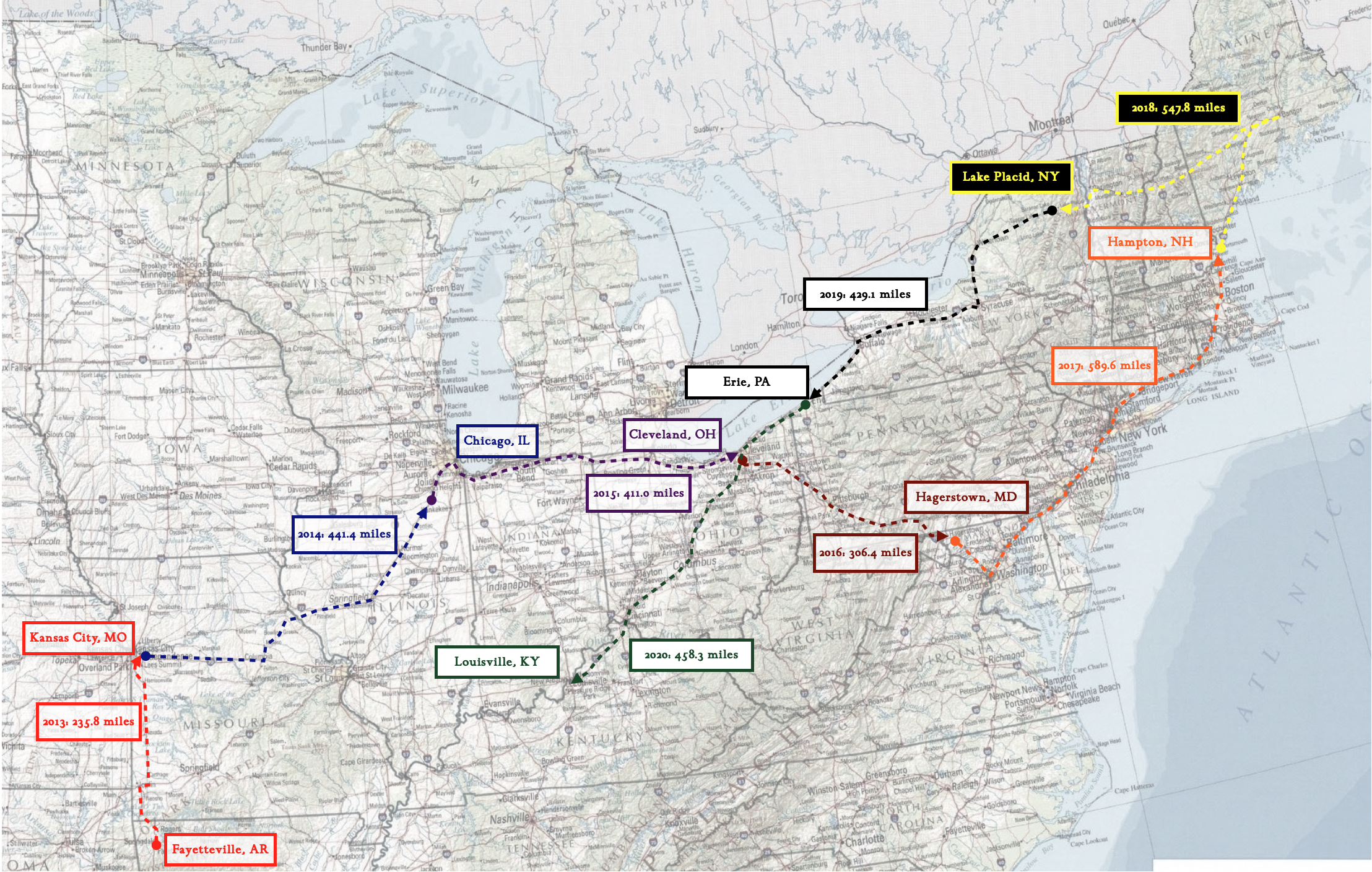
Total Laps in 2020: 6,836 (approximately 118 yards per lap)

Total Distance in 2020: 458.3 miles

Total Distance to date: 3419.4 miles

In 2020, my totals were the equivalent of walking from Erie, Pennsylvania down to Cleveland, Ohio, through Columbus and Cincinnati, and finally stopping in Louisville, Kentucky.

I was surprised but pleased that my totals increased from last year. I have certainly spent enough time walking around the Cloverdale auditorium over the last 18 months that people have become aware of this unusual practice and now joke with me about it.

It has been a couple of years (2018) since I hit 500 miles for the year; that is my goal for 2021.

2020 Blog Review


The end of the year is a good time for reflection, and one of the things I like to look back on is my yearly blogging here at The Doc File.

Overview

Since I started writing here back in 2006 (wow, it is hard for me to believe it has been that long!), I have been very up-and-down in how much I write each year. Last year, I lamented that I had written less in 2019 than any other year since The Doc File began; in 2020, I blogged 50 times, which is the most since 2014. This increase in production was largely due to two factors, I believe:

  • First, the lockdown situation that arose from COVID-19 back in late winter/early spring. It is not so much that this left me with an abundance of free time, but rather that I was sensing the great anxiety that so many were feeling (and feeling some of it myself), and wanted to produce some content that might, perhaps, be encouraging.
  • I engaged in a few different ongoing series this year, which helped give me direction in what to write (more on that below).

The increased frequency of posts combined with the popularity of several posts (see below) meant that The Doc File had over 31,000+ hits in 2020—the second-highest total since I started writing.

Top Posts

By traffic totals, here are my most-read posts during 2020 (posts in bold represents those actually written in 2020):

  1. A Christian Response to COVID-19, March 12, 2020
  2. A New Heaven & A New Earth: What the Bible Teaches about Eternity, April 9, 2020
  3. The Role and Character of Elihu in the Book of Job, December 3, 2010
  4. Lessons from David: Sin Has Consequences, March 17, 2014
  5. Creation and New Creation: Connections Between Genesis and Revelation, April 25, 2017
  6. Links Between Daniel and Esther, October 10, 2011
  7. Scattered Reflections on Race-Related Issues, June 9, 2020
  8. A New Heaven & A New Earth: What the Bible Teaches about Eternity Part 2: Distractions, April 16, 2020
  9. Moral Evil and Natural Evil, February 24, 2015
  10. A New Heaven & A New Earth: What the Bible Teaches about Eternity Part 3: “Problem” Texts: 1 Thessalonians 4.13-18, April 23, 2020

Five of the top ten posts were not written this year, and four of those (Elihu, David, Creation/New Creation, Evil) were in my top posts from last year as well. Those posts must be particularly accessible to search engines based on their enduring popularity.

“A Christian Response to COVID-19” was my most popular post of the year, and went somewhat viral (pun intended). I wrote it in the early days of the pandemic, and it clearly struck a chord with a lot of people. Similarly, “Scattered Reflections on Race-Related Issues” was read a lot, and also reflected on current events that were dominating all forms of media. The three posts on “A New Heaven & A New Earth” were all part of a much longer series that a lot of people read and seemed to benefit from.

The Year of Blog Series

That last sentence helps me transition to one of the biggest changes in my blogging in 2020, which was the extent to which I wrote multi-post blog series. Over the years, I have written several series on The Doc File, but it is something I have struggled to do (often taking a really long time to complete series or even abandoning a series midstream). With that in mind, I was proud of my perseverance in completing a few series in 2020:

A New Heaven & A New Earth: What the Bible Teaches about Eternity: I had taught on this subject back in 2019, but blogging through all of this material enabled me to polish my notes and provide citations as well as refine my thoughts. This series summarized what has been a significant theological shift for me over the past decade, one which has provided a great sense of purpose, hope, and excitement. Additionally, I felt that it was a fitting topic for the extended season of fear and uncertainty that Spring/Summer 2020 turned out to be.

It was a significant project—12 posts and some 37,000 words—and had I realized how much work it would take, I’m not sure that I would have begun it. I am really glad I did, though—in addition to the satisfaction of bringing a project of this size to a state of semi-polished completion, it also led to a lot of good conversations and feedback, and three of my most-read posts from 2020 were from this series (with several more just outside the Top 10).

Ranking Narnia: Early in quarantine, I began reading through The Chronicles of Narnia, which I found to be very good reading for the craziness of 2020: it provided imaginative distraction from current reality, and also helped re-orient me from fear to trust.

I have enjoyed these books since college, and the idea of blogging about them had been in my mind since at least 2007 or so. What began as a plan to write a post or two ranking the various books in the Narnia series continued to grow and expand, ultimately resulting in an 8-part, 23,ooo word series. In a sense, these were book reviews. I have never particularly enjoyed reviewing books, and so I didn’t get a lot of pleasure from writing this series, but I was really proud of the result for a few reasons. First, these posts represented growth for me as a writer as these reviews reflect greater depth and thoughtfulness than what I have done in the past. Also, spending so much time thinking and writing about Narnia helped me to appreciate the series even more and yielded new theological insights. Finally, I pushed through and finished[1] this series of posts despite the fact that almost no one read them.[2] In other words, while this series was not as long as the “A New Heaven & A New Earth” series, I am more impressed with it in the sense that I didn’t get a dopamine hit from lots of likes and comments every time I would share a post, but I still finished the series regardless.

Lament For A Son: One of my favorite books in 2020 was Nicholas Wolterstorff’s Lament For A Son. It was a short book, but I thought Wolterstorff shared so many compelling thoughts on the topic of suffering that I decided to write a series of short reflections and basically grouped them as a sub-series of posts under a larger, loosely-united series entitled A Theological View of Suffering (which dates back several years). Like Narnia, this was not a particularly popular series, but I thought Lament For A Son was an important book and worth writing about.

Politics From a Christian Perspective: One of the reasons I write The Doc File is because it helps me work out my thinking on certain topics, and that was certainly the case for this three-part series that I wrote in late October/early November in the midst of a rancorous election season. As a person of faith, I’m convinced that Scripture has a lot to tell us about the way we view politics, but I was dissatisfied with the political engagement I was witnessing from many professed Christians, and I wanted to wrestle with my own views against the background of biblical teaching.

I was under no illusion that my thoughts would change anyone’s mind (and in an election where an unprecedented number of people voted early, this series of posts came a little too late anyway), but this was a popular series that I got some good feedback on, and it was helpful for me to write about and work through my own beliefs.


So, that was The Doc File in 2020! I’m not sure what 2021 will look like, but it is my hope to continue to write about once a week (the rough pace of my blogging in 2020), and to continue with some multi-post series as well. Thanks to everyone who continues to read and follow, and especially to those who comment and join in the conversation. May God bless each of you in the coming year!


[1] As the length of these posts grew, they became more and more difficult to write and I was sorely tempted to revert to old habits and abandon the series. This can be seen in the release dates of the various posts: May 18, May 26, June 16, June 30, July 20, August 24, October 13, October 23. I went from eight days between the first two posts, to about two weeks between posts, two three wees, to a month, and then seven weeks. The concluding post was shorter and easier to write than the others, and came ten days after the last review.

[2] There were, of course, exceptions, as several people told me how much they enjoyed this series and a few actually reached out to me to see when (or if!) the next post would come out. But on the whole, these posts were amongst the least-read of what I wrote in 2020.

Return From Exile

My friend Smith Hopkins preaches for the Oliver Creek Church of Christ in Bartlett, Tennessee, and there are so many things I appreciate about him as a thinker, a minister, and a leader. During this season of pandemic and quarantine, he has been producing a series on YouTube called Light In The Darkness, and recently, he invited me on to have a conversation about the transition out of quarantine and back into some semblance of normalcy.

From my perspective, the biblical notion of Exile is instructive for us as we think about living during a pandemic and the interruptions and struggles that come with that. But in Scripture, following the period of the Exile, we have the Return from Exile, seen especially in the historical books of Ezra and Nehemiah. I think there are some lessons from that biblical period that are helpful for us as we begin to think what our own “return” looks like. Here is a hint: don’t place your hope in the wrong things.

I hope this discussion is helpful for you!

« Older posts

© 2026 The Doc File

Theme by Anders Noren — Up ↑