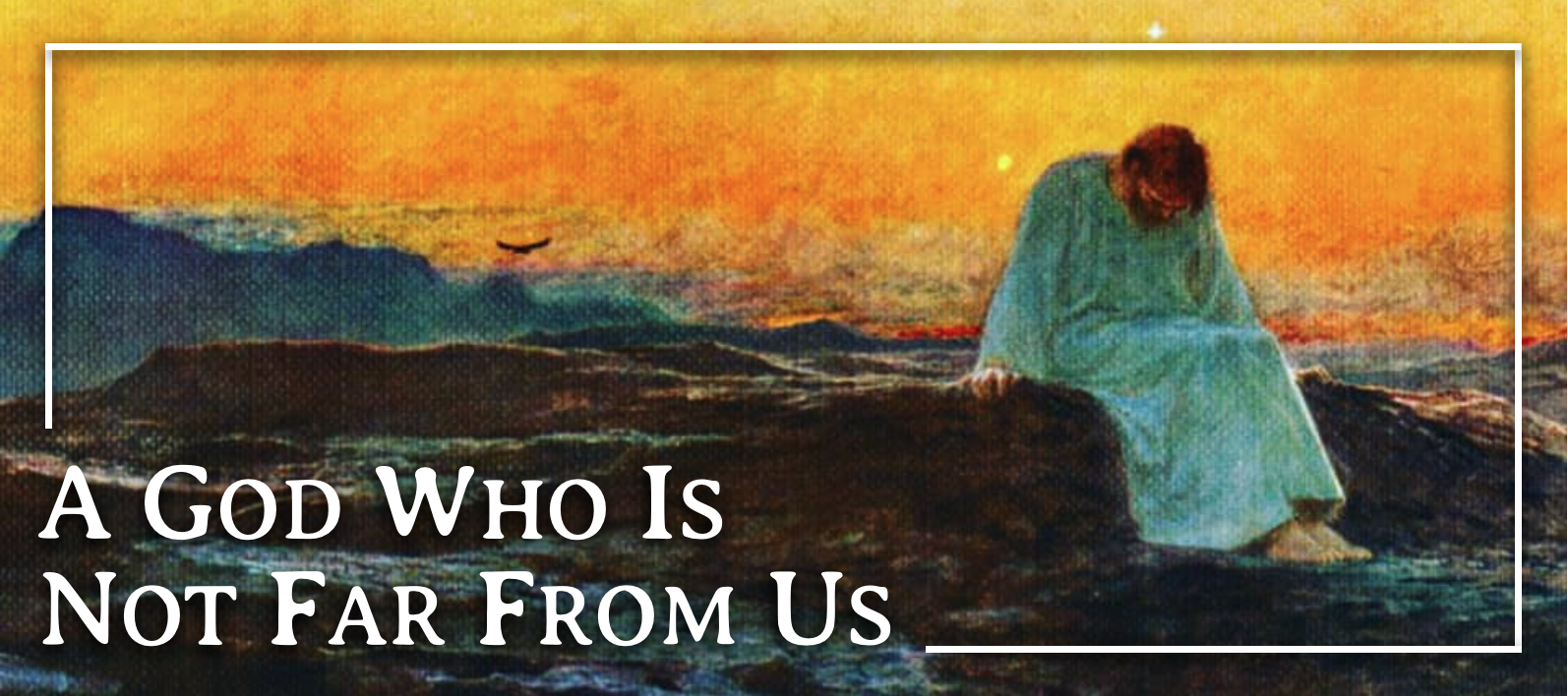
In a well-known passage in Acts 17, Paul addresses the Areopagus in Athens:
“Men of Athens, I perceive that in every way you are very religious. For as I passed along and observed the objects of your worship, I found also an altar with this inscription, ‘To the unknown god.’ What therefore you worship as unknown, this I proclaim to you. The God who made the world and everything in it, being Lord of heaven and earth, does not live in temples made by man, nor is he served by human hands, as though he needed anything, since he himself gives to all mankind life and breath and everything.”
The Greeks were a very religious people—I can remember studying in school about the various gods and goddesses in the Greek pantheon—and Athens was filled with temples, statues, and idols in honor of them. Apparently, in addition to these deities, they even worshipped an “unknown god”, apparently to ensure that they didn’t leave anyone out. But the point that Paul tries to make to the Athenians in Acts 17 is that they did leave Someone out—the most important Someone of all—the God who made the world and everything in it. Of this God, the Greeks were ignorant.
Being ignorant of God—what He is like and what He desires of us—is a problem that was not specific to the Greeks. It’s a recurring problem that has appeared throughout history. And when it’s up to us to determine what God is like and what He wants, we frequently end up in some pretty dark places.
Chichén Itzá was a pre-Columbian Mayan cultural center located on the Northern Yucatán peninsula in modern-day Mexico. Today it is a popular tourist attraction and every year thousands of people go and visit the ruins.
The Yucatán is a dry area with no rivers above ground, but despite this, Chichén Itzá was able to thrive as a major Mayan city because of the existence of a certain type of geological formation called a cenote. A cenote is a sinkhole which had formed in the limestone foundation and contained groundwater. There are several cenotes throughout the Yucatán, and at Chichén Itzá, there were two cenotes that were substantial in size and would likely have contained adequate drinking water year-round for the people of the city.
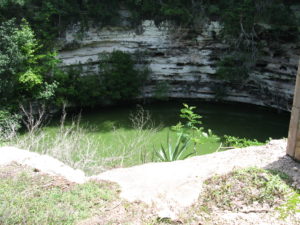
Cenote Sagrado, believed to be the home of the Mayan rain god, Chaac.
However, of the two cenotes, only one was used for drinking water, because one of them was believed to be the home of the Mayan rain god, Chaac. In order to keep Chaac happy and the rain plentiful (and plentiful rain was a big deal in such a dry area), the Mayan people would offer human sacrifices. These sacrifices—often children—would be weighted down with gold and silver jewelry and then tossed down into the cenote where Chaac was thought to live. Hundreds of years later when the area was excavated by archaeologists, many tiny skeletons, as well as the treasure that dragged them to their deaths, were found.
Senseless deaths…sacrifices made in order to appease a god they didn’t understand, whose will they had to guess at.
We hear that and perhaps it’s easy for us to dismiss that example as being far removed from our own circumstances, something done long ago by “primitive” people. It’s not an isolated incident, though. People have often justified terrible actions because they thought they were doing what God wanted: fighting in the Crusades…buying and selling people based on the color of their skin…blowing up abortion clinics…flying airplanes into skyscrapers. When it’s up to us to determine what God is like and what He wants, sometimes we end up in some pretty dark places.
But reading further in Acts 17, Paul says that it doesn’t have to be this way—we don’t have to be ignorant of God. He tells the people of Athens that God is “not far from each one of us”, and that we are His offspring. And then, speaking of Jesus, Paul goes on to say that God “has fixed a day on which he will judge the world in righteousness by a man whom he has appointed; and of this he has given assurance to all by raising him [Jesus] from the dead.”
Paul’s claim that God is not far from us finds fuller expression in the classic passage on the Incarnation in John 1. There, in verse 14 we read, “The Word became flesh and made his dwelling among us.”
A lot of times when speaking about the Incarnation, we talk about that first part: the Word becoming flesh. That’s certainly an important concept, but I want to focus on the second clause: the Word made His dwelling among us. Here John is using tabernacle language to explain how God came down to be among His people in a new and special way. A more literal translation would be something like, “He pitched His tent among us.”
In The Message, Eugene Peterson says that “the Word became flesh and moved into our neighborhood”, and I love that sentiment—through Jesus, God is no longer a mysterious stranger Whom we don’t understand, because He lives right down the street from us—we can see what God is like for ourselves!
The wonderful news of the Incarnation is that the God who does not wish to be far from each of us put on flesh, and Jesus took up residence in our neighborhood. From that proximity, we can see Jesus clearly, and we are never left to wonder what God is like, or what He wants from us.








