The online journal of Luke Dockery

Tag: Ecclesiastes (Page 1 of 2)

Ecclesiastes on Independence Day

Ecclesiastes has become one of my favorite biblical books. I have studied it a lot, and have actually released two books on Ecclesiastes in recent months, so it has a way of always being near the forefront of my mind.

The author of Ecclesiastes does not give his name, but instead calls himself Qoheleth (pronounced ko-hell-it), a Hebrew word meaning “gatherer” (Ecclesiastes is the Greek form of the Hebrew word Qoheleth). Likely, this is a reference to his gathering of observations and proverbs about wisdom to share with others, which is why the word is often translated as “Teacher.”

Many people assume that the Teacher of Ecclesiastes is some sort of cynical pessimist who is always criticizing, and ultimately sees no redeeming value in life. I would argue, however, that such people have not read Ecclesiastes closely enough. Indeed, the Teacher points out many negative elements of human existence. Life is brief and mysterious, and there are many things that we do not understand and that don’t turn out the way we think they should. The Teacher unflinchingly confronts the harsh realities of life.

In the face of these harsh realities, however, the Teacher doesn’t advocate despair, apathy, or cynicism; he urges…joy! Life is hard and there are things that are less than ideal, but that doesn’t negate the real, tangible blessings that God has bestowed upon us, and we should be grateful for and appreciate those things.


Today is July 4, Independence Day. When I was a kid, the 4th of July was an uncomplicated holiday for me. It was about going down to the country to be with my family and shoot off fireworks.

But Independence Day commemorates a historical event and, therefore, calls for reflection. As I have gotten older, those reflections have led to complicated thoughts and emotions. I have patriotic feelings, prompted by the blessings I experience as an American citizen, and recognition of good things that the United States has done in its history. But I also have feelings of regret, as I reflect on 200+ years of American history and the various times and instances in which we have failed to live up to our ideals of “life, liberty, and the pursuit of happiness” for all Americans. And beyond that, I have deep feelings of ambivalence, as my identity as a Christian calls me to question the validity of the revolution that produced the United States, and my primary allegiance to King Jesus means that I can only “pledge allegiance to the flag” in a very qualified way.


What does any of this have to do with Ecclesiastes? Quite a bit, I think.

Some will spend Independence Day glorifying the principles, ideals, and exploits of the United States, willfully blind to its many historical and current shortcomings. Others will spend the day in lament, critical of its many failings and finding nothing to celebrate.

I don’t think Qoheleth would do either of these, though. I think he would be the first to honestly admit that the US has often failed to live up to its best principles and that we still have a long way to go. Instead of being cynical about that reality, though, he would look for the joy. In addition to the critique, he would also acknowledge the good that the US has done for its citizens and in the world, thank God for the blessing of living in a land of opportunity, and enjoy a hot dog with friends and family.

Here’s wishing you a safe, enjoyable, and thoughtful Independence Day! May God be praised for the blessings He has heaped upon us, and may we use those blessings to demonstrate our love for our neighbors.

The Search for Significance: A Study of Ecclesiastes

I am excited to announce the release of a new book, The Search for Significance: A Study of Ecclesiastes, published by Regnum Media and available both in print and on Kindle (I previously wrote a book on Ecclesiastes for teens, but this edition is specifically for adults).

This is the first offering in Regnum Media’s new Biblia Series, and possesses several features to help with meaningful Bible study:

  • Inclusion of the relevant biblical text for each chapter
  • Discussion questions (or reflection questions if you are reading the book yourself) spread throughout the chapters
  • “A Closer Look” sections that provide deeper insights related to the original languages, historical backgrounds, or intertextual connections
  • “Discipleship Prompts” at the end of each lesson that provide a way to connect the lesson content to real life

From the back of the book:

Why are we here? What is life all about? Why is life filled with so much frustration and futility? These are the sorts of questions that the Teacher of Ecclesiastes examines as he tries to set forth what is truly significant in life. Set within the wisdom tradition of ancient Israel, Ecclesiastes is an important and challenging book that deserves close examination.

Written both for Bible class settings and personal study, The Search for Significance looks at Ecclesiastes in detail, and shows how this ancient text remains incredibly relevant for God’s people today, and has much to teach us about wisdom, priorities, and what really matters in life.

I have been humbled by the kind words of endorsement I have received:

“Qoheleth says, “Of the making of books, there is no end” (Ecclesiastes 12:12). In this case, we are grateful because Luke Dockery has produced for the church a resource that is exegetically sound and theologically rigorous with a strong emphasis on the text’s contemporary significance and applicability. Studying the book of Ecclesiastes forces us to ask the big questions about the ultimate meaning of life. This resource will be a blessing to your church class, small group Bible study, or individual devotional time.”

—Garrett Best, Ph.D, Associate Professor of Bible, Chair of the Bible Department, York University

“Luke Dockery has put together a very fine resource that makes the message of Ecclesiastes accessible for Bible class teachers and church members. Dockery highlights how Ecclesiastes faces the harsh realities of life with a call to enjoy God’s everyday gifts and to fear God. In a world searching for significance, these are things that matter. This book is well organized with discussion questions along the way and “discipleship prompts” that challenge readers to implement the spiritual insights.”

—Dave Bland, Ph.D, D.Min, Professor Emeritus, Harding School of Theology

“Luke does a masterful job of laying out the framework and heart of an oft-overlooked book such as Ecclesiastes. The manner in which he masterfully provides sound exegesis and explains in terms to be understood by teen to adult, seasoned believer to unbeliever, and all in between makes this a needed resource. I especially appreciate the “A Closer Look” and “Discipleship Prompt” sections included in the resource. I highly recommend churches and/or small groups add this to their curriculum.”

—Antwan D. Brown, Senior Minister, Chapel Hill church of Christ, Macon, Georgia

“In The Search for Significance, Luke Dockery provides an accessible study of the book of Ecclesiastes while offering penetrating insights. Dockery pays attention to the text, opening a window to the ancient world for a contemporary audience. At the same time, he remains aware of the contemporary scene, bridging the gap between the two horizons with grace and skill. Complete with “closer looks” and “discipleship prompts,” this project is designed for personal study as well as the Sunday school curriculum. I highly recommend this book for anyone wishing to deepen their faith, widen their understanding of Scripture, and challenge the idols that constantly seek first place in our lives.”

—Nathan Guy, Ph.D., Preaching Minister, West Side Church of Christ, Searcy, Arkansas

“The book of Ecclesiastes offers so much relevant wisdom for today. It is a book of the Bible everyone needs to study and understand. Unfortunately, it’s also a book many are hesitant to read. Luke has done a masterful job of writing a curriculum that will help Bible class teachers introduce people to this life-changing wisdom. I can’t wait to share it with the teachers in my congregation.”

—Wes McAdams, Preaching Minister, the church of Christ on McDermott Road, Plano, Texas; Host of the Radically Christian Bible Study Podcast

If you are interested in a personal study of Ecclesiastes, or as part of a Bible class or book club, I hope you’ll check out The Search for Significance!

Purchase the Book

Paperback: $11.99

Kindle: $9.99

Why Are We Here? Ecclesiastes For Teens

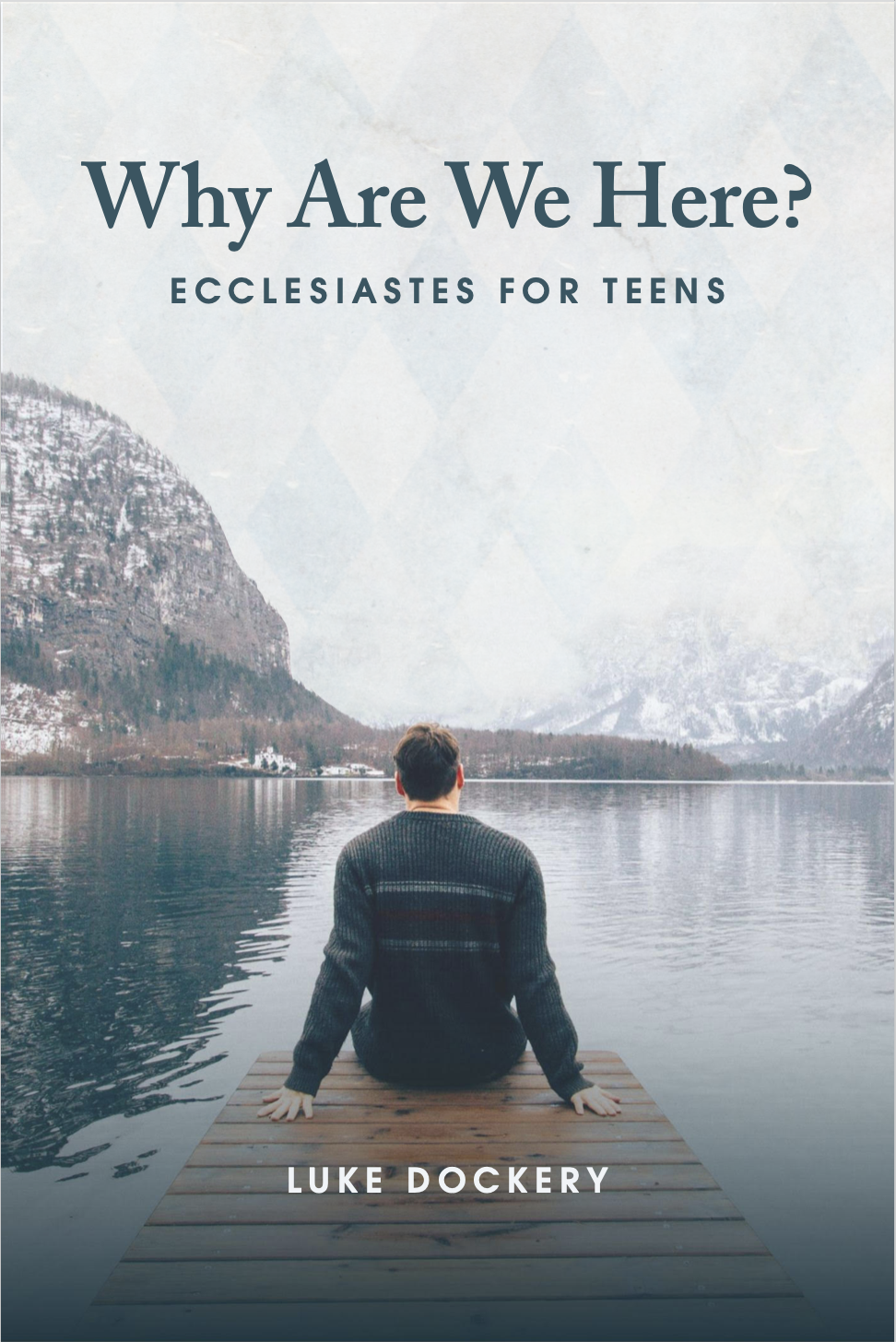
I am excited to announce that I have a new book out—Why Are We Here? Ecclesiastes For Teens—published by Deeper Youth Ministry and available digitally there or in print on Amazon.

Several years ago, I released a teaching series on Ecclesiastes through Deeper, but I have continued to study in the meantime, changed my views on some things, and decided that it was time for an updated and expanded version. It is not a radically different final product than the original version, but it is different and, I believe, superior (purchasers of the original version have received the update free of charge).

From the back of the book:

Part of what it means to be human is to seek meaning and purpose in life, and it is often during the teenage years that this universal human longing is felt for the first time. The book of Ecclesiastes is part of the wisdom literature of the Old Testament and seeks to identify what is truly significant in life. It is a challenging and important book that deserves close examination.

Written specifically for teens, Why Are We Here? looks at Ecclesiastes in detail and shows how this ancient biblical text is incredibly relevant for people of faith today and has much to teach us about wisdom, priorities, and what really matters in life.

If you work with or teach teenagers, I hope you will give it a look—there are 13 lessons, so it fits really nicely into a Bible Class quarter.

Additionally, I am working on a version for adults that I hope will be out sometime next year.

Purchase the Book

Paperback: Amazon $11.99

Digital: Deeper Youth Ministry $10

Gifts & Contentment: A Thanksgiving Message from Ecclesiastes

This is an adapted version of a sermon a preached this past Sunday. Happy Thanksgiving!

Thanksgiving is one of my favorite holidays of the year. I enjoy spending time with family, and I enjoy the good food that you get to eat at Thanksgiving. I’m also a big fan of Christmas, and to me, Thanksgiving always kicks off the Christmas season, so I like that about it too.

But most of all, as a Christian and a minister, I really appreciate that we have this time built into our yearly rhythm where we are encouraged to stop, reflect, and give thanks for what we have. That is an incredibly biblical thing to do. Thanksgiving is the basic response that God’s people should have in light of what God has done, and although this may be something that we lose sight of at times, this holiday, anchored on our calendars, helps remind us of this action which is central to our lives as followers of Jesus.

This particular Thanksgiving meditation comes from a somewhat unusual source: the Book of Ecclesiastes. I say “somewhat unusual” because the Book of Ecclesiastes is not something we focus on too much. Many people have a quotation from Ecclesiastes that they like, but they don’t really study the book in detail. A big part of this, I think, is that a lot of people think that the Book of Ecclesiastes is really depressing! Many people (including biblical scholars) suggest that Ecclesiastes has a very pessimistic view on life.

I disagree with that, though; I don’t think Ecclesiastes is pessimistic, I just think that it is very realistic. My wife would laugh to hear me say this, because all the time she tells me that I am a pessimist, and I disagree and say that I am a realist. I am just very aware that the world is broken, that people are deeply flawed, that we tend to get let down a lot, and that there is a lot of disappointment in life. I don’t always walk around with a scowl on my face or imagine the worst possible outcome of every situation, but I acknowledge that there are a lot of things that happen in life that are out of our control, that we don’t understand, and that we wish didn’t happen. And I think that is exactly how the author of Ecclesiastes looks at the world. I love Ecclesiastes.

And in this very realistic book, I think we are given a great perspective on Thanksgiving.

Real Talk About Money

I want to look specifically at the last half of Ecclesiastes 5, but to give a little bit of context, Ecclesiastes starts off with the author (who calls himself the Teacher or Preacher depending on your translation) saying that life is vanity, like chasing after the wind. And what he means by this is not that life has no meaning, but that life is brief and it’s hard to grasp, both literally and metaphorically—we don’t get to determine how long our lives are, and there are things about life that we simply can’t understand. It’s like trying to catch the wind or smoke.

And then the Teacher talks about all of these things in life that he sought after to find meaning, and he says that none of it lasts. We could say more, but that’s sufficient to give us an idea of what is going on in Ecclesiastes. Picking up in Ecclesiastes 5.10-17:

He who loves money will not be satisfied with money, nor he who loves wealth with his income; this also is vanity. When goods increase, they increase who eat them, and what advantage has their owner but to see them with his eyes? Sweet is the sleep of a laborer, whether he eats little or much, but the full stomach of the rich will not let him sleep.

There is a grievous evil that I have seen under the sun: riches were kept by their owner to his hurt, and those riches were lost in a bad venture. And he is father of a son, but he has nothing in his hand. As he came from his mother’s womb he shall go again, naked as he came, and shall take nothing for his toil that he may carry away in his hand. This also is a grievous evil: just as he came, so shall he go, and what gain is there to him who toils for the wind? Moreover, all his days he eats in darkness in much vexation and sickness and anger.

The Teacher begins by talking about money, and he has some important things to say about it. The harshest feedback I ever got from a sermon came once when I preached about money, but here’s the deal: the Bible talks about money all the time! The Law of Moses discusses it in detail, it is addressed repeatedly in wisdom literature (like Ecclesiastes), the prophets deal with the (mis)use of money, Jesus talks about it frequently, etc. If we want to be biblical, we will talk about money a lot—not because we worship it, but because we want to make sure that we don’t!

From earlier chapters in Ecclesiastes, we know that the Teacher was incredibly wealthy. He knew all about what money could buy, and he said it was vanity—vapor, smoke. It doesn’t last, and therefore doesn’t provide real significance. Here he goes on to list some of the problems that can come with money: addiction (v.10), it attracts the greedy (v.11), it promotes worry and lack of sleep (v.12), it leads to hoarding (v.13), it can easily be lost (v.14), and it cannot follow us after death (vv.15-17).[1]

Here I am, thinking that things would be a lot better if I just made a little bit more, but the Teacher doesn’t seem to agree. What a downer!

I should be clear here that money is not inherently a bad thing, but Scripture has a lot to say about wealth that should make us very careful in how we view it. Money can very easily become bad for us. It can compete with God for our devotion, twist our hearts, and destroy our lives.

To combat that, we should consider our money and indeed, all of our material possessions, as being a loan from God. All that we have belongs to God, but He gives us our possessions so that we can use them for His glory. Therefore, we should take care of our money and be good stewards of it, but we should always remember that it isn’t really ours. This perspective will help us to not get too attached to our money, and also to look for ways we can use it which will glorify God.

Everything Is A Gift

If this sounds pessimistic (first, it’s not; it’s realistic!), keep reading in Ecclesiastes 5.18-20:

Behold, what I have seen to be good and fitting is to eat and drink and find enjoyment in all the toil with which one toils under the sun the few days of his life that God has given him, for this is his lot. Everyone also to whom God has given wealth and possessions and power to enjoy them, and to accept his lot and rejoice in his toil—this is the gift of God. For he will not much remember the days of his life because God keeps him occupied with joy in his heart.

Ecclesiastes 5 ends with a summary statement emphasizing the importance of enjoying the blessings that God has given us (cf. Ecclesiastes 2.24-26).

Work is a good thing; we were created to be workers. When God created Adam, He placed him in the garden and told him to tend and cultivate it. From the beginning, we were intended to be workers. Think about those who are disabled and cannot work, or those who need jobs to provide for their families but can’t find them; those are unfortunate situations. If you are able to work and have a job, that is a blessing. If you enjoy your work and enjoy the people you work with, that is an even greater blessing.

In Ecclesiastes, the Teacher doesn’t understand everything about life (and if you go through the book, he is very clear about the parts of life that don’t make sense to him), but he does know that work, food, and family are blessings—gifts—from the Lord and should be enjoyed as such.[2] It is incredibly important that we view these things as gifts rather than achievements; if we do so, it completely changes our perspective.

Gifts are not something that we deserve. They are something that we receive because of the gracious nature of the giver. When you think about things in terms of gifts, it really changes your perspective. And here’s the secret, according to the Teacher of Ecclesiastes: everything is a gift! Life—as confusing as it is, as filled with heartache as it can be—is a gift. Work is a gift. Our food, our families…all of it: gift. If we look at the things that we have as gifts, it changes everything.

These are blessings God bestows on us to enjoy, not objectives for us to obsessively strive after. There is a lot of joy to be found in living a simple life that is satisfied with meaningful work, sufficient food, and edifying relationships.[3]

Content No Matter What?

This is all tied very closely to the idea of contentment, and if you’ll allow me, I want to jump to the New Testament for a minute to say a few words about that idea.

Paul’s letter to the Philippians is a favorite for a lot of people; it is one of his more positive letters, despite the fact that he wrote it from prison. He begins it by sharing his thankfulness for the Christians at Philippi. As Paul contemplates the possibility of his impending execution, He speaks of his great concern for spreading the Gospel and how Christ is at the very center of his work and identity regardless of what happens to him. He talks about the humility of Jesus and how He serves as an example to us, how as followers of Christ we are to be lights in the world and seek the standard of Jesus.

And then as Paul is closing the letter and encouraging the Philippian Christians, he says this in 4.10-13:

I rejoiced in the Lord greatly that now at length you have revived your concern for me. You were indeed concerned for me, but you had no opportunity. Not that I am speaking of being in need, for I have learned in whatever situation I am to be content. I know how to be brought low, and I know how to abound. In any and every circumstance, I have learned the secret of facing plenty and hunger, abundance and need. I can do all things through Him who strengthens me.

I think contentment is less about what you have and more about your attitude of thankfulness toward what you have. Paul says that he has learned to be content in whatever circumstance he finds himself. That confirms to me that contentment is an internal quality rather than an external one; it does not depend on what is going on around us. Paul had a lot of difficulty in his life (he was beaten, imprisoned, scourged, left for dead, shipwrecked, etc.), but he was able to find contentment regardless.

This also helps us better understand what Paul means in his famous “I can do all things through Christ who gives me strength” quote. This verse gets taken out of context and abused a lot, but Paul isn’t talking here about passing an algebra test or getting a job promotion or winning a basketball game. Instead, what he means is that Jesus Christ empowers him to find contentment in all situations.

And to me (and to tie this back to Ecclesiastes), one of the simplest and most powerful ways of finding contentment in all situations is to remember that our blessings are a gift from God.

Our world is filled with people who are chasing after the standards and achievements of the world in some obsessive quest for significance. As Christians, though, we are not to live lives of hopeless desperation; we find our significance and our meaning in the God who gives us all things. Our identity and purpose is not based on achievement; it is based on gift from our Creator.

And that is a cause for great Thanksgiving.


[1]See Chad Landman, Wisdom for Life: 6 Weeks in Ecclesiastes (Hashtag Media, 2013), 18.

[2]Phillip McMillion, Wisdom Literature Class Lecture Notes (Memphis: Harding University Graduate School of Religion, Fall 2010).

[3]William P. Brown, Character In Crisis: A Fresh Approach to the Wisdom Literature of the Old Testament (Grand Rapids, MI: Eerdmans, 1996), 136.
Working Hard without Being a Workaholic

As I was working obsessively to finish some work I was doing in the Book of Ecclesiastes, I was struck by its words of warning about being a workaholic (Ecclesiastes 2.18-23). Ironic, I know.

I think it is admirable and important to be a hard worker, so I work hard:

  • I work hard because the Bible teaches that God created people to be workers. From the beginning, God created Adam with a task, to tend and keep the Garden of Eden. We are not made for continued leisure; we are created for work.
  • I work hard because I think my work is important. Our church’s mission is to glorify God by making and maturing disciples to be like Christ. I try to help do that in a lot of ways, but as a youth minister, I specifically work to try and convert young people to Christ, and to help them grow as disciples.
  • I work hard because the work of ministry never ends. I never have nothing to do. I never come to the end of my tasks. There is always more that could be done…I could be better organized, I could be better prepared to teach or preach, I could study biblical languages more, I could spend more targeted time with a youth group member, etc.
  • I work hard to provide for my family. Like everyone, my wife and daughter have physical needs, and I work in order to keep them fed, clothed, and housed. I am thankful for the opportunity to provide for them.
  • I work hard because my salary is paid by other people who work hard. There is something very humbling about having your income provided by the generosity of others. Church members work hard at their jobs, freely offer contributions to the church, and I am paid from those funds. If I don’t work hard and do my best, I am robbing them and robbing God.

So hard work is good and there are a lot of good reasons to be a hard worker.

But, if I am honest, I am more than a hard worker—I am a workaholic. This does not make me particularly unusual, as it is becoming increasingly clear that in the United States, we are a nation of workaholics. Americans work more than any other industrialized nation, taking less vacation, working longer days, and retiring later as well.

Consider some of these American over-working statistics (available here):

  • 85.8% of men and 66.5% of women work over 40 hours per week.
  • From 1970 to 2006, the average numbers of work per year have increased by 200.
  • 70% of American children live in households where all adults are employed.
  • One in three American adults does not take his/her vacation days.
  • One in two workaholics’ marriages ends with a divorce.
  • 60% of workaholics spend less than 20 minutes eating during lunch.

Some of those bullets apply to me, as I frequently work well over 40 hours in a week, never take all of my vacation days, and rush or work through lunch some days. Additionally, here are some ways in which I sometimes act like a workaholic:

  • Already busy, it is easy for me to accumulate more and more tasks if I am not careful either because I am interested in a new task, or out of a desire to please people.
  • At times my work becomes a major part of my self-worth. It can be where I derive my sense of value.
  • I seek escape from life problems by plunging myself into my work.
  • Work can cause me to neglect relationships. This can happen when my busy schedule keeps me away from my family, but I noticed in strikingly one Sunday when I left a fellowship meal to go to my office to do more work.

Workaholism is unhealthy in any field. It can bring about unnecessary stress and fatigue which negatively impact our health. It can remove us from our families to the point that we neglect them. And as a minister, my excessive amount of work can fool me into thinking that somehow God loves me more for my many deeds, or that my obsessive desire to always do more in some way merits His favor. Definitely unhealthy.

This year, I am making a concerted effort to work hard without being a workaholic. Realizing that my work never ends but that I can come back and pick it up again the next day, I’m going to try to go home and see my family at a reasonable time rather than always working late. Knowing that my elders graciously give me a day off and vacation time for a reason, I will seek to use it. And knowing that ministry is primarily about being in the people business, I am determined to prioritize people over tasks.

Work is a good thing, but it is not the only thing. My study of Ecclesiastes has helped me to realize that, and I intend to live it out.

« Older posts

© 2026 The Doc File

Theme by Anders Noren — Up ↑