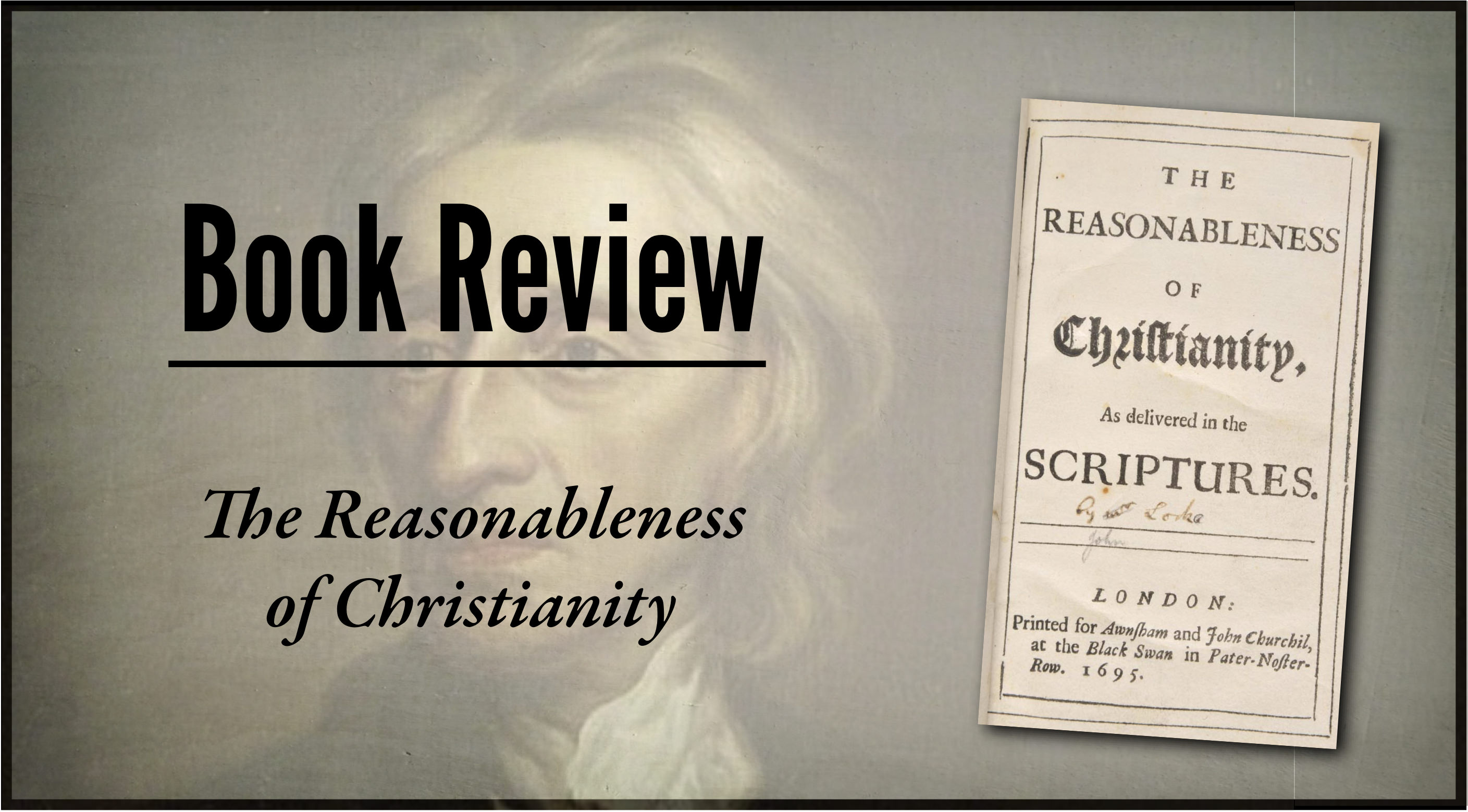
This semester I am in a church history class for grad school and as part of my reading for that class I recently finished John Locke’s The Reasonableness of Christianity. Locke is well-known to many people as a key thinker in the Enlightenment and specifically in the school of thought known as empiricism. His thoughts were very influential to the founding fathers of the United States, and he was also a great influence on Alexander Campbell, one of the leading early figures of the Stone-Campbell Restoration Movement.
In The Reasonableness of Christianity, Locke basically sets forth the Christian faith as he sees it. Scripture teaches that Adam sinned in the Garden of Eden and, as a result, lost bliss and immortality. Humanity inherits Adam’s immortality, although we are punished only for our own misdeeds. Unfortunately, all sin and fall short of God’s glory and thus, are in need of a Savior. Jesus Christ is this Savior, the Messiah of whom the prophets spoke.
God judges us according to the law of faith, and considers believers to be righteous, granting them life and immortality. Specifically, the faith that is necessary for justification is the belief that Jesus is the Messiah, and obedience to the moral and ethical standards that he set forth. Beyond this, Locke is open to differences of opinion on a variety of doctrines, and emphasizes the importance of tolerance in view of the fact that we have limited abilities and make mistakes about what we believe.
Here are some quotations that I particularly enjoyed and would like to share, along with some of my own thoughts:
“Nay, if God afford them a temporary, mortal life, ’tis his gift they owe to his bounty, they could not claim it as their right, nor does he injure them when he takes it from them.” (27)
We frequently pay lip service to the notion of our lives being a gift from God, but do we really believe that? I wonder, sometimes, when you hear the language we use when someone dies prematurely—it seems so unjust and tragic to us. I think Locke’s perspective is a better one: each day that we live is a gift from God, and from that perspective, however long we live is more than we have any right to expect or deserve.
“For if they believed him to be the Messiah, their King, but would not obey his laws, and would not have him reign over them, they were but the greater rebels…” (46)
This seems to me to be particularly relevant to the legions of nominal Christians that exist in our society who profess Jesus as Lord with their lips but deny Him with their lives. Those who reject Jesus live in rebellion to Him, but this is only to be expected. How much greater is the rebellion from those who claim Him as Lord but ignore His demands on their lives?
“‘Tis too hard a task for unassisted reason, to establish morality, in all its parts, upon its true foundations, with a clear and convincing light.” (60)
“…But yet some parts of that truth lie too deep for our natural powers easily to reach, and make plain and visible to mankind, without some light from above to direct them.” (65)
I expected Locke to hold human reason up as the ultimate source of knowledge and truth, but as the quotations above clearly show, he doesn’t do this. Rather, he is candid about the limitations of human reason, and ultimately holds that something greater that reason—revelation—is required for the establishment of universal moral truth.
Perhaps I approached The Reasonableness of Christianity with caricatures of Deism in my mind, but I was pleasantly surprised and impressed by what I read. There are certainly points I would quibble with, but on the whole, I thought Locke gave a succinct and fairly orthodox summation of the Christian faith. He does place significant value on reason, but this was actually less than I expected, and did not seem excessive to me. Locke does not dismiss Jesus’ miracles, but instead holds them to be essential (and reasonable) evidence that Jesus is exactly who He claims to be—the Messiah. Locke also asserts that Jesus’ ethical teachings are reasonable, but even these teachings ultimately required revelation. Left to its own reason, humanity had never been able to produce a universal moral law on its own.
Finally, although it was not the focus of this writing, I appreciated Locke’s emphasis on tolerance and the allowance for some diversity of opinion while at the same time upholding key fundamental doctrines about which all Christians must be in agreement. For Locke, the essentials are faith in Jesus as the Messiah and living a good moral life in accordance with His teachings.
In the context of the bitterly divided religious world in which Locke lived (and in which we still live today), such a call for tolerance seems like a hopeful basis for unity in God’s church. Of course, the difficulty always comes in determining which doctrines are fundamental and which are matters of opinion.







