The online journal of Luke Dockery

Tag: Esther

A Faith for the Storm, Or, My (Current) Favorite Bible Verses

So there’s one of those chain things going around on Facebook right now where you post your favorite Bible verse(s) and then tag others to get them to do the same. I got tagged by someone the other day, but since I’m not generally a fan of such things I decided to refrain. Then, upon further reflection, I decided that this would be a worthwhile thing to do, but that I would blog about it instead of posting to Facebook. This allows me a little more space for commentary, and also frees me from having to tag other people.

At one point in my life, my favorite verses likely would have been some of the same as the ones I have seen repeated so often:

“I can do all things through Christ who gives me strength…”

“And we know that God causes all things to work together for good…”

“No temptation has overtaken you that is not common to man. God is faithful, and he will not let you be tempted beyond your ability…”

Those are wonderful verses, and I still take comfort from them (though, in context, I don’t necessarily think they mean what a lot of people take them to mean).

But in this current season of my life, those aren’t my favorite verses. Verses about me overcoming all obstacles, conquering all challenges, and everything working out are not what seem most relevant to me right now.

Instead, my favorite verses are these:

“Go, gather together all the Jews who are in Susa, and fast for me. Do not eat or drink for three days, night or day. I and my attendants will fast as you do. When this is done, I will go to the king, even though it is against the law. And if I perish, I perish.”

(Esther 4.16)

“Though He slay me, I will hope in Him…”

(Job 13.15)

“If it be so, our God whom we serve is able to deliver us from the furnace of blazing fire; and He will deliver us out of your hand, O king. But even if He does not, let it be known to you, O king, that we are not going to serve your gods or worship the golden image that you have set up.”

(Daniel 3.17-18)

Some brief context:

The first verse is a quotation from Queen Esther. She has determined that she will use her position as queen in an attempt to save her people, but she realizes that she could very likely be put to death for doing so. And she does it anyway: if I perish, I perish.

The second verse is a quotation from Job. Job has lost all that he has: his children have been killed, his possessions are gone, he has lost his health, and even his wife has become a hindrance rather than an aid. For Job (who doesn’t know what is going on behind the scenes), it seems very possible that God will take his life too. But even so, Job trusts in God: though He slay me, I will hope in Him.

The third passage is a quotation from Shadrach, Meshach, and Abednego, after they have disobeyed King Nebuchadnezzar’s command to fall down and worship a golden statue. Nebuchadnezzar threatens to have executed in a fiery furnace, but they stick to their guns. They hope that God will save them, but even if He does not, they are determined to honor Him.

It’s verses such as these that resonate deeply within me at this point in my life. To be honest, I don’t feel much like a conquering hero who has everything figured out and is eagerly anticipating his impending victories. I feel more like a worn-out soldier headed into what seems like a hopeless battle, but determined to go forward in service to my King.*

These are verses which exhibit a defiant faith, and that’s where I am at this point. And really, I’m okay with that. In different ways and to different degrees, we all experience the storms of life, and we need to have a faith that is equipped to survive those storms. For me, it’s a more mature version of my faith, a version which has been tempered by the realities of living in a broken world, and which is not (as) contingent upon external circumstances.

*To be sure, I know that it is not a hopeless battle; but this is a true reflection of the way I currently feel. Our feelings frequently deceive us.
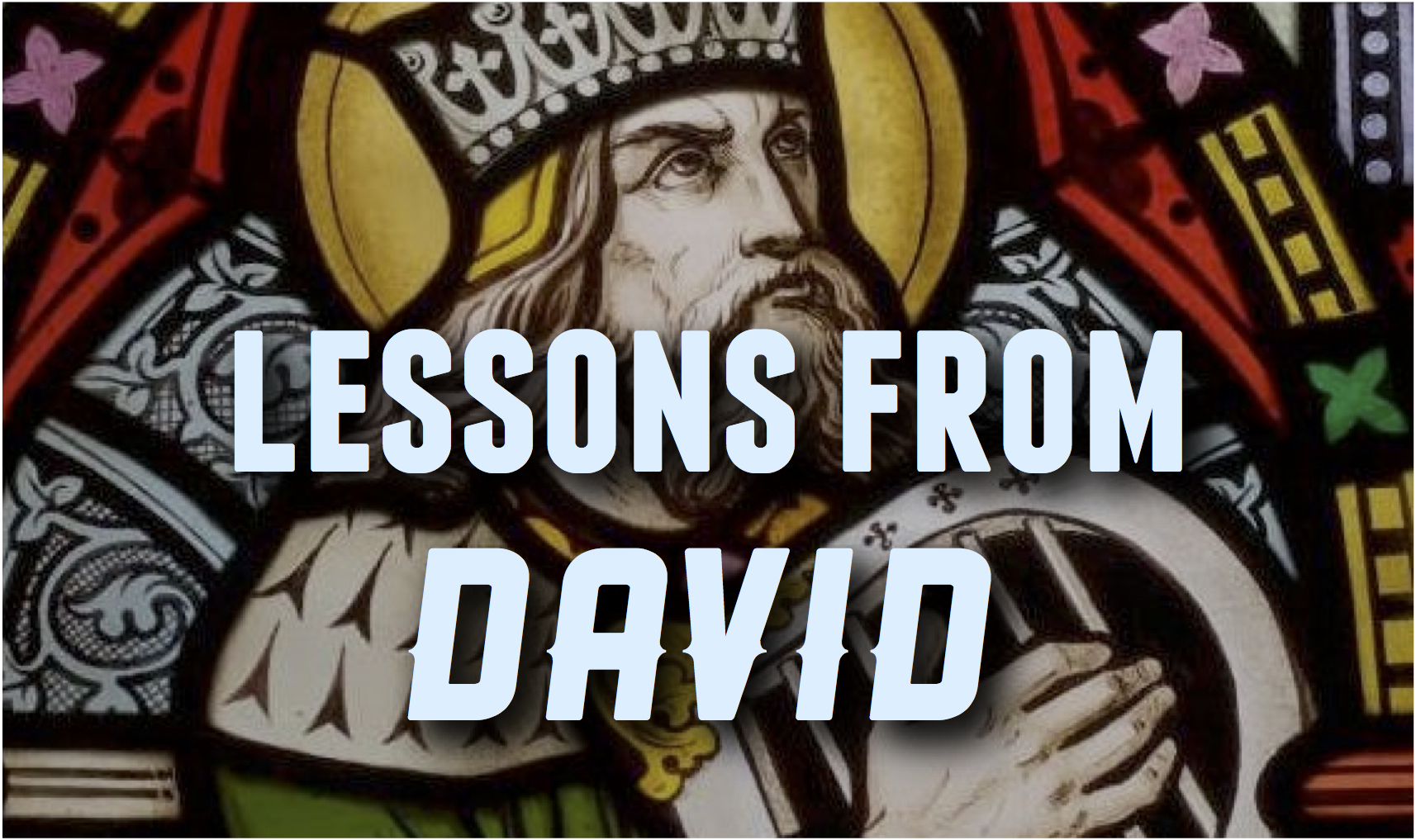
Image Credit: Bob Gonzalez

Lessons from David: God Can Use Unlikely People

Lessons from David

As I mentioned last week, the life of King David provides some remarkable lessons for people of faith today. This will not be an exhaustive series (there’s much more that can be learned from David than what we are able to cover here), but I do want to highlight some of the most important ones.

Today I want to talk about a lesson that the Bible teaches over and over again: God uses unlikely candidates to accomplish His will.

After King Saul disobeyed God, God send His prophet Samuel to anoint a new king for Israel from the sons of Jesse the Bethlehemite. Samuel goes to Bethlehem and Jesse brings his sons out, one by one, for Samuel to see. When Eliab, Jesse’s oldest son, comes out, Samuel was impressed; apparently this man looked like a king:

“But the LORD said to Samuel, ‘Do not look at his appearance or at the height of his stature, because I have rejected him; for God sees not as man sees, for man looks at the outward appearance, but the LORD looks at the heart.’” (1 Samuel 16.7)

Samuel sees Jesse’s seven oldest sons, but God rejects them all as king.

Apparently, the thought of David—the baby, the shepherd boy—being the one God was interested in hadn’t even entered Jesse’s mind, because he wasn’t even there; he was out with the sheep. So Jesses sends for him, and sure enough, David is the one God chooses, and the one Samuel anoints to be the next king of Israel.

David goes on to defeat Goliath, become a mighty warrior, and as King, leads Israel in many successful military campaigns, but if it had been left up to Samuel, David would’ve just stayed in the field with the sheep.

For God sees not as man sees, for man looks at the outward appearance, but the LORD looks at the heart.

God spoke these words in reference to David, but they don’t just apply to him. The fact is that God can use anyone, no matter what they look like on the outside, to further His will. In fact, God has almost always used men and women from unimpressive circumstances on the outside to accomplish His goals:

  • Moses was a murderer and an exile, a man who was apparently afraid to even speak in public. And yet, with God’s help, Moses stood up to Pharaoh, likely the most powerful man in the world at that time, freed the children of Israel, and then led them in their trek through the wilderness.
  • Rahab was a lowly prostitute, but she hid the Israelite spies and was pivotal in the Israelites’ great victory over the walled city of Jericho, and thus, their occupation of the land of Canaan.
  • Esther certainly looked impressive on the outside: in fact, she became queen only because she had won a beauty contest. But she had no political aspirations and was afraid to even speak to the king, but God used her to save the Jewish people.
  • Peter was an uneducated (probably), coarse fisherman who, even despite spending a lot of time with Jesus, just seemed to mess up all the time. He was always sticking his foot in his mouth, and deserted Jesus when things got touch. But on the Day of Pentecost when the Church was established, Peter preached the first gospel sermon and 3,000 were added to the Church.
  • Paul was present at the stoning of Stephen. He persecuted Christians and threw them in jail, and would later refer to himself as the chief of sinners. But God used Paul to speak the gospel message to countless Gentiles, and Paul became the greatest missionary the world has ever known.

The examples go on and on, but the principle remains the same: God uses unlikely candidates to accomplish His will. This was true with David, it was true throughout the Bible, and it is true today.

You might see yourself as lacking talent or ability, but God sees you as someone who He can use to accomplish great things for His Kingdom:

“For we are His workmanship, created in Christ Jesus for good works, which God prepared beforehand so that we would walk in them.” (Ephesians 2.10)

That verse seems pretty clear to me. No matter what you think about yourself or what you think your shortcomings are, God designed you to be useful! There are things that you can do (and maybe that only you can do) for His cause!

God uses unlikely candidates to accomplish His will!

Links Between Daniel And Esther

The Book of Daniel has been one of my favorite biblical books for a while now, and I’ve always enjoyed the Book of Esther as well. A while back, I heard a lesson on Esther which got me to thinking about the striking similarities between the two: 

Faithful Living in a Hostile Environment

Many of the following similarities can be traced to the overriding similarity in the setting of both books. The Book of Daniel follows the lives of Daniel and his three friends as they live godly lives during a time of captivity in Babylon, working in conjunction with powerful kings (first Nebuchadnezzar, then Belshazzar, then Darius).

The Book of Esther focuses on the lives of Esther and Mordecai as they live in Susa under the reign of Ahasuerus/Xerxes.


Emphasis on the Physical Beauty of Young People

Daniel 1.3-6 mentions that Daniel, Hananiah, Mishael, and Azariah were chosen for the king’s service because they were, among other things, “without blemish, of good appearance.” They were taken aside and were to be given special training and a special diet to prepare them to assist the king.

Similarly, Esther was chosen as part of the harem of Ahasuerus based on her great beauty (Esther 2.3, 8) and was similarly treated with a special diet and also given cosmetic treatment (vv. 9-12).

The Changing of Names

Daniel 1.7 is clear that Daniel and his friends are given new names in Babylon (Daniel becomes Belteshazzar, Hananiah is called Shadrach, Mishael is now Meshach, and Azariah is called Abednego) which seems to be an attempt to change the identity and allegiances of the young men. Allusions to Yahweh, the God of the Israelites, were removed from their names and were replaced with references to false Babylonian gods.

The Book of Esther is not as explicit, but Esther 2.7 mentions that Mordecai was “bringing up Hadassah, that is Esther….” Hadassah is a Hebrew name, which indicates that her name must have been changed to Esther at some point while she was under Persian influence and authority.

Accusations Against God’s People

In both Daniel and Esther, we have the theme of wicked men bringing accusations against God’s people. In Daniel, political officials who are jealous of the level of authority that Daniel has achieved under Darius realize that the only way they can get him in trouble is to outlaw his devotion to Jehovah, and they then inform Darius that he has violated the law by continuing to pray to his God (Daniel 6.1-14).

In Esther 3, Haman’s rage over Mordecai’s refusal to bow before him leads him to propose a scheme to Ahasueras to eradicate the Hebrew people (Also, this incident could be compared to the refusal of Shadrach, Mishael, and Azariah to bow to King Nebuchadnezzar’s golden image in Daniel 3).

God’s Ability to Save in Difficult Situations

In Daniel 3, Shadrach, Mishael, and Azariah are confident that God has the ability to rescue them from the fiery furnace. Later, in Daniel 6, Daniel seems to be unfazed by his punishment of being thrown in the lion’s den.

When Mordecai learns of Haman’s plan to wipe out the Jewish people, he reflects a similar attitude, telling Esther that the Jews will be delivered one way or another (Esther 4.13-14).*

Stubborn, Determined Faith

One awesome theme of both books is the portrayal of determined, defiant faith from the characters. Shadrach, Meschach, Abednego, and Esther all realize the possibility of dying for their actions, but are determined to remain faithful regardless. Their declarations of stubborn faith in Daniel 3.16-18 and Esther 4.16 are among my favorite passages in Scripture.

Promotion of God’s People to Places of High Authority

A final related theme of both Daniel and Esther is the way that God leads his faithful followers to places of high authority in their respective foreign lands. Daniel, Shadrach, Meschach, and Abednego (Daniel 1.20, 2.46-49, 3.30, 5.29, 6.1-4, 6.25) all find favor in the sight of their superiors and are elevated to positions of high authority.

Similarly, Esther and Mordecai (Esther 2.1-18, 5.1-8, 6.10-11, 10.2-3) are appreciated by their superiors and granted power and authority as well.

Conclusion

These are just some of the similarities that struck me between the two books; I’m sure there are more that could be listed. As I mentioned above, I think a lot of the similarities stem from the overall similarity in setting, as we have the stories of people trying to be faithful to God in a surrounding culture which doesn’t always support that lifestyle. In that sense, I think the books of Daniel and Esther are incredibly relevant to Christians today as we strive to live as “sojourners and exiles” in our world (1 Peter 2.11).

*Much has been made of the fact that Esther is the only biblical book which does not explicitly mention God. While this is interesting, I don’t think it is particularly significant, as the idea of God providentially caring for His people is as central to the Book of Esther as it is to the Book of Daniel.


The image above is from a series of Esther mosaics by Lilian Broca.

© 2026 The Doc File

Theme by Anders Noren — Up ↑