The early chapters of Exodus recount a dark period in the history of Israel.
Abraham’s descendants had arrived in Egypt through the influence of Joseph, who from his high position as Pharaoh’s right-hand man, had provided for the survival of his family (and many others) during a time of famine. Joseph’s brothers and their families stayed in Egypt, and grew and multiplied over time.
That was at the end of Genesis, but now, at the beginning of Exodus, a lot of time has passed and a new Pharaoh has come to power who doesn’t know Joseph or care about his family or descendants. This new Pharaoh is only concerned about the size and vigor of the Israelites, and so he decides to enslave them and force them into harsh labor. Even worse, he commands that Hebrew baby boys shouldn’t be allowed to live.
In Exodus 2, we have the famous story of the birth of Moses, and also the story of Moses killing an Egyptian when he grows up and then fleeing to the wilderness.
It is in this context that there is a brief note at the end of Exodus 2, as people find their servitude to be unbearable and, as a result, cry out to God:
During those many days the king of Egypt died, and the people of Israel groaned because of their slavery and cried out for help. Their cry for rescue from slavery came up to God. And God heard their groaning, and God remembered his covenant with Abraham, with Isaac, and with Jacob. God saw the people of Israel—and God knew.
(Exodus 2.23-25)
This is easy to overlook, but so powerful—the people cry out to God, and God hears their cry. He sees their suffering and is aware of what is going on. God saw the people of Israel—and God knew.
Of course, God responds to their problem by raising Moses to be his people’s great liberator. This plan would take time to develop, as we know that Moses spent 40 years in the wilderness before returning to Egypt, but the plan was in motion, and Moses would lead the Israelites from slavery to freedom. God saw the people of Israel—and God knew.
But, if you continue in the story of God’s people as told in the Hebrew Bible, you know that this is hardly the end of the people’s problems. There would be many more times in which the people would cry out to God and God would respond. The response wouldn’t always come in the way or the timeframe that the people expected, but God saw the people of Israel—and God knew.
Ultimately, though, we see this truth played out in the person of Jesus.
For generations, God’s people groaned under the burden of the consequences of their sinfulness: captivity in foreign lands, a lackluster return to their promised land, a temple and a nation that was a shell of their former glory, a persistent vulnerability to the pull of sin, and a desperate need for the Davidic descendant, the Messianic king for whom they had waited so long.
Deeply aware of humanity’s slavery to sin, in His own time and in His own way, God responded: the Son put on flesh and lived as a human. Through the incarnation of Jesus, God saw—and God knew in a new and special way, through His own experience of the human condition (Hebrews 4.15). While identifying with our human frailties, Jesus was different in that He lived without sin. He died to release us from our own captivity to sin, and was vindicated by the Father in His resurrection.
But there is more!
Before His crucifixion, Jesus told His disciples that He would be leaving, but that when He did, a Helper would come—God’s Holy Spirit—who would be with them (John 15). The Holy Spirit indwells followers of Jesus and, indeed, helps us in many ways. One of those ways is in our own communication with God:
Likewise the Spirit helps us in our weakness. For we do not know what to pray for as we ought, but the Spirit himself intercedes for us with groanings too deep for words.
(Romans 8.26)
Did you catch that? As we struggle through this life and our ongoing battle with sin, we are at times at a loss for what to pray. But the Spirit Himself intercedes for us with groanings too deep for words. The Israelites groaned to God for help; now, through the power of the Spirit, we don’t just groan to God, God groans in us…to Himself!
The Israelites groaned to God for help; now, through the power of the Spirit, we don’t just groan TO God, God groans IN us…TO Himself! Share on XBut still, there is more!
While we are assured that Jesus has defeated Satan, sin, and death, and the presence of the Spirit in our live serves as a down payment on our salvation, we continue to live in a broken world where there is still much about which we may rightly cry out to God. Against that reality, the promise of Scripture and the source of Christian hope is that Jesus will return one day, the cosmos will be redeemed, and every tear will be wiped from the eyes of God’s people.
The timeline may be different from what we expect, so we wait…and wait. But we can be confident, because God saw—and God knew.
 In this loose series of Scripture Reflections, I am sharing brief thoughts spurred on by my Bible reading. By way of reminder, my goal for these brief posts is two-fold:
(1) To remark on aspects of the biblical text that I find to be of interest that the reader may or may not have thought about previously.
(2) When possible, to point to the work and person of Jesus Christ. I believe the Bible is a unified story that points to Jesus, which means that He is frequently alluded to or foreshadowed in some way throughout the biblical canon.
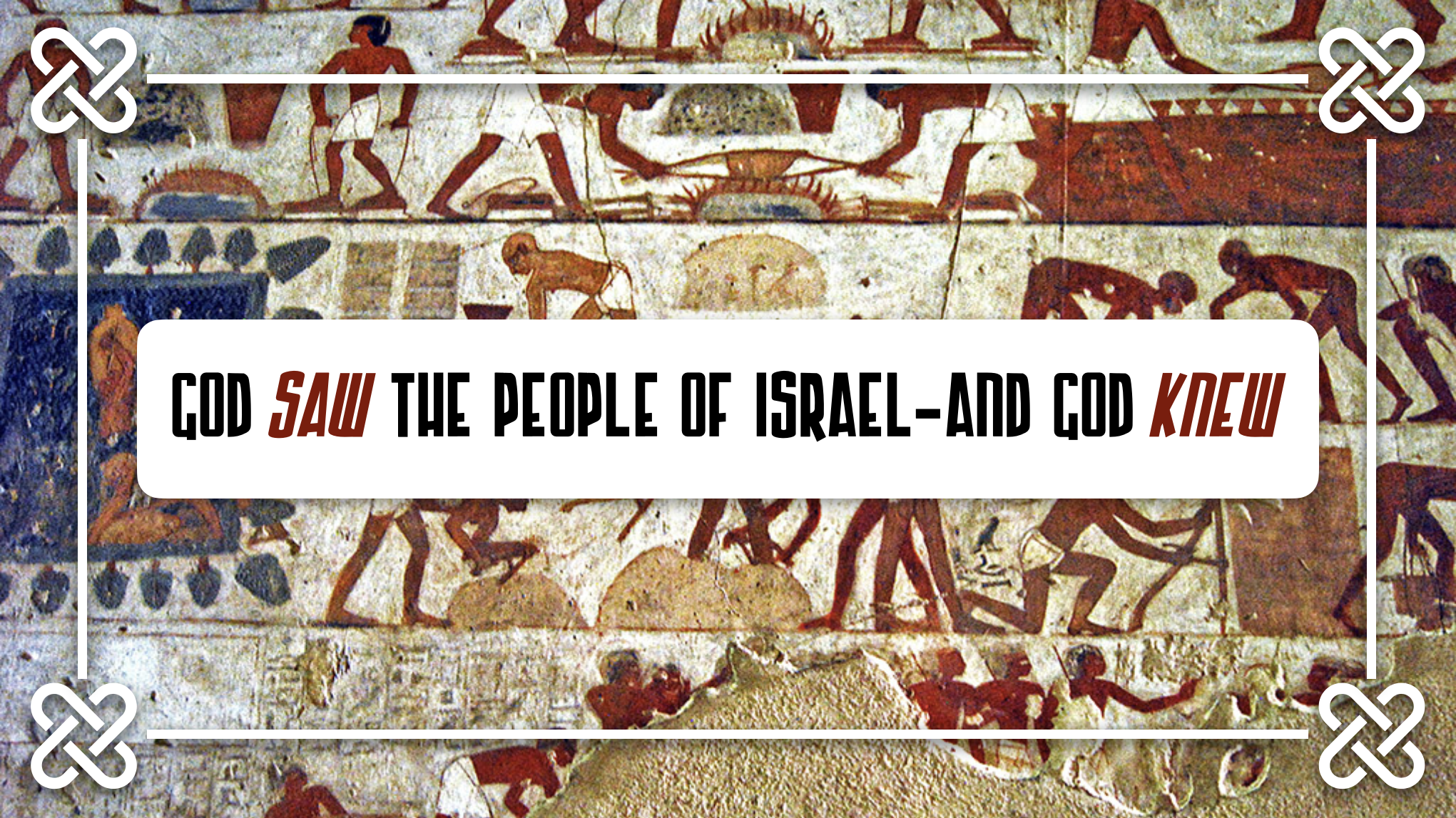
Photo Credit for the image above goes to Ferrell Jenkins. The image comes from the tomb of Vizier Rekhmire (ca. 1470-1445 BC), and depicts a brickmaking and building scene featuring slaves from the rough period of Israelite bondage in Egypt.