The online journal of Luke Dockery

Tag: Faith (Page 1 of 4)

Faith & Deconstruction

It’s likely that you’ve heard the term deconstruction quite a bit lately, as it has been used quite a bit in discussions surrounding the Christian faith, especially (though not exclusively) among young adults. As Christians, how should we respond to this phenomenon? How should the reality of deconstruction affect our ministry practices, especially with young people?

Which Deconstruction Are We Talking About?

Depending on who is using the term, deconstruction is variously held up as a virtuous act, dismissed as a fad, or condemned as faithlessness. Part of this range in response stems from the sad reality that we live in a polarized society where people tend to have extreme actions toward everything, but in this case, I think a big part of the issue is that deconstruction is a very nebulous term that reflects several different ideas.

I do not claim to be an expert on this topic, but I have tried to listen well to many who have deconstructed in some sense, and am convinced that we can actually identify at least four distinct processes or developments:

(1) Losing Faith: When some people talk about having deconstructed their faith, what they actually mean is that they have lost faith—at one point, they believed in God and were followers of Jesus, but now they are not. This process may have occurred for a variety of reasons and may have happened quickly or over a long period of time, but the end result is that their faith is gone.

(2) Leaving One “Kind” of Christianity for Another: The reality is that there are many different varieties or flavors of Christianity in the world. Many of the people who I have heard or read talking about deconstruction are actually talking about leaving a particular brand or denomination that they grew up in and now identifying with something else. Often, this is tied to the search for a different worship experience, sense of church history, or better alignment on theological perspectives.

(3) Extricating Essential Elements of Christianity from Cultural Trappings: The last few years have been quite revealing of the degree to which Christianity in the US is susceptible to the influence of unhealthy cultural influences. These influences are far-ranging, from racism and white supremacy, to political partisanship, to Christian nationalism, to sexual abuse in the church and related ideas about gender and sexuality. Although there is some overlap between this category and the previous one, the focus here is on trying to reclaim and preserve some core aspect of Christianity that is free of unhealthy (or even sinful) cultural baggage.

(4) Owning Faith: It is important to not overlook the fact that many (certainly not all) of those who are in the process of deconstruction are those in their late teens or early to mid-twenties. Until now, the faith they have had has largely been received from their parents, and now they are at a place where they are developing a faith of their own. That process involves examining and weighing the beliefs they have been taught and, ultimately, deciding what they will hang onto and what will be discarded.


How Should We Respond To Deconstruction?

Part of the reason that I wanted to delineate different expressions of deconstruction above is that I think how we respond should depend somewhat on which process we are actually witnessing. All of these processes do have at least a couple of elements in common, however:

  • Each is generally very difficult for the person going through it. It is not fun to lose your faith, leave your church, or feel the disorientation that comes from significantly changing your beliefs.
  • It is often not a process that the person going through it has actually chosen. Usually, a person doesn’t set out to deconstruct; they are responding to some sort of experience that has caused them to doubt or become unsatisfied with the faith they had previously.

Having established those commonalities, it is safe to say that, as Christians, we should approach such persons with compassion and understanding, in a non-adversarial sort of way (Jude 22: “Be merciful to those who doubt.”). These are not our enemies (though, they may act with anger or aggression), and even if they were, we owe them our love rather than our mockery or dismissiveness.

But, as I mentioned above, I do think that we should respond differently to people depending on which form of deconstruction they are wading through. Let’s start with the first and fourth categories, because I think those are the most straightforward.

Losing Faith: There are many reasons that lead to people losing their faith. Some are more understandable than others, and I have heard people who lost faith talk before and resonated strongly with some of what they say. But from a Christian perspective, losing faith is nothing sort of a tragedy. God loves all people, but a covenant relationship with God is based upon faith, and those who walk away from that faith are turning their backs on that covenant relationship. This grieves God, and obviously leaves the person without faith spiritually imperiled.[1] This sort of deconstruction is to be lamented.

Owning Faith: I have written and spoken at length of the importance of parents having faith and passing that faith onto their children. This is a crucial aspect of the spiritual formation as young people, and yet, we shouldn’t expect the spiritual lives of young adults to be carbon copies of their parents. In fact, if their spiritual lives are carbon copies of those of their parents, it likely means that they haven’t thought about faith much and are still fairly immature. I have immense respect for my parents and am deeply grateful for the faith they passed onto me, but my views are not identical in every detail to what they were when I was 18. The process of developing your own faith is challenging and risky[2], but it is essential: an inherited faith is an immature faith. If we are to grow in Christ, we have to reflect on what we have been taught, compare that with our understanding of God’s character and teachings as revealed in Scripture,[3] and, in that process, begin to build a faith of our own. This sort of deconstruction is to be praised (and guided, and prayed for).

Leaving One “Kind” of Christianity for Another: It is not my place or task to judge the faith of others, and I have no intention of doing that here. However, part of the reality of owning your faith is making determinations about what is right and pleasing to God and what is not, and it is obviously true that our views will more closely align with some Christian groups than others. I was raised and have spent my life in Churches of Christ, and am very grateful for many aspects of that heritage.[4] I am also quite aware of our many problems, historically and currently. Nevertheless, I continue to minister in the context of Churches of Christ not just out of comfort, but conviction: I think we get some really important things essentially right, and I would rather deal with our problems than trade them for the problems of some other group. I say all that in order to explain that how we feel about someone leaving one kind of Christianity for another will depend significantly on our own theological views: sometimes it may be a wonderful development, while at other times it may be very disappointing.[5]

Extricating Essential Elements of Christianity from Cultural Trappings: In my experience, this particular form of deconstruction is sometimes the messiest and most complicated, and thus, the most difficult to know how to respond to. I think this stems from the fact that this form of deconstruction occurs in reaction to something negative and, generally speaking, humans are really bad at reacting to something without overreacting. For example:

  • It is true that many Christians have allowed their faith to be overly tied to conservative (Republican) politics. But surely the answer to this is not to respond by tying our faith to liberal (Democratic) politics? And yet, I have observed some who have “deconstructed” from the former settle comfortably into the latter.
  • It is certainly true that racism and white supremacy have had strong and pernicious influence in the history of American Christianity, but does that mean that American churches are irredeemably racist or white supremacist? Does it mean that God has not and cannot work through such churches?
  • If some have overreached in their teaching about gender roles, is the proper response to teach that there are no gender roles?
  • If teaching on sexuality has been unhealthy, is the proper response to just allow culture to dictate sexual ethics instead?

It is a worthy endeavor to distinguish between teachings of Jesus and the Apostles and cultural trappings; I would argue that it’s something that all mature disciples should seek to do. It is also difficult. Ideally, this is the sort of thing that Christian community is for: as we individually seek to be faithful to the teachings of Scripture while living in a cultural setting that is often confusing, our fellow pilgrims help to sharpen and nuance our thinking on a variety of issues.

How Should The Phenomenon Of Deconstruction Affect Ministry With Young People?

This, for me, is the million dollar question, and I confess that I have not worked out a comprehensive answer. Here are some initial thoughts, though:

  • We should leave space for the expression of doubts and questions. Research shows that students who actually talk about their doubts are more likely to develop long-term faith than those who ignore them.
  • We should emphasize core doctrines of Christianity. There are essential, foundational beliefs that the vast majority of Christians have held for 2,000 years. We see them emphasized in Scripture and taught by the apostles. Extricating Christianity from unhelpful cultural baggage is easier for students who know what real Christianity looks like.
  • Be prepared to speak a prophetic word against cultural values that do not reflect Jesus. Especially do so across party lines, reinforcing the fact that all human ideologies fall short of the ways of God’s Kingdom.
  • Address difficult topics (sexuality, race, etc.).
  • Seek to connect students to the intergenerational community of faith. Real, authentic relationships with older, mature Christians give students conversation partners when they are wrestling with doubts, a voice if they have identified something harmful at church that needs to be changed, and resources and support as they work to develop their own faith.
  • Do some work with apologetics (especially, in my opinion, apologetics centered on Jesus).
  • Affirm the parents of students and the faith they have passed on, while acknowledging that, as they grow, developing a faith of their own will become a necessity.

If we aren’t doing these things, then I think we are probably contributing to unhealthy rather than healthy and necessary forms of “deconstruction”.


[1] This brings me to one of the worst phenomena I have witnessed as part of this larger conversation: seeing people rejoice at the loss of faith of Person X. Sometimes, this rejoicing even comes from someone who ostensibly still has faith themselves, but they are so wrapped up in celebrating some shallow victory (like Person X abandoning some specific doctrinal or political position as a part of their deconstruction) that they fail to appreciate the tragedy of Person X losing faith.

[2] How do we know that young people won’t develop a faith that looks very different from that of their parents, maybe even to an unhealthy degree? Ultimately, we don’t. There are no guarantees that this process will turn out well, but that doesn’t change the fact that it is a necessary process.

[3] More accurately, we could say, “as revealed in Jesus”, but the presentation of the Word made flesh occurs in the words of the Bible, so this is still accurate.

[4] Including the notion that we are not trying to be a Christian group or denomination to begin with. We don’t want to be a “kind” of Christianity, but just Christians. But, I digress.

[5] A few examples to help illustrate this point: if a friend from church were to suddenly leave our church and join the Roman Catholic Church, I would be saddened by this. I have friends who are Catholic and greatly appreciate certain aspects of the Catholic tradition, but that doesn’t change the fact that I perceive them to be in significant error on certain issues. In light of this, a step into Catholicism would be, from my perspective, unfortunate (though still a very different sort of development than walking away from faith!). On the other hand, if I had a friend at an LDS (Mormon) church who decided to become Catholic, I would actually view this as a positive development! It doesn’t change my (many) reservations about Catholic doctrine, but it would in my view represent a significant step in the right direction toward truth.

Furthermore, I should probably add that this doesn’t neatly fall along “conservative” or “liberal” lines. I would lament someone who took a “step to the right” if it meant that they had begun to read Scripture in overly literal ways that failed to honor what the text was trying to say, become sectarian in their outlook, and joined a church that was rigid and hateful. I would lament someone who took a “step to the left” if it meant that they had compromised on historic doctrines of the Christian faith.


The Faith of American Teenagers

Introduction: A Major Problem

In this post, I want to share some research regarding the faith of teens in the United States. One of the most important (and alarming) research findings is that what American Teens who call themselves Christians actually believe is not what “Christianity” has meant for 2,000 years.

As we look at the data, there are a couple of really important things to keep in mind. First, these are general conclusions drawn from research; that doesn’t mean they apply to every single teenager. Also, I’m not blaming teenagers for the problems and deficient beliefs we will discuss below. Teens believe what they do because adults—parents, youth ministers, teachers, leaders, the church, whoever—have failed to teach them any better.


Cultural Christianity: The Faith of American Teenagers

The National Study of Youth and Religion (NSYR) was a massive research study conducted from 2002-2005. Findings from this study were published in two important works, Soul Searching: The Religious and Spiritual Lives of American Teenagers, by Christian Smith and Melinda Lundquist Denton, and Almost Christian: What the Faith of Our Teenagers Is Telling the American Church, by Kenda Creasy Dean:[1]

  • Researchers studied more than 3,300 American teenagers between the ages of 13-17.
  • After the initial survey, the researchers conducted 267 follow-up face-to-face interviews.
  • 2,500 of the original 3,300 were revisited years later to see how their religious lives changed as they age.
  • Teens from all different religious backgrounds were examined (not just Christian).

What they found was that 3 out of 4 American teenagers claim to be Christian, but only about half consider their faith to be important, and less than half practice their faith as a part of their daily lives.[2]

Furthermore, the report showed that “the vast majority” of U.S. teens are “incredibly inarticulate about their faith”—in other words, even those teens who claim to be Christians are unable to explain what it means to be a Christian or what they actually believe.[3]

Research shows that “the vast majority” of U.S. teens are “incredibly inarticulate about their faith” Share on X

When asked questions about what they believed religiously, here were some of the actual responses:[4]

  • Uh, I haven’t really thought about that [pause]. I don’t know.
  • I believe in the [pause], I, ohhh [pause], I don’t think I’d really like to talk about that.
  • Hm, I don’t know, I’d have to like ask somebody or something, I don’t know.
  • Um, I guess I believe…[laughs], um, I don’t know. I don’t really know how to answer it.

Teens typically have a very difficult time explaining what it means to be a Christian or what they actually believe.

After the NSYR was completed, some of the experts who analyzed all of the data from this study realized that, although a lot of young people claim to be Christian, what they mean by “Christian” is not what that word has historically meant for the last 2,000 years. The NSYR suggests that many, many teenagers who consider themselves to be Christians don’t really practice Christianity at all; they practice a different religious faith altogether. In the words of Christian Smith and Melinda Lundquist Denton:

“A significant part of Christianity in the United States is actually only tenuously Christian in any sense that is seriously connected to the historical Christian tradition, but has rather morphed into Christianity’s misbegotten stepcousin, Christian Moralistic Therapeutic Deism.”[5]

So, a lot of young people who consider themselves to be Christians are not really practicing Christianity, but instead is a “misbegotten step-cousin” of Christianity—something that is kind of related to Christianity but really isn’t very close. Smith and Denton continue:

“The language, and therefore experience, of Trinity, holiness, sin, grace, justification, sanctification, church, Eucharist, heaven and hell appear, among most Christian teenagers in the United States at the very least, to be supplanted by the language of happiness, niceness, and an earned heavenly reward. It is not so much that U.S. Christianity is being secularized. Rather more subtly, Christianity is either degenerating into a pathetic version of itself or, more significantly, Christianity is actively being colonized and displaced by a quite different religious faith.”[6]

In other words, when most Christian teens talk about faith, they don’t talk about the things the Bible talks about: discipleship, sacrifice, holiness, sin, grace. Instead, they talk about things like “being nice” or “being a good person” or “getting to go to heaven when we die”. What a lot of teens talk about when they describe their faith, really isn’t Christianity at all.

And since it’s not really Christianity, the researchers came up with a new name for it: Moralistic Therapeutic Deism.

From the NSYR, here are the central beliefs of Moralistic Therapeutic Deism:[7]

  1. A god exists who created and orders the world and watches over life on earth.
  2. God wants people to be good, nice, and fair to each other, as taught in the Bible and by most world religions.
  3. The central goal of life is to be happy and to feel good about oneself.
  4. God is not involved in my life except when I need God to resolve a problem.
  5. Good people go to heaven when they die.

And this is why they call it Moralistic Therapeutic Deism.

  • What does “Moralistic” mean? If you are a moral person, it means that you understand the difference between right and wrong, and you try to do those things that are right and generally be a good person (2, 5).
  • What does “Therapeutic” mean? Usually, we think of this word in terms of going to therapy for something (physical therapy, occupational therapy, counseling, etc.). Therapy is a form of treatment you take in order to be healed or to feel better. So MTD is therapeutic in the sense that God helps us with our problems, and that the goal is for us to feel good about ourselves (3, 4).
  • What does “Deism” mean? You might think of Deism in terms of European History and the intellectual movement called the Enlightenment; here we don’t mean Deism in a technical sense, but more in a general sense: a belief in a deity who created the world but isn’t too involved in everything that happens (1).

So you can see why it’s called Moralistic Therapeutic Deism: it’s about trying to be good, trying to feel good about ourselves, and it is loosely connected to belief in “God”. We might also call it Cultural Christianity. It is “Christianity” as our culture views it and practices it, but it is not Christianity as described in the Bible. From here forward, I will use Cultural Christianity as a synonym for Moralistic Therapeutic Deism.

When you put all of this together, American Cultural Christianity is a watered-down version of Christianity. Sometimes, it’s not so bad to water something down. I like to water down Gatorade when I drink it, because it makes it less heavy and I think it tastes better. Sometimes we water things down in order to make them more pleasant or to suit us better, and that’s okay. But Cultural Christianity is a watered-down Christianity, and that’s not okay. Sure, in some ways it’s more pleasant—Cultural Christianity is easier; it’s less demanding. It is a religion that will not offend anyone…but neither will it save anyone.

Remember earlier how we said that 3/4 of American teenagers consider themselves to be Christians but only about half consider it to be important, and less than half practice their faith as a part of their daily lives? That’s what Cultural Christianity is all about: something you believe, but not something that is so important that it upsets your life or really impacts how you live too much.

Here’s the problem with that sort of thinking:

“Christianity, if false, is of no importance, and if true, of infinite importance. The only thing it cannot be is moderately important.”

(C.S. Lewis)


Interlude: What About “Post-Christian” America?

As a quick aside, we are obviously living during a time of cultural transition and there are a lot of changes occurring. One of these transitions you may have heard about is that the United States is increasingly a post-Christian society. If we are increasingly “post-Christian” what does that mean about Cultural Christianity? In short, watered-down Christianity is on the decline.

To clarify, when you take a look at the data and surveys, what is happening is not that devoted followers of Jesus who are plugged into local churches are walking away from the faith in droves; it’s cultural Christians who are checking out. And honestly, that makes complete sense to me: there’s nothing about Cultural Christianity that demands anything from you, gives you meaning or purpose, or changes your life for the better—why would you hold onto it?

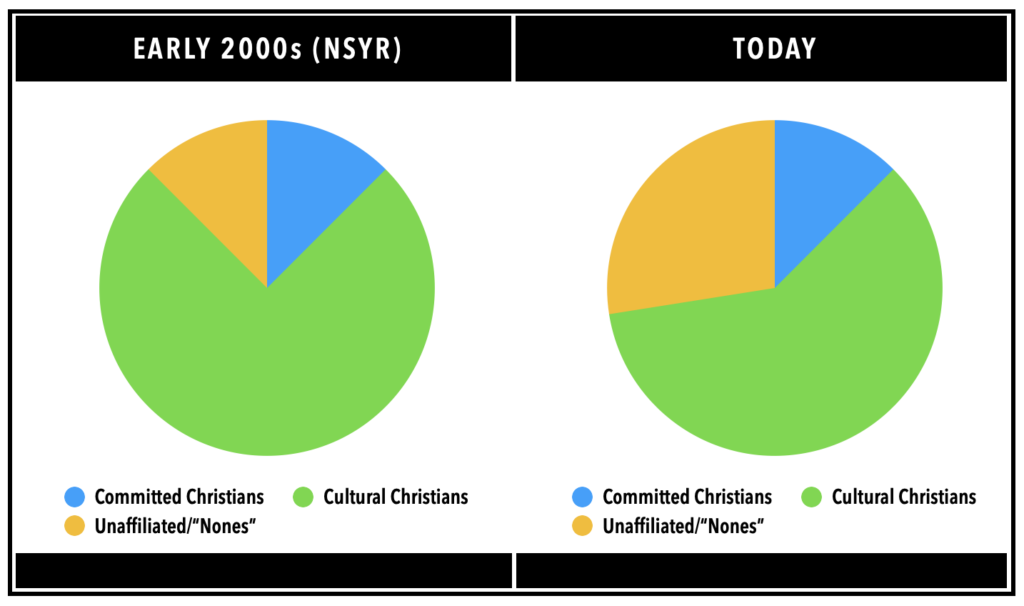
To summarize this differently, think in terms of a pie chart. At the time of the NSYR in the early 2000s, we might imagine that there was a large chunk of the pie that were cultural Christians, a small piece that professed no faith affiliation, and another small piece that represented committed Christians. Updated to today, the pie pieces would be apportioned differently: committed Christians still represent a similarly small piece, while the cultural Christian slice has shrunk in size, and the unaffiliated slice has grown.[8]

Nevertheless, the fact remains that, despite its decline, Cultural Christianity is still the belief system of a significant number of teenagers (and adults) in the United States.


Biblical Christianity: The Demands of Jesus

Let’s consider a different perspective.

We call ourselves Christians, and the word Christian simply means “follower of Christ,” someone who follows Jesus. If Jesus is our Lord, if He is our King, then we have to be loyal subjects of our King, and that means He gets to define what it means to follow Him.

If Jesus is Lord, that means He gets to define what it looks like to follow Him. Share on X

So, let’s look at what Jesus says, and then compare Biblical Christianity to Cultural Christianity:

24 Then Jesus told his disciples, “If anyone would come after me, let him deny himself and take up his cross and follow me. 25 For whoever would save his life will lose it, but whoever loses his life for my sake will find it. 26 For what will it profit a man if he gains the whole world and forfeits his soul? Or what shall a man give in return for his soul? 27 For the Son of Man is going to come with his angels in the glory of his Father, and then he will repay each person according to what he has done. 

(Matthew 16.24-27) 

Jesus says that if we want to be His followers, we have to deny ourselves, take up our crosses, and follow Him. In the ancient world, crosses were not used for jewelry, tattoos, or t-shirt designs; they were used for death. People were executed on crosses, and as we see in the crucifixion of Jesus, they were forced to carry their crosses to the place where they were hung on them to die. So Jesus is saying that would-be disciples must be ready to die. They have to die to self. That’s not an expression we use a lot—what does it mean to die to self? It means that we crucify—put to death—our own wishes, wants, and desires. We deny ourselves and what we want to do and instead seek to do the things God calls us to do.

Now, that is completely different from the cultural Christianity we’ve been discussing. Cultural Christianity is watered-down which makes it easy to swallow. It doesn’t offend anyone, it doesn’t demand sacrifice. It says that God wants you to be happy, and that He will bail you out of trouble and let you live with Him in heaven someday.

That is not what Jesus said, though. Jesus didn’t say following Him would be easy. He said it would be death. 

Jesus didn’t say following Him would be easy. He said it would be death. Share on X

Let’s go back and look at the core beliefs of Cultural Christianity and compare them to what Biblical Christianity says.

(1) A god exists who created and orders the world and watches over life on earth.

Of the five central beliefs of Cultural Christianity, this one is probably the most on target. It is true that God created the world and ordered it, and watches over life on earth. Beyond that, Scripture teaches that Jesus was intricately involved in creation, and it is through Him that our world holds together (Colossians 1.15-20).

But God is not some distant, disinterested Creator. God cares so much about what is going on in the world that through Jesus, He stepped into the world in order to fix what was broken and save us when we were lost.

(2) God wants people to be good, nice, and fair to each other, as taught in the Bible and by most world religions.

Does God want us to be good and nice and fair? Of course He does! That is a watered-down idea, though, because God wants us to be so much more than that.

In parables like the story of the Good Samaritan, we see that Jesus demands that His followers be hospitable and compassionate. We can be nice and polite without actually lifting a finger to help someone in need. We can say “please” and “thank you” and smile and go to church, but if we ignore those who are in need of food or clothing or companionship, God will reject us on the day of judgment (Matthew 25.41-46).

And another thing about being polite: a lot of people in our culture consider it to be rude or impolite to talk about religion in most social settings. But Jesus doesn’t want His disciples to observe social niceties if it means keeping their mouths shut about their faith. As Christians, we know that the world is sick and Jesus is the cure. Our job is to share the medicine with as many patients as possible! We are called to care enough about other people that we tell them about Jesus, even if our culture tells us to keep that to ourselves.

(3) The central goal of life is to be happy and to feel good about oneself.

This is, perhaps, the best example of all of these central beliefs of how much more Cultural Christianity is influenced by culture than by Christ.

In our culture, the most important goal in life is to be happy. We’re urged to “be true to ourselves” which is just another way of saying, “do what you want to do, do what feels good.” We are told to choose colleges, churches, and jobs based on what will make us happy. People divorce their spouses or walk out on their families because they aren’t happy as if somehow that justifies harming other people.

But God doesn’t think that our happiness is the most important thing. It’s not that God wants us to be miserable and unhappy; it’s just that He cares a lot more about our holiness than our happiness (1 Peter 1.14-16).

Jesus came and died on the cross to free us from sin and bring us salvation, not to enable us to selfishly go about in life doing whatever we can to be happy as often as we can. The central goal of life is to be faithful to God, rather than to feel good about ourselves. Because everything that exists, the whole arc of history, the eternal destiny of all things, is not about us; it’s about God.

We are commanded to rejoice (Philippians 4.4; 1 Thessalonians 5.16), and as Christians, we should be joyful people. But there is a stark difference between having joy in the knowledge that we are loved by our Heavenly Father, saved by the blood of Christ, indwelt by the Holy  Spirit, and joined to the family of God, and doing whatever we can to experience a self-centered and shallow feeling that our culture calls happiness.

(4) God is not involved in my life except when I need God to resolve a problem.

The idea that God is some sort of cosmic parachute that we pull out and use only when things get really bad is entirely foreign to the message of Scripture. God is not just sitting there twiddling His thumbs, waiting for us to ask Him to help us pass a chemistry test or to get us out of trouble for lying to our boss.

The basic truth of the Incarnation—the Son of God putting on flesh and living as the man Jesus—is that God cares enough about us that He enters into life alongside us. Jesus showed us how to live and died to save us, and even today, through His word and His Holy Spirit, God is always a part of the lives of Christians; He’s not just off to the side somewhere waiting for us to ask Him for help when we get really desperate.

I’m not saying we shouldn’t pray to God when we are in trouble and need His help; of course, we should do that. But we should also pray to Him when things are great and everything is going well in our lives. And more than that, God should always be involved in our lives because as followers of Christ, our primary marching orders in life are not determined by what we want to do, but rather by what God calls us to do (remember, being a disciple of Jesus means to deny yourself, take up your cross, and follow Jesus!).

(5) Good people go to heaven when they die.

This might not sound so bad at first; what’s wrong with it?

First, the Bible argues that there are no good people!

We were created good, in God’s image, but we are tainted by sin. All of us sin and fall short of God’s glory (Romans 3.23) and the wages of sin is death (Romans 6.23). I am not good, and you are not good. We are selfish and prideful and unkind. We do not deserve heaven, and there is nothing we can do to earn eternal life. In fact, the Bible says that all of the good deeds we do, all of our righteous acts, are like filthy rags (Isaiah 64.6). At our best, we have no hope of being “good enough” to earn eternal life.

The good news is, good people don’t receive eternal life; saved people do! And God, in His grace, is willing to save any of us, even though we’re not good. Good people don’t earn salvation; God graciously offers the gift of salvation to all people, no matter how bad they are. We are saved by grace through faith (Ephesians 2.8-9).

Good people don’t receive eternal life; saved people do. Share on X

Those who respond to God’s grace through faith in Christ and submission to Him in baptism are added to His Church, have their sins washed away, become a part of God’s people and God’s mission, and are also promised eternal life.

But “good people” as defined by society don’t go to heaven when they die. That’s not what the bible teaches.

These are two very different belief systems. No wonder they were called “misbegotten step-cousins”. They are barely related at all. It is very important that we make sure to teach the gospel that Jesus is Lord to our children and teens, rather than some sort of watered-down belief system based on doing good things and feeling good about ourselves.

Conclusion: We Must Do Better

I hope you can see how different Cultural Christianity and Biblical Christianity are. Really, they are two very different belief systems. No wonder they were called “misbegotten step-cousins”. They are barely related at all. 

This was a major wake-up call for me when I first read the research. These findings should cause us to think very carefully about our own faith, and also what we are teaching our young people. We need to make sure that we are teaching them real, Biblical Christianity rather than something that has been watered down by our culture. We need to make sure that what we teach them explicitly in Bible classes and sermons is not undermined by what we teach them implicitly in the way we live our lives and make daily decisions. And we need to make sure that we teach them in a way that equips them to be able to speak about what they believe and put it into words. 

Real, biblical Christianity is not as easy to swallow as the watered-down stuff—in fact, it can be really difficult. It requires that we die to ourselves. But it’s what Jesus demands, and it’s the only way to follow Him. This is what God wants our young people—and all people—to know, and this is what we must deliberately, intentionally teach.


[1]Kenda Creasy Dean, Almost Christian: What the Faith of Our Teenagers Is Telling the American Church (Oxford: Oxford University Press, 2010); Christian Smith with Melinda Lundquist Denton, Soul Searching: The Religious and Spiritual Lives of American Teenagers (Oxford: Oxford University Press, 2005).

Obviously, this data is not current, as the NSYR is almost 20 years old at this point. Indeed, today’s teenagers are from a different generational cohort than those studied in the NSYR (teens today are part of Generation Z, while those who were studied in the NSYR are Millennials). Nevertheless, there is no reason to think that the concerning patterns of belief that the NSYR uncovered have disappeared; if anything, they are worse now.

Having said that, there are some ways in which these findings may need to be nuanced or updated, and I will try to point those out as we go along.

[2]Kenda Creasy Dean, Almost Christian: What the Faith of Our Teenagers Is Telling the American Church (Oxford: Oxford University Press, 2010): 10; Christian Smith with Melinda Lundquist Denton, Soul Searching: The Religious and Spiritual Lives of American Teenagers (Oxford: Oxford University Press, 2005): 31.

Research on Gen Z students indicates that the percentage of teens who self-identify as Christian has fallen. While the NSYR revealed that roughly 3 out of 4 students identified as Christian, according to Barna, Gen Z: The Culture, Beliefs and Motivations Shaping the Next Generation (Barna Group and Impact 360 Institute, 2018): 26, that number is now more like 3 out of 5. The same research indicates that only 9% of Gen Z students are actively engaged in their faith, “with beliefs and practices that put faith front-and-center in their lives.”

[3]Smith and Denton, Soul Searching, 131.

[4]Ibid.

[5]Ibid., 171.

[6]Ibid.

[7]Dean, 14. By the way, “Moralistic Therapeutic Deism” is a descriptive term—no one actually self-identifies as a Moralistic Therapeutic Deist; it simply describes elements of this popular belief system.

[8]The chart here is inherently reductionistic and just used for the purpose of illustration. These wedges do not reflect precise percentages, and neither do they account for individuals belonging to other world religions.

Two for One Book Reviews: Heaven on Earth and The Treasure Chest of Grace

I enjoy reading and sharing helpful things that I read with others. I like to read lots of different kinds of books, but as a minister and a theology students, a lot of what I read tends to focus on those areas.

As a part of my schooling, I read widely across the spectrum of Christianity. This invariably means that I read a lot of things I disagree with, but also that I am challenged to think about what the Bible teaches and what I believe frequently. That’s a good thing, I think.

Over the last several years, I have noticed a marked increase in the number of books being put out by ministers and thinkers within Churches of Christ. This is also a good thing, I think, and I have made an effort to read some of those books when I get the chance (and in the process, have come across some very good material). Having said all that, I wanted to offer some quick reviews of a couple of those books: Heaven on Earth: Realizing the Good Life Now, by Chris Seidman and Joshua Graves, and The Treasure Chest of Grace: Following God’s Map to Untold Riches in Christ Jesus, by Wes McAdams.

Heaven on Earth

Heaven on Earth was good, although it was not what I expected. The book is actually a careful examination of Jesus’ Beatitudes at the beginning of the Sermon on the Mount, and how living those out makes a difference in the here and now (while also identifying us as the kind of people who will be with Jesus eternally).

The subtitle, “Realizing the Good Life Now”, could potentially mean a lot of things, but basically, the authors assert that living this way (according to the Beatitudes) constitutes living the “good life”, and helps us to establish the ideals of God’s Kingdom on earth (to be clear, there are no hints of prosperity gospel nonsense in this book about how God wants us to be happy and therefore will shower us with material blessings if we are faithful to Him).

Each chapter covers a Beatitude, and discusses what it means as well as illustrating it with an abundance of real-life examples, mostly from modern day. The two authors do not write together, and instead, take turns writing different chapters. This is probably my main criticism of the book, as I think it gives it a choppiness in thought and style that wouldn’t be present if either writer was working entirely on his own.

Here are some good quotes:

“The good life is only possible in so far as God is involved. Experiencing the good life is more about what God has done and is doing that what we have done or are doing.” (xi)

“For Jesus, the kingdom of heaven had everything to do with life on this side of the grave while many of us are inclined to think it mostly has something to do with life on the other side. Consequently , we think of Jesus’ proclamation of the kingdom of heaven coming near as meaning through Jesus we now have access to the pace of heaven after we die. Even though this is one aspect of the context, it is not the entire context.” (3)

“The longer Paul dwelled in the kingdom of light the more aware he became of the darkness in his own life.” (16)

“Mourning is a pure vision of the large gulf between how things could be versus how things actually are.” (28)

“How do we respond to the pain and suffering that haunts us? Something’s amiss. Is life beautiful? Yes. But just on the horizon of its inherent beauty is a wild storm, waiting to tear everything to pieces, total destruction. Life is beautiful. But life is also deadly, depressing, and full of pain.” (33)

“Doing the right thing—whether individually (righteousness) or collectively (justice)—is always a primary interest of God in the prophets, because a life is the totality of choices made for the individual and the community.” (57)

“The person you are setting free when you reconcile is yourself.” (99)

“The most dangerous believers in the world to the kingdom of darkness are the ones who live as though they have nothing to lose.” (109)

“Faith is about seeing the world as God sees it. Not simply seeing the world for what it is—in all its paradox of beauty and death—but also seeing the world for what it will one day become.” (131)

The Treasure Chest of Grace

The Treasure Chest of Grace focuses on the fact that we have been saved by grace—nothing we have done or can do on our own has any bearing on salvation apart of the gracious acts of God on our behalf—and then sets about determining what conditions we must meet in order to become recipients of that grace. This is where the “map” of the subtitle comes in: the pages of Scripture reveal to us what we must do in order to come into contact with God’s grace.

This book differs significantly from Heaven on Earth in that McAdams uses no stories or modern-day examples to prove his points; he only uses Scripture. This is by design: “I have made every effort in this book to prove every point with Scripture, and only Scripture. No quotations of man are used to prove any point, only words inspired by God” (8). I understand his reasoning and certainly agree with him at the core (we should base our religious beliefs on Scripture, not something else), but I think the writing suffered somewhat as a result: a short book peppered with hundreds of Scripture references and no other illustrations or examples is harder to read. My other gentle critique is a subjective one: I don’t like really short chapters. The main body of the book is 144 pages long, and those pages are divided into 25 chapters, rendering the average chapter as a little less than six pages long. Constantly shifting from chapter to chapter gives the reader the impression that some thoughts haven’t been well developed (which I don’t think is true, I just think that many of the “chapters” would function better as sections within longer chapters).

Anyway, on to the quotes:

“Man is utterly incapable of earning the things we receive from God. This does not mean, of course, that we are incapable of obeying Him, pleasing Him, honoring Him, glorifying Him; but we must remember that by doing so, we have earned nothing.” (16)

“When people try to save themselves, they are communicating to God that they have no need for His grace.” (25)

“If there were nothing man had to do to receive salvation, there would be none who were lost.” (46)

“Too often people have assumed that because God freely gives grace, He gives it without conditions.” (78)

“Unfortunately many in the religious world have tried to sever the biblical ties between salvation and baptism” (97)

“Man is not saved because he obeys the gospel; he is saved when he obeys the gospel. The gospel itself, not the obedience of man, is the reason man is saved.” (106)

“Your salvation lies at the lace where His “amazing grace” meets your “trust and obey”.” (152)

“Do not mistake the emphasis on baptism to mean that it is more significant than it really is. Nor should you make the mistake of assuming baptism is meaningless or insignificant. Because it is a part of God’s plan to redeem man, it has great importance. But without the blood of Christ, baptism is nothing more than a glorified bath.” (155)

I thought both of these books were short, easy-to-read, helpful treatments of two very biblical ideas: what living the Beatitudes means for us as citizens of God’s Kingdom, and how God’s grace and our obedient faith work together in the act of salvation. I was thankful to have read both.

Biblical Faith: Obedient Action

This is the final post in our series on biblical faith. Contrary to the way “faith” is typically defined in current conversation, I have tried to paint a more biblical picture of what the word means. Here are links to the previous entries in this series, in case you missed them or for review:

Biblical Faith: An Introduction

Biblical Faith: A Reasonable Leap

Biblical Faith: Trust

The Problem with Mental Assent

A lot of times, you’ll hear people say something like, “I believe that Jesus is God’s Son,” or “I believe what the Bible says,” but it becomes clear that those beliefs don’t really impact their daily lives in any real way: they don’t have anything to do with the church, they live their lives by their own moral code rather than that of the Bible they claim to believe in, they spend their lives chasing after the accumulation of material possessions, etc.

For people like this, what they really mean by believe is mental assent: “in my mind, I agree with the idea that Jesus is God’s Son,” or “I agree with the idea that the Bible is accurate in its claims.”

And to be fair, mental assent is one appropriate definition of the word “believe.” In fact, mental assent is exactly what I mean when I say something like, “I believe the 1927 Yankees were the greatest baseball team of all time.” I’m saying something like, “based on the information I have, I agree with the claim that the 1927 Yankees were the greatest baseball team of all time.”

But this idea of mental assent is not what the Bible is talking about when it talks about believing in something. It certainly involves agreeing with something (i.e. Jesus is God’s Son), but it involves much more than that: “Since I believe that Jesus is God’s Son, I will live my life according to his teachings and commandments.”

Biblical faith goes well beyond mental assent.

Faith vs. Works or Faith + Works?

Christians of different backgrounds have argued for hundreds of years over whether people are saved by faith or by works. To me, that’s an unfortunate argument, because the people who tend to dig their heels in around either element to the exclusion of the other are, well, wrong.

Look, the Bible teaches over and over again that we are incapable of saving ourselves through our good works. Isaiah 64.6 says that our righteous deeds are like filthy rags before God, and even bigger than that, if our salvation was accomplished by the good things we do, then there would have been no need for the atoning death of Christ in the first place.

It was in response to this erroneous viewpoint that the Reformers developed the mantra of “Faith Only”: we are saved by our faith in Jesus Christ, and nothing we do has anything to do with that.

But once again, this is not the biblical perspective. Biblical faith, by definition, includes works. Consider the following verses (emphasis added):

“What good is it, my brothers, if someone says he has faith but does not have works? Can that faith save him? If a brother or sister is poorly clothed and lacking in daily food, and one of you says to them, “Go in peace, be warmed and filled,” without giving them the things needed for the body, what good is that? So also faith by itself, if it does not have works, is dead.

But someone will say, “You have faith and I have works.” Show me your faith apart from your works, and I will show you my faith by my works.”

(James 2.14-18)

Or this passage from Ephesians 2, which is a favorite of faith-only types:

“For by grace you have been saved through faith. And this is not your own doing; it is the gift of God, not a result of works, so that no one may boast. For we are his workmanship, created in Christ Jesus for good works, which God prepared beforehand, that we should walk in them.”

(Ephesians 2.8-10)

Both of these passages fundamentally link faith to action. Are we saved by faith? Absolutely! But in the Bible, the very idea of faith includes works! Biblical faith involves taking action and obeying God’s commandments. If you take away the works, you’re left with something other than what the Bible commands.

Biblically, it is unthinkable to talk about faith separate and apart from the actions that result because of that faith.

Or in other words, if you say that you believe in Jesus but you don’t actually obey his teachings or attempt to follow his example in your life, then you don’t really have faith at all. At least, not in a biblical sense.

Biblical Faith: Trust

In our series on faith, last week’s post discussed how biblical faith is not a blind leap based on no evidence; neither is it a certainty which can be proven. Instead, it is a reasonable faith, somewhere in the middle of those two extremes.

Today I want to discuss another characteristic of biblical faith: trust.

Teens and Youth Events

I am a youth minister, which means that I spend a good amount of time putting together a calendar of activities for my teens—youth rallies, service projects, retreats, summer trips, etc.—and then encouraging them to go on those events. With some students, it’s always a struggle to get them to go, while other students will eagerly sign up for any event as soon as they hear about it.

I have one student in particular who signs up for everything, but if it’s a new activity that we haven’t done before, he always wants to know beforehand as much information about it as possible: Where will we be staying? How many people are going to be there? Where will we eat? Who will be speaking? What will we be doing all day? What kinds of activities are planned? Why are we supposed to bring _____ with us?

This is one of my favorite kids I’m talking about, and it’s a part of who he naturally is: he wants to be informed and he wants to know what is going to happen. And usually I try to answer his questions. But once not too long ago, after a barrage of his questions, I took a different approach:

Luke: Over the years, in your experience with me and on all the trips you’ve taken with me, have I ever given you a reason not to trust me?

Student: Well…no.

Luke: Then you should be able to trust that I’ll tell you the information that you need to know and the rest of it you’ll just have to wait and see, and it will be okay, right?

Student: Well…yeah…I just wanted to know.

Luke: I understand that you want to know everything; I want you to realize that you don’t have to know everything, and that you can trust that I know what’s going on and that it will be alright.

Student: Well…okay.

At this point, I don’t even remember what the event was or what we did, but it turned out fine.

And then it occurred to me that this example illustrates what biblical faith is all about.

Learning to Trust

The word used for believe or faith in the New Testament is the Greek verb πιστευω (pisteuo). In many places, that word is indeed translated as “believe” or “faith” (if it is a noun) in our English Bibles, but in many, many places it is also translated as “trust”, because the Greek word conveys both meanings.

So, without getting too technical, the point that I’m trying to make is that in the New Testament, the ideas of “believe” and “trust” are linked very closely, in a way that is not immediately apparent in English: faith is inherently tied to trusting in God. 

One author puts it this way: when it comes to understanding faith, “…every decision, every thought, and every action comes down to this: in whom do I place my trust? Do I trust my instincts, my desires, my convictions, or do I trust in Christ?”[1]

In the winding road of life, there are a lot of things that happen pretty much as we expect, and then there are the curveballs that life throws at us when we expect them the least. We find ourselves in situations we didn’t choose, we are uncertain as to how we should proceed, and we worry and obsess about what is going to happen and what we should do.

And a lot of times, we think that if we could just know exactly what was going to happen and how everything would turn out, then we’d be okay. Or, to put it in other words, if we could just have all of the details of the upcoming youth trip, then we could look forward to it and put our minds at ease.

But God is not in the business of giving us detailed itineraries of our futures; instead, he asks us to trust that he will take care of our futures.

The old church hymn by Ira Stanpill sums it up perfectly:

“Many things about tomorrow I don’t seem to understand;

But I know who holds tomorrow, And I know who holds my hand.”

There are a lot of things in my life that I don’t understand and about which I am inclined to worry. But God doesn’t ask me to understand it all, and he certainly doesn’t ask me to worry.

But he does ask that I trust him to take care of it. Because trusting God is what biblical faith is all about.


[1]Kara E. Powell and Chap Clark, Sticky Faith: Everyday Ideas to Build Lasting Faith in Your Kids (Grand Rapids: Zondervan, 2011), 34.

« Older posts

© 2026 The Doc File

Theme by Anders Noren — Up ↑