The online journal of Luke Dockery

Tag: Faith (Page 3 of 4)

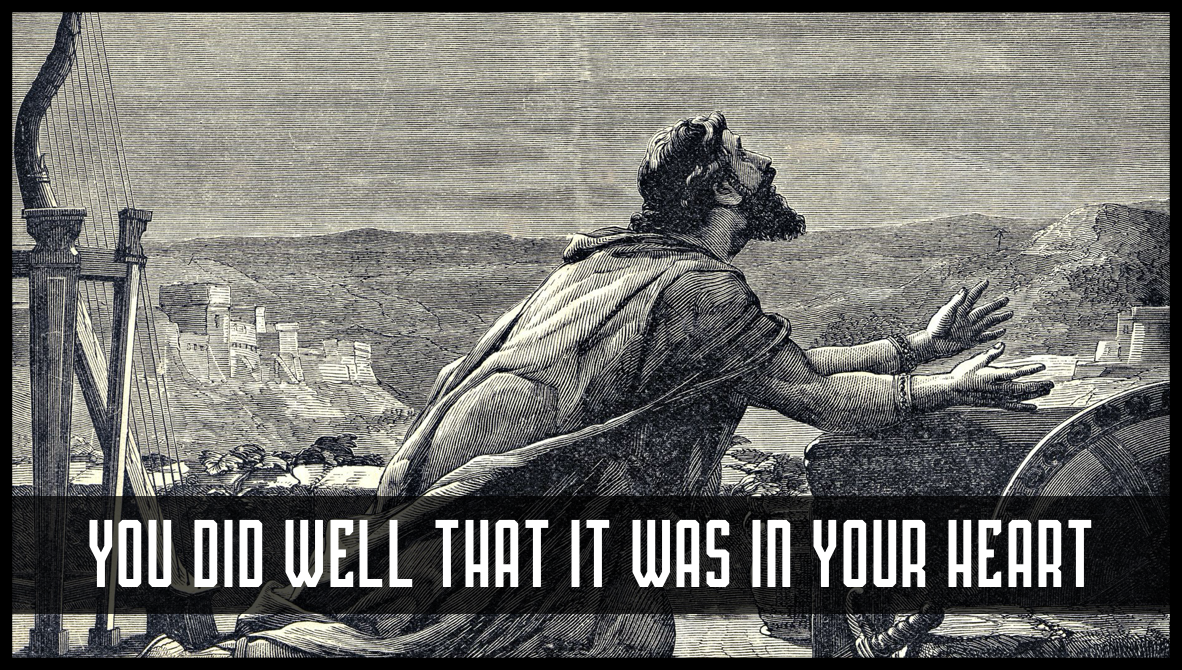
“You Did Well That It Was In Your Heart”

After the death of King Saul, there is a struggle between David and Saul’s son, Ish-bosheth, for the throne of Israel. With God’s support, David eventually wins out, things settle down, and everything seems to be okay.

But David isn’t happy. He isn’t happy because he realizes that while he lives in a nice, comfortable house made of cedar, the Ark of God is kept in a tent!

This doesn’t seem right to David, so he determines that he wants to build a temple for the Ark to be housed in. That sounds like a good idea, but God rejects his offer in 1 Chronicles 22.8-10:

“But the word of the Lord came to me, saying, ‘You have shed much blood and have waged great wars; you shall not build a house to My name, because you have shed so much blood on the earth before Me. Behold a son will be born to you, who shall be a man of rest; and I will give him rest from all his enemies on every side; for his name shall be Solomon, and I will give peace and quiet to Israel in his days. He shall build a house for My name, and he shall be My son and I will be his father; and I will establish the throne of his kingdom over Israel forever.’”

Later, Solomon talks about his father’s desire to build a temple for God in 1 Kings 8.17-19:

“Now it was in the heart of my father David to build a house for the name of the Lord, the God of Israel. But the Lord said to my father David, ‘Because it was in your heart to build a house for My name, you did well that it was in your heart. Nevertheless you shall not build the house, but your son who will be born to you, he will build the house for My name.’”

Did you catch that? God tells David, “You did well that it was in your heart.”

Even though David wasn’t going to be able to accomplish his goal of building the temple, God still appreciated and honored David’s intentions. Because he had been a man of war, David was told that he would not be the one to build a temple for the Lord—but God still appreciated that David had the desire to do so.

“It’s the thought that counts” is a common saying that we tend to throw around when we receive a gift we don’t like. It’s somewhat of an ironic saying since often the reason we receive bad gifts is specifically because very little thought was put into it, but I think it’s still a true statement, and it’s basically what God tells David in this story: “It’s the thought that counts.”

By extension, this passage means that God cares about our intentions as well. And to me, as a Christian and as a minister, that is incredibly encouraging—while our actions certainly matter, the thoughts behind our actions matter as well. We can’t always control how things turn out, but we can control our intentions.

When we try to do something big for God, as David did, and we fail and our plans don’t pan out, I’m thankful to know that we have a God who says, “You did well that it was in your heart!”

I don’t know what your exact situation is…

  • Maybe you try to help a friend with a problem like substance abuse or financial or marital difficulties, but your assistance is refused…God looks at your “failure” and says, “You did well that it was in your heart!”
  • Maybe you try to influence others for good and try to be salt and light in the world, but your influence is ignored and they continue to embrace darkness…You did well that it was in your heart!
  • Maybe you’re a youth minister and you’ve got that teen who you’ve poured yourself into— teaching, going to athletic events, modeling the Christian life, praying for them and lying awake at night worrying about them—but they choose to follow the world…You did well that it was in your heart!
  • Maybe you try to share your faith with someone, perhaps a family member or close friend, but it simply falls on deaf ears…You did well that it was in your heart!

Realize that you are going to fail in life. Your results won’t always match up with your intentions and your plans. But our God is someone who sees our hearts and appreciates our best efforts. With that in mind, let us attempt great things for Him!

Showing Our Faith By What We Do

I heard this awhile back, and it is always convicting to me:

If you lived in a society where being a Christian was illegal, and you were arrested and put on trial for being a Christian, would there be enough evidence to convict you?

For a whole lot of American ‘Christians’, for whom Christianity is more about a box they check on a census form than a way of life, I think the answer is a clear ‘no’.

James 2.14-18 is one of my favorite passages in all of Scripture:

“What good is it, my brothers, if a man claims to have faith but has no deeds? Can such faith save him? 

Suppose a brother or sister is without clothes and daily food. If one of you says to him, ‘Go, I wish you well; keep warm and well fed,’ but does nothing about his physical needs, what good is it? In the same way, faith by itself, if it is not accompanied by action, is dead.  

But someone will say, ‘You have faith; I have deeds.’ Show me your faith without deeds, and I will show you my faith by what I do.”

Real Christian faith is supported by evidence; it is demonstrated with a lifestyle of good works.

Failure and Faithfulness

I had written a fairly lengthy post on the subject of failure and faithfulness, but then I deleted it because it didn’t accomplish my goal—I found it to be more discouraging than encouraging.

Here was the overall point of that post: I fail. A lot. With my family, in my personal life, and in my ministry—especially in my ministry (it was in my attempt to list some of those failures that the post quickly became discouraging!).

But while failures can be incredibly disappointing and can sometimes even paralyze us into inaction, ultimately, they aren’t that big of a deal.

I ran across a quotation a year or so ago that I really liked:

“God doesn’t call us to be successful; He calls us to be faithful.”

I don’t remember where I came across it originally, and a quick Google search didn’t reveal the author. Nevertheless, I think it’s a good message: over and over again in Scripture, God calls for faithfulness from His followers, but He doesn’t demand success.

For a Christian, husband, father, and minister who seems to spend a lot of his time failing, that’s a comforting thought—God cares more about my unrelenting, dogged pursuit of Him than my triumphs (or lack thereof) on earth.

I can live with that.

“He just sets the example…”

An interesting comment from a guy on an ESPN article on Tim Tebow (specifically in regard to Tebow’s overt Christianity):

“There’s a guy who doesn’t waiver. What I haven’t heard from Tebow is a demand that you live like he lives. He just sets the example and hopes others see the benefits. I’m not a religious man, but that’s exactly the way it should be done. Lead by example.”

I’m an unabashed Tim Tebow fan. I have no idea how he continues to win games while completing less than 50% of his passes, but I think he is an overwhelmingly positive role model.

Neale Pryor (1935-2011)

A week ago Sunday, Neale Pryor, a longtime preacher, scholar, and Bible professor at Harding University passed away after a lengthy illness. Originally, I hadn’t planned to write anything about him here, but as time passed, I felt that I couldn’t let the passing of such a man go unmentioned.

Dr. Pryor was one of three absolutely outstanding Bible teachers that I had at Harding, and I sat through a lot of his classes—he was my teacher in multiple college courses, I often went to his mid-week Bible study, and I sat through his Sunday morning auditorium class at the College Church of Christ for most of my time at Harding. In a Bible class setting, I would estimate that I’ve heard more lessons from Dr. Pryor than I have from any other teacher.

Of course, there were reasons that I kept coming back for more. In all my life, I don’t think I’ve ever encountered someone who simultaneously so impressed me with his biblical knowledge and scholarship and his humble spirit. As we discussed what were sometimes controversial issues in class, you could always tell that Dr. Pryor had good reasons and support for his views, but he never made anyone feel stupid for disagreeing with or not understanding him, and he was willing to admit that he didn’t have all the answers (One thing Dr. Pryor said that has always stuck with me was that he had come to suspect that when he got to heaven, he might find that more people had “made it in” than he expected. If that was the case, he assured us that he wouldn’t find a corner to sulk in—he would enjoy their company!).

In 1 Corinthians 11.1, the Apostle Paul says, “Be imitators of me, as I am of Christ.” A lot of the people that Paul was writing to in Corinth probably hadn’t known Jesus personally, so imitating the lifestyle of Paul (someone they did know personally) as he himself attempted to imitate the life of Jesus was something that was easier to grasp. I think the same thing could be said of Dr. Pryor—during his years at Harding, he gave a tangible example to countless students of what imitating Christ looked like. To me, that was what was most impressive of all about him—as good of a teacher as he was, he was an even better man.

Dr. Pryor liked to quote his favorite verse a lot: “For what will it profit a man if he gains the whole world and forfeits his soul? Or what will a man give in exchange for his soul?” (Matthew 16.26). For him, the main priority in life was always clear, and he lived his life accordingly. Congratulations to him for finishing the course and keeping the faith, and for joining that great cloud of witnesses.

I look forward to meeting him again.

« Older posts Newer posts »

© 2026 The Doc File

Theme by Anders Noren — Up ↑







