
The online journal of Luke Dockery

Tag: Generation Z

Book Review: The Anxious Generation

Jonathan Haidt is one of several scholars I have benefited from over the last few years who do not write from a faith perspective but end up saying many things that resonate well with a Christian worldview.[1] I first encountered Haidt when I read and enjoyed The Righteous Mind after a friend recommended it to me in 2020, and The Coddling of the American Mind was one of my favorite reads in 2021. Ever since then, I have paid attention anytime I see an article shared by Haidt, and I was so convicted by his article in The Atlantic on the damage caused by social media to teen girls that I discontinued our youth group Instagram account.

The Anxious Generation: How the Great Rewiring of Childhood is Causing an Epidemic of Mental Illness was published in 2024 and made an immediate splash, but I was slow to read it myself because I was already familiar with a lot of Haidt’s work, had heard multiple presentations on this book in particular, and there were a lot of other books on my to-read list. So, I have been slowly working my way through The Anxious Generation this year and finished it earlier this week. In short, Haidt’s work is a tour de force, and I think it is essential reading for anyone living today who has any significant interaction with or influence over kids and teens.

The current generation of teens and young adults—Generation Z—is widely known to be the most mentally unwell of all generations with off-the-charts instances of anxiety, depression, and other mental health issues. Haidt’s basic contention in the book is that two factors, the decline of a “play-based childhood” (kids running around their neighborhoods exploring, creating games and entire worlds with friends and returning home for meal times or when it gets dark) coupled with the rise of a “phone-based childhood” (kids staying indoors and staring at screens especially on their smartphones and spending hours and hours on social media platforms) have led to the devastating mental health outcomes that we see in members of Gen Z. Haidt’s book has some three major strengths that I want to highlight.

First, Haidt does an excellent job laying out his case. He sets the landscape by identifying the mental health epidemic facing Gen Z, then offers his background narrative of how we got here. He then interacts with tons of research that indicates how a phone-based childhood disrupts child development in four key ways: (1) sleep deprivation, (2) social deprivation, (3) attention fragmentation, and (4) addiction.

Second, Haidt offers actionable advice regarding what we can do about this crisis. It is common for authors to spend the vast majority of their books describing a problem and then to offer a few pages of how we can respond to the problem at the very end. Haidt, however, offers a substantial Part 4, “Collective Action for Healthier Childhood” with dozens of ideas and examples of tangible things that governments and tech companies, schools, and parents can do now to address this problem and turn the tide of the mental health crisis. These suggestions fall into four foundational reforms: (1) No smartphones before high school, (2) No social media before age 16, (3) Phone-free schools, and (4) Far more unsupervised play and childhood independence.

Third, the book is written in such a way that it is really easy to come away with the main thrust of his arguments without getting lost in the weeds. The book is 300 pages long with another 40 pages of footnotes. To me that’s very manageable and I thought it was an enjoyable read, but I realize that is not the case for everyone. Never fear! At the end of each chapter, Haidt has an “In Sum” section where he offers a bulleted list of the main ideas of the chapter. This means that you could spend half an hour reading the summary sections at the end of each chapter and come away with a really solid understanding of his argumentation in the book—this is a great feature!

The book is so well done; I don’t think there are any major weaknesses. Haidt can come across a little strong at times (especially in the sense that his explanation is the explanation for the mental health epidemic), but he works hard to establish his claims, feels passionately about them, and honestly acknowledges places where his conclusions aren’t yet supported by rigorous research or where others disagree. Additionally, as I mentioned above, Haidt writes from a secular perspective and as part of that, he taps heavily into evolution as the explanation for how kids are naturally supposed to develop and how a phone-based childhood disrupts that. This can be frustrating at times, especially when he says things about how evolution designs certain characteristics, but ultimately, I was still able to appreciate the point he was making and attribute the element of human nature in question to the design work of a Creator, whether brought about through evolution or some other process.

Normally I like to share quotations, but there are simple too many noteworthy observations in the book to include here; I have highlights on almost every page. The Anxious Generation will definitely make my Top-10 list for 2025; I highly recommend it.


[1] See also Tom Holland, Jordan Peterson, and Louise Perry.

Youth Ministry & Gen Z

I have been working in youth ministry for quite a while now (over 20 years if we include summer internships in college). All of those years “in the trenches” bring a certain amount of experience and expertise, but the reality is that I am always learning. That is partially true because there are always areas in which I can improve (I can teach better, I can plan better, I can recruit and train volunteers better, etc.), but it is also true because, in some significant ways, teens today are quite a bit different than they were back when I started in the early 2000s.

In fact, the students I work with now are actually from a different generational cohort (Generation Z) than those I first worked with (Millennials). Now, I think generational studies can be somewhat overstated:

  • It is important to remember that generational research points to general findings, not universal truths.
  • Furthermore, the dividing lines between generations tend not to be neat, clean breaks: those born near the end of one generation or the start of another tend to bear characteristics of both.
  • Finally, the dynamics of individual families are also important: what if a Gen Z kid grows up in a family with two older siblings who are Millennials? Likely the Gen Z kid will look more millennial-ish than he would otherwise.

Still, there are trends that develop with different generations, and studying these can help us to better understand the challenges and opportunities that come with working with today’s students. The Barna Research Group has done extensive research on this generational cohort and released its findings in two volumes.[1] First, it might be helpful to begin with some quick generational definitions. Barna breaks down generations as follows (other, common generational definitions are included in parentheses).

  • Gen Z: 1999-2015 (1997-2012)
  • Millennials: 1984-1998 (1981-1996)
  • Gen X: 1965-1983 (1965-1980)
  • Boomers: 1946-1964
  • Elders: Before 1946


Major Characteristics of Gen Z Students

Again, what follows are general characteristics, not universal truths, but here are some of the major trends among Generation Z students, according to the Barna research:

(1) They are Screenagers.

Members of Generation Z cannot remember a time before the Internet; they are digital natives (Another common name for this generation is “iGen”). There is significant research on the effects of this: Gen Z teens are physically safer than ever, but they are psychologically more vulnerable:

  • Teens today are less likely to leave their homes, drink alcohol, or get pregnant.
  • On the other hand, rates of teen suicide and depression have skyrocketed.
  • Research shows that more time with screen activities is consistently linked to less happiness, but Gen Z students spend more time on screens than anyone despite the fact that half (51%) strongly agree that “happiness is my ultimate goal in life.”[2] 
  • Generally speaking, the higher a teen or young adult’s screen time, the more likely he or she is to report feelings of isolation, insecurity, and self-criticism.[3] This increases for young adults (18-21) over teens (13-17), and especially so for girls. Thus, young women are most likely to have negative feelings associated with screen time (and especially social media).[4]
Generally speaking, the higher a teen or young adult’s screen time, the more likely he or she is to report feelings of isolation, insecurity, and self-criticism. Share on X

There is evidence that both the amount of time spent viewing screens and the thoughtfulness about what we are viewing are both related to digital health.[5] Generally speaking, it is better to spend less time on screens rather than more, and to use screens for specific reasons (like to check in with a friend or “like” someone’s baby picture) rather than doom-scrolling through a social media feed or mindlessly watching a string of videos fed to you by YouTube’s algorithms).

This pervasive use of screens from a young age is also having cognitive effects on this generation, as Gen Z’s “capacity for linear thinking has been replaced by a new mode of thinking, in which they need to take in and dish out information in a fast, disjointed, overlapping manner.”[6] This has significant implications for a world that is still significantly based on linear thinking: research papers, logical argumentation, business plans, algebra, computer coding, legal briefs, etc.

(2) Their Worldview is Post-Christian.[7]

This is an example of how some of this generational research can get frustrating because Barna makes a big deal about this: only 4% of Gen Z have a “biblical worldview.” But two things to keep in mind about this alarming statistic:

  • First, Barna has a list of factors that they collectively define as a “biblical worldview” and if you disagree with one of those factors, then you don’t have a biblical worldview according to the Barna research. The list is pretty good, but there are a couple of items on there that make me pause and say, “What do you mean by that?” And in a survey where you can’t ask follow-up questions and simply have to check yes/no boxes, that is problematic. I am confident that there are a lot of people who deeply believe that they have a biblical worldview who would struggle with some of these questions.
  • Also, it’s not like this is suddenly a problem with Gen Z, where previous generations were all deeply biblical in their views and perspectives until that suddenly shifted with the current generation. Boomers (10%), Gen X (7%), and Millennials (6%) all had very low numbers that passed the Barna test. So it’s not that Gen Z is so significantly different from the generations that have come before them. Rather, it’s that we live in a post-Christian culture where the influence and practice of Christianity has diminished over the last 70 years, and Gen Z students are growing up further down the path than the generations before them.

Nevertheless, it is worth pointing out that there is a shift going on here:

  • If you remember a previous post about the Faith of American Teenagers according to the National Study of Youth and Religion, it suggested that 3/4 of American teens identified as Christian. But that research was done with Millennials; now, with Gen Z, it’s about 3/5 (58%). That is a significant drop of over 15% in one generation. The 58% of Gen Z students who identify as Christian can be further categorized:
    • 9% are Engaged Christians, which means they are actively involved in their churches, know what their churches believe and teach, and are in alignment with those beliefs.
    • 33% are Church Christians, which means they regularly attend their churches.
    • 16% are Unchurched Christians, which means they claim the descriptor “Christian”, but don’t really belong to a church community and may not attend at all beyond special holidays (Christmas and Easter, etc.).
  • A full third of Gen Z teens have no religious affiliation at all.
  • The percentage of Gen Z that identifies as atheist is double that of US adults.
  • The values of the average Gen Z student in all sorts of areas—life priorities, sexuality, truth, morality—represent a departure from historic Christian teaching (But it does depends on whether or not we are speaking of Engaged, Churched, or Unchurched Christians as described above.

(3) “Safe Spaces” Are Normal[8]

Gen Z teens do not like to make people feel bad, which, of course, is not a problem in and of itself. “Their collective aversion to causing offense is the natural product of a pluralistic, inclusive culture that frowns on passing judgment that might provoke negative feelings in the judged.”[9]

Two examples of this aversion to causing offense are trigger warnings, written notices that content could provoke negative emotions, and safe spaces, designated areas where such content is banned. The problem is that, while the intention behind these things—not wanting people to feel bad—may be noble, these initiatives ultimately do more harm than good. After all, we don’t learn if we never listen to something we disagree with. We don’t develop the ability to weigh an argument or learn how to disagree graciously. Environments like this also lead to self-censorship and anxiety, as teens don’t want to say anything that could cause offense and they struggle with anxiety and indecision when it’s time to give an answer or make a choice.[10]

(4) Real Safety Is a Myth[11]

This generation possesses a collective suspicion that true security is unattainable or outside of our control. Of course, this makes sense when you consider that they have been aware of war for their entire lives (9/11 occurred before they can remember), they grew up in the shadow of the Great Recession of 2008, and more recently, have navigated the turbulent times of the COVID-19 pandemic.

As the research points out, “Teens have never personally experienced a time when the norm was a dependable job with a livable wage and a reliable social safety net.”[12]

Ultimately, from a biblical perspective, I’m not sure this is a bad thing, as Scripture emphasizes that there is, indeed, much in life that is out of our control. Of course, the biblical response to this reality is reliance upon God, rather than despair or the creation of artificial “safe spaces.”

(5) They Are Diverse[13]

Diversity is a major trait of Generation Z:

  • 56% of Gen Z college students are women.
  • Acceptance and even elevation of non-male and non-white individuals is a generational marker.
  • The fastest-growing demographic within Gen Z is multi-racial.

(6) Their Parents Are Double-Minded[14]

The parents of Gen Z students are usually Gen Xers, who tend to be both over- and under-protective at the same time:

  • A preoccupation with safety has stripped childhood of much of its independence. It’s not that the world today is more dangerous—on the contrary, statistically, children are safer today than ever—but the world is perceived to be more dangerous. As a result, children don’t get to play and explore in their own chosen ways as much, and have become “less emotionally expressive, less energetic, less talkative and verbally expressive, less humorous, less imaginative, less unconventional, less lively and passionate, less perceptive…less synthesizing, and less likely to see things from a  different angle.”[15]
  • At the same time, digital technology is everywhere, and not supervised as it should be, leaving students vulnerable to an environment of social media, widespread pornography, self-harm, cyberbullying, and sexting.

Generation Z & Christianity: Pros and Cons[16]

Clashes with Christianity:

  • Truth: Reflective of the postmodern values of moral relativism and pluralism, there is a deep ambivalence within Gen Z on how to know what is true, and even on whether or not objective truth exists. On the other hand, Christians believe that we can know what is true because God reveals Himself to us in creation, the Scriptures, and most fully in Jesus Christ. Many Gen Z teens express confusion and uncertainty about truth and their grasp of it.
  • Sexuality: Gen Z members have largely clashed with historic Christian understandings of sexual ethics. This is probably not because Gen Z members have carefully studied and considered traditional Christian sexual ethics (unfortunately, many churches and Christian parents fail to teach this to their children) and then rejected it, but rather reflects an unthinking acceptance of consent as the ultimate ethical standard. This is one reason why pornography is so widespread amongst Millennials and Gen Z—not only is it easily accessible, but it also doesn’t seem to violate “consent”, so what could be wrong with it? Of course, consent should always be a necessary prerequisite for sexual activity, but it is not a sufficient prerequisite on its own.
  • Money: Gen Z members are heavily focused on personal happiness and financial success and order their lives accordingly. The New Testament writers are clear, however, that pursuing wealth as a primary goal is spiritually destructive. Honestly, though, this is a problem for American Christianity as a whole, rather than a particular weakness of Gen Z.
  • Technology: One of the key implications of the incarnation of Jesus is that Christianity is an embodied faith that values God’s creation and actual physical presence matters. Mobile devices and social media can be useful tools that add value to our lives, but they are no substitute for actual, real relationships.

Resonance with Christianity:

  • Diversity: Gen Z members have basic assumptions about the goodness of diversity that naturally resonate with Christian faith and priorities. The Bible is clear that people of all races, ethnicities, nationalities, and both sexes, belong in God’s family. In a church context that, historically, has witnessed great tension between different types and colors of people, Gen Z has something to offer the church in this area.
  • Empathy: Gen Z members are tolerant and greatly want to avoid being antagonistic, which coincides well with what Christians are told in 1 Peter 3.15-16, “If someone asks about your hope as a believer, always be ready to explain it. But do this in a gentle and respectful way.” Teens likely need some help being ready to explain their faith; older adults likely need some help learning how to do this gently and respectfully.
Teens likely need some help being ready to explain their faith; older adults likely need some help learning how to do this gently and respectfully. Share on X
  • Openness: Teens tend to be pretty ignorant about the Bible and a basic Christian worldview. That is obviously not ideal, but the silver lining is that means there is not a ton of bad spiritual baggage to undo or reteach. That, combined with a general openness about spirituality provides opportunities for sharing faith.
  • Emptiness: Moralistic Therapeutic Deism cannot save people, and it is not fulfilling. The failure of Moralistic Therapeutic Deism to provide meaning or purpose in life opens the door for God’s people to introduce Gen Z students to the only One who can—the God who is Father, Son, and Spirit.
The failure of Moralistic Therapeutic Deism to provide meaning or purpose in life opens the door for God’s people to introduce Gen Z students to the only One who can—the God who is Father, Son, and Spirit. Share on X

Today’s generation of students has its weaknesses and blind spots, but so does every other generation. Knowing some of the struggles and challenges that teens and young adults face today (as well as some of their strengths) can help those of us who work with individuals from this age group to better connect with them, help them, and learn from them.


[1] Barna Group, Gen Z: The Culture, Beliefs and Motivations Shaping the Next Generation (Ventura, CA: Barna, 2018); Barna Group, Gen Z Vol 2: Caring for Young Souls and Cultivating Resilience (Ventura, CA: Barna, 2020).

[2] Gen Z: The Culture, Beliefs and Motivations Shaping the Next Generation, 19.

[3] Gen Z Vol 2: Caring for Young Souls and Cultivating Resilience, 39.

[4] For more on the profound negative effects that Instagram, Facebook, and Snapchat can have on teenage and young adult women, see Jonathan Haidt’s poignant and devastating essay, “The Dangerous Experiment on Teen Girls.”

[5] Gen Z Vol 2, 35-37.

[6] Gen Z, 17. It is worth pointing out that this evolution (devolution?) in thinking patterns is happening to everyone, not just Gen Z members. It is based on screen time, not age.

[7] Ibid., 24-26.

[8] Ibid., 27-28.

[9] Ibid., 27.

[10] This research coheres closely with one of the main points of The Coddling of the American Mind, by Greg Lukianoff and Jonathan Haidt.

[11] Gen Z, 28-29.

[12] Ibid., 29.

[13] Ibid., 29-34.

[14] Ibid., 34-35.

[15] Ibid., 35.

[16] Ibid., 103-06.

The Faith of American Teenagers

Introduction: A Major Problem

In this post, I want to share some research regarding the faith of teens in the United States. One of the most important (and alarming) research findings is that what American Teens who call themselves Christians actually believe is not what “Christianity” has meant for 2,000 years.

As we look at the data, there are a couple of really important things to keep in mind. First, these are general conclusions drawn from research; that doesn’t mean they apply to every single teenager. Also, I’m not blaming teenagers for the problems and deficient beliefs we will discuss below. Teens believe what they do because adults—parents, youth ministers, teachers, leaders, the church, whoever—have failed to teach them any better.


Cultural Christianity: The Faith of American Teenagers

The National Study of Youth and Religion (NSYR) was a massive research study conducted from 2002-2005. Findings from this study were published in two important works, Soul Searching: The Religious and Spiritual Lives of American Teenagers, by Christian Smith and Melinda Lundquist Denton, and Almost Christian: What the Faith of Our Teenagers Is Telling the American Church, by Kenda Creasy Dean:[1]

  • Researchers studied more than 3,300 American teenagers between the ages of 13-17.
  • After the initial survey, the researchers conducted 267 follow-up face-to-face interviews.
  • 2,500 of the original 3,300 were revisited years later to see how their religious lives changed as they age.
  • Teens from all different religious backgrounds were examined (not just Christian).

What they found was that 3 out of 4 American teenagers claim to be Christian, but only about half consider their faith to be important, and less than half practice their faith as a part of their daily lives.[2]

Furthermore, the report showed that “the vast majority” of U.S. teens are “incredibly inarticulate about their faith”—in other words, even those teens who claim to be Christians are unable to explain what it means to be a Christian or what they actually believe.[3]

Research shows that “the vast majority” of U.S. teens are “incredibly inarticulate about their faith” Share on X

When asked questions about what they believed religiously, here were some of the actual responses:[4]

  • Uh, I haven’t really thought about that [pause]. I don’t know.
  • I believe in the [pause], I, ohhh [pause], I don’t think I’d really like to talk about that.
  • Hm, I don’t know, I’d have to like ask somebody or something, I don’t know.
  • Um, I guess I believe…[laughs], um, I don’t know. I don’t really know how to answer it.

Teens typically have a very difficult time explaining what it means to be a Christian or what they actually believe.

After the NSYR was completed, some of the experts who analyzed all of the data from this study realized that, although a lot of young people claim to be Christian, what they mean by “Christian” is not what that word has historically meant for the last 2,000 years. The NSYR suggests that many, many teenagers who consider themselves to be Christians don’t really practice Christianity at all; they practice a different religious faith altogether. In the words of Christian Smith and Melinda Lundquist Denton:

“A significant part of Christianity in the United States is actually only tenuously Christian in any sense that is seriously connected to the historical Christian tradition, but has rather morphed into Christianity’s misbegotten stepcousin, Christian Moralistic Therapeutic Deism.”[5]

So, a lot of young people who consider themselves to be Christians are not really practicing Christianity, but instead is a “misbegotten step-cousin” of Christianity—something that is kind of related to Christianity but really isn’t very close. Smith and Denton continue:

“The language, and therefore experience, of Trinity, holiness, sin, grace, justification, sanctification, church, Eucharist, heaven and hell appear, among most Christian teenagers in the United States at the very least, to be supplanted by the language of happiness, niceness, and an earned heavenly reward. It is not so much that U.S. Christianity is being secularized. Rather more subtly, Christianity is either degenerating into a pathetic version of itself or, more significantly, Christianity is actively being colonized and displaced by a quite different religious faith.”[6]

In other words, when most Christian teens talk about faith, they don’t talk about the things the Bible talks about: discipleship, sacrifice, holiness, sin, grace. Instead, they talk about things like “being nice” or “being a good person” or “getting to go to heaven when we die”. What a lot of teens talk about when they describe their faith, really isn’t Christianity at all.

And since it’s not really Christianity, the researchers came up with a new name for it: Moralistic Therapeutic Deism.

From the NSYR, here are the central beliefs of Moralistic Therapeutic Deism:[7]

  1. A god exists who created and orders the world and watches over life on earth.
  2. God wants people to be good, nice, and fair to each other, as taught in the Bible and by most world religions.
  3. The central goal of life is to be happy and to feel good about oneself.
  4. God is not involved in my life except when I need God to resolve a problem.
  5. Good people go to heaven when they die.

And this is why they call it Moralistic Therapeutic Deism.

  • What does “Moralistic” mean? If you are a moral person, it means that you understand the difference between right and wrong, and you try to do those things that are right and generally be a good person (2, 5).
  • What does “Therapeutic” mean? Usually, we think of this word in terms of going to therapy for something (physical therapy, occupational therapy, counseling, etc.). Therapy is a form of treatment you take in order to be healed or to feel better. So MTD is therapeutic in the sense that God helps us with our problems, and that the goal is for us to feel good about ourselves (3, 4).
  • What does “Deism” mean? You might think of Deism in terms of European History and the intellectual movement called the Enlightenment; here we don’t mean Deism in a technical sense, but more in a general sense: a belief in a deity who created the world but isn’t too involved in everything that happens (1).

So you can see why it’s called Moralistic Therapeutic Deism: it’s about trying to be good, trying to feel good about ourselves, and it is loosely connected to belief in “God”. We might also call it Cultural Christianity. It is “Christianity” as our culture views it and practices it, but it is not Christianity as described in the Bible. From here forward, I will use Cultural Christianity as a synonym for Moralistic Therapeutic Deism.

When you put all of this together, American Cultural Christianity is a watered-down version of Christianity. Sometimes, it’s not so bad to water something down. I like to water down Gatorade when I drink it, because it makes it less heavy and I think it tastes better. Sometimes we water things down in order to make them more pleasant or to suit us better, and that’s okay. But Cultural Christianity is a watered-down Christianity, and that’s not okay. Sure, in some ways it’s more pleasant—Cultural Christianity is easier; it’s less demanding. It is a religion that will not offend anyone…but neither will it save anyone.

Remember earlier how we said that 3/4 of American teenagers consider themselves to be Christians but only about half consider it to be important, and less than half practice their faith as a part of their daily lives? That’s what Cultural Christianity is all about: something you believe, but not something that is so important that it upsets your life or really impacts how you live too much.

Here’s the problem with that sort of thinking:

“Christianity, if false, is of no importance, and if true, of infinite importance. The only thing it cannot be is moderately important.”

(C.S. Lewis)


Interlude: What About “Post-Christian” America?

As a quick aside, we are obviously living during a time of cultural transition and there are a lot of changes occurring. One of these transitions you may have heard about is that the United States is increasingly a post-Christian society. If we are increasingly “post-Christian” what does that mean about Cultural Christianity? In short, watered-down Christianity is on the decline.

To clarify, when you take a look at the data and surveys, what is happening is not that devoted followers of Jesus who are plugged into local churches are walking away from the faith in droves; it’s cultural Christians who are checking out. And honestly, that makes complete sense to me: there’s nothing about Cultural Christianity that demands anything from you, gives you meaning or purpose, or changes your life for the better—why would you hold onto it?

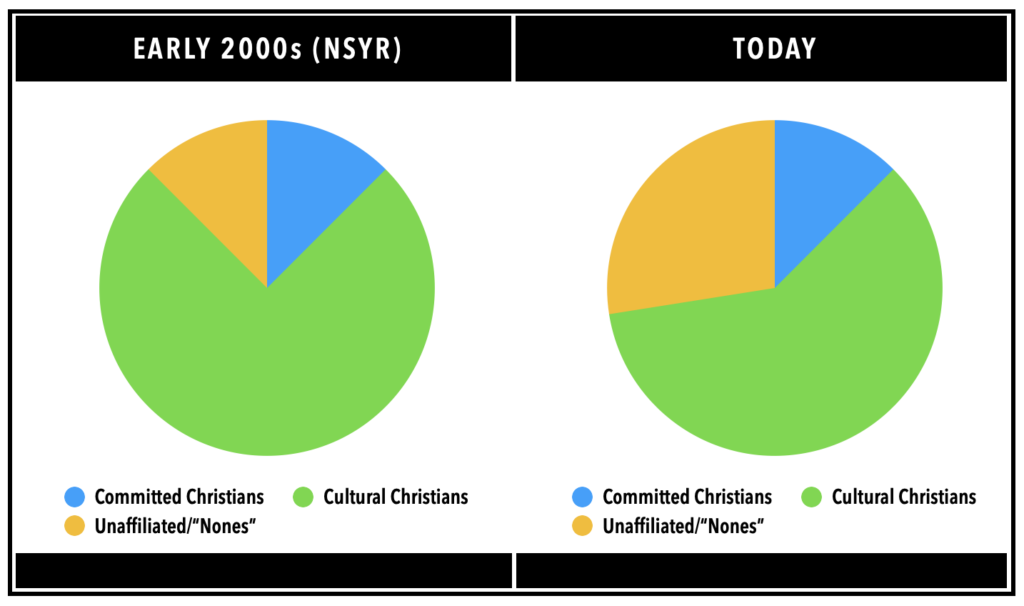
To summarize this differently, think in terms of a pie chart. At the time of the NSYR in the early 2000s, we might imagine that there was a large chunk of the pie that were cultural Christians, a small piece that professed no faith affiliation, and another small piece that represented committed Christians. Updated to today, the pie pieces would be apportioned differently: committed Christians still represent a similarly small piece, while the cultural Christian slice has shrunk in size, and the unaffiliated slice has grown.[8]
Nevertheless, the fact remains that, despite its decline, Cultural Christianity is still the belief system of a significant number of teenagers (and adults) in the United States.


Biblical Christianity: The Demands of Jesus

Let’s consider a different perspective.

We call ourselves Christians, and the word Christian simply means “follower of Christ,” someone who follows Jesus. If Jesus is our Lord, if He is our King, then we have to be loyal subjects of our King, and that means He gets to define what it means to follow Him.

If Jesus is Lord, that means He gets to define what it looks like to follow Him. Share on X

So, let’s look at what Jesus says, and then compare Biblical Christianity to Cultural Christianity:

24 Then Jesus told his disciples, “If anyone would come after me, let him deny himself and take up his cross and follow me. 25 For whoever would save his life will lose it, but whoever loses his life for my sake will find it. 26 For what will it profit a man if he gains the whole world and forfeits his soul? Or what shall a man give in return for his soul? 27 For the Son of Man is going to come with his angels in the glory of his Father, and then he will repay each person according to what he has done. 

(Matthew 16.24-27) 

Jesus says that if we want to be His followers, we have to deny ourselves, take up our crosses, and follow Him. In the ancient world, crosses were not used for jewelry, tattoos, or t-shirt designs; they were used for death. People were executed on crosses, and as we see in the crucifixion of Jesus, they were forced to carry their crosses to the place where they were hung on them to die. So Jesus is saying that would-be disciples must be ready to die. They have to die to self. That’s not an expression we use a lot—what does it mean to die to self? It means that we crucify—put to death—our own wishes, wants, and desires. We deny ourselves and what we want to do and instead seek to do the things God calls us to do.

Now, that is completely different from the cultural Christianity we’ve been discussing. Cultural Christianity is watered-down which makes it easy to swallow. It doesn’t offend anyone, it doesn’t demand sacrifice. It says that God wants you to be happy, and that He will bail you out of trouble and let you live with Him in heaven someday.

That is not what Jesus said, though. Jesus didn’t say following Him would be easy. He said it would be death. 

Jesus didn’t say following Him would be easy. He said it would be death. Share on X

Let’s go back and look at the core beliefs of Cultural Christianity and compare them to what Biblical Christianity says.

(1) A god exists who created and orders the world and watches over life on earth.

Of the five central beliefs of Cultural Christianity, this one is probably the most on target. It is true that God created the world and ordered it, and watches over life on earth. Beyond that, Scripture teaches that Jesus was intricately involved in creation, and it is through Him that our world holds together (Colossians 1.15-20).

But God is not some distant, disinterested Creator. God cares so much about what is going on in the world that through Jesus, He stepped into the world in order to fix what was broken and save us when we were lost.

(2) God wants people to be good, nice, and fair to each other, as taught in the Bible and by most world religions.

Does God want us to be good and nice and fair? Of course He does! That is a watered-down idea, though, because God wants us to be so much more than that.

In parables like the story of the Good Samaritan, we see that Jesus demands that His followers be hospitable and compassionate. We can be nice and polite without actually lifting a finger to help someone in need. We can say “please” and “thank you” and smile and go to church, but if we ignore those who are in need of food or clothing or companionship, God will reject us on the day of judgment (Matthew 25.41-46).

And another thing about being polite: a lot of people in our culture consider it to be rude or impolite to talk about religion in most social settings. But Jesus doesn’t want His disciples to observe social niceties if it means keeping their mouths shut about their faith. As Christians, we know that the world is sick and Jesus is the cure. Our job is to share the medicine with as many patients as possible! We are called to care enough about other people that we tell them about Jesus, even if our culture tells us to keep that to ourselves.

(3) The central goal of life is to be happy and to feel good about oneself.

This is, perhaps, the best example of all of these central beliefs of how much more Cultural Christianity is influenced by culture than by Christ.

In our culture, the most important goal in life is to be happy. We’re urged to “be true to ourselves” which is just another way of saying, “do what you want to do, do what feels good.” We are told to choose colleges, churches, and jobs based on what will make us happy. People divorce their spouses or walk out on their families because they aren’t happy as if somehow that justifies harming other people.

But God doesn’t think that our happiness is the most important thing. It’s not that God wants us to be miserable and unhappy; it’s just that He cares a lot more about our holiness than our happiness (1 Peter 1.14-16).

Jesus came and died on the cross to free us from sin and bring us salvation, not to enable us to selfishly go about in life doing whatever we can to be happy as often as we can. The central goal of life is to be faithful to God, rather than to feel good about ourselves. Because everything that exists, the whole arc of history, the eternal destiny of all things, is not about us; it’s about God.

We are commanded to rejoice (Philippians 4.4; 1 Thessalonians 5.16), and as Christians, we should be joyful people. But there is a stark difference between having joy in the knowledge that we are loved by our Heavenly Father, saved by the blood of Christ, indwelt by the Holy  Spirit, and joined to the family of God, and doing whatever we can to experience a self-centered and shallow feeling that our culture calls happiness.

(4) God is not involved in my life except when I need God to resolve a problem.

The idea that God is some sort of cosmic parachute that we pull out and use only when things get really bad is entirely foreign to the message of Scripture. God is not just sitting there twiddling His thumbs, waiting for us to ask Him to help us pass a chemistry test or to get us out of trouble for lying to our boss.

The basic truth of the Incarnation—the Son of God putting on flesh and living as the man Jesus—is that God cares enough about us that He enters into life alongside us. Jesus showed us how to live and died to save us, and even today, through His word and His Holy Spirit, God is always a part of the lives of Christians; He’s not just off to the side somewhere waiting for us to ask Him for help when we get really desperate.

I’m not saying we shouldn’t pray to God when we are in trouble and need His help; of course, we should do that. But we should also pray to Him when things are great and everything is going well in our lives. And more than that, God should always be involved in our lives because as followers of Christ, our primary marching orders in life are not determined by what we want to do, but rather by what God calls us to do (remember, being a disciple of Jesus means to deny yourself, take up your cross, and follow Jesus!).

(5) Good people go to heaven when they die.

This might not sound so bad at first; what’s wrong with it?

First, the Bible argues that there are no good people!

We were created good, in God’s image, but we are tainted by sin. All of us sin and fall short of God’s glory (Romans 3.23) and the wages of sin is death (Romans 6.23). I am not good, and you are not good. We are selfish and prideful and unkind. We do not deserve heaven, and there is nothing we can do to earn eternal life. In fact, the Bible says that all of the good deeds we do, all of our righteous acts, are like filthy rags (Isaiah 64.6). At our best, we have no hope of being “good enough” to earn eternal life.

The good news is, good people don’t receive eternal life; saved people do! And God, in His grace, is willing to save any of us, even though we’re not good. Good people don’t earn salvation; God graciously offers the gift of salvation to all people, no matter how bad they are. We are saved by grace through faith (Ephesians 2.8-9).

Good people don’t receive eternal life; saved people do. Share on X

Those who respond to God’s grace through faith in Christ and submission to Him in baptism are added to His Church, have their sins washed away, become a part of God’s people and God’s mission, and are also promised eternal life.

But “good people” as defined by society don’t go to heaven when they die. That’s not what the bible teaches.

These are two very different belief systems. No wonder they were called “misbegotten step-cousins”. They are barely related at all. It is very important that we make sure to teach the gospel that Jesus is Lord to our children and teens, rather than some sort of watered-down belief system based on doing good things and feeling good about ourselves.

Conclusion: We Must Do Better

I hope you can see how different Cultural Christianity and Biblical Christianity are. Really, they are two very different belief systems. No wonder they were called “misbegotten step-cousins”. They are barely related at all. 

This was a major wake-up call for me when I first read the research. These findings should cause us to think very carefully about our own faith, and also what we are teaching our young people. We need to make sure that we are teaching them real, Biblical Christianity rather than something that has been watered down by our culture. We need to make sure that what we teach them explicitly in Bible classes and sermons is not undermined by what we teach them implicitly in the way we live our lives and make daily decisions. And we need to make sure that we teach them in a way that equips them to be able to speak about what they believe and put it into words. 

Real, biblical Christianity is not as easy to swallow as the watered-down stuff—in fact, it can be really difficult. It requires that we die to ourselves. But it’s what Jesus demands, and it’s the only way to follow Him. This is what God wants our young people—and all people—to know, and this is what we must deliberately, intentionally teach.


[1]Kenda Creasy Dean, Almost Christian: What the Faith of Our Teenagers Is Telling the American Church (Oxford: Oxford University Press, 2010); Christian Smith with Melinda Lundquist Denton, Soul Searching: The Religious and Spiritual Lives of American Teenagers (Oxford: Oxford University Press, 2005).

Obviously, this data is not current, as the NSYR is almost 20 years old at this point. Indeed, today’s teenagers are from a different generational cohort than those studied in the NSYR (teens today are part of Generation Z, while those who were studied in the NSYR are Millennials). Nevertheless, there is no reason to think that the concerning patterns of belief that the NSYR uncovered have disappeared; if anything, they are worse now.

Having said that, there are some ways in which these findings may need to be nuanced or updated, and I will try to point those out as we go along.

[2]Kenda Creasy Dean, Almost Christian: What the Faith of Our Teenagers Is Telling the American Church (Oxford: Oxford University Press, 2010): 10; Christian Smith with Melinda Lundquist Denton, Soul Searching: The Religious and Spiritual Lives of American Teenagers (Oxford: Oxford University Press, 2005): 31.

Research on Gen Z students indicates that the percentage of teens who self-identify as Christian has fallen. While the NSYR revealed that roughly 3 out of 4 students identified as Christian, according to Barna, Gen Z: The Culture, Beliefs and Motivations Shaping the Next Generation (Barna Group and Impact 360 Institute, 2018): 26, that number is now more like 3 out of 5. The same research indicates that only 9% of Gen Z students are actively engaged in their faith, “with beliefs and practices that put faith front-and-center in their lives.”

[3]Smith and Denton, Soul Searching, 131.

[4]Ibid.

[5]Ibid., 171.

[6]Ibid.

[7]Dean, 14. By the way, “Moralistic Therapeutic Deism” is a descriptive term—no one actually self-identifies as a Moralistic Therapeutic Deist; it simply describes elements of this popular belief system.

[8]The chart here is inherently reductionistic and just used for the purpose of illustration. These wedges do not reflect precise percentages, and neither do they account for individuals belonging to other world religions.

© 2026 The Doc File

Theme by Anders Noren — Up ↑