The online journal of Luke Dockery

Tag: Gideon

Son of Samson? The Tragic Legacy of Doing What’s Right in Our Own Eyes

Samson is a tragic Old Testament figure. Far from being the hero that children’s storybooks often make him out to be, he is more of a cautionary tale of what happens when we give in to our own selfish desires rather listen to God’s call and direction for our life.

Samson was specially chosen by God: a miraculous offspring to a barren woman, set apart as a Nazirite all his days, with the mission of beginning to save the people of Israel from the Philistines (Judges 13.3-5). Famously, he is blessed with great strength by God, but he mainly uses it to pursue personal vengeance or evade consequences for his actions rather than any sort of concerted effort on behalf of the people of Israel. Further, he apparently despises his Nazirite vow, violating every element of it, from touching a lion corpse, to participating in drunken parties, to ultimately letting his hair be cut (Judges 14–16).

This latter event occurs while he is in the clutches of the femme fatale Delilah, and is the direct cause of his downfall. Samson is blinded and enslaved by the Philistines, but even in this lowly state, God works through him to bring about a final act of judgment on the Philistines (Judges 16.23-31).

And thus, the tragic tale of Samson comes to an end…or does it? I’ve read through the book of Judges numerous times, but on my last reading, I discovered something that I had never seen before.


Judges 17–21 are different from the rest of the book. Rather than providing narratives of different judges, these chapters relate stories to indicate the lawlessness of Israel in a time when “there was no king” and “everyone did what was right in their own eyes.”[1]  Judges 17–18 might be described as religious lawlessness, while chapters 19–21 are indicative of moral lawlessness. The point is that things have thoroughly gotten really bad in Israel, in all aspects of life.

But, are these chapters more directly connected with what has come before? Judges 17 introduces the character of Micah:

1 There was a man of the hill country of Ephraim, whose name was Micah. 2 And he said to his mother, “The 1,100 pieces of silver that were taken from you, about which you uttered a curse, and also spoke it in my ears, behold, the silver is with me; I took it.” And his mother said, “Blessed be my son by the LORD.” (Judges 17.1-2a)

The lawlessness of Israel is on immediate display here, as Micah steals from his own mother, but the interesting detail that should catch our attention is the amount that he stole: 1,100 pieces of silver. This same number appeared in the last chapter, as it was the amount that each of the “lords of the Philistines” promised to pay Delilah for delivering Samson into their hands.

So, is this a mere coincidence, or is the narrator deliberately linking Micah’s unnamed mother with the character of Delilah? Furthermore, is it possible that Samson himself could be the father of Micah? Scholars have suggested so:

“The Philistine lords each give Delilah eleven hundred pieces of silver, the same amount Micah steals. The question immediately arises as to why the amounts are the same. The easiest answer is that the narrator attempts to establish a connection between the two stories: that Samson is Micah’s father and Delilah, his mother.”[2]

In addition to the link of the amount of silver pieces, there are other points of connection:

  • The story is told directly after the Samson cycle in Judges 13–16.
  • Both Delilah and Micah’s mother are portrayed as unattached, and interfere with God’s religious activity among His people—Delilah compromises an Israelite judge, and Micah’s mother compromises Israelite religion by encouraging Micah to create an idol.[3]
  • There is a geographical link: the “hill country of Ephraim” is close to the Valley of Sorek where Samson meets Delilah.[4]
  • Micah has no named father; this would be the first case in Judges where a main male character did not have a named father. [5]
  • In the story, Micah will have significant dealings with the tribe of Dan, Samson’s own tribe.[6]

Micah himself is a shady character: after confessing to stealing from his mother, she returns some of the silver to him so he can make an idol from it. He then goes on to create a shrine in his house, and ordains one of his sons to become a priest. Later, when a Levite travels through town, Micah offers him a job as a priest in his heretical shrine, and thinks that somehow this will manipulate the LORD into blessing him (Judges 17.13). Blessing does not come, however, as a group of thuggish Danites arrive in Judges 18, and steal Micah’s new Levite priest from him and threaten him with violence. Again, it is a sad story that points to the lawlessness and depravity of Israel.

Connecting this story to Samson isn’t necessary to interpret it well, but is there anything gained from this connection? I think so. Part of the theme of the book of Judges is that Israel experiences a downward spiral of unfaithfulness—things get worse and worse as time goes on, and Israel’s spiritual dysfunction is intergenerational. We already have an example of one judge with a mixed record whose offspring is a villain (Gideon and Abimelech), and Samson and Micah could be a recapitulation of this theme. And perhaps, this is the big point: when even the leaders of God’s people do “what is right in their own eyes,” what hope is there for the next generation?

When even the leaders of God’s people do “what is right in their own eyes,” what hope is there for the next generation? Share on X

May God, in His grace, save us from such leaders, and for those of us who are leaders, may we seek what is right in God’s eyes rather than our own!


[1] Regardless of the inclinations of postmodern culture where everyone is encouraged to “live out their own truth,” the biblical narrative is clear: when everyone does what is right in their own eyes, the result is lawlessness and depravity.

[2] Rob Fleenor and Mark S. Ziese, Judges & Ruth, The College Press NIV Commentary (Joplin, MO: College Press, 2008), 249.

[3] Fleenor and Ziese, Judges & Ruth, 249.

[4] Ibid.

[5] Tammi Schneider, Judges, Berit Olam (Collegeville, MN: Liturgical Press, 1999), 232.

[6] Schneider, Judges, 232.

Biblical Faith: A Reasonable Leap

As I mentioned last week, I want to spend the next few Mondays looking at biblical faith, because even though “faith” is a popular topic in today’s society, I’m not sure that it’s understood all that well (even by some Christians).

Today, I want to get a better idea of what biblical faith is by looking at a couple of things that it isn’t.

Biblical Faith Is Not Blind Faith

I think a lot of people who are not believers seem to have the idea that, in order to be a Christian, you have to be incredibly gullible or foolish. Basically, they think that you have to have blind faith, that you’re willing to accept anything that Christianity claims without any evidence at all. For people like this, being a Christian and having faith in God makes about as much sense as believing in unicorns or leprechauns.

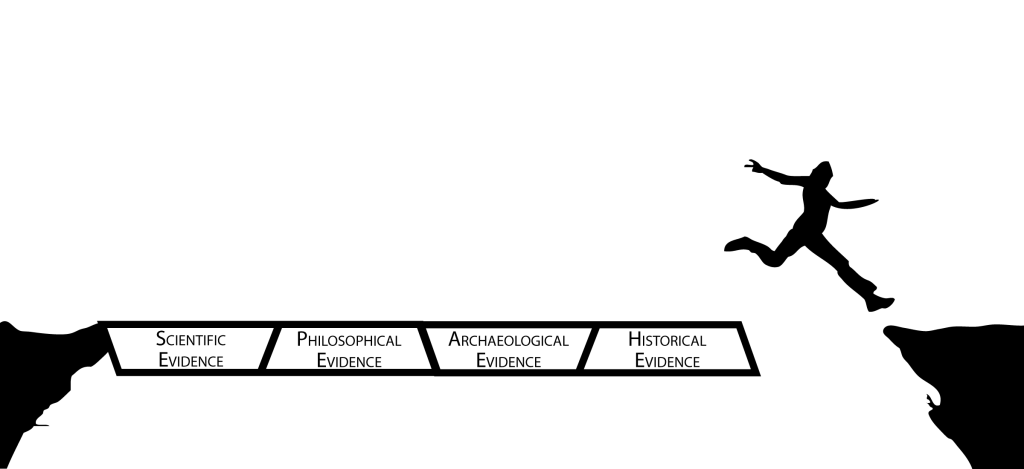
To illustrate this kind of faith, you might imagine two cliffs facing each other with a vast chasm in between. In order to get from one side to the other, a massive leap of blind faith is required.

If that was what the Bible required of me—blind faith—then I would have a hard time accepting the claims of Christianity myself.

But that’s not what biblical faith is. Biblical faith is something that comes about in conjunction with evidence.

When God appeared to Moses to enlist him to free the Israelites from Egypt, He appeared to him in the form of a bush which was on fire but was not burning up. This miraculous appearance gave Moses evidence that God was who He said He was.

When God called Gideon in Judges 6 to free the Israelites from under the yoke of Midian, Gideon is hesitant at first. And maybe that makes sense when you realize that Gideon was apparently raised in a household of Baal worshipers. By asking for the sign of the fleece, Gideon is basically asking for evidence that God is who He says He is. And God has no problem providing that evidence.

In Jesus’ earthly ministry, He was constantly going around performing astounding miracles. Of course, He did this because He loved people and wanted to help them, but He also did it in order to provide evidence that He was who He said He was (cf. John 20.30-31).

Over and over again in the Bible, we see that God didn’t expect people to respond in blind faith, and that He was perfectly willing to provide evidence to support their belief.

And the same is true for us today—there is plenty of evidence which supports the claims of Christianity. It is a reasonable faith—you don’t have to park your brain in order to be a Christian! I don’t want to derail the purpose of this post with a foray into Christian evidences, but there are multiple arguments and evidences from a variety of fields—science, philosophy, archaeology, history, and others—which lend credence to the truth of Christianity.

Biblical faith is not blind faith; it’s a faith which is informed by evidence.

Biblical Faith Is Not Absolute Certainty

If on one extreme you have people who claim that Christians are gullible people who have blind faith without any evidence at all, on the other extreme, you have some Christians who claim that faith is an absolute certainty and have the misconception that we can go about proving our faith to people.

Going back to our metaphor of the two cliffs, this perspective would require no leap at all; you’d just have a bridge which would carry you effortlessly across the chasm.

The problem with this notion is that biblical faith is not absolute certainty. You see, when you talk about something being absolutely certain, you remove any element of doubt, and any element of hope. And at that point, you’re no longer talking about faith, you’re talking about sight. But as Paul says in 2 Corinthians 5.7, “…we walk by faith, not by sight.”

I think the story of Thomas in John 20 really illustrates this point. After Jesus’ resurrection, He appears to the apostles but Thomas is not with them when He comes. So the other disciples try to tell Thomas about it but he doesn’t believe and says he won’t believe until he can see Jesus for himself and touch his wounds.

Eight days later, the apostles are together again and this time, Thomas is with them. Jesus appears to them and basically says to Thomas, “Here I am Thomas, what do you think?” Thomas answers, “My Lord and my God!” Jesus gives Thomas a mild rebuke: “Because you have seen Me, have you believed? Blessed are they who did not see, and yet believed.”

Jesus is not looking for us to prove Him; He’s not looking for us to never have any doubts or any questions. He is looking for us to have faith in Him despite whatever doubts or questions we may have. He’s looking for us to walk by faith, and not by sight!

A Reasonable Faith

There’s nothing wrong with studying Christian evidences and using that evidence to strengthen our faith. In fact, those types of things are a big part of my faith; they help me to see that Christian faith makes sense and is reasonable. But the evidence we have never reaches the point of proof, and at some point, we still have to make a leap of faith.

Returning one more time to our cliff metaphor, biblical faith would not require a blind leap across a vast chasm, but neither would it be an easy trot across a bridge. Instead, it’s something like the image below: evidence bridges much of the gap and makes the remaining distance manageable, but at some point, you still have to make the leap of faith.

So that leaves us with a picture of reasonable faith: the Bible does not demand that we base our lives on myths and fairy stories; neither does it offer certainty free from doubt (nor condemn us when doubts arise).

As Christians, we struggle through a world of difficulty and doubt, but we are confident that one day, when Jesus returns, we will see him for ourselves.

Gideon’s 300

The Battle of Thermopylae is one of the most famous military engagements in history.

In 480 BC, desperate to halt the advance of the Persian empire into Greece, 300 Spartans (along with another couple thousand Greeks who are generally forgotten about) rushed to the mountain pass of Thermopylae.

There they met the immense Persian army head on—no one knows for sure how big of an army it was, but even modern, conservative estimates suggest that it was at least 200,000 men, or a ratio of 100 Persians to every Greek.

This was possible because the Spartans were amazing warriors. From childhood, Spartan males were trained and hardened, and by adulthood, they were the world’s best fighting machines. The Spartans also employed good strategy in the battle, occupying the narrow pass of Thermopylae where the massive Persian army couldn’t overwhelm them all at once.

King Leonidas of Sparta and his men held the pass for three days against overwhelming numerical odds, but were eventually defeated when the Persians discovered a mountain path that led behind Greek lines.

Ultimately, the battle was a success—the Spartans’ three-day stand delayed the advance of the Persian army and afforded Athens the time it needed to prepare for the decisive naval battle which would end up determining the outcome of the war—but every Spartan was killed.


Some 700 years prior to the Battle of Thermopylae, during the Old Testament period of the Judges, God appeared to a man named Gideon and told him to defeat the Midianites who had been oppressing Israel for seven years.

There would be some similarities between this battle and the Battle of Thermopylae. Like the Persians, the Midianites had a vast army—as numerous as the sand on the seashore (Judges 7.12). On the other hand, the Israelite army was tiny, as God had Gideon trim it down from an original size of 32,000 to just 300.

Although the Israelite army was outnumbered like the Spartan army would be hundreds of years later, the similarities pretty much stopped there. The Israelites weren’t the world’s best soldiers—they were mainly farmers, and it seems possible that many of them had never fought before at all. Furthermore, their battle plan seemed to be lacking, as they entered into battle armed with only trumpets and torches.

But most different of all was the outcome of the battle. There was no way the Israelites should have won, but they did. The Bible says that when the Israelites blew their trumpets, God caused confusion in the Midianite camp, and they panicked and turned on each other. Israel left the battlefield victorious.


In the Battle of Thermopylae, Sparta, the world’s best warriors, against great odds managed an amazing accomplishment, but they ended up losing the battle and every man was killed in the process. Meanwhile Gideon and his ragtag army defeated the Midianites with ease. Why the different results?

I think the lesson to be learned by comparing these two stories is that human ability can lead to amazing achievement, but ultimately, it falls short.

Isaiah 40.28-31 is one of my favorite Old Testament passages:

“Do you not know? Have you not heard?
The Everlasting God, the LORD, the Creator of the ends of the earth
Does not become weary or tired.
His understanding is inscrutable.
He gives strength to the weary,
And to him who lacks might He increases power.
Though youths grow weary and tired,
And vigorous young men stumble badly,
Yet those who wait for the LORD
Will gain new strength;
They will mount up with wings like eagles,
They will run and not get tired,
They will walk and not become weary.”

When times get tough, where do you turn? Do you rely on your own strength and abilities? On other people? Sooner or later, all of those things will fail you. But if God is the source of your strength, you’ll never run out.

© 2026 The Doc File

Theme by Anders Noren — Up ↑