I’m a big fan of Christmas music. I’ve enjoyed it for as long as I can remember, and I tend to start listening to it in early November each year. I like the children’s classics, the traditional mid-century standards, and even some of the more recent additions. But my favorite Christmas music is in the form of carols or those songs that are religious in nature, teach theology, and focus on the coming of Christ into the world.
I remember from when I was a kid that my dad’s favorite Christmas carol was “Good King Wenceslas,” which he would sing sometimes. I have one particular memory of him singing it outside while we were working, and I thought it was a silly song because of the hard-to-pronounce name of the king and some of the cadence of the song. It is with some regret that I inform you that it was not until 30+ years later (i.e. now) that I actually looked up the lyrics to the song and read them all for the first time. I enjoyed them so much that I decided to actually kick off a series on Christmas Carol Theology, and let this carol bat leadoff, so to speak.
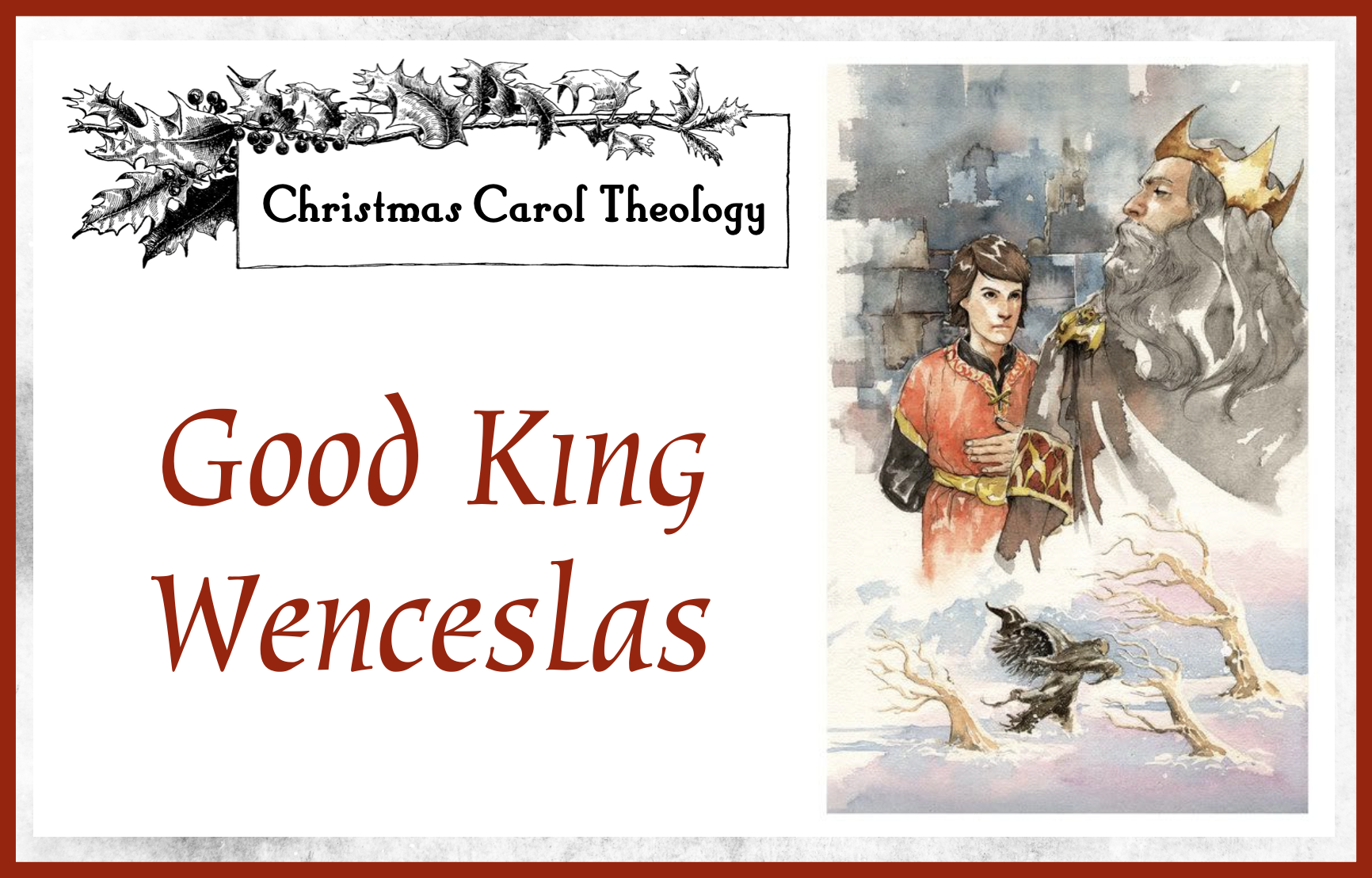
The good king in the song is based on the 10th-century Wenceslaus I of Bohemia, and tells of his journey through harsh winter weather to give alms to a poor peasant on the Feast of Stephen, which falls on the second day of Christmas (December 26).
In 1853, John Mason Neale wrote the lyrics:
Good King Wenceslas looked out
on the feast of Stephen,
when the snow lay round about,
deep and crisp and even.
Brightly shone the moon that night,
though the frost was cruel,
when a poor man came in sight,
gathering winter fuel.
Hither, page, and stand by me.
If thou know it telling.
yonder peasant, who is he?
Where and what his dwelling?
Sire, he lives a good league hence,
underneath the mountain,
right against the forest fence
by Saint Agnes fountain.
Bring me flesh, and bring me wine.
Bring me pine logs hither.
Thou and I will see him dine
when we bear the thither.
Page and monarch, forth they went,
forth they went together
through the rude wind’s wild lament
and the bitter weather.
Sire, the night is darker now,
and the wind blows stronger.
Fails my heart, I know not how.
I can go no longer.
Mark my footsteps my good page,
tread thou in them boldly.
Thou shalt find the winter’s rage
freeze thy blood less coldly.
In his master’s step he trod,
where the snow lay dented.
Heat was in the very sod
which the saint had printed.
Therefore, Christian men, be sure,
wealth or rank possessing,
ye who now will bless the poor
shall yourselves find blessing.
The king sees a poor man illuminated by the bright moon, and calls a page to ask if he knows who the peasant is and where he stays. When the page tells the king that he recognizes and knows where he lives, Wenceslas has the page gather food and firewood so they can take it to the poor man.
The boy and his king, “page and monarch”, venture out into the cold night, but with the deep snow, howling wind, and bitter cold, the young page is soon overwhelmed. The kind king encourages him to follow in his footsteps so the going will be easier, and indeed, it is: “heat was in the very sod which the saint had printed.” And then the final stanza offers a word of exhortation: those who bless the poor will find themselves blessed in the process.
This is a good song! It tells a story, setting the scene, describes a problem, it has rising and falling action, a resolution, and then a moral at the end. And from a theological perspective, it has much to teach us:
(1) The Blessedness of Giving
This lesson is fairly obvious in the song, as it is told in the concluding stanza (but I suspect many never make it that far into the song!). This is a bedrock Christian value, based on the teaching of Jesus Himself (Acts 20.35), and exemplified by His life and actions. Christians believe that we are blessed by God not some we can store up and hoard those blessings, but so that we can share them with others, and that we are ourselves blessed when we do so.
(2) The kenosis of Good King Wenceslas
The Greek word kenosis (κένωσις) refers to the willing self-emptying of the Son, who left His lofty position in heaven to come and live as Jesus of Nazareth, fully experiencing the lows of human existence and taking the form of a servant for the sake of humanity (Philippians 2.6-11). Good King Wenceslas experiences a kenosis of a sort, as he leaves his palace on a feast day and undergoes suffering in the bitter cold to seek out a poor man so that he, too, can join in the feast, which has strong echoes of Jesus’s parables emphasizing His desire to invite others to join him at great feasts or wedding banquets (Matthew 22; Luke 14).
(3) The Safety of the King’s Footsteps
The page, seeking to follow his king on the mission of mercy, finds himself overwhelmed by the difficulties of the journey. His heart fails him, and he wants to give up! But the good king reassures the boy: he knows the way, and will make a way that the page can follow. What would be impossible on his own is doable if he follows in the steps of the king. As Christians, we often find ourselves buffeted by the winds and difficulties of life, and left to our own devices, it can seem impossible to go on. But the remedy is close at hand: we are to fix our eyes on our Good King, Jesus, the “pioneer and perfecter of faith” (Hebrews 12.2, NIV). What is impossible on our own is achievable if we just follow His footsteps.[1]
As you can see, this is a song with good theology to share! I regret that I neglected it for so much of my life, but I will seek to remedy that moving forward. May you be blessed by the story of a good king, who points us to the Good King!
[1] The “pioneer” language calls to mind a sort of trailblazer, who braves the harsh conditions and makes it easier for those who follow, as Wenceslas did in the snow.







