The online journal of Luke Dockery

Tag: Harding (Page 2 of 4)

2023 Harding University Lectureship Recap

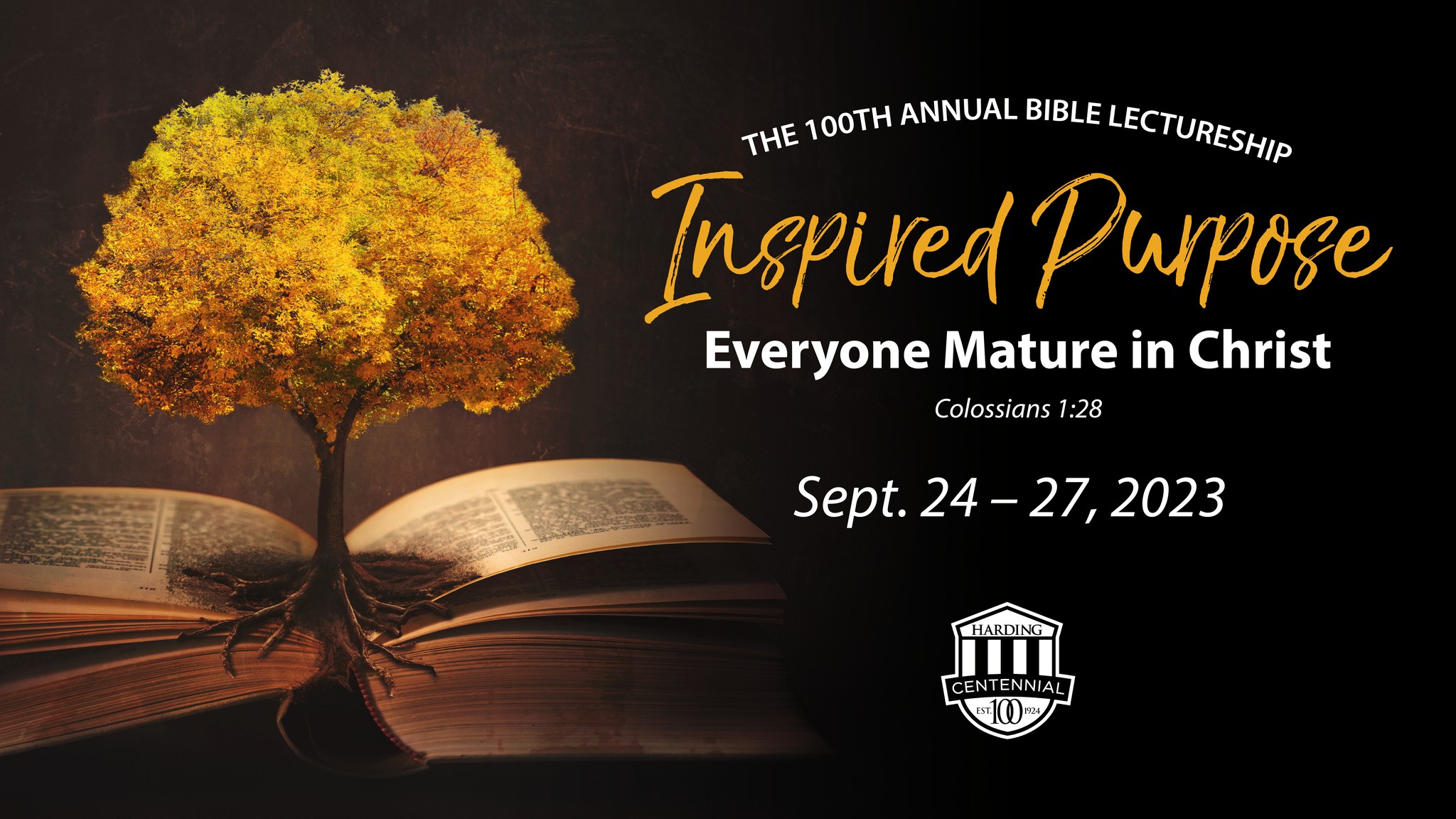
Harding University’s 100th annual Bible Lectureship was a couple of weeks ago, at the end of September. I always enjoy going to Lectureship, and have developed the practice of providing a quick recap of Lectureship and the different presentations I got to attend. The theme for this year was Inspired Purpose: Everyone Mature in Christ, and Colossians was the biblical book under study.

I was privileged to attend several good lectures and classes, and here is a brief recap of what I went to, along with some takeaway quotes:

Inspiration of our Purpose (Colossians 1.15-20), Jason Darden: Jason teaches Bible at Harding, and kicked off Lectureship with this Sunday night keynote. He focused on the Christ poem/hymn in Colossians 1 and talked about the “Jesus +” heresy of the Colossians Christians: the idea that Jesus Himself wasn’t enough, and that some additional element(s) was/were needed. Darden’s key takeaways were: (1) Imitate the faith of those you admire, (2) Cultivate your unique gifts through practice, (3) Duplicate your faith in Christ through mentorship.

Neller Preaching Workshop, Kevin Burr and Matt Love: I don’t normally go to the preaching workshop, but this year, the two speakers were two of my friends, so I caught four of the six sessions. Kevin (who has a PhD in New Testament) did a great job basically giving a verbal commentary on the book of Colossians, from which I took a ton of notes. Matt (who is getting his PhD in Preaching) spoke on the craft of preaching, and spoke about the preacher as Bard/Poet, Sage, and Tutor. Kevin and Matt were both excellent.

“We’re losing our churches at the expense of cool sermons.”

A Freed African to Free Africa: Alexander Cross and the Liberian Mission, Shawn Daggett: Shawn teaches missions at Harding, and shared the story of Alexander Cross, the first missionary from Churches of Christ to Africa. He himself was a freed slave, and had his freedom purchased by a southern congregation in order to enable mission work to the African nation of Liberia (Daggett was clear that this wasn’t done from entirely pure motives, but nevertheless: “These were people of the time who were seeking to change the times.”). Cross actually contracted malaria after reaching Africa and died soon after, but that doesn’t change the value of a sacrificial life offered in service to God.

“God counts success by faithfulness; not by numbers.”

Practicality in Youth Ministry, Garison Money and Erin Faurie: Garison and Erin are two of the associate youth ministers at the College Church of Christ here in Searcy. Garison shared some practical tips for youth ministry. I have been a youth minister for a long time, but these were still helpful reminders for me: (1) Get your parents on board, (2) Be involved, (3) Go deeper, (4) Get connected with the church and (5) Have fun. Erin spoke about why we need women involved in youth ministry (whether in official, paid roles or not), and offered three important reasons for this: (1) Women need women, (2) It’s empowering for students to see women in ministry, and (3) It promotes a Titus 2 mentality (where older women are instructed to teach those who are younger). I appreciate both Garison and Erin and enjoy working with them, and found these to be valuable reminders.

J.N. Armstrong: First Take Hold of My Heart, Monte Cox: With this being Harding’s 100th Lectureship, Dr. Monte Cox, the Dean of the College of Bible and Ministry, did a series of lectures on some important figures from Harding’s history. I went to his Monday presentation on J.N. Armstrong, Harding’s first president. Armstrong is a figure for whom I have a great deal of respect, and Monte shared eight striking characteristics about him: (1) He displayed a deep trust in God, (2) He deeply valued God’s grace, (3) He was a man of humble generosity, (4) His commitment to undenominational Christianity, (5)The pursuit of truth that leave room for honest disagreement, (6) The priesthood of all believers, (7) His conviction about kingdom-first priorities, and (8) His focus on the heart. I really enjoyed this presentation, and my admiration for Armstrong only increased!

Inspired by the Cross (Colossians 2.13-15), Steve Cloer: Steve teaches at Harding School of Theology and directs the Doctor of Ministry program there, and is one of my favorite preachers. His Monday night keynote was amazing, and focused on how the Colossian Christians felt weak, fearful, and overwhelmed, which led them to look for something in addition to Jesus to deal with their circumstances. Steve did a particularly good job of explaining the ideas of the “certificate of debt” and “triumphed in power” in Colossians 2 and expertly applied the Colossian situation to our context.

“Sin is not just a verb we need forgiveness for; it is a dominion we need freedom from.”

“Christ is everything and He can handle whatever makes us week, what we are fearful about, and whatever overwhelms us.”

Captive through Philosophy and Empty Deception—Spiritual Not Religious (Colossians 2.8), Steve Cloer: In this class, Steve addressed the mysterious “Colossian Heresy”, and applied that to the current context and the growing number of people who are interested in spirituality, but who want to do so outside of the institution of the church. He shared helpful (and hopeful!) data that breaks down the not religious crowd into four groups: (1) “I love Jesus, but not the church” people, (2) “Nothing in particulars”, (3) Atheists, and (4) Agnostics. What’s interesting is that atheists and agnostics, while very resistant to evangelism/faith, also only comprise 12% of the population, and that percentage isn’t growing. In an increasingly post-Christian society, it is the first two groups that are growing, and these folks are much more open to conversations about Jesus.

Why Disciple-Making Matters, Why Disciple-Making Now?, Eight Principles That Are Working There…and Will Work Here As Well, Paul Huyghbaert: This was a three-part disciple-making seminar that was excellent. I learned a lot and took a ton of notes. Huyghbaert presented a convicting and devastating critique of the current state of the American church, which is almost exclusively attractional, and is, overall, not growing either in terms of numbers or maturity. He then shared common characteristics of disciple-making movements, which are currently happening only in the Global South. These presentations left me with much to consider.

“The model embraced by the majority of North American churches produces shallow, surface-level believers.”

“The North American church spends, on average, $1.5 million per baptism.”

“What you celebrate is what is replicated.”

Multicultural Ministry—No Distinction between Greek and Jew (Colossians 3.11), Bob Turner and Juan Meza: Bob and Juan work at the Church of Christ at White Station in Memphis, which is making very intentional efforts to be a multicultural church. I didn’t take a lot of notes in this session because they largely shared stories, but it was encouraging to hear about their efforts to very seriously follow the “Gospel-centered mandate to be a multicultural church.”

Unmistakable Marks of Christlike Maturity (Colossians 4.2-6), Brian Mashburn: Mashburn wrapped up the lectureship with this Wednesday night keynote, providing somewhat of a summary of the whole lectureship and book of Colossians, and talking about what Christian maturity looks like. He also offered a pointed critique of some expressions of the Restoration plea, emphasizing that the goal is not to look like some mythically perfect first-century church, but to look like Jesus. Although I thought this was presented in somewhat of a strawman fashion, this is still a good reminder.


In addition to attending all of the lectures described above, I also had the opportunity to speak at the Harding School of Theology Luncheon on Wednesday. It was an honor to get to speak to such a large audience filled with so many of my mentors, former professors, fellow colleagues, and good friends. It was also a poignant event, as the gathering came on the heels of the announcement that HST will be moving from Memphis to Harding’s main campus in Searcy next fall.

I was blessed to attend Lectureship this year, to see so many old friends, and to sit at the feet of so many great teachers (indeed, I have been blessed again going over my notes and typing up these short summaries). I would highly recommend taking part in this next year if you are able!
Teaching Youth Ministry in College

It has been a dream of mine to teach at the college level for a long time, and this past semester, for the first time I had the privilege of teaching a youth ministry class at Harding University. It was a great experience! I have enough college professors in my life that I expected prepping a brand new course to be a lot of work and grading to not be much fun (both of these expectations were correct, by the way), but I was pleasantly surprised to enjoy teaching even more than I thought I would.


I learned a lot from my first semester as an adjunct college professor, but here were a few of the major takeaways:

College Students Are Awesome

My “first day of school” photo

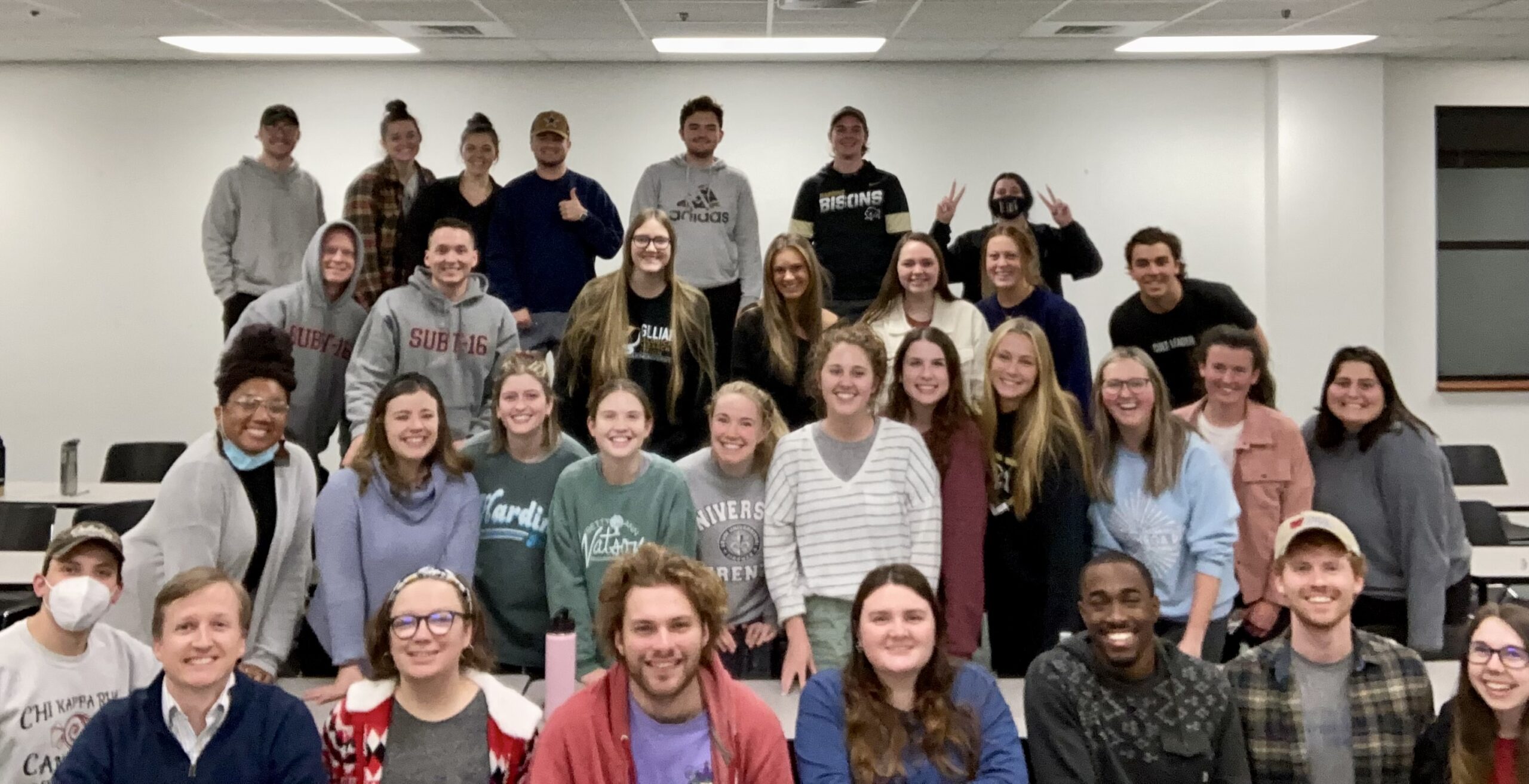
I love teenagers. If I didn’t, I would be in a different line of work. I confess, though, that as a general rule, I tend to enjoy my students more as they get older, and I have lamented before that about the time my students get really interesting, they leave me and go on to college! I had about 35 students in class, most of them juniors and seniors, and they were such a joy to be around. As a group, they were talented, passionate, and engaged, but also vulnerable, open-minded, and desperate for Jesus. I really enjoyed getting to know them through class discussions and assignments.

College Students Are What the Research Says They Are

Over the last several years, I have read a ton of youth ministry-related research. I have taught on that research in churches and at lectureships and workshops, and have even written a book on it. That research touches on a lot of topics, including:

  • The high percentage of Christian teens who check out of the church and shelve their faith after high school
  • The fact that youth groups tend to isolate teens from the Body of Christ rather than integrating them into it
  • The way that teens largely feel abandoned and ignored by their youth groups and churches after high school
  • The sad reality that Christian families often neglect practicing faith in the home
  • The incongruence between what Christian teens believe and the historic beliefs of Christianity
  • The lengthening of the developmental stage of adolescence

My class of students served as a sort of focus group, and confirmed each of these findings. Since these findings are largely negative, this wasn’t exactly a happy discovery, but it is still helpful: problems have to be clearly identified before they can be fixed. Getting to see the spiritual development of students a few years down the road from my own youth ministry students and hearing about their hurts and struggles encourages me to do better (in very specific ways) with the kids in my youth group.[1]

College Students Are Hurting

At this point, it is fairly well established that Generation Z students (which would include college students and the students in my youth group) are physically safer than ever, but more at risk than ever in other ways as anxiety and depression are at unprecedented levels in teens and young adults. I witnessed this clearly with a lot of my students: they are concerned about so many things going on in the world, unbelievably stressed out, and entirely too busy. They are hurting. The root causes for all of this are beyond the scope of this post (although, you can check out two excellent books that address this problem from two different angles here and here), but being aware of this reality enables those of us who interact with this age cohort to offer support, encouragement, and love. It was a blessing for me to have the opportunity to do that with my students this past semester.

As you can perhaps discern from the points above, teaching was not all fun and games. We had some tough conversations last semester, and I was touched by many of the things students shared with me. The church has a lot of work to do in being better stewards of God’s children. It is my prayer to engage in that work in my efforts in youth ministry, and teaching at HU was a wonderful complement to that. I look forward to doing it again.

The church has a lot of work to do in being better stewards of God’s children. Share on X

Class photo with my youth ministry scholars before we took our final exam: a great group!


[1]As a side note, I should mention that, in many ways, I was teaching the cream of the crop, spiritually speaking: students who actually chose to attend a Christian university and stayed there long enough to be juniors or seniors. If these findings were true for them, you can only imagine the situation for those in less fortunate circumstances.

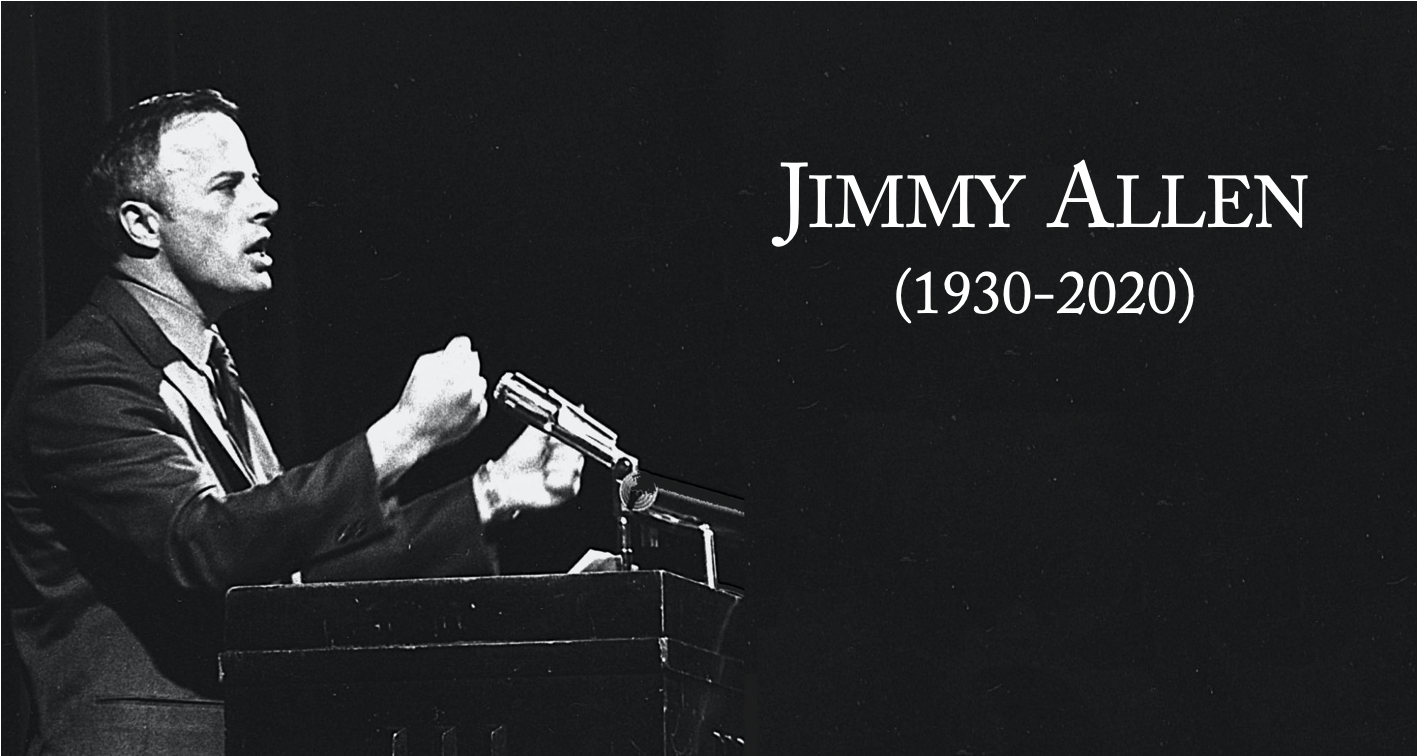
Jimmy Allen (1930-2020)

I was saddened to hear that Jimmy Allen, well-known evangelist and long-time Bible professor at Harding University, passed away early yesterday morning. He had been in poor health for some time, so his passing was not a surprise, but still, I feel that the world has been made a dimmer place by his absence.

Allen was best known as an evangelist, and specifically, was a revivalist in the style of Billy Graham. In the 1960s and 1970s, he held a series of citywide gospel meetings, preaching to thousands and thousands in coliseums and sports stadiums. It is estimated that his evangelistic efforts led to over 10,000 baptisms.

Within the Harding community, however, Allen was also well-known as a Bible professor, and it was in that role that I knew him best. Dr. Allen was one of three absolutely outstanding Bible teachers that I had at Harding who made a profound impact upon my life (another was Neale Pryor, who I wrote about after his passing in 2011). By the time I came to Harding in the early 2000s, Allen’s style of fiery preaching was not popular with college students, but he seemed to be universally loved by those who had him as a teacher, and this despite the fact that he was notorious for rarely giving out A’s (the running joke was that the Apostle Paul couldn’t swing better than a B+ in Allen’s Romans class).

When I took Allen’s Romans class (and, also, when I read his autobiography, Fire In My Bones), I learned so much. Here are some lessons that have stayed with me:

Burden for the Lost

The driving passion of Jimmy Allen’s life was telling people about Jesus. He did not hide the fact that he had lived a prodigal sort of life before giving his life to Christ, but once he made Jesus the Lord of his life, he was obsessed with telling others about Him. There are so many stories of Allen taking advantage of “captive audiences” (friends in his fishing boat, even hitchhikers in his car!) and converting them to Christ. Allen didn’t consider himself to be a preacher (he would say, “I’m not a preacher, I’m a school teacher!”), but he felt that it was his mission to share his faith and it was unfathomable to him that so many other Christians didn’t seem to feel the same way.

Biblical Interpretation

I well remember an idea that Allen repeated often:

“You don’t learn anything about a Bible subject by reading a verse where it is not mentioned.”

This, perhaps, seems obvious, but people neglect this sound advice all the time. For example, if you want to know what baptism accomplishes, you need to read the various passages that talk about baptism and what it does. It is poor biblical interpretation to read passages that don’t mention baptism and then infer ideas about baptism from its absence.

Believing the Best of Others

I don’t remember the specific context, but it was in his Romans class that Allen said these words that I’ll never forget:

“If I hear something bad about someone, I never believe it. If it comes to the point that I have no choice but to believe it, I do not delight in it.”

These words have become a standard for my life. I do not always abide by them perfectly, but this is the goal that I seek. In an increasingly graceless cancel culture that pounces on the misdeeds of others and seeks to write them off, these words obviously represent a different path, but I believe it to be a path of profound wisdom.

Continual Learning

In Fire In My Bones, Allen shares several areas in which his views have changed over the years. He introduces that chapter with these words:

“A brother who says, “I haven’t changed any of my Biblical views in the last twenty five years,” has not had his head in the Bible. Furthermore, he would make a stagnant, mosquito-infested, mud hole look like fresh water! In teaching others, we are continually asking them to change from error to truth. We should be willing to practice the same.” (201)

This idea has played out in my own life: the more I study Scripture, the more my understanding of it grows. Some beliefs are anchored more deeply, others are nuanced and refined, and still others are changed significantly, as I learn new things that I didn’t know before. Like Allen, I am deeply suspicious of those who hold their never-changing ideas up as some sort of badge of pride.

Hope of Resurrection

In his younger days, Allen was an impressive athlete. I remember he used to tell us that when he was in college, he could run the 100-yard dash in 10 seconds flat, and there are all sorts of stories about his exploits on faculty teams in intramural sports. When I had him as a teacher, he was in his 70s, but I would still see him jogging outside.

In Romans class, I well remember his exposition of Romans 8.18-25, and his discussion of the resurrection body. Well aware of his own decaying body that no longer could do the things it once did, he eagerly anticipated “the redemption of our bodies” (v. 23), and the splendid and powerful body that he would have post-resurrection. His emphasis on bodily resurrection as the center of Christian hope was re-orienting for me, and remains influential in my own views; his teaching on the redemption of creation (from the same passage) was a significant influence in my understanding of eschatology that has developed over the last several years.

In addition to what I mentioned above, Allen was also noteworthy for his teaching on grace at a time when that had not been properly emphasized, his commitment to racial equality in a time of segregation and racial tensions, and his dedication to a nonsectarian Restoration ideal. In short, he was an impressive and inspirational man in a lot of ways.


For a man who was so active and had such a brilliant mind, I cannot imagine how frustrating the last few years must have been: from what I understand, he was confined to a nursing home, in declining physical and cognitive health.

Echoing the words of the Apostle Paul, we can truly say that for a man whose life was Christ, his death is gain: Jimmy Allen is now with Jesus, and he awaits the resurrection. But at the same time, we can lament, for death is never a good thing; it is not a part of God’s plan. It is an enemy, indeed, the last enemy to be defeated. But as Christians, we believe that it will be defeated, that our bodies will be raised, and our lowly, corruptible bodies will be transformed and become like Christ’s glorious, incorruptible body. Jimmy will enjoy that; he has long anticipated it.

Friday Summary Report, November 2

Today’s installment will be brief, as I am in the midst of a particularly busy day:

(1) Yesterday, Harding University (my alma mater) announced that Bruce McLarty has been selected as the next President of the school. It has been interesting to me to read the array of responses from various parties about the announcements. I think Bruce firmly grasps Harding’s identity in the context of Churches of Christ, Christian colleges, and education in general, and it is my belief that he will continue to steer Harding on the unique course which it has chosen. In general, my feeling is this: if you love what Harding is, then I think Bruce is a great choice; if you are critical of Harding, then probably he is not your ideal candidate. Personally, I am excited.

(2) Here is an outstanding post from Scott Bond on “Why Little Girls Need Their Dad.” As a fairly recent father of a little girl, the post was especially meaningful for me, but I think it’s a good read for any Christian father.

(3) Last month set an all-time record in traffic here at The Doc File. This was a pleasant surprise, as my school workload really slowed down my posting after the first few days of the month. Thanks to all who continue to read!

(4) This post on Hashtag Media has gotten some attention. If you haven’t read it yet, check out the good things that these guys are doing.

Comforting Words From An Eminent Scholar

Dr. Jack Lewis (fittingly) in the midst of research

Dr. Jack Lewis is one of the great scholars in the fellowship of Churches of Christ, and really, is a pioneer as well. At a time when none of our Christian colleges offered post-graduate education (and a time when a lot of churches viewed such education suspiciously anyway), Lewis went on to receive a Ph.D. in New Testament from Harvard University and a Ph.D. in Old Testament from Hebrew Union.

Either degree on its own would be impressive—together, it’s almost unbelievable.

Lewis went on to teach Bible courses at Harding University and the Harding University Graduate School of Religion (now Harding School of Theology) for over 50 years, and also served on the editorial boards of multiple scholarly journals and wrote more than a dozen books.

Dr. Lewis is highly respected, not just within Churches of Christ, but within the field of biblical studies as a whole.

To be as clear as possible, I will never even approach his level of scholarship.

So it was pretty cool that yesterday I got to meet Dr. Lewis (He still hangs out at the library at Harding School of Theology, and despite his advanced age, continues to spend his time doing research). I introduced myself to him after lunch and we exchanged a few pleasantries, and then, I had the privilege of getting to talk to him some more at Bible study last night.

The fellow grad student I was with asked Dr. Lewis (who had Ph.D.’s in fields which required extensive study of Greek and Hebrew) if language study came easily to him. Dr. Lewis smiled and said, “No, not at all,” and then proceeded to describe how, when he first took Greek, it was so stressful for him that he developed shingles!

Furthermore, he informed us that he had to take Elementary Hebrew three different times. Apparently, he originally had taken a Hebrew class in college, and then when he got to graduate school he was asked by a teacher which level of Hebrew class he thought he should be placed in. Dr. Lewis wasn’t sure, so the teacher gave him a Hebrew text to read to test his ability. When Dr. Lewis didn’t understand any of what he looked at, he tried to turn the book upside down so that it would make more sense. At that point, the professor said, “It looks like Elementary Hebrew is the class for you!”

For someone who is struggling through language study, it was comforting to hear that such a world-class scholar had similar difficulties.

« Older posts Newer posts »

© 2026 The Doc File

Theme by Anders Noren — Up ↑