The online journal of Luke Dockery

Tag: Hebrew

Book Review: Exegetical Fallacies

Of all the books I read in 2013, D.A. Carson’s Exegetical Fallacies was near the top of the list. It has a rough title and a terrible cover design, but the content is outstanding.

As readers of this blog know, in addition to being a full-time minister, I am also a theology graduate student. In the course of those studies (and my less formal studies as a minister) I have spent hours and hours learning the original biblical languages of Greek and Hebrew, as well as other skills to help me to better interpret (or exegete—see the book’s title above) the text of the Bible.

In the course of those studies, as I have grown better skilled and more careful about interpreting the Bible. At the same time, I have become dismayed by witnessing so frequently what I would consider to be ill-informed, haphazard, and shoddy biblical work. Sometimes this is done by people who have never studied original languages and yet presume to teach about them, and other times it is done by brilliant people who make careless errors. But either way, it happens all the time (and to be fair, I’m sure I do it too, but hopefully I do it less frequently than I once did).

Written by respected New Testament scholar D.A. Carson, Exegetical Fallacies addresses a lot of these interpretative problems, and I strongly believe that it is a book which should be read by all preachers, teachers, and studious Christians (a heavy recommendation, I know). The book is divided into four main sections.

Word-Study Fallacies

In my opinion, this section was vitally important because preachers and authors so frequently appeal to Hebrew and Greek words to make their arguments, and they so frequently do it poorly. Here are a couple of good quotations, some of which will refer to some ideas that you may have heard before [with my comments in brackets]:

“There is nothing intrinsic to the verb ἀγαπαω (agapao) or the noun ἀγαπη (agape) to prove its real meaning or hidden meaning refers to some special kind of love.” (p. 32) [How many times have you heard that Christians are supposed to exhibit agape love, which is a higher and purer kind of love than what is described by other Greek words?]

“Our word dynamite is etymologically derive from δυναμις (dynamis, power, or even miracle). I do not know how many times I have heard preachers offer some such rendering of Romans 1:16 as this: “I am not ashamed of the gospel, for it is the dynamite of God unto salvation for everyone who believes…”—often with a knowing tilt of the head, as if something profound or even esoteric has been uttered. This is not just the old root fallacy revisited. It is worse: it is an appeal to a kind of reverse etymology, the root fallacy compounded by anachronism. Did Paul think of dynamite when he penned this word? And in any case, even to mention dynamite as a kind of analogy is singularly inappropriate. Dynamite blows things up, tears things down, rips out rock, gouges holes, destroys things.” (p. 33-34) [And the implication is that it is not dynamite or a similar force that raises us from the dead and transforms us into the likeness of Christ. It is power of an entirely different sort.]

“It is methodologically irresponsible to read the meaning of a Hebrew word into its Greek equivalent without further ado. The case must be argued.” (p. 62) [You should be a little suspicious when someone refers to a word from the Old Testament and says “The same word in the New Testament is…” or vice-versa.]

“As important as word studies are, it is very doubtful if profound understanding of any text or of any theme is really possible by word studies alone.” (p. 64) [Words ultimately derive their meaning from context; you can’t divorce words from their context without also stripping away much of the meaning.]

Grammatical Fallacies

Again, this is an important part of the book, for similar reasons to those mentioned above. Often times, the biblical languages are abused in ways that misunderstands the grammar of those languages rather than specific words.

I won’t include any quotations from this part of the book, but as an example of this type of problem, it is common to hear or read the claim that the aorist tense of the verb in Greek refers to a “once for all” or “completed” action, and then some grand theological point is made from this. The problem is that the aorist tense is incredibly flexible and means a great variety of things. Frequently in the New Testament aorist verbs are used to described ongoing or repeated actions.

Carson provides examples of several other types of grammatical fallacies as well.

Logical Fallacies

I found this section to be less helpful, just because I had studied logical fallacies multiple times before in communication classes. I would imagine that this chapter would still be very helpful if this was a subject you hadn’t previously studied before.

Carson covers a variety of fallacies including appeal to selective evidence, purely emotive appeals, the non sequitur, and simplistic appeals to authority.

Presuppositional and Historical Fallacies

This was another very important section for me. Increasingly, I have witnessed preachers and scholars use their historical reconstruction of the supposed setting of a biblical text (i.e. something which might have influenced the text but which we don’t actually know for sure) to trump what the text actually says. This is poor exegesis.

“The fallacy is in thinking that speculative reconstruction of first-century Jewish and Christian history should be given much weight in the exegesis of the New Testament documents…a little speculative reconstruction of the flow of history is surely allowable if we are attempting to fill in some of the lacunae left by insufficient evidence; but it is methodologically indefensible to use those speculations to undermine large parts of the only evidence we have.” (p.131-32)

Concluding Thoughts

Again, I think this is a really important book, and so I’ll just repeat what I said above: I strongly believe that it is a book which should be read by all preachers, teachers, and studious Christians.

Having said that, reading about so many potential exegetical problems can have its drawbacks: (1) It will make you more critical of the sermons you hear (and, if you’re not careful, in an unhealthy way), and (2) It will make you more hesitant about your own biblical interpretation and exegesis. But, helpful as always, Carson has good words on this topic as well:

“A little self-doubt will do no harm and may do a great deal of good: we will be more open to learn and correct our mistakes. But too much will shackle and stifle us with deep insecurities and make us so much aware of methods that we may overlook truth itself. I have no easy answer to this dilemma. But we will not go far astray if we approach the Bible with a humble mind and then resolve to focus on central truths. Gradually we will build up our exegetical skills by even handed study and a reverent, prayerful determination to become like the workman ‘who correctly handles the word of truth.’” (p. 142)
The Best Prayers Are Short Prayers

Obviously, the title of this post is not comprehensively true—there are certainly times when long, extended prayers are appropriate and necessary. The Bible teaches that, at times, Jesus went out and prayed for hours on end (Luke 6.12; Luke 22.39-46), and if He felt it was necessary to do so on occasion, how much more should we?

At the same time, I think we sometimes feel that brief prayers are less meaningful or less useful, and this certainly is not what the Bible teaches. In Matthew 6.7, Jesus says, “And when you pray, do not heap up empty phrases as the Gentiles do, for they think that they will be heard for their many words.” He then goes on to provide a prayer as model which is not lengthy at all.

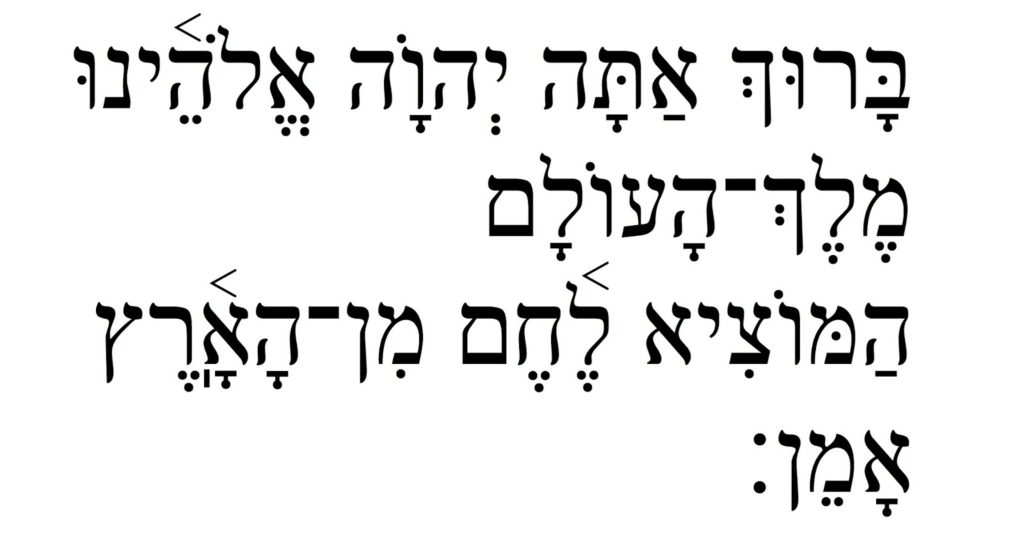
I mentioned that I am studying Hebrew this semester, and in class, my teacher shared with us the words pictured above, which comprise a Hebrew Table Prayer (i.e., a prayer that would be said before a meal by an observant Jewish family).

Translated, the prayer goes something like this (words in [ ] convey additional meaning implied in the Hebrew):

Blessed are you, O LORD [God of covenant] 

Our God, [God of creation]

King of the universe [eternal king]

Who brings forth bread [food]

From the earth.

Amen.

As this illustrates, the briefest of prayers can convey great meaning, and simplicity can possess great power:

As the God of covenant, we are reminded that God desires relationship with his people, and that it is through our relationship with him that all spiritual blessings come. As the God of creation, we are reminded that everything which exists exists because God made it—we owe Him our very existence. As the eternal King of the universe, we are reminded that God’s dominion and authority extends over all things, and throughout (and beyond) all times. And as the One who brings forth food from the earth, we are reminded that we are dependent on God for our daily survival; He is our Sustainer as well as our Creator.

Some very important reminders in just a few simple words. Don’t sell short the power of a short prayer; it can convey the deep truths of life and faith!

What Language Study Has Taught Me About The Bible

I have written before about my (mis)adventures in the study of languages, and this semester is a continuation of that trend, as I am simultaneously taking my final Greek class and my first Hebrew class.

The two languages are different enough that, so far, I haven’t gotten them too mixed up in my head, but studying both at the same time has been difficult and has required a lot of my brainpower. Greek is now pretty familiar (this is my fourth class in it) and I actually enjoy working and translating it, but Hebrew is just so foreign that it has been a strain.

Having said all this, I am repeatedly struck by three significant lessons that I have learned from language study:

(1) We owe such a debt to those who have gone on before us and have translated the Scriptures into our own languages. Language study takes a lot of patience, diligence, and perseverance. Translating from one language to another is difficult, and is especially more difficult when you are translating from hard-to-read ancient texts. There was a time when the vast majority of church-going people were unable to read the Bible for themselves, and were completely reliant on what others told them about it. We are in such a position of privilege to be able to read Scripture in our own tongue, and to do so with a great degree of confidence that what we are reading is an accurate portrayal of the original.

(2) It is important to read from and consult multiple translations. As I mentioned above, translating from one language to another is difficult. Anyone who has engaged in the process knows that often, a certain Hebrew or Greek word can be translated in multiple ways in English, and the different options have to be weighed. Ultimately, a lot of opinion and subjective interpretation comes into play when translating from one language to another, not because people are biased or dishonest or irresponsible, but simply because there is no other way to translate. A certain degree of interpretation is inherently involved. One of the great things about consulting multiple translations is that they tend to have a way of correcting the biases and weaknesses of one another. In other words, if you’re holding onto a particular doctrinal position based on one translation which is in disagreement with all others, you probably need to reevaluate your position.

(3) The Bible is a masterpiece. Studying the Bible in its original languages emphasizes to me how awesome it is. It is so intricately woven together, with certain words or literary devices emphasizing themes or creating links between different stories, books, and even between the Old and New Testaments. It has reinforced to me the unity and diversity of Scripture: composed by dozens of human authors whose individual voices shine through, but ultimately inspired by the Spirit of God, who works all pieces together into a complete and complementary whole.

To sum it all up, while studying biblical languages has been (and will continue to be) a challenge, it has also been a blessing because of these important lessons I have learned (or relearned). Hopefully, they will bless your lives as well.

Comforting Words From An Eminent Scholar

Dr. Jack Lewis (fittingly) in the midst of research

Dr. Jack Lewis is one of the great scholars in the fellowship of Churches of Christ, and really, is a pioneer as well. At a time when none of our Christian colleges offered post-graduate education (and a time when a lot of churches viewed such education suspiciously anyway), Lewis went on to receive a Ph.D. in New Testament from Harvard University and a Ph.D. in Old Testament from Hebrew Union.

Either degree on its own would be impressive—together, it’s almost unbelievable.

Lewis went on to teach Bible courses at Harding University and the Harding University Graduate School of Religion (now Harding School of Theology) for over 50 years, and also served on the editorial boards of multiple scholarly journals and wrote more than a dozen books.

Dr. Lewis is highly respected, not just within Churches of Christ, but within the field of biblical studies as a whole.

To be as clear as possible, I will never even approach his level of scholarship.

So it was pretty cool that yesterday I got to meet Dr. Lewis (He still hangs out at the library at Harding School of Theology, and despite his advanced age, continues to spend his time doing research). I introduced myself to him after lunch and we exchanged a few pleasantries, and then, I had the privilege of getting to talk to him some more at Bible study last night.

The fellow grad student I was with asked Dr. Lewis (who had Ph.D.’s in fields which required extensive study of Greek and Hebrew) if language study came easily to him. Dr. Lewis smiled and said, “No, not at all,” and then proceeded to describe how, when he first took Greek, it was so stressful for him that he developed shingles!

Furthermore, he informed us that he had to take Elementary Hebrew three different times. Apparently, he originally had taken a Hebrew class in college, and then when he got to graduate school he was asked by a teacher which level of Hebrew class he thought he should be placed in. Dr. Lewis wasn’t sure, so the teacher gave him a Hebrew text to read to test his ability. When Dr. Lewis didn’t understand any of what he looked at, he tried to turn the book upside down so that it would make more sense. At that point, the professor said, “It looks like Elementary Hebrew is the class for you!”

For someone who is struggling through language study, it was comforting to hear that such a world-class scholar had similar difficulties.

© 2026 The Doc File

Theme by Anders Noren — Up ↑







