The online journal of Luke Dockery

Tag: Hebrews

Two Pictures of Humanity

Creation Stories

It is commonly understood that the first two chapters of Genesis give us two creation accounts, but there is not much consensus as to how these two accounts are to be understood in relation to one another.

Some have suggested that these two accounts are from two different sources, presented side-by-side by a later editor, perhaps Moses or someone else. Of those who hold this view, some find the two accounts to be complementary, while others see them in great tension with one another. Others see the two accounts as coming from a single source and meshing seamlessly together, but with two different purposes: Genesis 1 takes the 30,000 foot view, providing a summary of the seven days and describing how God fashioned a good creation out of what was previously “formless and void”, while Genesis 2 zooms in, describing the creation of humanity in more detail.

I incline toward the latter view, though I don’t claim to know for certain. What I do feel confident about is that Genesis 1 and 2 give us two different perspectives on humanity that need to be held together in tension if we are to understand who we are.

In Genesis 1, humanity is presented as the pinnacle of God’s creation, formed on the sixth day. Male and female are “created in God’s image”, a theologically pregnant term that conveys great meaning. To be Imago Dei, means that we resemble our Father and that we are His representatives to rule over His creation in His name as He would have us to do. Creation is good, but when God reflects on humanity, He rates us as very good. What a glorious status we possess—God-imaging creatures.

But Genesis 2 tells us another aspect of the story, because humans are also…dirt. God forms the man out of the dust of the ground. This is actually where the name Adam comes from; he is formed from the ground (Hebrew: adamah). And what is it that humanity is called to do? If Genesis 1 gives us the lofty idea of ruling creation, in Genesis 2 it looks a lot more like…gardening. We are reminded of our earthy, creaturely nature, and it is fitting that, drawn from the dust of creation itself, we should be called to minister and serve in the context of that creation.[1]

In summary, we might say that Genesis 1 presents the grandeur of humanity, while Genesis 2 reminds us of our humility. If Genesis 1 raises us up to the heavens, Genesis 2 brings us back down to earth. This is the odd paradox of humanity—fashioned in the image of the Creator of the universe, but fashioned from dirt.

Genesis 1 presents the grandeur of humanity, while Genesis 2 reminds us of our humility. If Genesis 1 raises us up to the heavens, Genesis 2 brings us back down to earth. Share on X

Adam’s Story, Our Story, Christ’s Story

As we reflect on the nature of humanity, we can see this truth for ourselves, right? We catch glimpses of the glory of humanity—the capacity for extraordinary generosity or sacrifice, stunning creativity or beauty—but also of human frailty, failure, and folly. There are moments where we see marvelous things that other people accomplish, and we can feel immensely proud: “One of us did that!” But then there are other moments when we hang our heads in shame at the depths of human depravity.

In Prince Caspian, C.S. Lewis captures this seeming paradox in a conversation between Aslan and the young Caspian:[2]

“You come of the Lord Adam and the Lady Eve,” said Aslan. “And that is both honour enough to erect the head of the poorest beggar, and shame enough to bow the shoulders of the greatest emperor on earth. Be content.”

As the Narnia books so often do, this idea reflects biblical teaching. As the psalmist puts it in Psalm 84.4-6:

4 What is man that you are mindful of him,
and the son of man that you care for him?
5 Yet you have made him a little lower than the heavenly beings
and crowned him with glory and honor.
6 You have given him dominion over the works of your hands;
you have put all things under his feet…

Ultimately, this paradox, this tension baked into the creation narratives of Genesis 1-2, points ahead to and is fulfilled in Jesus Christ. This is made helpfully clear when the Hebrews writer takes the psalm quoted above and applies it directly to Jesus in Hebrews 2:

9 But we do see Jesus, who was made lower than the angels for a little while, now crowned with glory and honor because he suffered death, so that by the grace of God he might taste death for everyone.

Paul makes a similar point in Philippians 2.5-11, borrowing from what is believed by many to be an ancient Christian hymn:

5 Have this mind among yourselves, which is yours in Christ Jesus, 6 who, though he was in the form of God, did not count equality with God a thing to be grasped, 7 but emptied himself, by taking the form of a servant, being born in the likeness of men. 8 And being found in human form, he humbled himself by becoming obedient to the point of death, even death on a cross. 9 Therefore God has highly exalted him and bestowed on him the name that is above every name, 10 so that at the name of Jesus every knee should bow, in heaven and on earth and under the earth, 11 and every tongue confess that Jesus Christ is Lord, to the glory of God the Father.

Jesus perfectly images the Father, showing us exactly what it looks like to carry out our God-given vocation. But He does so as a lowly human, made of dust, subject to pain, fatigue, grief, and suffering.

Or, to use the words of Lewis once more: “The Son of God became a man to enable men to become sons of God.”[3]


In this loose series of Scripture Reflections, I am sharing brief thoughts spurred on by my Bible reading. By way of reminder, my goal for these brief posts is two-fold:

(1) To remark on aspects of the biblical text that I find to be of interest that the reader may or may not have thought about previously.

(2) When possible, to point to the work and person of Jesus Christ. I believe the Bible is a unified story that points to Jesus, which means that He is frequently alluded to or foreshadowed in some way throughout the biblical canon.


[1] Many scholars have pointed out that the “gardening” task of humanity is also a priestly task, and that Adam and Eve are given the job of ministering in the “Temple” of Eden. Indeed, the words translated “to work” (Hebrew: ‘abad) and “to keep” (Hebrew: shamar), are commonly used in religious contexts related to the ministerial work of priests and Levites. See Shara Drimalla and BibleProject Team, “Were Adam and Eve Priests in Eden?” BibleProject, April 12, 2021, https://bibleproject.com/articles/were-adam-and-eve-priests-eden/

[2] C.S. Lewis, Prince Caspian (New York: HarperTrophy, 1951), 233.

[3] C. S. Lewis, Mere Christianity (New York: HarperOne, 1952), 178.

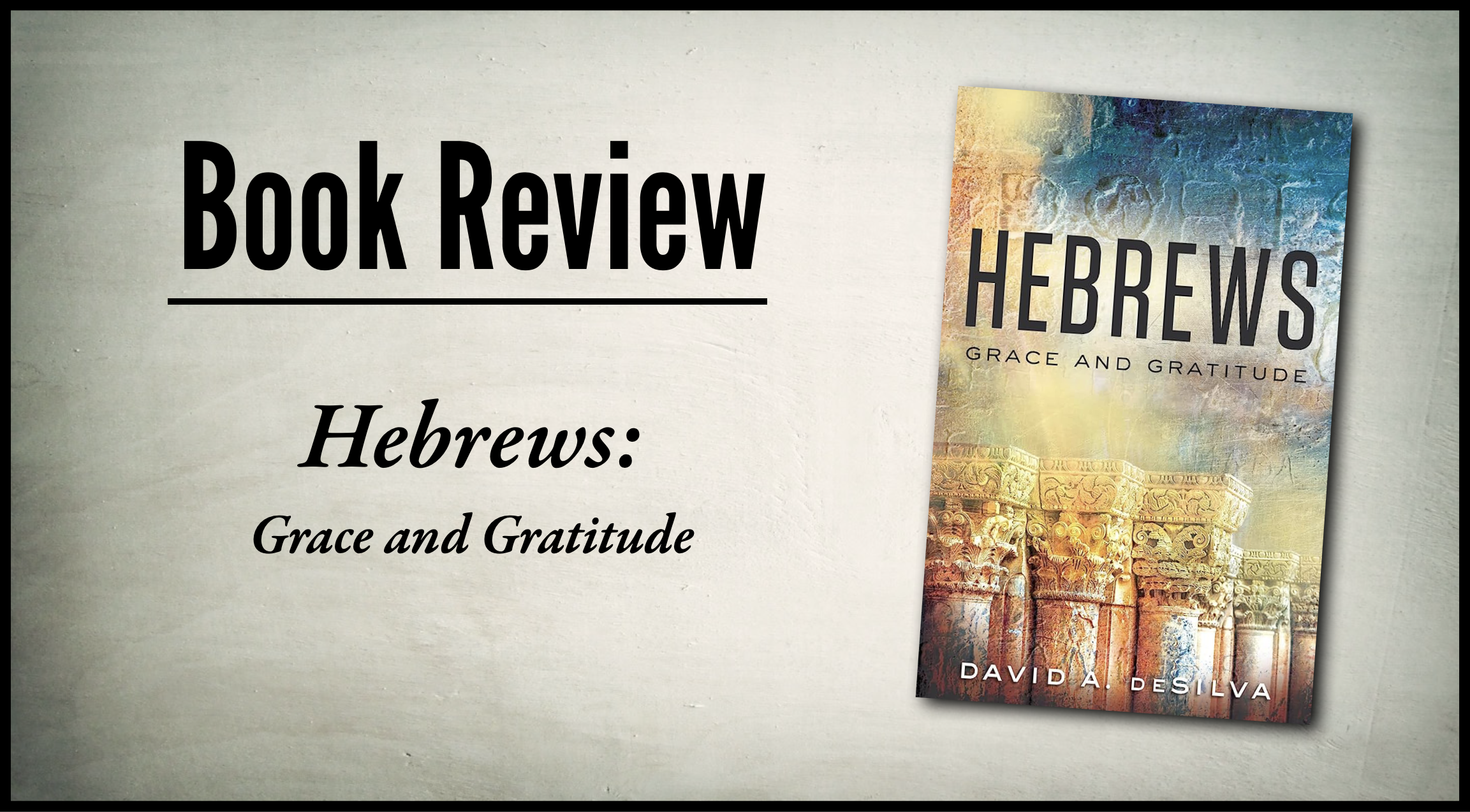
Book Review: Hebrews: Grace and Gratitude

I recently finished David DeSilva’s Hebrews: Grace and Gratitude; I was using it as a resource to aid in teaching the book of Hebrews to my high school students. DeSilva is an impressive biblical scholar and prolific author, and I was intrigued to see how his work would translate to a popular-level, shorter work (136 pages). On the whole, I was very impressed—Hebrews: Grace and Gratitude hits the key points of the dense and sometimes hard-to-access theology of Hebrews, while still being accessible for the average Christian (though I did have to re-contextualize it somewhat for my teens).

DeSilva works his way broadly through the text of Hebrews, but does so through the lenses of Grace and Gratitude (which, obviously, serve as the subtitle of the book). Basically, DeSilva argues that the audience of Hebrews (likely made up of Jews and Gentiles) found themselves in a situation where they were being pressured by their friends and neighbors to give up on their faith in Jesus. The author of Hebrews wants to assure his readers that whatever ostracism they risk for their faith, it is absolutely worth it. Through Jesus, God has lavished blessings upon His people, but this grace of God initiates a relationship with His people that requires a life of gratitude in response.

This situation is remarkably relevant for Christians in the West, DeSilva argues, who are rarely persecuted for their faith, but are often subtly pressured to make less of Jesus, to downplay our faith in some way, or simply to focus on other things.

“Following Jesus means committing yourself to him completely. Does Jesus really offer you enough to make it worth investing that much—your whole life? Do you find yourself pulling back from serving Christ and bearing witness to Christ as fully as you feel called because you’re concerned that your neighbors and associates might start viewing you less favorably? Do you tend to give God what is left over from your time and energy after giving the lion’s share to everything else? Do you ever wonder if perhaps God desires and deserves more from you, given what God has done and promises to do for you according to our faith?” (9)

DeSilva repeatedly emphasized (because the Hebrews writer emphasizes) the value of the gifts that his audience has received; these are worth whatever trials or sufferings we have to do in order to cling to them!

“How could it ever be a good investment, therefore, to acquire a larger share of what is temporary at the cost of relinquishing a share of what is eternal—or of alienating the one who is eternal?” (26)

DeSilva is well-versed in the historical backgrounds of the New Testament world, which shines through in various places in the book. Understanding the ancient context gives us a much better understanding of the implications of grace/gifts as described in Hebrews:

“It was common knowledge in the first century that to accept such a gift was also to accept an obligation to the giver. The greater the gift or assistance given (the “grace” shown), the greater was the obligation to show gratitude. Between two people, the giving and receiving of a gift involved more than the transfer of a commodity. It initiated a relationship that would continue to be refreshed as the recipient made a return of some kind, prompting future gifts or assistance, which would then be reciprocated, and so on. These relationships tended to form long-lasting alliances. When one party in the relationship was significantly inferior to the other in terms of resources, political influence, and the like, he or she could still make an appropriate return toward the giver, and looking for opportunities to perform services for the giver. The two parties might not exchange gifts of anything approaching equal value, but they should each show equal commitment to the relationship.” (62)

“Grace was well received only when it produced a grateful spirit and nurtured a relationship of loyalty and mutual assistance. For someone to accept favor and gifts and later insult the giver, break faith with him or her, or refuse him or her a service would be unthinkable.” (63)

Hebrews talks about the inferiority of the Old Covenant compared with the New, because of its inability to make people “perfect” (Hebrews 7.11, 18; 10.1). But this “perfection” is not a reference to moral flawlessness; rather, it is talking about maturity or completion. While the Old Covenant brought people no closer to the presence of God, the New Covenant, mediated through the blood of the perfect High Priest, does exactly that.

“The term [perfection] has connotations in English that the corresponding Greek family of words lacks. For example, there is no sense in Greek that perfection means doing everything correctly all the time or lining up flawlessly with an elevated standard.…Rather, the Greek words translated as “perfection” or related terms tend t speak of something arriving at its ultimate goal or being fully-realized. Thus for the child, “perfection” means to become a full-fledged adult.…For the child of God, perfection means to be gathered into God’s everlasting house and homeland.” (78-79)

Realizing the great value of God’s gifts helps to give believers motivation for a life of gratitude, and a framework for how we move through life:

“The preacher challenges all Christians to decide for whose approval they will live. If we look for God’s approval in everything we do, asking what will lead God to say, “Well done,” we will enjoy the peace of single-mindedness and integrity of life. When faced with a decision, which choice would God applaud? When faced with temptation, what will lead to God’s affirmation rather than self-condemnation? When reviewing our choice of career, our living and spending habits, our use of time—where does God affirm us, and where have we been living to please ourselves or to find affirmation by living up to the standards promoted by media?” (110-11)

And finally, a conclusion that summarizes Hebrews through the lens that DeSilva employs throughout:

“The underlying message of the Letter to the Hebrews is ultimately one of grace. It is not, however, about grace merely as something that benefits us, but about grace as something that, having benefited us, shapes the whole of our lives into a consistent walk and witness of gratitude to God and to the Savior who reconnected us with God. The preacher focuses our hearts and minds on the magnitude of  the favors we have received and are yet to receive from God so that we might fathom  and feel more fully the magnitude of the gratitude that is God’s due and give ourselves just as fully to God and God’s cause in our world. It is a call to remain in grace by persevering in gratitude.”(135-36)

Confession: despite my years as a Bible student and minister, I had not studied Hebrews in any significant way (though I had read it many times), and I had certainly not taught through it. Hebrews is a dense book, relying significantly on a deep knowledge of the Hebrew Bible that most Christians just do not have. I simply did not have time in my teaching schedule to teach through it chapter by chapter, so I was intrigued when I saw this accessible study by a respected scholar who broke down this masterpiece into six lessons.

I was blessed by reading it! I came to a better understanding and appreciation of Hebrews, and enjoyed teaching it to my students. If you are looking for a brief, readable book that will help you study through Hebrews (on your own or as a resource to teach from), I recommend Hebrews: Grace and Gratitude.

Seeking a Homeland

In the midst of a discussion of various heroes of faith, the Hebrew writer says:

These all died in faith, not having received the things promised, but having seen them and greeted them from afar, and having acknowledged that they were strangers and exiles on the earth. For people who speak thus make it clear that they are seeking a homeland. If they had been thinking of that land from which they had gone out, they would have had opportunity to return. But as it is, they desire a better country, that is, a heavenly one. Therefore God is not ashamed to be called their God, for he has prepared for them a city.

(Hebrews 11.13-16)

Above, these people of faith are described as “seeking a homeland.” This was true in a physical sense for Abraham and Sarah, who left their homeland to go to the place which God directed them, but in a deeper sense, it is true (or should be true) of all of God’s people.

The older I get, the more keenly aware I am that this world, which was created “good” but was broken and cursed by the plague of sin, is not a suitable homeland for me. I yearn for a better, kinder, more whole place. And this is a normal feeling (or at least, it should be): the New Testament in several places indicates that Christians are sojourners who are out of place in this world, and citizens of another (John 15.18-19, John 17.16, Philippians 3.20, 1 Peter 2.11). As Christians, we long for Jesus to return, mend the brokenness in His good creation, and bring about cosmic redemption.

Unfortunately, I think our modern world—with all of its distractions and comforts—frequently makes Christians forget that this isn’t, in fact, our homeland. We obsess over the things of this life and arrange our lives based on worldly priorities. Then, we aren’t content with those lives and, what’s more, we’re surprised that we aren’t content, missing the point that we’re not supposed to be content and at peace with a life that is so anchored to this world in its current, cursed state.

And the irony is, by being so focused on this world, we don’t actually benefit the world much at all. In Mere Christianity, C.S. Lewis said:

If you read history you will find that the Christians who did most for the present world were precisely those who thought most of the next. It is since Christians have largely ceased to think of the other world that they have become so ineffective in this.

We desperately need to recover our sense of being pilgrims in this world and longing for the next. It enables us to have contentment in our lives, and to better benefit those around us. Remember, we are people who are “seeking a homeland.”


In this loose series of Scripture Reflections, I am sharing brief thoughts spurred on by my Bible reading. By way of reminder, my goal for these brief posts is two-fold:

(1) To remark on aspects of the biblical text that I find to be of interest that the reader may or may not have thought about previously.

(2) When possible, to point ahead to the work and person of Jesus Christ. I believe the Bible is a unified story that points to Jesus, which means that He is frequently alluded to or foreshadowed in some way throughout the biblical canon.

Can The Saved Be Lost? A Study Of Hebrews 6.4-6

Introduction: A Passage of Controversy

The Epistle to the Hebrews focuses on the preeminence of Christ as our High Priest, but at multiple points along the way, the author cautions his readers about the dangers of leaving the Christian faith. Of these “warning passages” in Hebrews, Hebrews 6:4-6 is generally considered to be the most forceful and most troublesome. This passage has sparked debate for centuries, and its abuse is one of the reasons why Hebrews was left out of the canon of the church in the West for some time.[1] On a surface level, Hebrews 6:4-6 seems to indicate that saved persons who commit apostasy and consciously turn away from their faith can permanently lose their salvation. This contradicts the Calvinist doctrine of the perseverance of the saints, and is therefore the main issue around which battle lines are drawn in the discussion of this passage. Many claim this passage as evidence that salvation can indeed be lost, while those who adhere to Calvinist doctrine argue that these passages are not addressed to true believers, but instead to persons who have been exposed to Christianity but have ultimately rejected it.

In addition to these two major viewpoints, this paper will also present three of the more frequently discussed minority views, which help to give an idea of the different areas of contention and the wide array of interpretations of Hebrews 6:4-6 which are available.

Major Viewpoints

The two major viewpoints generally agree on both the nature of the sin described in Heb. 6:4-6 and its consequences but differ as to the identity of the audience to which the Epistle to the Hebrews was written. The sin described as “fallen away” in Heb. 6:6 is generally interpreted as apostasy, or the “renunciation of the covenant relationship with God.”[2] As Neil Lightfoot points out, this specific sin should be distinguished from the regular sins and shortcomings that are a part of our human nature: “Falling short is not the same as falling away. It is one thing to yield to sin contrary to the new life in Christ, it is another thing to abandon that new life altogether.”[3]

The consequences of this sin are grave indeed, as Hebrews 6:4-6 states that it is “impossible” to restore such persons to repentance. Although many have tried to soften the force of “impossible” over the years,[4] modern critics generally reject this approach, arguing that impossible means exactly what it says.[5] F. F. Bruce does a good job of harmonizing these thoughts when he says, “God has pledged himself to pardon all who truly repent, but Scripture and experience alike suggest that it is possible for human beings to arrive at a state of heart and life where they can no longer repent.”[6]

Having discussed the aspects of Hebrews 6:4-6 upon which the two major interpretations largely agree, we now turn to the area where disagreement arises: the audience to which the passage was written.

Once Saved, Now Lost

Many scholars believe that Hebrews 6:4-6 is addressed to true believers who are in danger of abandoning their faith and, as a result, losing the salvation they had received. Scot McKnight subscribes to this Saved and Lost interpretation, and supports his argument both with general evidence from throughout the epistle of Hebrews and also with a detailed analysis of the terms used to describe the audience in Hebrews 6:4-5. First, McKnight notes that the Hebrew writer at times identifies himself with the audience by using the first person plural pronoun “we,” and multiple times refers to his audience as “brothers.” These terms indicate that the author did not see his audience as insincere believers, but rather as fellow believers with whom he shares a spiritual relationship because of their common faith.[7] In Hebrews 6:4-5 the Hebrew writer describes his audience as “those who have once been enlightened, who have tasted the heavenly gift, and have shared in the Holy Spirit, and have tasted the goodness of the word of God and the powers of the age to come.”[8] McKnight points to these descriptions as further evidence, saying that collectively, they depict the conversions experienced by his audience. McKnight concludes, “Phenomenologically, the author believes [the audience] to be, and presents them as, believers in the fullest sense possible.”[9] Speaking of this same descriptive passage, Grant R. Osborne puts it even more forcefully, saying that “it is nearly impossible to relegate these descriptions to non-Christians.”[10]

Pseudo-Christians

Even opponents of the Saved and Lost argument admit that it is the most natural interpretation if the Hebrews 6:4-6 passage is considered on its own.[11] However, by looking at the pericope in the context of the whole of Scripture, they conclude that the warning passages must refer to people who are very aware of Christianity and have experienced some of its benefits, but were never true believers themselves. This interpretation allows the doctrine of the perseverance of the saints to stand. Wayne Grudem supports this Pseudo-Christian interpretation, and claims that although the terms used in Hebrews 6:4-5 to describe the audience could apply to true believers, they could also “apply to people who were not yet Christians but who had simply heard the gospel and had experienced several of the blessings of the Holy Spirit’s work in the Christian community.”[12] Philip Hughes concurs, pointing to New Testament figures such as Judas Iscariot, Simon Magus, and Demas as individuals to whom the descriptive terms could be applied but were not true believers.[13]

Minority Viewpoints

Although the Saved and Lost and Pseudo-Christian viewpoints are the two dominant interpretations of Hebrews 6:4-6 and represent the vast majority of scholars and commentators, there are a few minority views as well, and we will now turn our attention to a brief description of these.

Hypothetical Interpretation

First is the Hypothetical interpretation, which suggests that the Hebrew writer is giving a description of what would happen if a true believer were to fall away, even though such an event could never really occur since true believers cannot fall away.[14] This theory is supported by Thomas Hewitt, among others, who says it “has much in its favor and little against it. It in no way contradicts other passages of Scripture, neither is it in conflict with the doctrine of the perseverance of the saints.”[15] Although this view takes the apparent Christianity of the audience at face value and does not contradict with the doctrine of the perseverance of the saints, it is not without problems. As David B. Armistead points out, “A severe warning against an impossible case serves no purpose whatsoever….”[16] Philip Hughes goes even further in criticizing this view, saying that for the author to speak of an impossible scenario as if it could truly happen to his readers in order to frighten them into being better Christians would be “subchristian and incompatible with the whole tenor of the epistle.”[17]

Community View

Another minority perspective on Hebrews 6:4-6 is Verlyn D. Verbrugge’s Community interpretation. Verbrugge claims that the metaphor of the thorn-producing land that is cursed by God in Hebrews 6:7-8 forms the basis for verses 4-6, and is itself based on the Old Testament passage of Isaiah 5:1-7, which is directed toward the nation of Israel.[18] Against this backdrop, Verbrugge concludes that the Hebrew writer is primarily concerned with addressing the “covenant community and not the individual child of God. Thus when we read of the falling away and of God’s subsequent rejection, it is rejection of a community that is in focus.”[19] Basically, Verbrugge manages to avoid the implications of the Saved and Lost view by arguing that the author of Hebrews is not addressing individual believers, but rather a local body of the church. Although critics of this view applaud Verbrugge’s recognition of the emphasis the Hebrew writer puts on the Christian community, they ultimately think he ignores the even stronger emphasis placed on the individual, and also find his argument of Hebrews 6:7-8 directly relating to Isa. 5:1-7 to be unconvincing.[20]

Christian Maturity

A final perspective to consider is the Christian Maturity interpretation, which suggests that Hebrews 6:4-6 is addressed to true believers and warns not against apostasy, but a “decisive refusal to mature” in the Christian life.[21] Proponents of this view disagree about the exact consequences of failing to heed the warning that the Hebrew writer gives, but they agree that eternal salvation is not at stake. Drawing largely on the metaphor of the thorn-infested ground in Hebrews 6:7-8, Thomas K. Oberholtzer sees eschatological implications, and argues that the result of continued immaturity in the Hebrews audience is not a loss of eternal salvation, but a loss of rewards in the millennial kingdom.[22] Randall C. Gleason sees extensive parallels between the believers described in Hebrews 6:4-5 and the Israelites who refused to enter the land of Canaan at Kadesh-Barnea, and argues that the immature Christians of Hebrews 6 run the risk of physical death, possibly during the impending destruction of Jerusalem[23] (Gleason assumes that Hebrews was written to Jewish believers living “not far from Jerusalem.”[24]). Both veins of the Christian Maturity view are rejected by other scholars for multiple reasons.[25]

Conclusion: A Real Warning of Apostasy

The entire debate over the proper interpretation of Hebrews 6:4-6 is centered around the Calvinist doctrine of the perseverance of the saints. Those who reject this doctrine have little problem accepting the passage at face value, while those who affirm it are compelled to conclude either that the passage does not refer to true believers, or that the consequences of apostasy must be something other than the loss of eternal salvation.

With the three minority views all possessing significant problems, it seems that the best interpretation of Hebrews 6:4-6 must come from one of the two dominant views, which disagree about the audience to which the passage was written. Although the Pseudo-Christian view has been popular for centuries and makes some good arguments, it also approaches the passage with too much presupposition and from the outset tries to make it mean something other than what it seems to mean. The Saved and Lost interpretation, on the other hand, takes the Hebrew writer at his word, and therefore seems to be the best. After all, what more could the author have said to show that he was writing to true believers than what he already did?


[1]Roger Nicole, “Some Comments on Hebrews 6:4-6 and the Doctrine of the Perseverance of God with the Saints,” in Current Issues in Biblical and Patristic Interpretation; Studies in Honor of Merrill C. Tenney presented by his Former Students, ed. Gerald F. Hawthorne (Grand Rapids: Eerdmans, 1975), 355.

[2]Alan Mugridge, “Warnings in the Epistle to the Hebrews: An Exegetical and Theological Study,” Reformed Theological Review 46 (September-December 1987): 77.

[3]Neil R. Lightfoot, Jesus Christ Today: A Commentary on the Book of Hebrews (Grand Rapids: Baker Book House, 1976), 126.

[4]Philip Edgcumbe Hughes, “Hebrews 6:4-6 and the Peril of Apostasy,” Westminster Theological Journal 35, no. 2 (Winter 1973): 144-45.

[5]William L. Lane, Hebrews 1-8, Word Biblical Commentary, vol. 47A (Dallas: Word Books, 1991), 142; David B. Armistead, “The ‘Believer’ who Falls Away: Heb 6:4-6 and the Perseverance of the Saints,” Stulos Theological Journal 4, no. 2 (1996): 140-44.

[6]F. F. Bruce, The Epistle to the Hebrews, The New International Commentary on the New Testament (Grand Rapids: Eerdmans, 1990): 149.

[7]Scot McKnight, “The Warning Passages of Hebrews: A Formal Analysis and Theological Conclusions,” Trinity Journal 13 (Spring 1992) 43.

[8]All biblical references in this paper are taken from the English Standard Version.

[9]McKnight, 44-48.

[10]Grant R. Osborne, “A Classical Arminian View,” in Four Views on the Warning Passages in Hebrews, ed. Herbert W. Bateman IV (Grand Rapids: Kregel, 2007), 112.

[11]Wayne Grudem, “Perseverance of the Saints: A Case Study from the Warning Passages in Hebrews,” in Still Sovereign: Contemporary Perspectives on Election, Foreknowledge & Grace, ed. Thomas R. Schreiner and Bruce Ware (Grand Rapids: Baker Books, 1995), 137; Armistead, 144.

[12]Grudem, 171-72.

[13]Hughes, 149-150.

[14]Grudem, 152.

[15]Thomas Hewitt, The Epistle to the Hebrews: An Introduction and Commentary (Grand Rapids: Eerdmans, 1960): 110-11.

[16]Armistead, 139.

[17]Hughes, 144.

[18]Verlyn D. Verbrugge, “Towards a New Interpretation of Hebrews 6:4-6,” Calvin Theological Journal 15, no.1 (April 1980): 62-65.

[19]Verbrugge, 62.

[20]McKnight, 53-54; Robert A. Peterson, “Apostasy in the Hebrews Warning Passages,” Presbyterion 34, no.1 (Spring 2008): 27-29.

[21]Randall C. Gleason, “The Old Testament Background of the Warning in Hebrews 6:4-8,” Bibliotheca Sacra 155 (January-March 1998): 81-82.

[22]Thomas K. Oberholtzer, “The Warning Passages in Hebrews Part 3 (of 5 parts): The Thorn-Infested Ground in Hebrews 6:4-12,” Bibliotheca Sacra 145 (July-September 1988): 319-28.

[23]Gleason, 78-89.

[24]Randall C. Gleason, “A Moderate Reformed View,” in Bateman, 337-40.

[25]Grudem, 151-52; Brent Nongbri, “A Touch of Condemnation in a Word of Exhortation: Apocalyptic Language and Graeco-Roman Rhetoric in Hebrews 6:4-12,” Novum Testamentum 45, no. 3 (2003): 268-69; Grant R. Osborne, “Classical Arminian Response,” in Bateman, 378-95; Buist M. Fanning, “Classical Reformed Response,” in Bateman, 396-414.


© 2026 The Doc File

Theme by Anders Noren — Up ↑