The online journal of Luke Dockery

Tag: Idolatry

God Is The One Upon Whom We Should Rely: Lipscomb On Human Government

David Lipscomb was a very influential leader within Churches of Christ in the late 19th and early 20th centuries. Lipscomb served as a minister, an educator (a co-founder of the Nashville Bible School, which exists today as Lipscomb University), and an editor of the very influential Gospel Advocate.

Lipscomb was also a pacifist, and in some sense, a Christian anarchist: he believed that Christians had no business interacting with government, including voting in elections or serving on juries. My own views on government are not as extreme as Lipscomb’s, but I do think his thoughts serve as a helpful corrective to what I see from a lot of people.

It has been distressing to me during this election cycle to see so many Christians who (based on their comments on Facebook or Twitter) seem to be placing so much of their hope for the betterment of our world in political candidates (regardless of which party they happen to support). To these folks, Lipscomb offers some helpful words:

“Everyone who honors and serves the human government and relies upon it, for good, more than he does upon the Divine government, worships and serves the creature more than he does the Creator.”

On Civil Government, 50

With all due respect to Lipscomb, I believe that it is appropriate for Christians to vote and that, ideally, Christians should use their vote to reinforce the values of the Kingdom. And sometimes it can be easy to get pretty wrapped up in the political process because those values can mean a lot to us.

But I think he is right on the money about this: let us never think that the president we elect or the government we put into place is the ultimate source to which we should look for guidance, protection, or good. Those things come from God, and He still sits firmly on His throne, in control of all the things we debate and worry about.
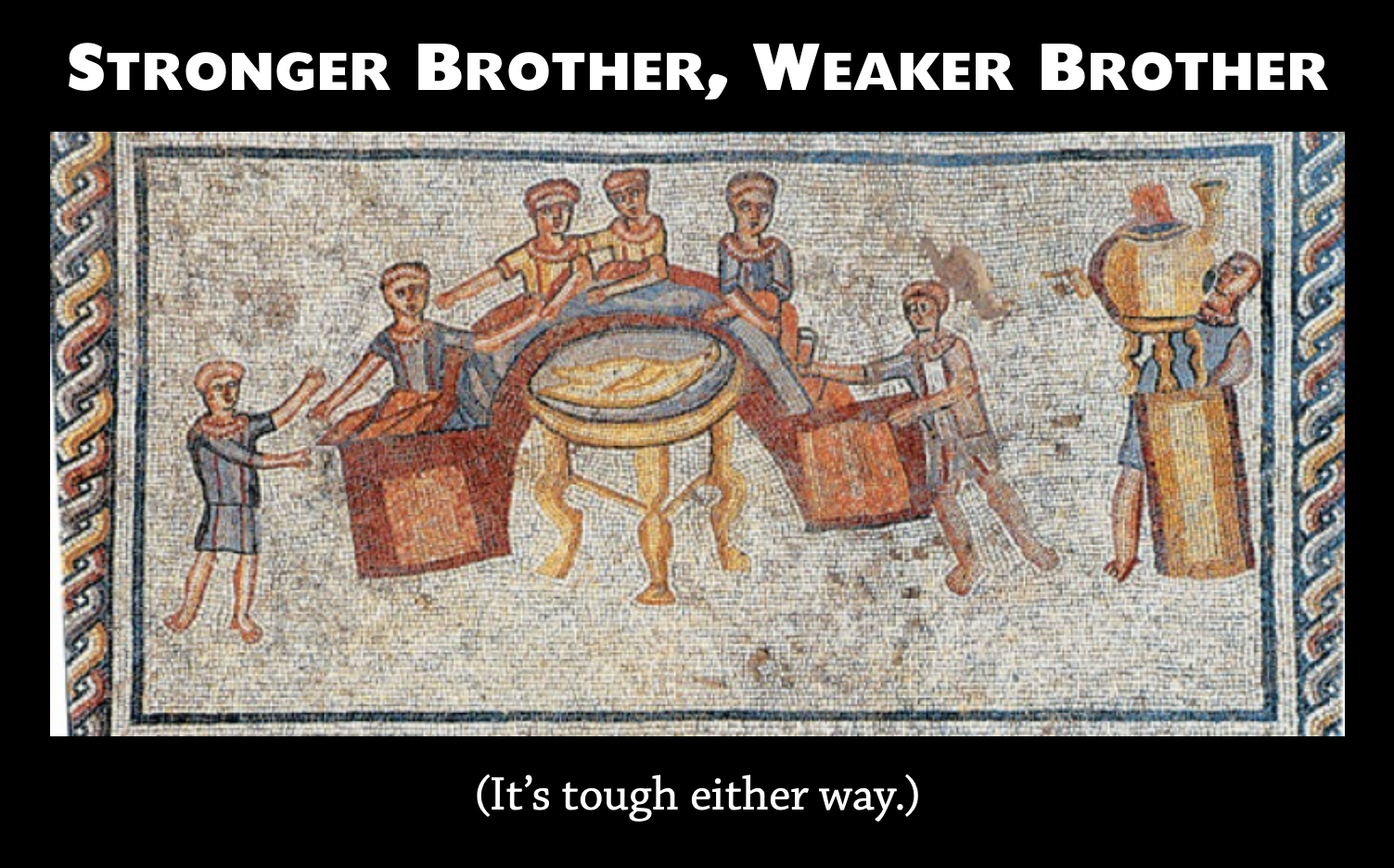

Stronger Brother, Weaker Brother: It’s Tough Either Way

There are a few places in the New Testament where  Paul addresses the idea of the stronger brother and the weaker brother, usually in the context of the issue of eating meat that had formerly been sacrificed to idols (Romans 14; 1 Corinthians 8.4-13; 1 Corinthians 10.25-32).

It’s a fairly complex issue, but basically, Paul says that since idols are nothing (because they represent gods which don’t actually exist), eating food that had previously been offered to them is no big deal. Stronger, more mature Christians would be able to realize this, and would see that eating such meat would not be inherently wrong.

However, weaker, newer Christians, especially those who had been recently converted from a pagan background, could struggle with the idea of eating meat that had been sacrificed to an idol, and could feel like they were compromising their faith by doing so. For these Christians, it would be wrong for them to eat because doing so would violate their conscience.

Paul’s real focus in these passages is less on giving specific instructions on which activities should be partaken in and which should be abstained from, and more about teaching the stronger and weaker brothers how to interact with one another. Basically, they should treat one another with love: the stronger brother should be willing to give up meat forever in order to avoid leading his weaker brother to sin against his conscience, and the weaker brother shouldn’t try to bind his stronger brother’s actions by his own conscience.

In many ways, Paul’s thoughts are summed up in Romans 14.3:

“Let not the one who eats despise the one who abstains, and let not the one who abstains pass judgment on the one who eats, for God has welcomed him.”

Depending on the issue, I think I have been both the weaker and stronger brother at different times, and what Paul commands in Romans 14.3 is challenging to both groups.

The stronger brother is not to despise the weaker. I’ve seen this happen a lot, and it can be tempting to do. We grow frustrated at the qualms of our weaker brethren and so it gets easy to ridicule them as hopelessly backward and just write them off completely. Maybe make jokes about their limited understanding and speak with condescension to and about them.

The weaker brother is not to pass judgment on the stronger. This is tempting as well. Since our brothers are doing something that our own consciences won’t permit us to do, we are tempted to view them as less holy or less devoted to their faith than we are. Perhaps we even cease to think of them as faithful Christians.

As Paul points out in the verse above, both of these attitudes are wrong. Regardless of which side we find ourselves on, we have to be careful about how we treat each other: love and respect for our brethren should always be our primary response.

© 2026 The Doc File

Theme by Anders Noren — Up ↑






