The online journal of Luke Dockery

Tag: Incarnation (Page 1 of 2)

Linking Heaven and Earth: Jacob’s Ladder and Jesus

The Gospel of John is one of my favorite books in the Bible, and one of its special characteristics is that, more than any other, it emphasizes the divinity of Jesus. This is done over and over again and in many different ways, but one interesting way it does so is through an allusion in John 1.47-51.

Here, Jesus calls Philip to follow Him, and then Philip subsequently goes and recruits a man named Nathanael as well. Nathanael is skeptical that Jesus, from the lowly town of Nazareth, could be the Messiah whom Moses and the prophets had proclaimed, and so Philip invites him to go and see Jesus for himself:

47 Jesus saw Nathanael coming toward him and said of him, “Behold, an Israelite indeed, in whom there is no deceit!” 48 Nathanael said to him, “How do you know me?” Jesus answered him, “Before Philip called you, when you were under the fig tree, I saw you.” 49 Nathanael answered him, “Rabbi, you are the Son of God! You are the King of Israel!’’

(John 1.47-49)

Although Nathanael was really impressed that Jesus knew what he had been doing before they had even met, Jesus basically told him that he hadn’t seen anything yet:

50 Jesus answered him, “Because I said to you, ‘I saw you under the fig tree,’ do you believe? You will see greater things than these.” 51 And he said to him, “Truly, truly, I say to you, you will see heaven opened, and the angels of God ascending and descending on the Son of Man.”

(John 1.50-51)

If you know are familiar with the narratives of Genesis, then the imagery of heaven opening up and angels ascending and descending is probably very familiar to you, and it almost certainly would have been familiar to Nathanael. It is most likely an allusion to Genesis 28, where Jacob, while on a journey to Haran to stay with his uncle Laban (and ultimately get married), stops to sleep for the night, using a stone for a pillow:

12 And he dreamed, and behold, there was a ladder set up on the earth, and the top of it reached to heaven. And behold, the angels of God were ascending and descending on it!

(Genesis 28.12)

At the top of the ladder, the LORD appears, and basically reaffirms to Jacob the same promises that He had previously made to Abraham and Isaac. When Jacob awakens from his sleep, he realizes that something significant has happened:

16b “‘Surely the LORD is in this place, and I did not know it.’ And he was afraid and said, ‘How awesome is this place! This is none other than the house of God, and this is the gate of heaven.’”

(Genesis 28.16b)

The next morning Jacob takes his stone pillow and sets it up as a monument, naming the place “Bethel,” which means “house of God.” This approximates temple language, and likely gives us a better picture of what Jacob’s dream looked like. Scholars suggest that what Jacob saw was not a “ladder” as we think of it, but a ziggurat, a Mesopotamian step-pyramid/temple.[1] In the cosmology of the ancient world, temples were overlapping spaces that linked heaven and earth, God’s space and human space. Ziggurats, in particular, had extensive staircases that were designed to connect divine space with human space and enable gods to “come down” to their temples.
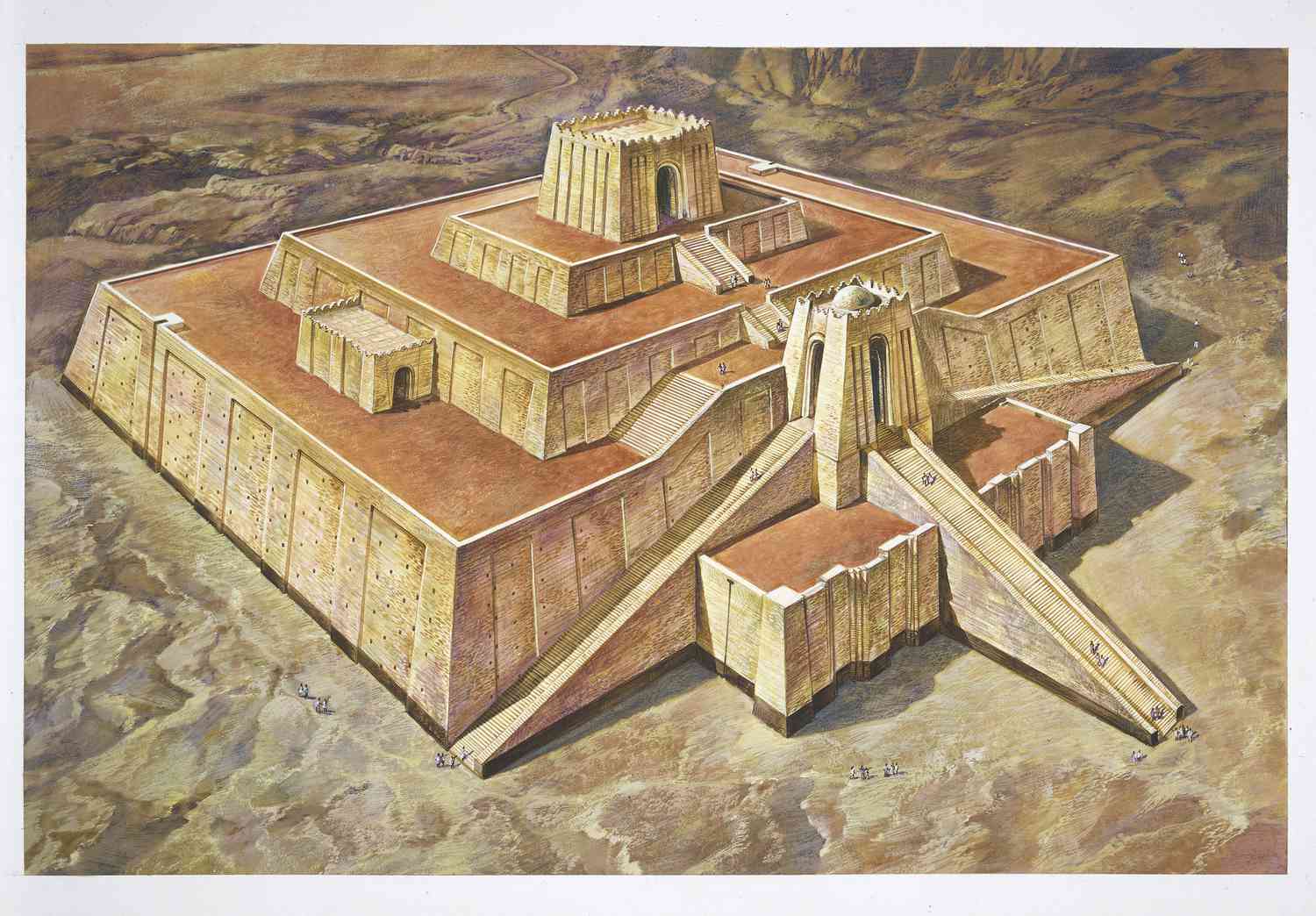
Ancient ziggurats had extensive steps, ideal for the ascending and descending that Jacob witnessed in his dream.

As already suggested above, the language of Genesis 28.12 and John 1.51 is so similar that it seems clear that Jesus was intentionally alluding to Jacob’s dream. So what does the connection mean?

In Jacob’s dream, a “ladder” connected earth (where Jacob is) and heaven (where the LORD is), and angels ascend and descend upon the ladder. Jacob is awed by what he sees. In John 1, Jesus paints a similar picture for Nathanael: the heavens open, and the angels of God are ascending and descending. The difference is that now, instead of ascending and descending upon a ladder, the angels are doing so upon the Son of Man—Jesus Himself.

The implication is that Jesus is the new “ladder”, the New Bethel, the new house of God. 

This is the greater thing that Nathanael will get to see: just as Bethel was the place where the heavens were connected to earth, so Jesus is the medium through which heaven and earth, God and man, are brought together.[2]

Just as Bethel was the place where the heavens were connected to earth, so Jesus is the medium through which heaven and earth, God and man, are brought together. Share on X

The Gospel of John affirms here—as it does elsewhere—that Jesus was absolutely unique. As the Son of God, His roots were in heaven, but as a human, He also put down roots on earth. This is the wonderful mystery of the Incarnation, the Word becoming flesh, and is what enabled Him to carry out the work of reconciling creation to its Creator (cf. 2 Corinthians 5.18-19).


In this loose series of Scripture Reflections, I am sharing brief thoughts spurred on by my Bible reading. By way of reminder, my goal for these brief posts is two-fold:

(1) To remark on aspects of the biblical text that I find to be of interest that the reader may or may not have thought about previously.

(2) When possible, to point to the work and person of Jesus Christ. I believe the Bible is a unified story that points to Jesus, which means that He is frequently alluded to or foreshadowed in some way throughout the biblical canon.


[1] For example, see Scott Aniol, “What Was Jacob’s Ladder?”, By the Rivers of Babylon, October 9, 2024.

[2] F. F. Bruce, The Gospel of John, (Grand Rapids: Eerdmans, 1983), 62: “In this application of Jacob’s vision, however, the union between earth and heaven is effected by the Son of Man: he is the mediator between God and the human race.”

A God Who Is Not Far From Us

In a well-known passage in Acts 17, Paul addresses the Areopagus in Athens:

“Men of Athens, I perceive that in every way you are very religious. For as I passed along and observed the objects of your worship, I found also an altar with this inscription, ‘To the unknown god.’ What therefore you worship as unknown, this I proclaim to you. The God who made the world and everything in it, being Lord of heaven and earth, does not live in temples made by man, nor is he served by human hands, as though he needed anything, since he himself gives to all mankind life and breath and everything.”

The Greeks were a very religious people—I can remember studying in school about the various gods and goddesses in the Greek pantheon—and Athens was filled with temples, statues, and idols in honor of them. Apparently, in addition to these deities, they even worshipped an “unknown god”, apparently to ensure that they didn’t leave anyone out. But the point that Paul tries to make to the Athenians in Acts 17 is that they did leave Someone out—the most important Someone of all—the God who made the world and everything in it. Of this God, the Greeks were ignorant.

Being ignorant of God—what He is like and what He desires of us—is a problem that was not specific to the Greeks. It’s a recurring problem that has appeared throughout history. And when it’s up to us to determine what God is like and what He wants, we frequently end up in some pretty dark places.


Chichén Itzá was a pre-Columbian Mayan cultural center located on the Northern Yucatán peninsula in modern-day Mexico. Today it is a popular tourist attraction and every year thousands of people go and visit the ruins.

The Yucatán is a dry area with no rivers above ground, but despite this, Chichén Itzá was able to thrive as a major Mayan city because of the existence of a certain type of geological formation called a cenote. A cenote is a sinkhole which had formed in the limestone foundation and contained groundwater. There are several cenotes throughout the Yucatán, and at Chichén Itzá, there were two cenotes that were substantial in size and would likely have contained adequate drinking water year-round for the people of the city.

Cenote Sagrado, believed to be the home of the Mayan rain god, Chaac.

However, of the two cenotes, only one was used for drinking water, because one of them was believed to be the home of the Mayan rain god, Chaac. In order to keep Chaac happy and the rain plentiful (and plentiful rain was a big deal in such a dry area), the Mayan people would offer human sacrifices. These sacrifices—often children—would be weighted down with gold and silver jewelry and then tossed down into the cenote where Chaac was thought to live. Hundreds of years later when the area was excavated by archaeologists, many tiny skeletons, as well as the treasure that dragged them to their deaths, were found.

Senseless deaths…sacrifices made in order to appease a god they didn’t understand, whose will they had to guess at.

We hear that and perhaps it’s easy for us to dismiss that example as being far removed from our own circumstances, something done long ago by “primitive” people. It’s not an isolated incident, though. People have often justified terrible actions because they thought they were doing what God wanted: fighting in the Crusades…buying and selling people based on the color of their skin…blowing up abortion clinics…flying airplanes into skyscrapers. When it’s up to us to determine what God is like and what He wants, sometimes we end up in some pretty dark places.

When it’s up to us to determine what God is like and what He wants, sometimes we end up in some pretty dark places. Share on X

But reading further in Acts 17, Paul says that it doesn’t have to be this way—we don’t have to be ignorant of God. He tells the people of Athens that God is “not far from each one of us”, and that we are His offspring. And then, speaking of Jesus, Paul goes on to say that God “has fixed a day on which he will judge the world in righteousness by a man whom he has appointed; and of this he has given assurance to all by raising him [Jesus] from the dead.”

Paul’s claim that God is not far from us finds fuller expression in the classic passage on the Incarnation in John 1. There, in verse 14 we read, “The Word became flesh and made his dwelling among us.”

A lot of times when speaking about the Incarnation, we talk about that first part: the Word becoming flesh. That’s certainly an important concept, but I want to focus on the second clause: the Word made His dwelling among us. Here John is using tabernacle language to explain how God came down to be among His people in a new and special way. A more literal translation would be something like, “He pitched His tent among us.”

In The Message, Eugene Peterson says that “the Word became flesh and moved into our neighborhood”, and I love that sentiment—through Jesus, God is no longer a mysterious stranger Whom we don’t understand, because He lives right down the street from us—we can see what God is like for ourselves!

The wonderful news of the Incarnation is that the God who does not wish to be far from each of us put on flesh, and Jesus took up residence in our neighborhood. From that proximity, we can see Jesus clearly, and we are never left to wonder what God is like, or what He wants from us.

Incarnation & Human Involvement In God’s Transformative Work

Several weeks back, I finished my series on The Chronicles of Narnia, and now I am thoroughly enjoying reading through Paul Ford’s Companion To Narnia: Revised and Expanded. It is basically a reference work that discusses the process of C.S. Lewis writing the Chronicles, analyzes how they relate to the rest of his works, and provides encyclopedic entries for everything imaginable in the world of Narnia. I am just now in the Es, so I have a long way to go, but it has been a lot of fun to read.

A while back I read through the entry for Aslan, which, as you might expect, is incredibly lengthy, with the Great Lion being the central character of the Narnia series and Lewis’s imagined Christ Figure in the world of Narnia. In that entry, Ford makes an insightful comment on Lewis’s effort to point his readers to the implications of the incarnation:

[Aslan’s] encouragement of the now-revived lion with the phrase “us-lions” and his employment of the giant to break down the castle walls and the sheepdog to organize the creatures into a force that will be helpful in what will later be called the First Battle of Beruna are all instances of Lewis’s profound belief that one of the consequences of the incarnation (God’s desire to identify with us by becoming one of us) is that he wants our help in the process of transforming the world.[1]

In the Incarnation, God identifies Himself with humanity through Jesus of Nazareth entering the world stage in the form of a baby. In so doing, God affirms the goodness of creation and also His intention to partner with humanity in bringing about His purposes for that creation.


This is, in large part, what it means to be created in God’s Image; we are God’s representatives, bearing His authority to carry out the task He has given us. This is the picture we have of Adam and Eve in the garden: God giving them the task to steward and cultivate His creation, partnering with Him, under His authority, to take care of it and develop it.

Tragically, Adam and Eve fail to live up to their vocation. In the bitterest of ironies, they clutch after the forbidden fruit hoping to become like God, failing to realize that they already were! And humans have similarly failed ever since then.

In the bitterest of ironies, Adam and Eve clutch after the forbidden fruit hoping to become like God, failing to realize that they already were! Share on X

In the Incarnation, Jesus comes to show us a different way. He perfectly reflects the divine image, obeying the Father’s will in all things. Rather than seeking after power or God-likeness, He willingly lays it down and lives as a servant, even to the point of dying on the cross.

Those of us who would follow Jesus are called to imitate His example. The vocation that God bestowed upon humanity in the garden has not changed: still, we are encouraged to take up our crosses and join in God’s mission. In The Lion, the Witch and the Wardrobe, the resurrected Aslan could have defeated all evil, established his reign and rule, and brought about the transformation of the world all on his own, but he chose not to. And this, as Ford points out, is no accident: Lewis was simply reflecting the biblical teaching that the all-powerful God chooses to bring about the redemption of all things in collaboration with human agents of new creation.

One of the great truths of the incarnation is that God brings about the transformation of the world—new creation—through His partnership with humanity.


[1]  Paul Ford, Companion to Narnia: Revised Edition (San Franciso: HarperCollins, 2005): 60.

When God Shows Up: The Delightful Surprise of Job

The Book of Job is one of my favorites in the Bible, and Elihu is one of my favorite characters within the book. I have written on Elihu at length, but here, I just want to focus on Elihu’s role in what I like to think of as the “delightful surprise” of Job.

For a little bit of context to those who are not intimately familiar with the structure of Job, it goes something like this:

  • Prologue (Job 1-2): We are introduced to Job, learn of the wager between God and Satan, and watch as Job is dealt one devastating blow after another.
  • Dialogue Between Job and Friends (Job 3-28): Job laments his condition and three of his friends offer their thoughts, ultimately making things worse.*
  • Job’s Closing Monologue (Job 29-31): Job presents his summary defense and, maintaining his innocence, longs for an audience with God.
  • Elihu’s Speeches (Job 32-37): Young Elihu enters the scene, corrects Job’s friends, and foreshadows the appearance of God.
  • God’s Speeches (Job 38-42.8): God appears and addresses Job (with Job’s brief responses).
  • Epilogue (Job 42.9-17): The story of Job is resolved and his fortunes are restored.

I have argued that the primary purpose that Elihu serves is that he seeks to take Job’s focus off of his own troubles and turn his thinking to God instead. He concludes his speeches in Job 37 with repeated reference to the majesty of God, as illustrated by the power seen in thunder, storms, lightning, and other aspects of God’s creation. Elihu concludes his thoughts on God’s majesty and indeed, his speeches, by basically telling Job (cf. Job 37.23): “God is beyond us. We cannot understand Him and He owes us no explanation…don’t expect Him to show up!” From a literary perspective, this is part of the masterpiece of Job and the deep irony of Elihu: simultaneously, his talk of God’s majesty prepare us for a God who appears out of a whirlwind while his concluding statement tells us not to expect any appearance at all!

Elihu disappears from the scene and then, the surprising and incredible thing happens. Contrary to Elihu’s expectations, and Job’s expectations, and the reader’s expectations, the God of majesty who shows His power in the wonder of creation, the God who is beyond us…shows up! 

When He does, he doesn’t give Job what he wants—He doesn’t give an explanation for why Job has suffered and why so many terrible things have happened to him. In this way, God’s response confirms what Elihu was saying: God is beyond Job, and doesn’t owe him an explanation for everything. But even better than God’s explanation is His presence! He appears before Job, and that response of presence is better than any explanation. It is enough for Job to continue on in faith, despite what he has experienced.

Reading Scripture from a Christological perspective, I think this appearance of God foreshadows His ultimate appearance in the incarnation: Jesus comes and lives as a man, dies a cruel death, and is then raised from the dead. Ultimately, Jesus does all of this not to answer all of our questions, but to show that He is truly with us. 

Better than God’s explanation is His presence:

  • In the incarnation, He is present with us in our very nature.
  • In the crucifixion, He is present with us in the experience of suffering.
  • In the resurrection, He gifts us the hope of His eternal presence.

And rather than explanation, it is God’s presence, seen through Jesus Christ, that gives us comfort even when life deals us inexplicable hardship and suffering!

*Many scholars would break this down further and some would remove Job 28 as a separate poem to wisdom. That level of specificity is beyond my purposes here.

Image Credit: Sean Heavey

Jesus: God In Our Neighborhood

Who is God? What is He like? What does He want from me? What does He expect of me?

These are ancient questions, asked by countless people over thousands of years, but they are also modern questions that people still wrestle with today. We can get answers to those questions and can learn things about God by looking at nature, and by reading about Him in Scripture, but the fullest and clearest expression of what God is like was made available to us through the Incarnation of Jesus.

The word “incarnation” comes from Latin and literally means “to make into flesh” or “to be made flesh”. The Incarnation is one of the central teachings regarding Jesus, and says that Jesus was the Son of God, but that he “became flesh” and lived life as a man. Jesus was both God and human.

For many of us, that idea is pretty straightforward because it’s what we’ve been taught for a long time, but it’s an idea that was debated and argued about for a long time in the early church, and a lot of false teachings came up to try and explain who Jesus really was:

  • Adoptionism said that Jesus was an ordinary man who followed and obeyed the Law so carefully that he became the Messiah and that God “adopted” Jesus as His Son at baptism. So basically this view says that Jesus was a man, but was not really God—it stressed His humanity, but not His divinity.
  • Docetism said that Jesus was a divine being that took on human appearance but not flesh. It comes from a Greek word which means “to seem”, so basically this view says that Jesus seemed like a man but really wasn’t one. Docetism stresses the divinity of Jesus, but not His humanity.
  • Arianism said that Jesus was divine in some sense, but that He was created by the Father, so that He wasn’t an eternal being—He wasn’t God in the same sense that the Father was.
  • Nestorianism said that the Son of God and the man Jesus shared the same body, but were two separate beings within that body with different natures. Almost like Jesus had a split personality.

That all might start to sound somewhat confusing, and that’s okay, because it is confusing, and I think it illustrates an important point—sometimes we get ourselves into trouble by trying to explain things that we really can’t explain. The Bible really doesn’t try to explain in detail how the Incarnation “worked”—how it was that Jesus was both God and human at the same time—it just affirms that that’s who He was. He wasn’t part human and part God, he was completely human and completely God at the same time. So while I can’t fully explain how the Incarnation worked, I can say that the “isms” that we mentioned before are not true, because they deny that Jesus was both fully human and fully God.

What I think is more important than completely understanding how the Incarnation worked is understanding what the Incarnation means to us as Christians—how Jesus living as a human shows us what God is like and what He expects from us.

The classic passage on the Incarnation is in John 1. There in v. 14 it says, “The Word became flesh and made his dwelling among us.”

A lot of times when speaking about the Incarnation, we talk about that first part, “The Word becoming flesh” and that’s an important concept (all of arguments and debates and “isms” mentioned above are based on the first part of the verse), but I want to focus on the second clause, “The Word made his dwelling among us”.

Here John is using Old Testament language from the time when the Israelites wandered in the wilderness and God dwelt in the tabernacle to explain how God, through Jesus, came down to be among His people in a new way. A more literal translation of the end of John 1.14 would be something like, “he put up his tent among us.”

The Message, which is a paraphrase translation of Scripture in modern language, says in John 1.14 that the Word became flesh and moved into our neighborhood, and I love that idea—through Jesus, God is no longer Someone who is unknowable or impossible to figure out, because He lives right down the street from us—we can see what God is like for ourselves!

Shah Abbas the Great

There’s an old story about Shah Abbas, the great king of Persia who came to the throne in the late 1500s. Shah Abbas was beloved by his people, and he loved them in return, and in order to understand them better, historically we know that he would often disguise himself as a common man and mingle among them.

The story goes that one day, while visiting a bathhouse, Shah Abbas went down into the cellar and sat down next to the poor man whose job was to keep the furnaces burning to heat the baths. The king quickly struck up a friendship with this lowly laborer, who welcomed his company without having any idea who he was. They became friends and the king returned often to visit the furnace keeper. When mealtime came, the peasant would share his meager food with the king, and the two came to be close.

At last, one day the king revealed his true identity to the man. Shah Abbas expected the keeper of the fire to ask him for a special gift or some favor. Instead, when the man recovered from his shock, his request of the king was for neither wealth nor favors. He simply said:

“You left your palace and your glory to sit with me in this dark place, to eat of my coarse food, to care whether my heart is glad or sorry. To others you may give rich presents, but to me you have given yourself, and all I can ask is that you never withdraw the gift of your friendship.”

Like the Shah of the story, God put on a lowly disguise and through Jesus, moved into our neighborhood. From there, right down the street, He offers the gift of friendship and as our friend, we are never left to wonder what He is like, or what He wants from us.

Through Jesus, we can know what God is like, and how He wants us to live.

« Older posts

© 2026 The Doc File

Theme by Anders Noren — Up ↑