The online journal of Luke Dockery

Tag: J.N. Armstrong

2023 Harding University Lectureship Recap

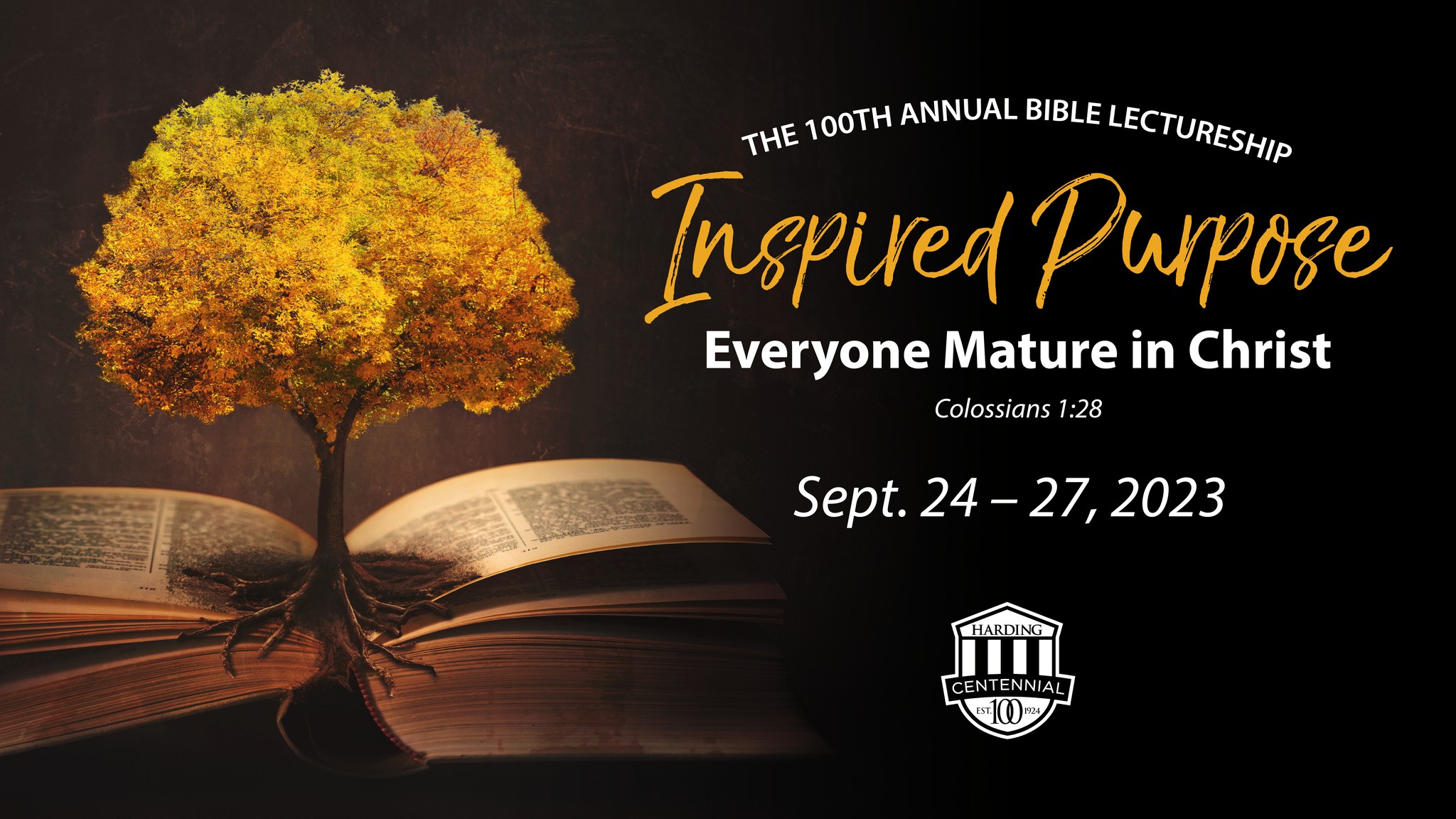
Harding University’s 100th annual Bible Lectureship was a couple of weeks ago, at the end of September. I always enjoy going to Lectureship, and have developed the practice of providing a quick recap of Lectureship and the different presentations I got to attend. The theme for this year was Inspired Purpose: Everyone Mature in Christ, and Colossians was the biblical book under study.

I was privileged to attend several good lectures and classes, and here is a brief recap of what I went to, along with some takeaway quotes:

Inspiration of our Purpose (Colossians 1.15-20), Jason Darden: Jason teaches Bible at Harding, and kicked off Lectureship with this Sunday night keynote. He focused on the Christ poem/hymn in Colossians 1 and talked about the “Jesus +” heresy of the Colossians Christians: the idea that Jesus Himself wasn’t enough, and that some additional element(s) was/were needed. Darden’s key takeaways were: (1) Imitate the faith of those you admire, (2) Cultivate your unique gifts through practice, (3) Duplicate your faith in Christ through mentorship.

Neller Preaching Workshop, Kevin Burr and Matt Love: I don’t normally go to the preaching workshop, but this year, the two speakers were two of my friends, so I caught four of the six sessions. Kevin (who has a PhD in New Testament) did a great job basically giving a verbal commentary on the book of Colossians, from which I took a ton of notes. Matt (who is getting his PhD in Preaching) spoke on the craft of preaching, and spoke about the preacher as Bard/Poet, Sage, and Tutor. Kevin and Matt were both excellent.

“We’re losing our churches at the expense of cool sermons.”

A Freed African to Free Africa: Alexander Cross and the Liberian Mission, Shawn Daggett: Shawn teaches missions at Harding, and shared the story of Alexander Cross, the first missionary from Churches of Christ to Africa. He himself was a freed slave, and had his freedom purchased by a southern congregation in order to enable mission work to the African nation of Liberia (Daggett was clear that this wasn’t done from entirely pure motives, but nevertheless: “These were people of the time who were seeking to change the times.”). Cross actually contracted malaria after reaching Africa and died soon after, but that doesn’t change the value of a sacrificial life offered in service to God.

“God counts success by faithfulness; not by numbers.”

Practicality in Youth Ministry, Garison Money and Erin Faurie: Garison and Erin are two of the associate youth ministers at the College Church of Christ here in Searcy. Garison shared some practical tips for youth ministry. I have been a youth minister for a long time, but these were still helpful reminders for me: (1) Get your parents on board, (2) Be involved, (3) Go deeper, (4) Get connected with the church and (5) Have fun. Erin spoke about why we need women involved in youth ministry (whether in official, paid roles or not), and offered three important reasons for this: (1) Women need women, (2) It’s empowering for students to see women in ministry, and (3) It promotes a Titus 2 mentality (where older women are instructed to teach those who are younger). I appreciate both Garison and Erin and enjoy working with them, and found these to be valuable reminders.

J.N. Armstrong: First Take Hold of My Heart, Monte Cox: With this being Harding’s 100th Lectureship, Dr. Monte Cox, the Dean of the College of Bible and Ministry, did a series of lectures on some important figures from Harding’s history. I went to his Monday presentation on J.N. Armstrong, Harding’s first president. Armstrong is a figure for whom I have a great deal of respect, and Monte shared eight striking characteristics about him: (1) He displayed a deep trust in God, (2) He deeply valued God’s grace, (3) He was a man of humble generosity, (4) His commitment to undenominational Christianity, (5)The pursuit of truth that leave room for honest disagreement, (6) The priesthood of all believers, (7) His conviction about kingdom-first priorities, and (8) His focus on the heart. I really enjoyed this presentation, and my admiration for Armstrong only increased!

Inspired by the Cross (Colossians 2.13-15), Steve Cloer: Steve teaches at Harding School of Theology and directs the Doctor of Ministry program there, and is one of my favorite preachers. His Monday night keynote was amazing, and focused on how the Colossian Christians felt weak, fearful, and overwhelmed, which led them to look for something in addition to Jesus to deal with their circumstances. Steve did a particularly good job of explaining the ideas of the “certificate of debt” and “triumphed in power” in Colossians 2 and expertly applied the Colossian situation to our context.

“Sin is not just a verb we need forgiveness for; it is a dominion we need freedom from.”

“Christ is everything and He can handle whatever makes us week, what we are fearful about, and whatever overwhelms us.”

Captive through Philosophy and Empty Deception—Spiritual Not Religious (Colossians 2.8), Steve Cloer: In this class, Steve addressed the mysterious “Colossian Heresy”, and applied that to the current context and the growing number of people who are interested in spirituality, but who want to do so outside of the institution of the church. He shared helpful (and hopeful!) data that breaks down the not religious crowd into four groups: (1) “I love Jesus, but not the church” people, (2) “Nothing in particulars”, (3) Atheists, and (4) Agnostics. What’s interesting is that atheists and agnostics, while very resistant to evangelism/faith, also only comprise 12% of the population, and that percentage isn’t growing. In an increasingly post-Christian society, it is the first two groups that are growing, and these folks are much more open to conversations about Jesus.

Why Disciple-Making Matters, Why Disciple-Making Now?, Eight Principles That Are Working There…and Will Work Here As Well, Paul Huyghbaert: This was a three-part disciple-making seminar that was excellent. I learned a lot and took a ton of notes. Huyghbaert presented a convicting and devastating critique of the current state of the American church, which is almost exclusively attractional, and is, overall, not growing either in terms of numbers or maturity. He then shared common characteristics of disciple-making movements, which are currently happening only in the Global South. These presentations left me with much to consider.

“The model embraced by the majority of North American churches produces shallow, surface-level believers.”

“The North American church spends, on average, $1.5 million per baptism.”

“What you celebrate is what is replicated.”

Multicultural Ministry—No Distinction between Greek and Jew (Colossians 3.11), Bob Turner and Juan Meza: Bob and Juan work at the Church of Christ at White Station in Memphis, which is making very intentional efforts to be a multicultural church. I didn’t take a lot of notes in this session because they largely shared stories, but it was encouraging to hear about their efforts to very seriously follow the “Gospel-centered mandate to be a multicultural church.”

Unmistakable Marks of Christlike Maturity (Colossians 4.2-6), Brian Mashburn: Mashburn wrapped up the lectureship with this Wednesday night keynote, providing somewhat of a summary of the whole lectureship and book of Colossians, and talking about what Christian maturity looks like. He also offered a pointed critique of some expressions of the Restoration plea, emphasizing that the goal is not to look like some mythically perfect first-century church, but to look like Jesus. Although I thought this was presented in somewhat of a strawman fashion, this is still a good reminder.


In addition to attending all of the lectures described above, I also had the opportunity to speak at the Harding School of Theology Luncheon on Wednesday. It was an honor to get to speak to such a large audience filled with so many of my mentors, former professors, fellow colleagues, and good friends. It was also a poignant event, as the gathering came on the heels of the announcement that HST will be moving from Memphis to Harding’s main campus in Searcy next fall.

I was blessed to attend Lectureship this year, to see so many old friends, and to sit at the feet of so many great teachers (indeed, I have been blessed again going over my notes and typing up these short summaries). I would highly recommend taking part in this next year if you are able!

Jeroboam and the Lure of Political Power

The Story of Jeroboam

Jeroboam is one of the Bible’s incredibly tragic characters. He was a man who God granted an amazing opportunity, and he squandered it away. 

Jeroboam’s story begins with King Solomon, who himself was a tragic character: a man who was given wisdom, power, and great wealth by God, but who turned away from God and began to worship other gods (1 Kings 11.1-8). Because of this, God ultimately determines to divide the kingdom of Israel in the days of Rehoboam, Solomon’s son. Rehoboam remains king over two tribes in the south (creating the Southern Kingdom of Judah), while Jeroboam is established as king over the remaining ten tribes (creating the Northern Kingdom of Israel).

The story is absolutely clear that God, in His grace, has offered a covenant agreement to Jeroboam: God will bless him, make him king over Israel, and give Him all that he desires if he will listen to God’s commands and walk in His ways like David did. And moreover, God promises to build Jeroboam a house or a dynasty like He did for David. 

Jeroboam’s rise to power was the work of God’s providential hand, and Jeroboam knew this. And yet, as soon as he sits down on the throne, Jeroboam’s thinking seems to shift from providential to pragmatic: the question Jeroboam asks himself is, “What do I need to do to stay in power?” 

Ironically, Jeroboam already had the answer—God had told him he simply needed to listen to God’s commands and walk in His ways as David did, but Jeroboam ignores that answer and pursues his own plans instead.

After some initial efforts to fortify some of his cities, Jeroboam makes his big mistake. He reasons that if the citizens of the Northern Kingdom return to the Jerusalem Temple (in the Southern Kingdom) to offer sacrifices as they are supposed to, it will draw their hearts back to Rehoboam king of Judah, and then they won’t want to follow Jeroboam anymore, and will overthrow him and return to Rehoboam and Judah. So Jeroboam gets what he thinks is a brilliant idea, and he makes two golden calves; he sets one up in Dan and another in Bethel, representing the northern and southern borders of the territory of the Northern Kingdom.

Scholars debate whether Jeroboam is trying to get the Israelites to worship another god by doing this, or, rather, if he is simply introducing an innovation in the way in which they worship Jehovah/Yahweh. I tend to think it is the latter, but calves are so closely related with Canaanite pagan religion that it is hard to be sure.

Either way, it doesn’t really matter. Even if Jeroboam was not setting up worship of a new god (and thus not violating the first commandment),  he was still guilty of creating an image to serve as a symbol of God (which violates the second commandment). So at the very least, he perverted the worship of the true God. Jeroboam’s disregard for the religious statues that God had set up did not stop there, as he also created alternate worship sites on high places at Dan and Bethel, put in place non-Levitical priests, and instituted his own feast day. These actions broke God’s commandments, and also revealed Jeroboam’s feelings that civil matters were more important than religious conviction.

Jeroboam has not been on the throne for long, but already he has dramatically departed from God’s instruction to walk in all His ways as David did. Instead, Jeroboam seems to have forgotten Who placed him on the throne in the first place, and rather than obey the real Power behind the throne, takes matters into his own hands to secure his position by his own power.

In 1 Kings 13, a prophet comes from God and condemns what Jeroboam has done, also predicting that judgment will come upon him because of it:

O altar, altar, thus says the LORD: “Behold, a son shall be born to the house of David, Josiah by name, and he shall sacrifice on you the priests of the high places who make offerings on you, and human bones shall be burned on you.” And he gave a sign the same day, saying, “This is the sign that the LORD has spoken: ‘Behold, the altar shall be torn down, and the ashes that are on it shall be poured out.’”

(1 Kings 13.2-3)

Not surprisingly, Jeroboam isn’t a big fan of this message and stretches out his hand: “Seize him!” But as soon as this happens, his hand “dried up, so that he could not draw it back to himself” (1 Kings 13.4). Ironically, in this very act, Jeroboam actually gives credibility to the prophecy—clearly, there is some power behind it because Jeroboam’s hand shrivels up, and furthermore, the altar was torn down as the prophecy said. Jeroboam asks the prophet to entreat God for him that his hand might be restored, and the prophet does so, and Jeroboam is healed.

Jeroboam is probably grateful to the man of God for his healing, and invites him to dine with him, but the prophet refuses because God had commanded him to return directly after his mission was completed. It is possible that dining with the king would have made the prophet appear to approve of the religious apostasy that Jeroboam was promoting.

Here, the narrative takes leave of Jeroboam and follows the young prophet and his strange interaction with an old prophet from Bethel. Since our focus is on Jeroboam we won’t dwell on this, but it is a tragic story of the young prophet from Judah being deceived by the older prophet from Israel, disobeying God, and dying as a result. This may seem like strange information to include in an extended narrative on the reign of Jeroboam, but it reinforces the idea that God expects to be obeyed, and severe consequences fall upon those who refuse to do so.

Regardless of this cautionary tale, 1 Kings 13 ends by saying:

After this thing Jeroboam did not turn from his evil way, but made priests for the high places again from among all the people. Any who would, he ordained to be priests of the high places. And this thing became sin to the house of Jeroboam, so as to cut it off and to destroy it from the face of the earth.

(1 Kings 13.33-34)

So this story also shows us that Jeroboam remains unrepentant—he is determined to continue his disobedience to God. 

The rest of Jeroboam’s reign isn’t very happy. His son grows sick, and when he enquires of a prophet of God to determine if his sone will recover, he learns that not only will his son die, but because Jeroboam had incited the wrath of heaven by leading the Northern Kingdom into idolatry instead of being faithful to the covenant God had offered him, judgment had been pronounced not just on Jeroboam, but on every male from his house—the line of Jeroboam will be wiped out.

We also know that he was a man of war, and that he warred constantly with Rehoboam, and also fought against Rehoboam’s son, Abijam/Abijah and was defeated by him (2 Chronicles 13) and never recovered the level of power he had previously had. 

And that is basically what we know about Jeroboam.

Sacrificing Principle for Political Gain

Jeroboam is one of the truly tragic characters of Scripture. His legacy is that he is the man who “made Israel to sin”—this lamentable epitaph is mentioned over 20 times in Scripture, and his sinfulness really summarizes the entire period of the Divided Kingdom. I think there are a lot of things we can learn from the sad story of Jeroboam, but I want to focus on just one that I believe is particularly relevant for a lot of people today.

Jeroboam’s blessing, security, and power rested in his obedience to God. Instead of trusting in God, however, he chose to do the pragmatic thing. He made religious changes for political reasons, thinking that this would ensure his longevity as king. Instead, it led to the downfall of his kingdom. Jeroboam’s power and position rested on his faithfulness, not his politics. 

If there is a lesson that I think American Christians need to hear in 2019—a time of rampant political division and rabid political devotion—it might be this one: political power is not the means by which Christians are called to change the world. 

As most of my readers know, I am a part of Churches of Christ, which find historical roots in the American Restoration Movement. Our heritage has an interesting and diverse relationship with politics. Some Restorationist voices were highly involved in politics: Alexander Campbell, one of the key early leaders in the movement, served as a member of the Virginia Constitutional Convention in 1829-30. James A. Garfield, 20th President of the United States, was a Restoration Movement preacher. 

Others had a much different view of politics. David Lipscomb, the longtime Gospel Advocate editor and a major leader in Churches of Christ in the decades following the Civil War, was avowedly apolitical. He was a pacifist who didn’t think Christians should serve in the military or even vote. J.N. Armstrong, the first President of Harding College, was strongly influenced by Lipscomb and had similar views.

I take this brief historical detour as a way of saying that I think that, in the spirit of Romans 14, the Christian’s relationship to politics is one of those areas where we are to do our best to follow the teachings and ethics of Jesus and be careful not to judge the scruples of others. 

Having said that, when it comes to politics, let us never sacrifice principle for political expediency.

In the crisis of the moment, it might seem like a good thing to do, but as Jeroboam learned, it never pays off. I think Jeroboam’s disobedience was largely motivated by fear—he was afraid of what would happen if he let the people go to Judah to worship, so out of his fear, he made a politically expedient decision. 

We live in an environment where political fervor always seems to be at a fever pitch. If we aren’t focused on a current or coming election, we are enamored with the latest political scandal or partisan feud.

In the last Presidential election, I heard a lot of fear from Christians (regardless of their political views) about what was going to happen. Speaking for myself (again, in the spirit of Romans 14, I am not placing judgment on those who disagree), I found myself unable to vote for either major party candidate. Both candidates had been in the public eye for a long time, and I knew plenty about the kind of people they were and the sort of character they had, and I didn’t feel like I could vote for either one. What really bothered me, though, was how often I was told or read from other Christians who supported one candidate or the other (because I got this from both sides of the aisle), that I basically needed to ignore my principles and vote for the “lesser of two evils” (whoever that may have been depending on the person I was talking to at the time), with the implication being that if I didn’t, our next President would likely bring about the end of the world.

You know, I don’t care who you vote for, but it does bother me:

  • When Christians encourage others to choose the lesser evil…because we aren’t supposed to choose evil in greater or lesser varieties!
  • When Christians encourage others to ignore their principles…because we aren’t supposed to ignore our principles!
  • When Christians suggest that the future hinges upon some human ruler…because God is the one who is in charge! When Pharaoh ruled the world, God freed His people from Egypt! When Nebuchadnezzar ruled the world, God saved three Hebrew teenagers from a fiery death! When Nero ruled the world, God orchestrated the greatest growth in the history of the church!

It is up to you to choose what your relationship with politics will be, and in my personal opinion, our political voice is an opportunity that we have to glorify God. However, let us never make the mistake of thinking that political power is the means by which Christians are called to change the world, or that it is acceptable for us to sacrifice our principles for the sake of political expediency.

The lure of political power is strong, and it can easily deceive us into thinking that the ends justify the means. But as Jeroboam learned, they do not. 

© 2026 The Doc File

Theme by Anders Noren — Up ↑








