The online journal of Luke Dockery

Tag: Jackie Robinson (Page 2 of 2)

Happy Jackie Robinson Day!

Sixty-two years ago today, on April 15, 1947, Jackie Robinson integrated Major League Baseball.

Robinson’s 10-year career had an unquestioned and inestimable impact on the Civil Rights movement in the United States. The skill and grace with which he played and the way he handled himself on and off the field forced many Americans to face difficult questions about race for the first time, and ultimately resulted in the changing of the hearts and minds of millions.

I’ve written more on Jackie Robinson here, but I just wanted to take note of today’s significance.

Preacher Roe (1915-2008)

I discovered yesterday that Preacher Roe had passed away on Sunday at the age of 92.

Roe was a left-handed pitcher who played in the Major Leagues in the 1940s and 50s, making five All-Star teams, leading the league in strikeouts once, and had a personal best record of 22-3 in 1951 with the Brooklyn Dodgers.

For his career, Roe accumulated 127 wins against 84 losses, a good record that likely would have been more impressive had he not missed time for service in World War II.

But the reason I know about Preacher Roe and the reason I thought all of this would be interesting to the majority of my readership is that Preacher Roe is the only Harding student to play in the Major Leagues. When I was at Harding, his old Dodgers jersey was on display in the Ganus Athletic Center, and I bet it’s still there.

Roe seems to have been an interesting character.

Born Elwin Charles Roe, he got his lifelong nickname at the age of 3 when his uncle returned from the first World War and asked his little nephew what his name was. Roe responded that his name was “Preacher” (apparently because he liked the local preacher who would take him on horse and buggy rides), and the nickname stuck.

He suffered a major setback early in his career when he was still with the Pittsburgh Pirates. In the 1945 off-season, while coaching a high school basketball game (baseball players didn’t make as much then as they do now), he suffered a skull fracture after getting into a fight with the referee. He struggled through the next few seasons.

He turned his career around in Brooklyn, however, where he began throwing the (illegal) spitball as his signature pitch, and played alongside Jackie Robinson.

In an interview later in life, Roe expressed his pride in getting to play with Robinson: “I just felt if Jackie hit a home run while I was pitching, it counted just as much for me as if Pee Wee Reese hit it or some of the other guys that were white…I’d say, ‘You never have seen a good ballplayer until you’ve seen him.’ He was that good.”

If you look closely at the picture below, the setting might be familiar to some of you…it was taken at Camp Tahkodah.

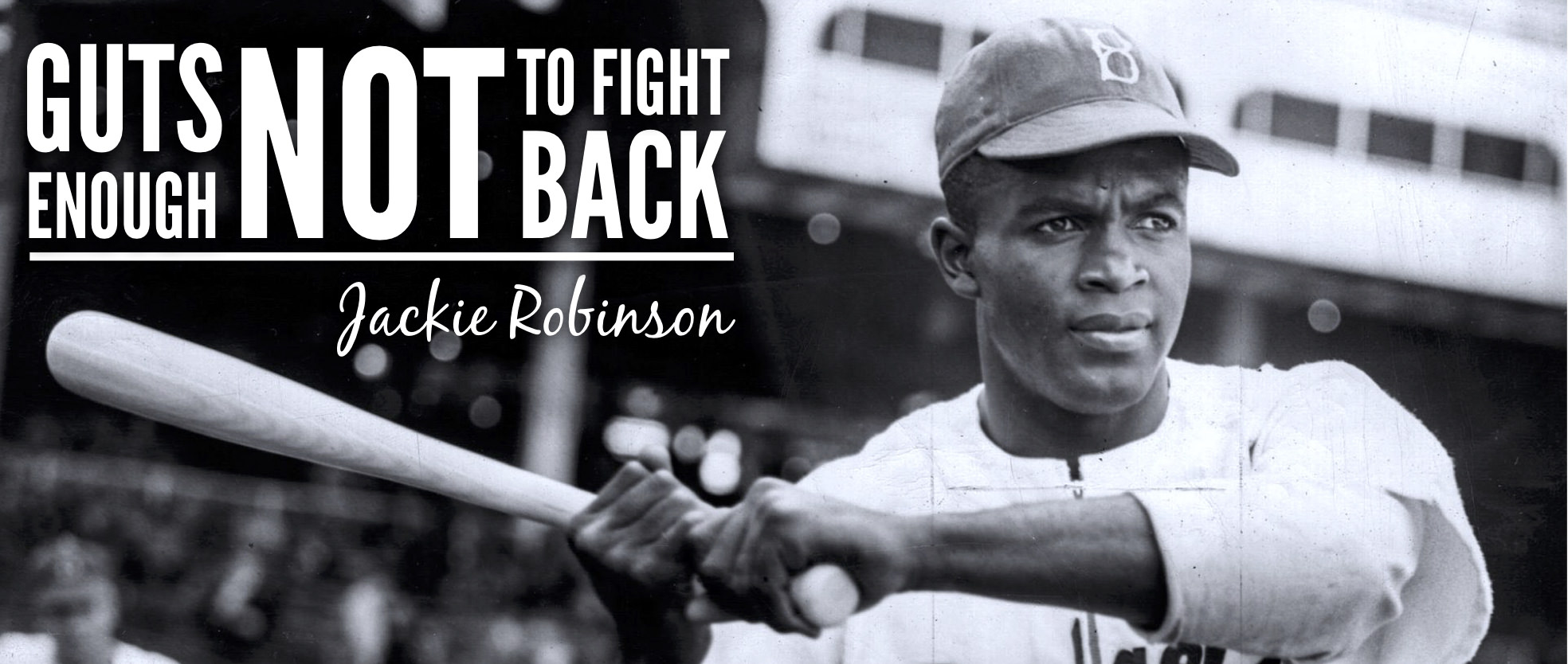
Guts Enough Not To Fight Back: Jackie Robinson

As a general rule in college and professional sports, teams retire the jersey numbers of the all-time greats who played for them. For example, no Chicago Bull can wear number 23, because that was Michael Jordan’s number and it has been retired. No New York Yankee can wear number 3, because that was Babe Ruth’s number and it has been retired. If you play Major League Baseball, regardless of what team you play for, you can’t wear the number 42, because that was Jackie Robinson’s number, and it is the only number to be retired by Major League Baseball.[1]

Sixty years ago yesterday, on April 15, 1947, Jackie Robinson donned that number 42 Brooklyn Dodgers jersey and appeared in his first regular-season Major League game, breaking baseball’s racial color barrier.[2]

Robinson’s Hall of Fame career and the way he handled himself on and off the field opened doors for other black athletes in professional sports (and ultimately many other fields as well), and it has been said that only Dr. Martin Luther King Jr. accomplished more for the American Civil Rights Movement than did Jackie Robinson.

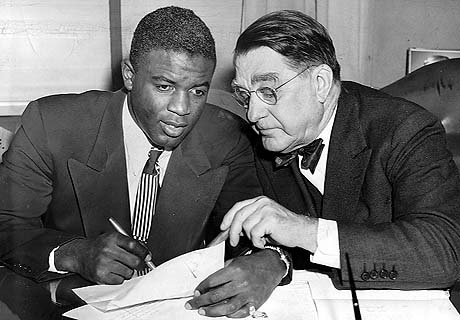
Jackie Robinson and Branch Rickey

Before he signed a contract to play for the Dodgers, Robinson was called into the office of Team President and General Manager Branch Rickey. To give him a taste of what it would be like to be the only black player in the Big Leagues, Rickey spent three hours taunting and insulting Robinson, calling him every racial slur he could think of. Rickey then told Robinson that this is what he would face every day on the field and that if he wanted it to work out, he would have to promise not to fight back or respond to insults of any kind for the first three years of his career.

Robinson, who possessed a fiery temperament and was very outspoken (he was actually court marshaled for refusing to sit at the back of a military bus), was put off by this and asked, incredulously, “Mr. Rickey, are you looking for a player who is afraid to fight back?”

Branch Rickey replied, “No, I want someone with guts enough not to fight back.”

After some deliberation, Robinson agreed to Rickey’s terms, and he lived up to them on the field. When opposing baserunners tried to spike him when sliding into second base, he didn’t fight back. When fans and players yelled and cursed at him and even questioned his very humanity, he showed them how wrong they were by taking the moral high ground.

He had the guts not to fight back.

What Branch Rickey told Jackie Robinson reminds me of Jesus’ words in The Sermon on the Mount in Matthew 5:

“But I tell you, do not resist an evil person. If someone strikes you on the right cheek, turn to him the other also. And if someone wants to sue you and take your tunic, let him have your cloak as well. If someone forces you to go one mile, go with him two miles.”

The world tells us to stand up for ourselves when we are treated unjustly. It tells us to have the courage to fight back and not let others push us around. On the other hand, Jesus tells us to have the courage to show that we are different from the world because we don’t fight back, and He tells us to forgive others when they mistreat us.

Jesus wants followers with guts enough not to fight back.


[1] Major League Baseball has established the practice of temporarily lifting this prohibition on April 15 to commemorate the anniversary of Robinson’s first game as a Dodger, as representatives from each Major League team wear number 42 in his honor.

[2] Contrary to popular belief, Robinson was not the first African-American to play in the Major Leagues. That honor goes to Moses Fleetwood Walker, who played for the Toledo Blue Stockings in 1884. Regardless of this, Robinson was the first African-American to play Major League Baseball in the 20th century, and it was his breaking of baseball’s color barrier that led to the permanent integration of the Major Leagues.

34 Years Ago Today

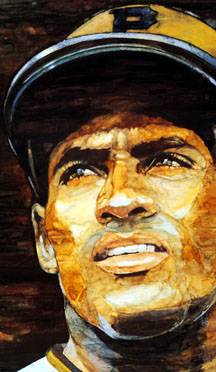
Baseball legend Roberto Clemente died 34 years ago today.

Born into humble circumstances on August 18, 1934 in San Juan, Puerto Rico, Clemente was a gifted athlete with a passion for baseball, and by the time he was 17, he was playing for the Santurce Crangejeros, a Puerto Rican minor league team. Clemente was a real talent who could do it all; he could hit to all fields with power, he was a great baserunner, and he had an incomparably strong throwing arm.

While playing for Santurce, he was discovered and drafted by the Dodgers, signed to play for the same AAA Montreal Royals that Jackie Robinson played for, and experienced many of the same types of racial discrimination. On top of that, because he was a bonus baby, Clemente had to fight through the Dodgers’ efforts to hide his talents. Not wanting other clubs to discover how good he really was, the Royals’ manager would keep Roberto, a right-handed batter, out of the lineup against left-handed pitching, and would bench him enough to prevent him from getting into any sort of rhythm with his swing. But some talents cannot be hidden, and realizing how good Roberto could be, the Pittsburgh Pirates signed him after the 1954 season for $4,000.

After a mediocre rookie season (he only hit .255), Clemente hit .311 in 1956 and began to form his reputation as one of the best players in the game. In the field, he made spectacular catches and threw out runners all over the basepaths with his incredibly strong and lethally accurate arm (Vin Scully once said that Clemente could field the ball in New York and throw out a guy in Pennsylvania), and at the plate, he hit to all parts of the field and came up with big hits in clutch situations.
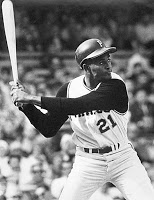
But not all was perfect in Pittsburgh. Clemente felt out of place and isolated there, living in a city with no Hispanic community to speak of. Proud of his Latino heritage, he bristled when sportswriters called him “Bobby”, and was constantly accused by the media and fans alike of being a hypochondriac, despite the fact that he played in constant back pain from a spinal injury he suffered in a car accident during his rookie season, and played 152 games during the 1965 season while suffering from an attack of malaria.

Roberto also felt under-appreciated as a Latino star playing for the small-market Pirates, as he received little nationwide attention despite leading Pittsburgh to a World Series title in 1960 and winning batting titles in 1961 and 1964. Even after a dazzling 1966 season that won him the National League MVP award, he was still not as well-known as other stars like Hank Aaron and Willie Mays.

By 1971, Clemente was a veteran of 16 seasons in the Major Leagues and was undoubtedly one of the very top players in the game, but still didn’t receive much national attention. But in 1971, the Pirates played the Baltimore Orioles in the World Series, finally putting Roberto in the national spotlight, and he made the most of it. He played inspired baseball, hitting .414 for the series with 12 hits and two home runs while playing his usual spectacular defense in the outfield. Pittsburgh won the series four games to three, and Clemente won the MVP award for the series.

The next fall, on September 30, 1972, Clemente doubled off of Jon Matlack of the New York Mets. It was the 3,000th hit of his illustrious career. It would also turn out to be his last.

After the end of the season, on December 23, 1972, a severe earthquake hit the city of Managua, Nicaragua, killing over 7,000 people and leaving over 250,000 homeless. Roberto, who had previously traveled to Nicaragua and had many friends there, was affected very deeply, and, according to his wife, said over and over, “Something has to be done! Somebody has to do something!”

What he did was to work furiously over the next few days collecting supplies and donations for the earthquake victims. He worked close to 20 hours a day, sleeping very little, and not even taking the time to open Christmas presents. But his work was a success, as he collected over $150,000 and more than 26 tons of clothing, food, and medicine.
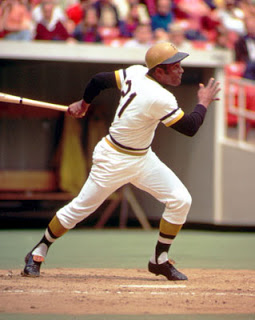
Roberto hired an old DC-7 airplane to take some of the supplies down to Nicaragua on December 31, but the plane was barely in the air when one of the engines began to vibrate and caught fire. After a series of explosions, the plane fell to the Atlantic Ocean, within a mile of the Puerto Rican coast. There were no survivors, and the bodies of Clemente and the other four passengers were never recovered.

In 1973, Clemente became the second Latin American to be elected to the Baseball Hall of Fame. Baseball commissioner Bowie Kühn waived the mandatory five-year waiting period, saying it wasn’t necessary “because of how great Clemente was as a player, how great he was as a leader and how great he was as a humanitarian.”

Kühn also said:

“[Clemente] gave the term ‘complete’ a new meaning. He made the word ‘superstar’ seem inadequate. He had about him the touch of royalty.”

Apart from being a Hall of Fame-caliber player, Roberto Clemente was a pioneer, whose excellence in the Big Leagues opened the door for the Latin American players of the future. Due in large part to his accomplishments, Latin Americans dominate today’s game as never before.

But Clemente was more than that. In his life, he was the pride of Latin America, and a hero and example for his teammates, his fans, and his family. In his death, he was the pride of the whole world, and was a hero and example for all of us.

Roberto Clemente’s life made him famous; his death made him a legend.


Sources for this post include The Baseball Almanac, BaseballLibrary.com, El Pelotero Online, Latino Sports Legends, and Baseball Reference.

Newer posts »

© 2026 The Doc File

Theme by Anders Noren — Up ↑