The Gospel of John is one of my favorite books in the Bible, and one of its special characteristics is that, more than any other, it emphasizes the divinity of Jesus. This is done over and over again and in many different ways, but one interesting way it does so is through an allusion in John 1.47-51.
Here, Jesus calls Philip to follow Him, and then Philip subsequently goes and recruits a man named Nathanael as well. Nathanael is skeptical that Jesus, from the lowly town of Nazareth, could be the Messiah whom Moses and the prophets had proclaimed, and so Philip invites him to go and see Jesus for himself:
47 Jesus saw Nathanael coming toward him and said of him, “Behold, an Israelite indeed, in whom there is no deceit!” 48 Nathanael said to him, “How do you know me?” Jesus answered him, “Before Philip called you, when you were under the fig tree, I saw you.” 49 Nathanael answered him, “Rabbi, you are the Son of God! You are the King of Israel!’’
(John 1.47-49)
Although Nathanael was really impressed that Jesus knew what he had been doing before they had even met, Jesus basically told him that he hadn’t seen anything yet:
50 Jesus answered him, “Because I said to you, ‘I saw you under the fig tree,’ do you believe? You will see greater things than these.” 51 And he said to him, “Truly, truly, I say to you, you will see heaven opened, and the angels of God ascending and descending on the Son of Man.”
(John 1.50-51)
If you know are familiar with the narratives of Genesis, then the imagery of heaven opening up and angels ascending and descending is probably very familiar to you, and it almost certainly would have been familiar to Nathanael. It is most likely an allusion to Genesis 28, where Jacob, while on a journey to Haran to stay with his uncle Laban (and ultimately get married), stops to sleep for the night, using a stone for a pillow:
12 And he dreamed, and behold, there was a ladder set up on the earth, and the top of it reached to heaven. And behold, the angels of God were ascending and descending on it!
(Genesis 28.12)
At the top of the ladder, the LORD appears, and basically reaffirms to Jacob the same promises that He had previously made to Abraham and Isaac. When Jacob awakens from his sleep, he realizes that something significant has happened:
16b “‘Surely the LORD is in this place, and I did not know it.’ And he was afraid and said, ‘How awesome is this place! This is none other than the house of God, and this is the gate of heaven.’”
(Genesis 28.16b)
The next morning Jacob takes his stone pillow and sets it up as a monument, naming the place “Bethel,” which means “house of God.” This approximates temple language, and likely gives us a better picture of what Jacob’s dream looked like. Scholars suggest that what Jacob saw was not a “ladder” as we think of it, but a ziggurat, a Mesopotamian step-pyramid/temple.[1] In the cosmology of the ancient world, temples were overlapping spaces that linked heaven and earth, God’s space and human space. Ziggurats, in particular, had extensive staircases that were designed to connect divine space with human space and enable gods to “come down” to their temples.
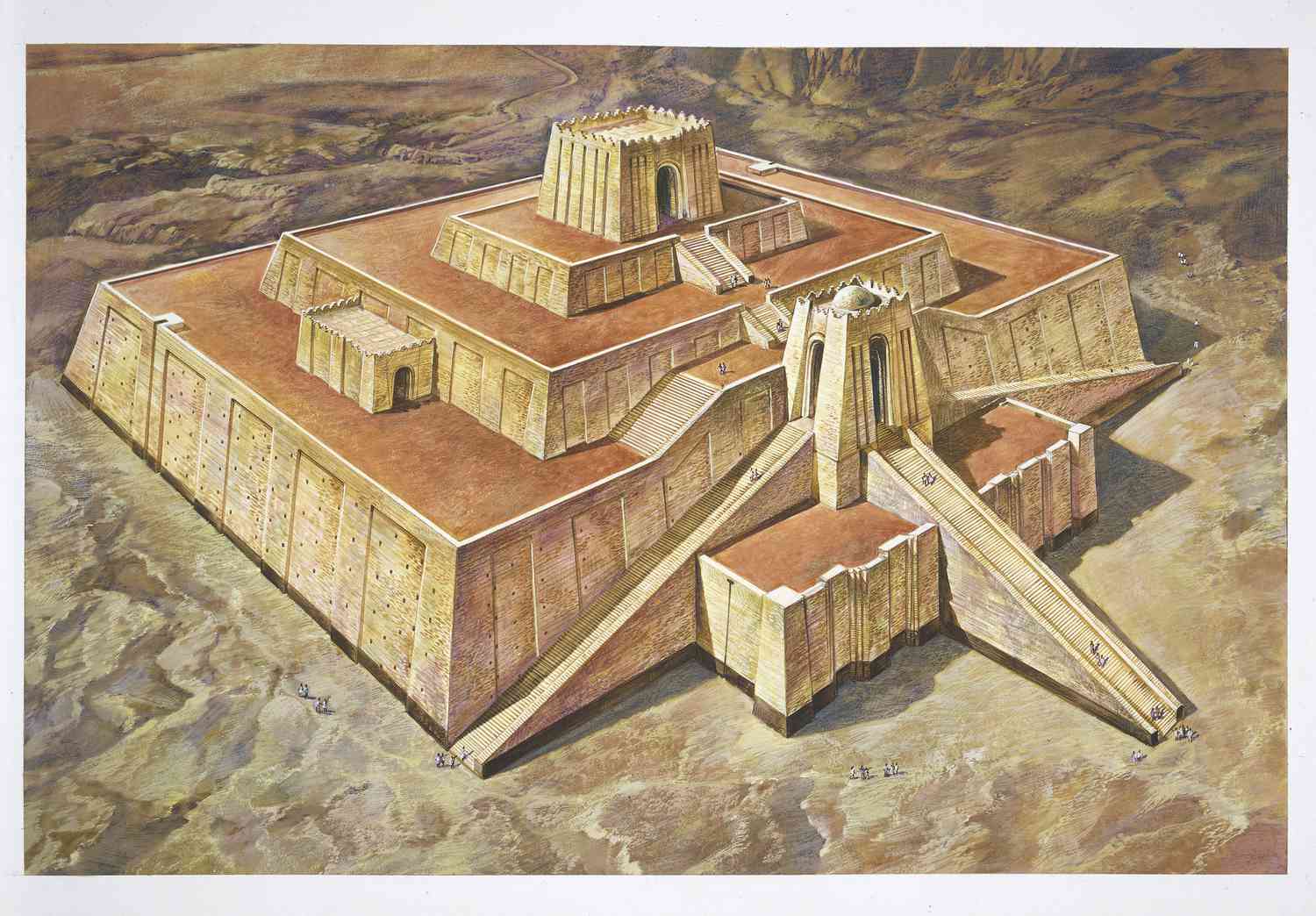
Ancient ziggurats had extensive steps, ideal for the ascending and descending that Jacob witnessed in his dream.
As already suggested above, the language of Genesis 28.12 and John 1.51 is so similar that it seems clear that Jesus was intentionally alluding to Jacob’s dream. So what does the connection mean?
In Jacob’s dream, a “ladder” connected earth (where Jacob is) and heaven (where the LORD is), and angels ascend and descend upon the ladder. Jacob is awed by what he sees. In John 1, Jesus paints a similar picture for Nathanael: the heavens open, and the angels of God are ascending and descending. The difference is that now, instead of ascending and descending upon a ladder, the angels are doing so upon the Son of Man—Jesus Himself.
The implication is that Jesus is the new “ladder”, the New Bethel, the new house of God.
This is the greater thing that Nathanael will get to see: just as Bethel was the place where the heavens were connected to earth, so Jesus is the medium through which heaven and earth, God and man, are brought together.[2]
Just as Bethel was the place where the heavens were connected to earth, so Jesus is the medium through which heaven and earth, God and man, are brought together. Share on XThe Gospel of John affirms here—as it does elsewhere—that Jesus was absolutely unique. As the Son of God, His roots were in heaven, but as a human, He also put down roots on earth. This is the wonderful mystery of the Incarnation, the Word becoming flesh, and is what enabled Him to carry out the work of reconciling creation to its Creator (cf. 2 Corinthians 5.18-19).
 In this loose series of Scripture Reflections, I am sharing brief thoughts spurred on by my Bible reading. By way of reminder, my goal for these brief posts is two-fold:
(1) To remark on aspects of the biblical text that I find to be of interest that the reader may or may not have thought about previously.
(2) When possible, to point to the work and person of Jesus Christ. I believe the Bible is a unified story that points to Jesus, which means that He is frequently alluded to or foreshadowed in some way throughout the biblical canon.
[1] For example, see Scott Aniol, “What Was Jacob’s Ladder?”, By the Rivers of Babylon, October 9, 2024.
[2] F. F. Bruce, The Gospel of John, (Grand Rapids: Eerdmans, 1983), 62: “In this application of Jacob’s vision, however, the union between earth and heaven is effected by the Son of Man: he is the mediator between God and the human race.”