The online journal of Luke Dockery

Tag: Jesus (Page 11 of 15)

Jesus, the Pharisees, and the Sadducees

In Backgrounds of Early Christianity, Everett Ferguson has a really good summary of the Pharisees and Sadducees, especially in the sense that he moves past a lot of unhelpful oversimplifications of the Pharisees (i.e., the idea that all Pharisees were hypocrites).

I really liked this summary statement of what separated Jesus’ views of the Hebrew Scriptures from that of the Pharisees and Sadducees:

[The] interpretation of the law in terms of fundamental principles distinguishes Jesus from the rival groups in Judaism of his day. According to him the Sadducees were right in exegesis—the Scriptures did not mean what the Pharisees made them mean—but they were wrong in relegating Scripture to the place of an archaic relic with less and less relevance to the present. The Pharisees were right in trying to keep Scripture applicable, but were wrong in their method by making tradition superior or equal to the written word.

Jesus offered a corrective to both viewpoints. The written word is authoritative, but the great fundamental principles therein take precedence and provide the standard by which it is to be interpreted and applied.

(p.518)

Reaching Your Spiritual Potential: Introduction

Misunderstanding the Spiritual

The Gospel of John is one of my favorite books in the Bible. I took a course on it in undergrad and a second one in grad school. I’m also now teaching it for the second time.

One of the repeated themes in John’s Gospel, something that you see over and over, is the idea of misunderstanding—Jesus presents some form of teaching, and His audience completely fails to understand what He is talking about.

  • This is very apparent in John 3, where Jesus tells Nicodemus that he must be born again, and Nicodemus can’t understand Him because he’s trying to imagine a physical rebirth—re-entering his mother’s womb to be born again (which, admittedly, would be pretty difficult).
  • We see it again in John 4, when Jesus is talking to the Samaritan woman at the well; Jesus talks about “living water”, referring to something spiritual, but the woman assumes that He is talking about a special kind of water which can be seen, touched, and drunk.
  • Later on in John 6, Jesus says that He is the bread of life, and that those who eat His flesh and drink His blood have eternal life. This turns off a lot of the people, because they think He is literally talking about eating Him.

There are more examples that we could give, but I think you can see the point—over and over again in John’s Gospel, people misunderstand what Jesus is saying, and the reason for this is that Jesus is focused on spiritual teachings while His audience is locked in on the physical side of things.

You know, I think we have a very similar problem today.

Oftentimes I think we struggle to do the things that Jesus calls us to do and to live the way He expects us to live because we are so focused on the physical—what we can see and touch—that we tend to neglect the spiritual.

“Reaching your Potential”

There’s a lot of talk in our world today about “reaching your potential”.

You hear it a lot in the context of athletes and sports teams. A coach might talk about how his team has a lot of talent, but how they have to work to reach their full potential. You also hear it in the context of education—a particular student may have a lot of natural ability, but a lot of work is involved to be the best student he or she can be.

Potential involves raw talent and ability, but getting the most out of it requires hard work! No Hall of Fame athlete achieved that success without committing himself to long hours of exercise and practice. No Rhodes Scholar ever achieved that honor without committing herself to long hours of study and review.

I think the same thing is true in regards to spiritual potential.

For those of us who have committed our lives to Christ and have put Him on in the waters of baptism, it is our responsibility to mature and develop spiritually, to work to follow Jesus more closely and live increasingly holy lives. Another way of saying that is that it is our duty to reach our spiritual potential![1]

But how do we do that? I’d like to spend a few posts looking at practical ways in which we can develop our spiritual potential. These aren’t new or flashy ideas; they are simple steps which require hard work and diligence. But if followed, they are practices which will help us to reach our spiritual potential and serve God more effectively.


[1]Some readers will likely feel uncomfortable by some of the language in this paragraph which emphasizes our role in our spiritual growth and development. Isn’t it God’s work (though Christ) which saves us? Isn’t it God’s work (though the Spirit) which sanctifies us? Certainly. But neither of those truths eliminates the fact that we also have a role to play. Your own personal efforts can’t make you holy, but at the same time, the work of the Spirit won’t happen without your willingness and cooperation.

Lessons from David: Sin Can Be Forgiven

In our quick look at some of the many lessons that could be learned from the life of King David, we have noted that God Can Use Unlikely People To Accomplish His Will, and somewhat somberly, that Sin Has Consequences. Today we conclude this series on an upbeat note by pointing out one of Scripture’s central truths: Sin Can Be Forgiven.

David’s guilt was plain in the matter of Bathsheba and Uriah the Hittite: he lusted after Bathsheba, he committed fornication, he abused his power as king, and ultimately, he had Uriah killed to cover up what he had done.

But ultimately, God forgave David of his great sin:

“Then David said to Nathan, ‘I have sinned against the LORD.’ And Nathan said to David, ‘The LORD also has taken away your sin; you shall not die.’”

(2 Samuel 12.13)

The Book of Psalms records David’s words of repentance:

“Be gracious to me, O God, according to Your lovingkindness; According to the greatness of Your compassion blot out my transgressions. Wash me thoroughly from my iniquity and cleans me from my sin. For I know my transgressions, and my sin is ever before me.

Create in me a clean heart, O God. And renew a steadfast spirit within me. Do not cast me away from Your presence. And do not take your Holy Spirit from me. Restore to me the joy of Your salvation And sustain me with a willing spirit.”

(Psalm 51.1-3; 10-12)

God was willing to forgive David of his sins, and the good news for us is that He will do the same for us if we repent. Some of my favorite verses in all of the Bible speak to this truth:

“As far as the east is from the west, so far has He removed our transgressions from us.”

(Psalm 103.12)

“…If we walk in the light as He Himself is in the light, we have fellowship with one another and the blood of Jesus His Son cleanses us from all sin.”

(1 John 1.7)

That forgiveness doesn’t mean that all of the physical consequences of sin will necessarily go away. David’s child still died, no matter how hard he prayed about it. The drunk driver who takes a life will still face prison time, and will still have to deal with the guilt of having killed someone for the rest of his life. The pregnant teenage girl will still have to face the trials and stigma of being a single parent. No matter how hard the woman tries, she may never be able to completely undo the damage of hateful words.

But, the eternal, spiritual consequences can disappear.

Jesus died on the cross to bridge the gap that sin had created between us and God, and when He did that, He received the punishment for sin so that we would not have to. The Bible’s best-known verse, John 3.16, says, “For God so loved the world, that He gave His only begotten Son, that whoever believes in Him shall not perish, but have eternal life.”

As mentioned in the last post, our wages—what we deserve in return for our sin—is death. But thanks to Jesus, we don’t have to get what we deserve; we can have eternal life with Him instead.

Biblical Faith: A Reasonable Leap

As I mentioned last week, I want to spend the next few Mondays looking at biblical faith, because even though “faith” is a popular topic in today’s society, I’m not sure that it’s understood all that well (even by some Christians).

Today, I want to get a better idea of what biblical faith is by looking at a couple of things that it isn’t.

Biblical Faith Is Not Blind Faith

I think a lot of people who are not believers seem to have the idea that, in order to be a Christian, you have to be incredibly gullible or foolish. Basically, they think that you have to have blind faith, that you’re willing to accept anything that Christianity claims without any evidence at all. For people like this, being a Christian and having faith in God makes about as much sense as believing in unicorns or leprechauns.

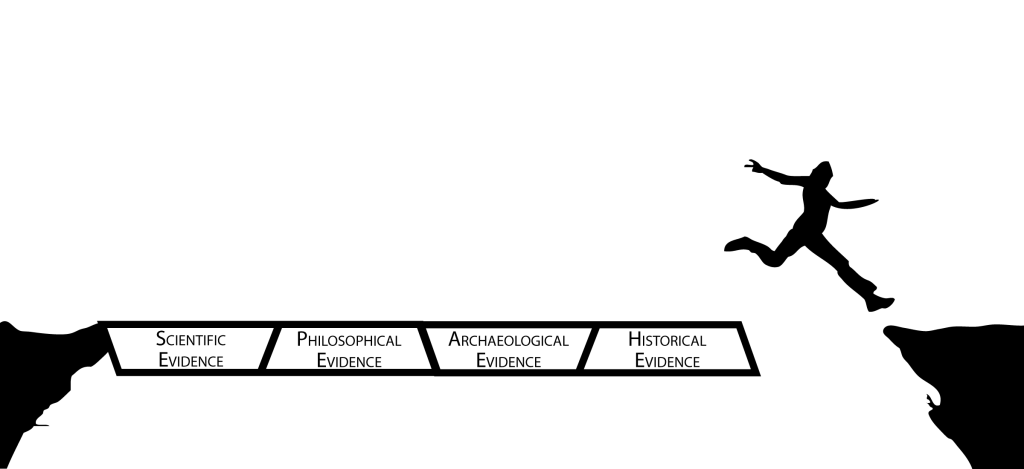
To illustrate this kind of faith, you might imagine two cliffs facing each other with a vast chasm in between. In order to get from one side to the other, a massive leap of blind faith is required.

If that was what the Bible required of me—blind faith—then I would have a hard time accepting the claims of Christianity myself.

But that’s not what biblical faith is. Biblical faith is something that comes about in conjunction with evidence.

When God appeared to Moses to enlist him to free the Israelites from Egypt, He appeared to him in the form of a bush which was on fire but was not burning up. This miraculous appearance gave Moses evidence that God was who He said He was.

When God called Gideon in Judges 6 to free the Israelites from under the yoke of Midian, Gideon is hesitant at first. And maybe that makes sense when you realize that Gideon was apparently raised in a household of Baal worshipers. By asking for the sign of the fleece, Gideon is basically asking for evidence that God is who He says He is. And God has no problem providing that evidence.

In Jesus’ earthly ministry, He was constantly going around performing astounding miracles. Of course, He did this because He loved people and wanted to help them, but He also did it in order to provide evidence that He was who He said He was (cf. John 20.30-31).

Over and over again in the Bible, we see that God didn’t expect people to respond in blind faith, and that He was perfectly willing to provide evidence to support their belief.

And the same is true for us today—there is plenty of evidence which supports the claims of Christianity. It is a reasonable faith—you don’t have to park your brain in order to be a Christian! I don’t want to derail the purpose of this post with a foray into Christian evidences, but there are multiple arguments and evidences from a variety of fields—science, philosophy, archaeology, history, and others—which lend credence to the truth of Christianity.

Biblical faith is not blind faith; it’s a faith which is informed by evidence.

Biblical Faith Is Not Absolute Certainty

If on one extreme you have people who claim that Christians are gullible people who have blind faith without any evidence at all, on the other extreme, you have some Christians who claim that faith is an absolute certainty and have the misconception that we can go about proving our faith to people.

Going back to our metaphor of the two cliffs, this perspective would require no leap at all; you’d just have a bridge which would carry you effortlessly across the chasm.

The problem with this notion is that biblical faith is not absolute certainty. You see, when you talk about something being absolutely certain, you remove any element of doubt, and any element of hope. And at that point, you’re no longer talking about faith, you’re talking about sight. But as Paul says in 2 Corinthians 5.7, “…we walk by faith, not by sight.”

I think the story of Thomas in John 20 really illustrates this point. After Jesus’ resurrection, He appears to the apostles but Thomas is not with them when He comes. So the other disciples try to tell Thomas about it but he doesn’t believe and says he won’t believe until he can see Jesus for himself and touch his wounds.

Eight days later, the apostles are together again and this time, Thomas is with them. Jesus appears to them and basically says to Thomas, “Here I am Thomas, what do you think?” Thomas answers, “My Lord and my God!” Jesus gives Thomas a mild rebuke: “Because you have seen Me, have you believed? Blessed are they who did not see, and yet believed.”

Jesus is not looking for us to prove Him; He’s not looking for us to never have any doubts or any questions. He is looking for us to have faith in Him despite whatever doubts or questions we may have. He’s looking for us to walk by faith, and not by sight!

A Reasonable Faith

There’s nothing wrong with studying Christian evidences and using that evidence to strengthen our faith. In fact, those types of things are a big part of my faith; they help me to see that Christian faith makes sense and is reasonable. But the evidence we have never reaches the point of proof, and at some point, we still have to make a leap of faith.

Returning one more time to our cliff metaphor, biblical faith would not require a blind leap across a vast chasm, but neither would it be an easy trot across a bridge. Instead, it’s something like the image below: evidence bridges much of the gap and makes the remaining distance manageable, but at some point, you still have to make the leap of faith.

So that leaves us with a picture of reasonable faith: the Bible does not demand that we base our lives on myths and fairy stories; neither does it offer certainty free from doubt (nor condemn us when doubts arise).

As Christians, we struggle through a world of difficulty and doubt, but we are confident that one day, when Jesus returns, we will see him for ourselves.

A Difficult Birth, Part 3: The Danger of Christmas

This week I’ve been discussing why the Birth of Jesus was a difficult one, and how we tend to smooth out the rough edges of the Christmas story. But ultimately, it’s a good thing for us that it was a difficult birth, because it helps us to see how to better live our difficult lives.

The first post addressed the element of scandal in Christ’s birth, and yesterday’s post focused on the discomfort of Christmas.

The Danger of Christmas

In those nice Hallmark cards it sure seems like Jesus is plenty safe, but Matthew 2 shows us the danger that was involved in this story. There we learn about the visit of the wise men and there is a lot about the wise men that we don’t know, a lot of things we commonly think of that might not have been true.

Were there three wise men? We don’t know; we often assume that there were three because there were three gifts mentioned, but the Bible doesn’t actually give us the number. Also, if you read carefully, the wise men weren’t there with Jesus right when he was born. Matthew 2.11 says “And going into the house they saw the child with Mary his mother…”, so by the time the wise men saw Jesus, he was no longer in the manger and was instead in a house.

The wise men were from “the east”, probably Babylon or Persia; they would have been astrologers, followers of the stars.

These men come to King Herod in Jerusalem and they ask him, “Where is he who has been born king of the Jews?”

And Herod is troubled by this, because he kinda thought that he was the king of the Jews, and he certainly didn’t want to have any rivals for the throne. In fact we know from history, Herod was actually a pretty terrible guy, and to protect his power, he murdered his own wife, several of his sons, and some other relatives as well. And so it’s no surprise that he wants to eliminate this baby king that had been born.

So Herod brings the chief priests and scribes together in order to learn where the Christ, the Messiah, was supposed to be born, and they point him to Micah 5.2 and say that he’s supposed to be born in Bethlehem.

Then Herod calls the wise men back, encourages them to search for Jesus, and then to return and let him know where He is when they find Him. And the wise men do find Jesus, but they’re warned in a dream not to tell Herod anything, and so they go home a different way. At the same time, an angel of the Lord appears to Joseph in a dream in Matthew 2.13 and warns him that Herod wants to kill Jesus, so in the middle of the night, Joseph scoops up his wife and infant son, and they flee to Egypt. They leave the country.

At some point, Herod realizes that the wise men aren’t coming back and that they’ve tricked him. Enraged, he decides to kill all the male children in Bethlehem and in the whole surrounding region who are 2 years of age and under, just to make sure.

And so tragedy and heartbreak enters homes all over, as mothers have their baby boys torn from their arms, fathers watch helplessly, and soldiers draw their weapons, carrying out the orders of a murderous madman.

You don’t see all this in the Christmas cards, but the birth of Jesus was a dangerous time.

Danger in Our Lives

Just like we try to smooth over the danger in the Birth of Jesus, a lot of times we try to do that in our lives as well.

To be honest, most of us don’t actually face a lot of danger in our lives. It might be different if you are in the military or serve as a policeman or fireman, but those are careers; rarely do we face danger in the world today for the cause of Christ, unless you’re a missionary (where danger can be a very real thing).

What we do face though, is the reality of living in what is called a post-Christian society. Living in a society like this doesn’t put us in the path of the same kind of life-and-death danger we talked about in conjunction with the birth of Jesus, but it does mean that Christians can face social and perhaps economic fallout for trying to live according to the teachings of the Bible and sharing those teachings with others.

If you’ve followed the Duck Dynasty saga this past week you know exactly what I’m talking about. I don’t want to get off topic here by addressing that issue in detail, but I don’t think there’s any denying that some of teachings of the Bible cause a great deal of backlash with our society today. At times in can be easy for us to feel like we get picked on just for believing what the Bible says.

But I think Christians of the first century would look at the “persecutions” we go through in our country today and kind of chuckle, because it’s nothing like what they had to deal with. At least for now, no one here is in danger of being fed to lions in the Colosseum or being beheaded and having their heads used as lanterns in the emperor’s garden.

And to those Christians, our brothers and sisters of two millennia ago, the writers of the New Testament didn’t tell them to smooth over the dangers of the Christian life:

They didn’t tell them to avoid persecution at all cost…

They didn’t tell them to fight against it…

They didn’t tell them to run to Facebook in protest…

They told them to be ready for it, to be prepared, because it was coming…

These early Christians were reminded that Jesus was persecuted and killed, and that if that happened to Him, then surely His followers could expect to face trials and persecutions as well. And the same goes for us. But if we do face trials and persecutions for the cause of Christ, that’s okay: it’s a sign that we’re doing it right.

Don’t try to avoid the dangers of the Christian life. Don’t run from the persecutions. Be prepared for them, and glorify God when they come. Be a living sacrifice for Him.

Conclusion—A Difficult Birth Indeed

The birth of Jesus—as it really was—was a difficult birth. It doesn’t really fit in a children’s story or on a Christmas card. But for us, that’s good news! It shows us how to live our difficult lives!

The scandal of Jesus’ birth reminds us that we don’t have to fear the scandal in our lives or the sin in the world. Jesus has overcome sin! He wants to take it away from you if you’ll let Him! His blood can cleanse the sin of the world, if we’ll share it!

The discomfort of Jesus’ birth reminds us that comfort is not all it’s cracked up to be. It’s not God’s goal for your life. Seek to live a life that is uncomfortably devoted to God!

The danger of Jesus’ birth reminds us of the possibility—nay, the likelihood—that we’ll face trials and persecutions as we strive to follow Jesus. Don’t try to avoid them, don’t fret about them; glorify God through them.

Praise be to God for the oh-so-difficult birth of His Son!

« Older posts Newer posts »

© 2026 The Doc File

Theme by Anders Noren — Up ↑