
The online journal of Luke Dockery

Tag: Jesus (Page 13 of 15)

Christmas 1914 and the Hope for Peace

The Christmas Truce of 1914 is fairly well-known; my brother once wrote about it here:

“The First World War broke out in August of 1914. Many rushed to war almost gleefully, confident in victory for their particular side. Many thought the war would be over by Christmas. But when Christmas came the war was still young. It would last another four years and claim the lives of some 8 million soldiers before it was through.

In the midst of this bloodshed, though, a remarkable thing happened. In many places along the Western Front, particularly where the British and the Germans faced each other, unofficial Christmas truces were made in 1914. And here, for a brief few hours, the killing ceased.

Instead of firing bullets at each other, the mortal enemies sang Christmas carols to one another on Christmas Eve. German soldiers even decorated their trenches with candles and with Christmas Trees—tannebaum, they called them. On Christmas morning, soldiers from both sides met in no man’s land and exchanged what gifts they had: buttons and medals, candy and tobacco and liquor. Soldiers who had once been barbers gave free haircuts. One German soldier who had been a juggler in happier times gave a performance in no man’s land.

The goodwill between enemies was only temporary. In a matter of days they were back to the grim business of trying to blow one another apart. But for a few brief hours, the influence of the Prince of Peace had been felt.”

Moments like these where the Kingdom of God breaks into the twisted and fallen world in which we live don’t seem to come often enough. But they are made possible by the fact that 2000 years ago, the Word became Flesh and the Son of God came to earth. The baby Jesus grew to be a man, lived a perfect life, and then died on our behalf, and for Christians, that is a source of great hope.

A lot of times we don’t understand the concept of biblical hope very well, because in everyday usage, the word hope means something very different than what it means in the Bible. We use hope as a synonym for wish, as in “I hope I win the lottery”, or “I hope our economy gets better soon”—both of these are things that people wish would happen, but they don’t actually expect either of them to happen.

Biblical hope is something different though—it is a confident expectation of something that will happen because it has been promised by God. And the entrance of Jesus into the world and His subsequent death and resurrection are a source of great hope for Christians because they make possible a Day of Peace—a day when there will be no more suffering, no more disease, no more school shootings, and no more war. For those who have made peace with God, it is a day to look forward to—an everlasting day which will find the faithful in the presence of the Heavenly Father. That’s the hope—the confident expectation— that Christians have.

And in the meantime, as we wait for that day to come, Christians have a lot to do to keep busy:

  • We gather together to remind one another of that hope and to pledge our devotion to the cause of Christ…
  • We work to instill the values of the heavenly Kingdom into our earthly surroundings, so that our friends and neighbors can taste the peace of God for themselves…
  • And we celebrate the small down payments on the promise of peace that God has given us…such as the few blessed hours when the armies of the world ceased their strife and remembered the Baby of Bethlehem.

Merry Christmas to you and your family this holiday season! Glory to God in the highest, and on earth peace and good will toward men!
Church Signs Revisited

I have previously shared my thoughts about church signs—you know, the ones where you can change the letters and put up (ideally) clever or inspirational messages.

Generally speaking, I’m not a big fan of them because I tend to think they have more influence in a negative sense than a positive one. In other words, people driving by are more likely to be turned off by a hokey saying on a church sign than they are encouraged by a thoughtful one.

Sometimes, though, a church sign goes beyond being hokey or lame and actually promotes bad theology. I saw an example of that this week. A church sign in my neck of the woods is currently displaying the following message:

RELIGION: A MIRAGE
JESUS: A REALITY

This is yet another manifestation of a common theme that you hear these days, where people are desperately trying to divorce Jesus from the church, or separate being religious (which is supposedly a bad thing) from being spiritual (which is supposed to be the ideal). There was even a YouTube video on this topic that went viral a while back (see this article which has the video embedded along with an excellent response).

Here’s the key point though: the whole Religion vs. Jesus thing is a false dichotomy because you don’t have to (and in fact, can’t) choose between them. Jesus himself was very religious (and spiritual!). Furthermore, the church was purchased with his blood (Acts 20.28), so it has great, great value to him.

End of rant.

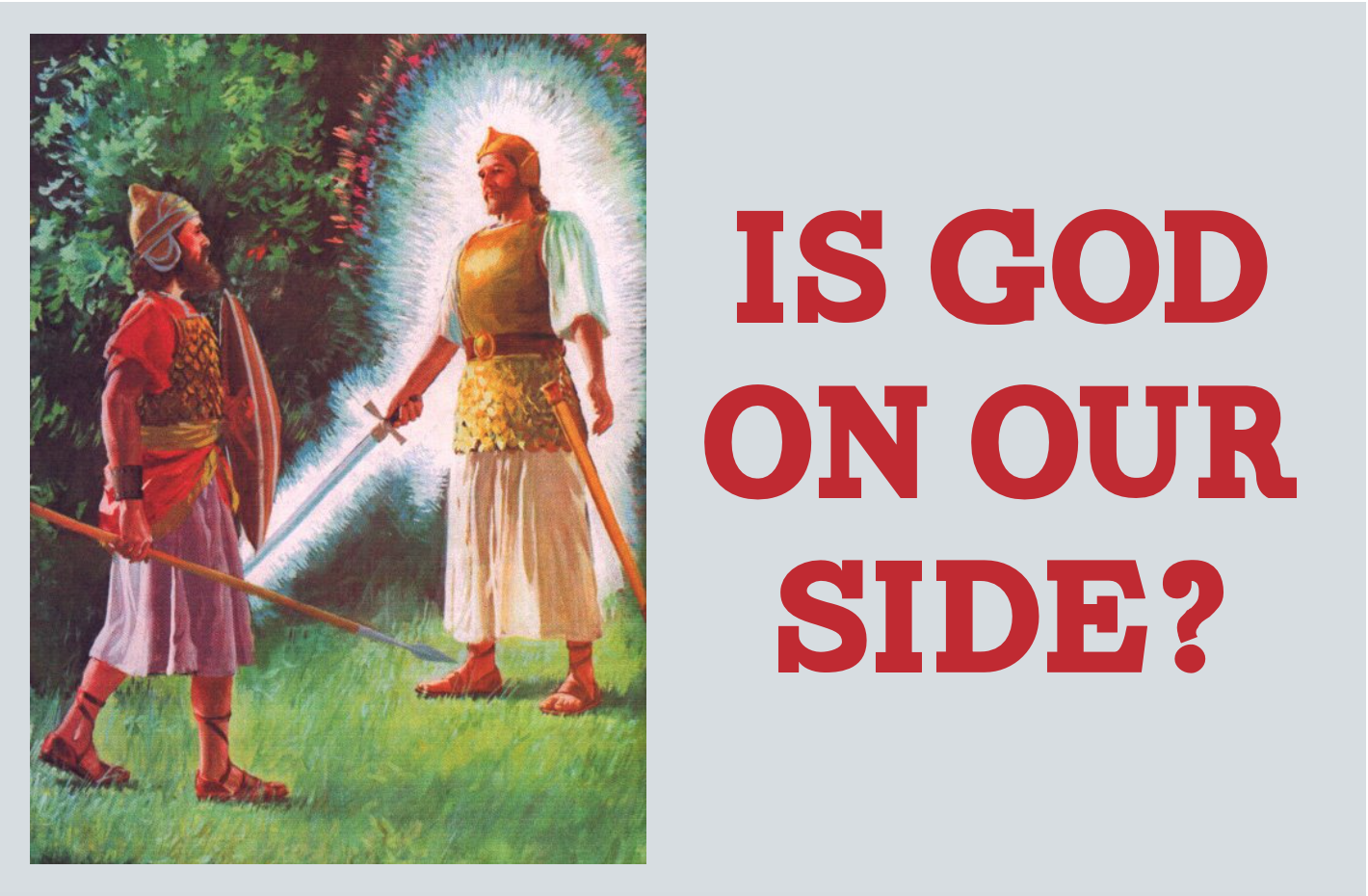
Is God On Our Side?

“God is on our side.”

It’s a phrase you hear often (or something like it) in Christian books, music, and teaching. It’s a popular notion, and why wouldn’t it be? Of course we like the idea of having God on our side! But is it biblical?

The Book of Joshua recounts the efforts of the Israelites (God’s chosen, set-apart people) as they work to accomplish their (divinely-appointed) mission to conquer the land of Canaan (the land which God had promised to give to them). If there was ever a time of God being on “our” side, you’d expect to find it here.

As Joshua is about to lead the people over the first big hurdle of the Conquest, the defeat of the city of Jericho, he has an interesting encounter (Joshua 5.13-15):

“When Joshua was by Jericho, he lifted up his eyes and looked, and behold, a man was standing before him with his drawn sword in his hand.
And Joshua went to him and said to him, ‘Are you for us, or for our adversaries?’ And he said, ‘No; but I am the commander of the army of the LORD. Now I have come.’
And Joshua fell on his face to the earth and worshiped and said to him, ‘What does my lord say to his servant?’ And the commander of the LORD’s army said to Joshua, ‘Take off your sandals from your feet, for the place where you are standing is holy.’ And Joshua did so.”

It’s interesting to me: Joshua asks the man if he is on the side of the Israelites, or on the side of Jericho, and in response, he says, “Neither; I’m on God’s side, not yours.”

Later on in Joshua 24, Joshua, advanced in age, addresses the people. He knows that he is near death, and is concerned about what the people will do after he is gone (Joshua 24.15-20):

“‘…Choose this day whom you will serve, whether the gods your fathers served in the region beyond the River, or the gods of the Amorites in whose land you dwell. But as for me and my house, we will serve the LORD.’
Then the people answered, ‘Far be it from us that we should forsake the LORD to serve other gods, for it is the LORD our God who brought us and our fathers up from the land of Egypt, out of the house of slavery, and who did those great signs in our sight and preserved us in all the way that we went, and among all the peoples through whom we passed. And the LORD drove out before us all the peoples, the Amorites who lived in the land. Therefore we also will served the LORD, for he is our God.’
But Joshua said to the people, ‘You are not able to serve the LORD, for he is a holy God. He is a jealous God; he will not forgive your transgressions or your sins. If you forsake the LORD and served foreign gods, then he will turn and do you harm and consume you, after having done you good.’”

In response to Joshua’s concern, the people basically say, “Don’t worry about it Joshua—we’ll serve the LORD. After all, He’s always been on our side.”

But Joshua isn’t convinced; he believes that the people won’t be faithful to God and that then they’ll find that He isn’t on their side at all—where He once provided for them and fought for them, He will now withhold blessings and actively fight against them.

And how well Joshua knows his people! Within a generation, they will fall away from following God and as a result, will experience a long period of turmoil and suffering as God allows their neighbors to conquer and oppress them (the Book of Judges, which recounts this time period, is one of the lowest points in all of Scripture!).

So, having said all that, back to the original question: is God on our side? I’d have to answer with a qualified “no.”

First, the qualifications:

I’m not doubting God’s love for us, His interest in our condition, or His saving work on our behalf. I’m not doubting that we can cast all our anxiety on Him, because He cares for us (1 Peter 5.7). I’m not doubting that God is “for us” in a Romans 8 sort of way, or that God doesn’t root for us to be successful (where success is defined in terms of faithfulness).

So what am I saying? Here’s my big point:

Jesus didn’t come to earth to live and die for us because God was on our side. He came so that we could be on God’s side. 

Maybe it sounds like I’m just arguing semantics, but really, I think there’s more to it than that. One perspective is centered on mankind, while the other is centered on God: if God is on our side, then all the focus is on us, instead of on God. But the focus should be on God, not us.

This helps to explain the Israelites in the Old Testament. When they were on God’s side and followed Him faithfully, He blessed them with prosperity and victory over their enemies. When they ceased to be on His side, the blessings ceased as well.

This also helps to put the Incarnation into proper perspective. The Incarnation wasn’t about Jesus becoming a man because humanity is the focus of everything; the Incarnation was about God becoming a man in order that men could become more like God, because God is the focus of everything!

So, with this God-centered perspective in mind, let’s ask the question one last time: is God on our side? According to Scripture, we don’t even have a side; we have to choose a side! The real question is, are we going to choose to be on God’s side, or will we side with the world?

Why Non-Christians Don’t Like Christians

For the purposes of this post, I am using the term “Christian” in the broadest sense. After all, many of those who aren’t Christians don’t understand the (significant) differences within Christianity anyway.

Generally speaking, I think there are two main reasons why a lot of people don’t find Christians to be very likable:

(1) It can be hard for people to like Christians when they don’t resemble Christ. Another way of saying that is people can’t stand it when Christians are hypocrites:
–When it turns out that famous televangelists have been cheating on their wives for years or embezzling hundreds of thousands of dollars from their viewers, it turns people off of Christianity.

–When Catholic priests who are supposed to be caring for the members of their parishes turn out to be pedophiles who prey on innocent children, it turns people off of Christianity.

–And perhaps a little closer to home, when Christians spend their Sundays worshipping God and the rest of the week denying Him by lifestyles of materialism, gossip, judgment, and immoral behavior, it turns people off of Christianity.

Non-Christians aren’t the only ones who are turned off by such people—God has never been pleased with people who honor Him with their lips but have hearts which are far from Him (Isaiah 29.13), and Jesus would prefer that such Christians quit pretending to follow Him and get out of the Church (Revelation 3.16)!

Mahatma Gandhi famously summed it up this way:

“I like your Christ; I do not like your Christians. Your Christians are so unlike your Christ.”

On a fundamental level, we as Christians are supposed to resemble Christ. Certainly all Christians fail to do that from time to time, but when we do so repeatedly as a way of life, we invalidate what we claim to be most important.
(2) It can be hard for people to like Christians when they do resemble Christ. This point might be harder for some to understand, so bear with me.

When trying to peg why the world doesn’t like Christians, I think a lot of people easily identify hypocrisy in the church (after all, we hear this reason all the time) and think that the way of Christ is only unappealing to people because we fail to live it correctly.

The thing is, sometimes when we do live as Jesus calls us to, people still don’t like Christians. A good example of this today would be Tim Tebow—although he has a ton of fans, he also gets a lot of negative attention and a lot of people say terrible things about him, not because of his play, but because of his Christianity.*

It might be surprising to us that a lot of people don’t like us for living the way Christ has called us to, but it really shouldn’t, because Jesus Himself explicitly said that it would happen!

“If the world hates you, know that it has hated me before it hated you. If you were of the world, the world would love you as its own; but because you are not of the world, but I chose you out of the world, therefore the world hates you. Remember the word that I said to you: ‘A servant is not greater than his master.’ If they persecuted me, they will also persecute you.” (John 15.18-20)

It’s hard for us to remember this sometimes, but when Jesus was on earth, a lot of people didn’t like Him at all—they disliked Him so much, in fact, that they conspired to have him killed! If we seek to exemplify Jesus in our daily lives, a lot of people won’t like us any more than they did Him.

So, if some people won’t like us if we don’t act like Christ, while others won’t like us if we do, where does that leave us? Basically, there will be people in the world who dislike us no matter what. As Christians, we need to make sure that if the world doesn’t like us, it’s because we do look like Jesus, not because we don’t.


*Certainly people criticize Tebow for his quarterback play as well (and that might even be the main source of the criticism), but some people criticize Tebow specifically for his character or his faith. All of this despite the fact that Tebow uses his fame and wealth to help those who are less fortunate, by all accounts is a genuinely nice guy, and doesn’t at all seem to be hypocritical about his faith.

Book Review: Jesus and Jonah by J.W. McGarvey

In an earlier post, I mentioned that I wanted to do a better job in 2012 of writing about some of the books I read. I’m not sure how well I will stick to that goal for the year, but here’s a brief review of one book I read last month.

Jesus and Jonah was published by J. W. McGarvey in 1896, and was actually a compilation of several articles he wrote in The Christian Standard. McGarvey is a well-known author and scholar within the Restoration Movement (and close associate of Robert Graham), and was one of the first conservative scholars to actively oppose the trends of liberal theology and higher criticism that were growing in popularity around the turn of the 20th century.

In Jesus and Jonah, McGarvey argues against a “symposium” of scholars who had denied the historicity of the biblical account of Jonah.

The book isn’t exactly a page-turner—McGarvey spends the majority of the book examining the arguments of the scholars he disagrees with, and as those scholars basically all use some form of the same 2-3 arguments, McGarvey’s responses quickly become repetitive. Nevertheless, McGarvey’s argument is sound—since Jesus certainly seems to consider the Jonah account to be historical in Matthew 24.38-39, those who argue that it isn’t are basically forced to hold to one of two positions:

  • Jesus spoke of the events of Jonah as if they were historic when He knew they were not, in which case He was being deceptive (McGarvey makes this point especially well).
  • Jesus spoke of the events of Jonah as if they were historic because He thought they were, but was mistaken. This position raises lots of questions about the nature of Jesus and the knowledge He possessed while on earth (these are questions which are easily dismissed by a lot of liberal scholars today who question or reject the divinity of Christ, but would not be as easily dismissed by the less radical scholars McGarvey was addressing in Jesus and Jonah).

A third possibility that the book didn’t really address might be that Jesus wasn’t being deceptive because both He and His audience might have had a shared understanding of Jonah as some sort of satirical fable. With that common understanding, Jesus could have referred to Jonah as if he were a real character in order to prove a point (kind of like I might refer to Robin Hood or Scrooge McDuck) and His audience would have followed right along. It seems that a lot of work would need to be done to establish that this is what was happening, though.

All in all, Jesus and Jonah was a worthwhile read—a short book which, in my opinion, successfully argued for the historicity of Jonah and also provided an interesting analysis of the biblical Jonah story.

« Older posts Newer posts »

© 2026 The Doc File

Theme by Anders Noren — Up ↑







