The online journal of Luke Dockery

Tag: Jesus (Page 6 of 15)

The Beatitudes: Blessed Are the Poor in Spirit

As discussed in the introductory post of this series, Jesus’s Beatitudes in the Sermon on the Mount are basically a description of what a good life really looks like from God’s perspective. Jesus redefines what blessedness is, and provides an alternative set of values for His followers, those who desire to be a part of His alternative community.


Blessed Are the Poor in Spirit

“Blessed are the poor in spirit, for theirs is the kingdom of heaven.”

(Matthew 5.3)

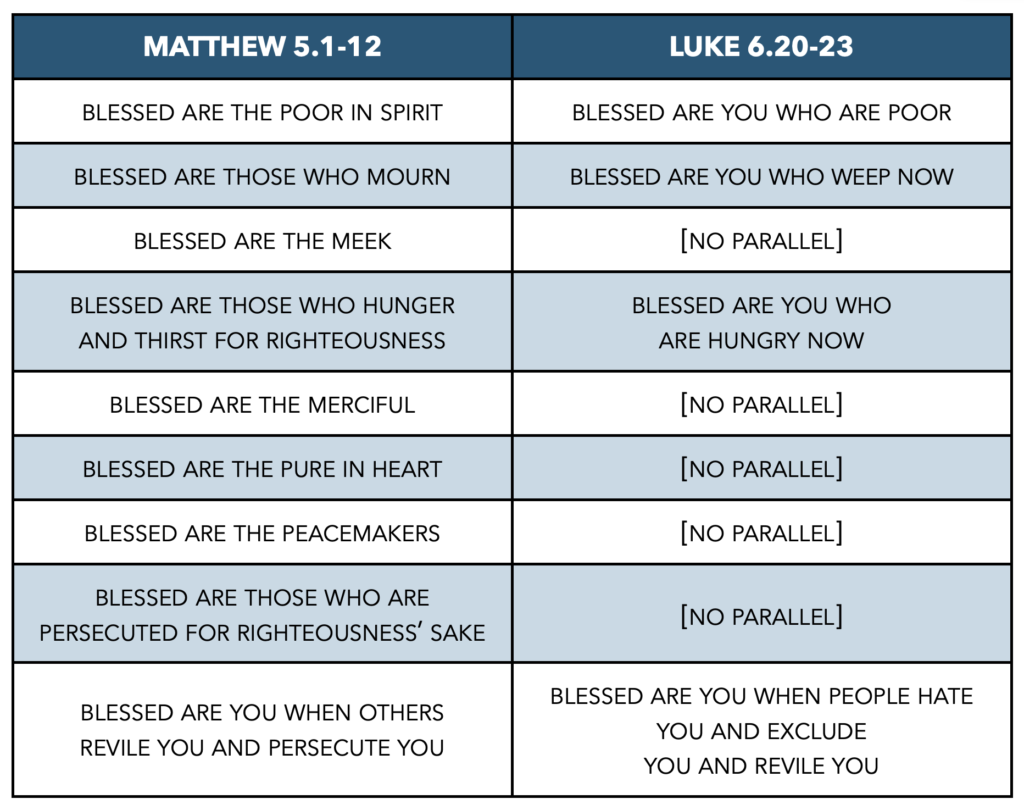
This first beatitude is a good example of something we discussed in the previous post, the “over-spiritualizing” of Jesus’s statements. In this instance, some people try to interpret “poor in spirit” to be a spiritual condition having nothing to do with literal poverty.[1] But, in his version of the Beatitudes, Luke simply refers to “the poor” (see chart), and there is no reason to assume that Matthew is talking about something completely different.
Instead, I think what is going on here is that Matthew focuses on the spiritual or psychological condition of those who are physically poor: being “poor in spirit” is the internal frame of mind of those who suffer from oppression and economic hardship.[2] The Hebrew Bible discusses the same idea in numerous places (Psalm 9.18, 34.6, 37.14, 69.29; Isaiah 57.15, 61.1, 66.2), and the equivalent term in Hebrew conveys the idea of a lack of status and social rights in addition to financial poverty.[3]

Jesus lived (and Matthew wrote) at a time when Judea was a backwater province of Rome, and approximately 97% of the population of the Roman Empire suffered from literal poverty, relegated to varying degrees of hunger and poor health.[4] The vast majority of people had little money, low status, and limited rights. Also, while the New Testament does mention some followers of Jesus who were wealthy, the early church overwhelmingly consisted of the poor and socially outcast.

As a Christian living in the United States of America, I have to acknowledge that this is a very different context from what I am familiar with. In the United States (the location of most of the readers of this blog), for the most part, Christians are a pretty middle-class crowd, and to be honest, don’t we like it that way? Speaking for myself, I will readily admit that I am in no hurry to be financially destitute, oppressed in some way, or a social outcast.

Still, just because we are financially better off than the original audience for Jesus’s teaching here doesn’t mean that we cannot relate to the idea of “poor in spirit.” All of us have, at one time or another, felt like we were the lowest of the low, completely beaten down by the circumstances of life, and that feeling of helplessness and powerlessness is closely tied to the idea of being poor in spirit.

And here is the shocking claim: Jesus says that people who feel like this are blessed!

Roman society viewed the wealthy elite who lived in ease and had all the power as the ones who live the blessed life, and our culture aligns itself closely with Roman values in this regard. American culture places great value on wealth, prosperity, and power, and even in the church and the individual lives of Christians, wealth can at times be pursued as an unqualified good, and power as something that should be sought after rather than laid aside.

But Jesus challenges this pursuit and presents a very counter-cultural idea: God’s favor extends to all people, including the poor in spirit, those that are beaten down and cast aside by society at large. And more than that, these people are specifically blessed: since they have no earthly resources, they know they can’t rely on themselves, and can therefore more easily put their trust in God and depend entirely upon Him.[5]

Jesus challenges the pursuit of wealth and power and presents the counter-cultural idea that God’s favor extends to all people, including those that are beaten down and cast aside by society at large. Share on X

The kingdom of heaven belongs to people like this. They are right at home in Jesus’s alternative community, the different sort of world that He invites us to imagine and be a part of.
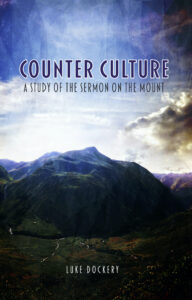

If you enjoyed this post, you might enjoy my book on the Sermon on the Mount, Counter Culture: A Study of the Sermon on the Mount. 

Although this book was written specifically as an aid to teaching the Sermon on the Mount to junior high and high school students, it is also useful for personal Bible study, and the depth of the material makes it a great resource for adult Bible classes.


[1] See, for example, Francis Wright Beare, The Gospel According to Matthew: A Commentary (Oxford: Basil Blackwell, 1981), 128; Rubel Shelly, The Beatitudes: Jesus’ Formula for Happiness (Nashville, TN, 20th Century Christian, 1982), 12.

[2] Larry Chouinard, Matthew, The College Press NIV Commentary (Joplin, MO, College Press, 1997), 95.

[3] Chouinard, 95-96; Jack P. Lewis, The Gospel According to Matthew, Part I, The Living Word Commentary (Austin, TX: Sweet Publishing, 1976), 80. Though our own society is different in many ways from the cultures of the biblical narratives, it remains very similar at least in this regard: the financially poor also tend to be disadvantaged socially, politically, medically, educationally, and in other ways as well.

[4] Warren Carter, “Power and Identities: The Contexts of Matthew’s Sermon on the Mount,“ in Preaching the Sermon on the Mount: The World It Imagines, ed. David Fleer and Dave Bland (St. Louis: Chalice Press, 2007), 14-15.

[5] Chouinard, 95; William Barclay, The Gospel of Matthew Volume 1, The Daily Study Bible (Philadelphia, Westminster Press, 1956), 85-86.

Known to Them in the Breaking of the Bread

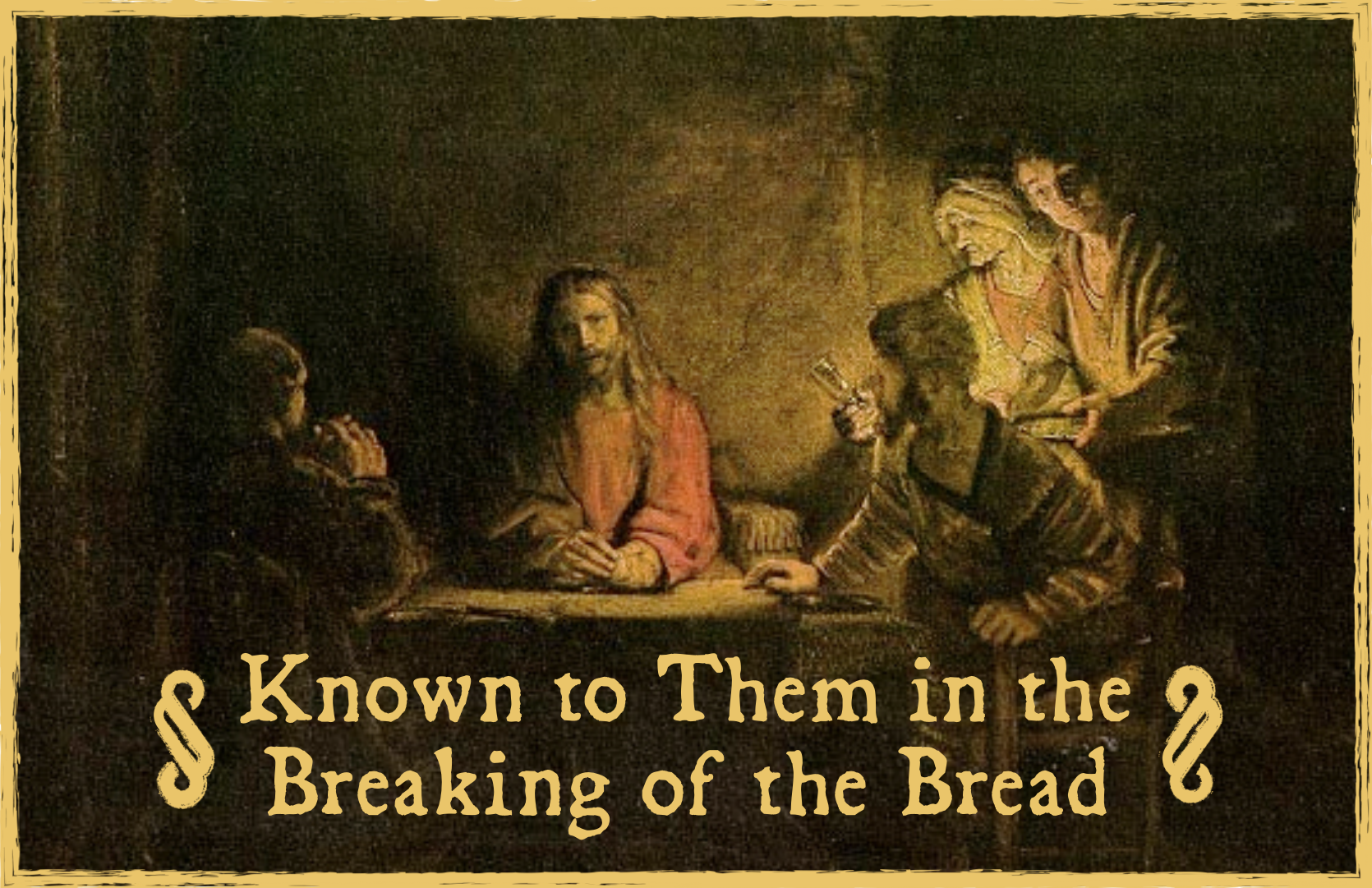
Luke 24.13-35 recounts the story of Jesus appearing to two disciples on the road to Emmaus following His resurrection.

These two disciples were downcast and dejected. Jesus appears to them and begins walking with them, but they are kept from recognizing Him. When He asks them what is wrong, they respond by explaining the events that had recently occurred in Jerusalem: the Jesus who they had believed to be the Messiah and in whom they had placed their hopes had been killed. Adding to their confusion, there was now a report from some of the women in their group that Jesus’ tomb was empty, and an angel had reported that He had risen from the dead. 

The unrecognized Jesus chides them, and then begins to explain how all of the Hebrew scriptures pointed to Himself, and revealed that He must suffer, die, and be raised. The disciples are blown away by the teaching, and invite this mysterious stranger to stay with them once they reach their destination.

Jesus does so, and when they gather around the table, he takes the bread, blesses it, breaks it, and gives it to them. And suddenly they recognize Him. Jesus vanishes, and the two disciples return to Jerusalem to tell the apostles that Jesus is risen and had appeared to them:

Then they told what had happened on the road, and how he was known to them in the breaking of the bread.

(Luke 24.35)

The post-resurrection appearances of Jesus are interesting. It is clear that Jesus is different than He previously was, but also, He is…the same. He still has holes in His hands and sides. He is recognizable at times. He eats, and has flesh and bones.

But at other times, He is not recognizable. He suddenly appears in the midst of His disciples despite locked doors, and and at other times, He disappears. In Luke 24, He walks with two of His disciples for a long time and teaches them, but it is only in the breaking of the bread that they recognize Him.

Jesus is a multi-faceted character who did and accomplished much, and if we are not careful, we can focus on some of those characteristics and accomplishments and miss out on really knowing Jesus.

Jesus was certainly a wise teacher, but He was more than that. He was a miracle worker, but He was more than that. He was a religious leader and a brilliant theologian, but He was more than that. He was a leader of men, but He was more than that. He was a political theorist (though not in the way we would use that term), but He was more than that. 

Jesus was the Son of God, who emptied Himself, and came to live as a servant. He was obedient to the Father’s will and was willing to suffer on the cross, and on the cross, overcame the dark power of sin. Through His resurrection, He defeated the power of death. 

Sometimes, we don’t recognize Jesus. Sometimes, we look at the world around us, and we fail to see Him. Sometimes, we do not see Him in our circumstances; indeed, God feels very distant at times. Sometimes, we may catch glimpses of God in the beauty of Creation, but we don’t really know Him through that. 

At the table, though, Jesus is made known to us. As we eat of the bread and drink of the cup, we are reminded that God’s Son came into this world and lived as one of us. He stepped into our suffering and experienced it for Himself. We remember that, through the cross, Jesus set us free from sin’s bondage and condemnation, and through His resurrection, He offers us victory over death. 

When we pause our hectic lives and come together to take of the bread and the cup, we are able to see Jesus most clearly, and to recognize what He has done, and what He will do.

Sometimes we don’t recognize Jesus in the circumstances of our lives, but at the table, we are able to see Him clearly and to recognize what He has done and what He will do. Share on X

In this loose series of Scripture Reflections, I am sharing brief thoughts spurred on by my Bible reading. By way of reminder, my goal for these brief posts is two-fold:

(1) To remark on aspects of the biblical text that I find to be of interest that the reader may or may not have thought about previously.

(2) When possible, to point to the work and person of Jesus Christ. I believe the Bible is a unified story that points to Jesus, which means that He is frequently alluded to or foreshadowed in some way throughout the biblical canon.

The Beatitudes: Kingdom Character

I don’t remember what the driving force was at the time, but about seven years ago, I got into the Sermon on the Mount. I mean, really got into it. I taught it to my teenagers. I taught an adult Bible class on it. I spoke in a summer series on it. I published a book on it. I directed a youth conference on it. It was pretty much an obsession—I had come to realize that this was Jesus’s Kingdom Manifesto, where He declared what living in His kingdom is all about, to those who desire to be a part of that kingdom.[1] As someone who desired to be a part of that kingdom, it seemed really important to me that I take Jesus’s words very seriously.

What I found was that, as I really got into the Sermon on the Mount, it actually really got into me. Not overnight, but gradually, as I read it and taught it more and more, it began to change me from the inside out. I began to pray the Lord’s Prayer more. The way I interacted with people online began to change—I was not as quick to rush in to straighten someone out, or as defensive when someone was critical of me. I tried to be more generous in my judgments of other people. My views on how Christians are to interact with and influence the world changed significantly. It’s not an overstatement to say that the Sermon on the Mount gradually became the default lens through which I viewed the world.[2]

What I found was that, as I really got into the Sermon on the Mount, it actually really got into me. Share on X

With all that in mind, I’d like to do a series on the first part of the Sermon on the Mount, the sayings that Jesus presents known as the Beatitudes.


Our English word “beatitude” comes from beatitudo, which is the Latin equivalent of the Greek word μακαριος/makarios, a word that means “happy” or “blessed,” and this is how all of the Beatitudes start: “Blessed are the _________.”[3] We live in a world where people desperately do anything they can think of in order to be happy, but what Jesus is talking about here is not a pleasant emotional response that comes to us based on outward circumstances. Instead, the sense of this word is something like, “God is pleased with” or “God’s favor rests upon” the people who possess the characteristics that Jesus goes on to describe.[4] Jesus is telling us what a good life really looks like from God’s perspective.

In the Sermon on the Mount, Jesus is setting up an alternative community, where people live by values and principles that are dramatically different from those of the world, and we clearly see this in the Beatitudes. First, the people who Jesus describes as being happy or blessed are not the people who the world would describe in that way.[5] Jesus redefines what blessedness is and provides an alternative set of values for His followers. Also, the word μακαριοι/makarioi that we have already discussed that Jesus uses repeatedly here is plural. This means that Jesus’ beatitudes are not directed at individuals, but are to be the practices of the community that Jesus is establishing.[6] So Jesus’s beatitudes will describe the same group of people in multiple ways: God’s kingdom, an alternative community made up of His disciples.

Matthew’s record of these beatitudes bears some similarity to the shorter beatitudes recorded in Luke’s Sermon on the Plain:

Some biblical scholars have made a big deal about the differences between Luke’s beatitudes and Matthew’s, suggesting that Luke focuses on physical characteristics (poor, hungry, etc.), while Matthew emphasizes spiritual characteristics instead (poor in spirit, hunger for righteousness, etc.). These interpreters sometimes “spiritualize” Matthew’s beatitudes so much that they no longer have any connection to the historical context in which Jesus is speaking.[7]

I don’t think it is necessary to make such a sharp distinction, though. It seems unlikely that Jesus would present two different, unconnected sets of beatitudes, one focused on physical characteristics and the other on spiritual characteristics. What makes more sense is that in both places Jesus presents characteristics of those who God calls “blessed”, but in Matthew, He emphasizes that certain physical characteristics have spiritual implications.

With that in mind, we want to be balanced as we look at these traits. While it is true that the Sermon on the Mount doesn’t portray Jesus as a political revolutionary who is advocating for social or economic upheaval, He does address social and economic problems that are a result of the political realities of His day. In a real sense, Jesus invites His audience (including us) to imagine a different sort of world: the kingdom of God. And God’s kingdom is an upside-down kingdom, which reverses the conditions of people where the poor, hungry, and persecuted are called “blessed.”[8]

I hope you’ll read along as we examine the Beatitudes one by one.

Jesus invites His audience—including us—to imagine a different sort of world: the kingdom of God. Share on X

If you enjoyed this post, you might enjoy my book on the Sermon on the Mount, Counter Culture: A Study of the Sermon on the Mount. 

Although this book was written specifically as an aid to teaching the Sermon on the Mount to junior high and high school students, it is also useful for personal Bible study, and the depth of the material makes it a great resource for adult Bible classes.


[1] J. Oswald Dykes, The Manifesto of the King: An Exposition of the Sermon on the Mount (London, J. Lisbet, 1881).

[2] In many ways, this seems providential to me, in light of all that has gone on in the world over the last several years: the rise of Trump, the COVID-19 pandemic, Black Lives Matter and racial unrest, QAnon, the January 6 uprising, increased political polarization; the list goes on and on. I cannot pretend that I responded perfectly to all of these developments, but I truly believe that my deep immersion in the Sermon on the Mount helped me to have a kingdom perspective on these events that saved me from a lot of unhealthy responses.

[3] Jack P. Lewis, The Gospel According to Matthew, Part I, The Living Word Commentary (Austin, TX: Sweet Publishing, 1976), 79.

[4] Warren Carter, “Power and Identities: The Contexts of Matthew’s Sermon on the Mount,” in Preaching the Sermon on the Mount: The World It Imagines, ed. David Fleer and Dave Bland (St. Louis: Chalice Press, 2007), 17.

[5] J.W. McGarvey, Matthew and Mark, The New Testament Commentary (Delight, AR: Gospel Light Publishing Company, 1875), 51: “The world’s conception of the man who is superlatively blessed has always been the reverse of what is here taught.” Randy Harris, Living Jesus: Doing What Jesus Says in the Sermon on the Mount (Abilene, TX, Leafwood, 2012), 31: “Jesus’ idea of the blessed life and our idea of the blessed life have almost nothing in common.”

[6] Carter, 17.

[7] Francis Wright Beare, The Gospel According to Matthew: A Commentary (Oxford: Basil Blackwell, 1981), 133, is a good example of someone who emphasizes the supposed distinctions between Matthew and Luke in the Beatitudes. McGarvey, 51, spiritualizes Matthew’s Beatitudes, to where, for example, “poor in spirit” has nothing to do with actual poverty.

[8] Beare, 127; Larry Chouinard, Matthew, The College Press NIV Commentary (Joplin, MO, College Press, 1997), 94.

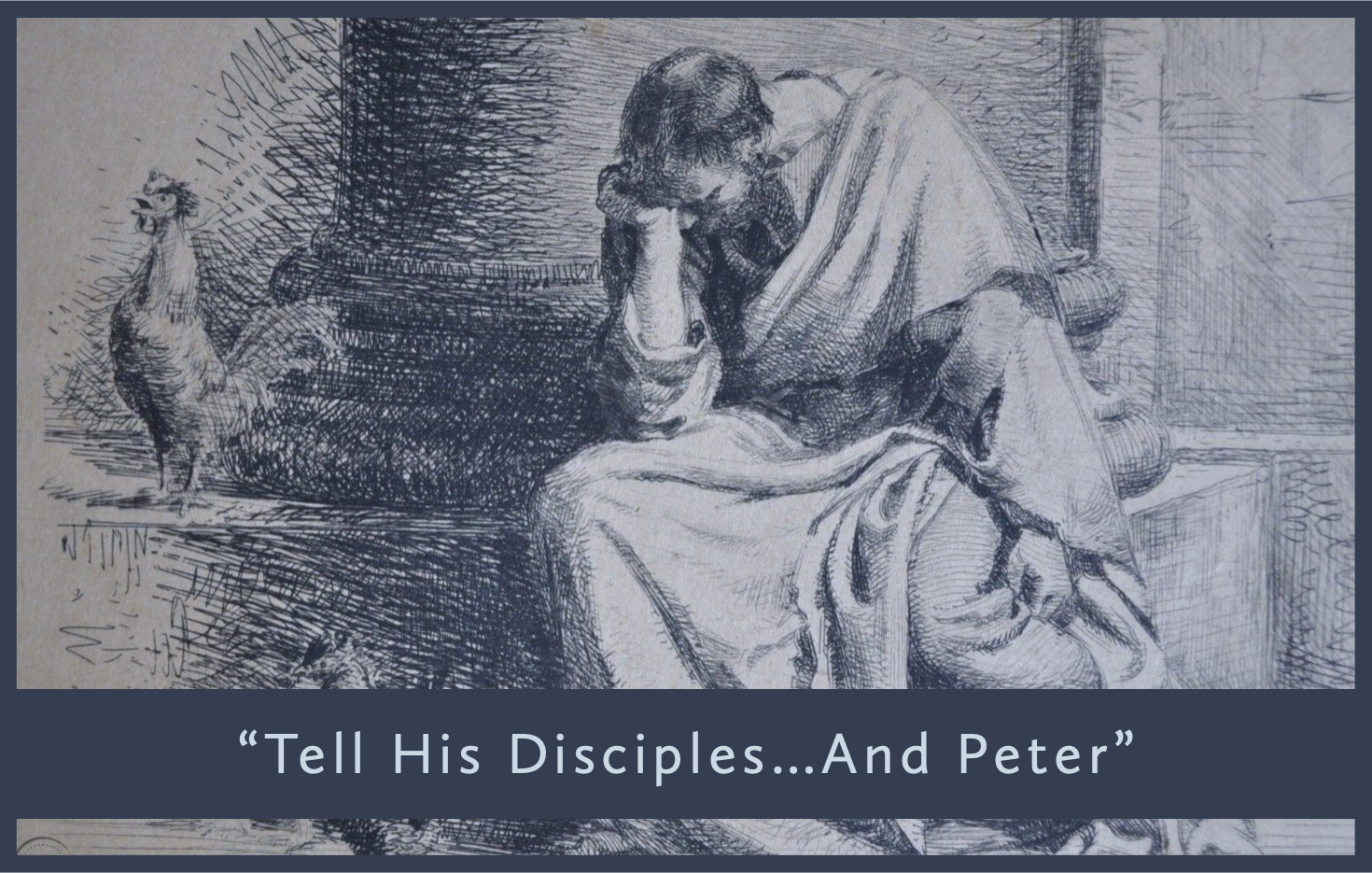
“Tell His Disciples…and Peter”

In the Gospel of Mark, after Jesus has been crucified and buried, and right before the controversial ending of Mark, Mary Magdalene, Mary the mother of James, and Salome come to the tomb of Jesus with spices to anoint Him. They discovered the stone rolled away from the tomb and the tomb itself empty. They see a young man, dressed in a white robe sitting at the side of the tomb and are alarmed.

He tells them:

“Do not be alarmed; you are looking for Jesus of Nazareth, who was crucified. He has been raised; he is not here. Look, there is the place they laid him. But go, tell his disciples and Peter that he is going ahead of you to Galilee; there you will see him, just as he told you.”

(Mark 16.6-7)

Some of this is straightforward enough: remarkably, Jesus has been resurrected from death, and this news needs to be shared with his disciples. Furthermore, this news affirms something that Jesus Himself had told His disciples earlier in Mark 14.28, that He would return from death and go before His disciples to Galilee. Things have happened just as Jesus predicted, and now He calls His disciples to join Him again.

Of course, in that same context in Mark 14, Jesus had also predicted that His disciples would desert Him in the moment of crisis and had specifically told Peter that he would desert Him by denying Him three times (Mark 14.29-31). And that had also come to pass (Mark 14.66-72).

The different gospel accounts (including Mark) are quite clear that Peter is devastated by his denial of Jesus once he really comes to grips with what he has done. I can imagine that the shame and heartache he felt on Thursday night following his denials had only continued and intensified when Jesus was subsequently scourged, crucified, and buried. Peter had been willing to kill for Jesus in the Garden of Gethsemane, but wasn’t willing to die for Him; He had let down His Lord and teacher. I wonder if he even considered himself a disciple anymore.

The messenger at the tomb seems perceptive of all of this. “Go tell His disciples,” he says, “and Peter.” Perhaps Peter is separate because he is no longer one of the disciples, or perhaps it is just a repetition of what happened on the night of Jesus’ betrayal and arrest. Then, it was predicted that all of the disciples would desert Jesus, but Peter is singled out as the one who will deny Him three times. Now, all the disciples are invited to meet the resurrected Christ, but Peter, the one who failed so spectacularly, is singled out with a special invitation.

As one commentator states:

“Why do you suppose the angel singled out Peter as one who was particularly to be told this message? It was done because just three days prior to this, Peter had denied that he had had any association with the Lord. This underscored the fact that, although Peter had rejected Jesus, Jesus had not rejected him.

The same was true of all the disciples. On the night of Jesus’ betrayal, the other apostles did basically what Peter did. All the rest forsook Him and refused to stand by Him. They left and fled in fear for their own lives. But on the heels of the resurrection is the affirmation that though the disciples had abandoned Him, He was not abandoning them.… What they had thought was over and done with, a thing broken, too broken to mend, was still very much alive.”[1]

I imagine that being singled out on the night of Jesus’ betrayal was awkward and awful for Peter. But now, to specifically be included in the invitation to meet the resurrected Christ? That must have been so reassuring: despite Peter’s past failures, Jesus still wanted to see him.


As of the time this article was published, yesterday was Easter, the church’s celebration of the events of Mark 16. Christians around the world proclaim the message that the women at the tomb were told to share. It is a day of joy, celebration, and hope: in the midst of a world plagued by Sin and Death, the resurrection reminds us that Death does not get the last word, and will indeed be defeated someday. There is a sense of triumphalism surrounding Easter, and that is appropriate because Jesus the Christ certainly triumphed.

But there are many, many out there who perhaps feel on Easter similarly to how Peter felt on the Sunday of the Resurrection. There are many who have followed Jesus at one point, but perhaps deserted Him when things got too difficult. Maybe they denied Him to their peers, or quit following Him because they feared death—if not literal death, the death to self that true discipleship requires. For those in this category, Easter possibly brings feelings of guilt and shame similar to those experienced by Peter.

Such feelings are not necessary, however, because the Good News of the empty tomb is for disciples…and Peter. If you have failed and, perhaps, failed so spectacularly that you feel that there is no place for you among followers of Jesus any longer—be reassured. The invitation to meet and follow the resurrected Christ is for you, too. Just like Peter.

If you have failed so spectacularly that you feel that there is no place for you among followers of Jesus any longer—be reassured. The invitation to meet and follow the resurrected Christ is for you, too. Just like Peter. Share on X

In this loose series of Scripture Reflections, I am sharing brief thoughts spurred on by my Bible reading. By way of reminder, my goal for these brief posts is two-fold:

(1) To remark on aspects of the biblical text that I find to be of interest that the reader may or may not have thought about previously.

(2) When possible, to point ahead to the work and person of Jesus Christ. I believe the Bible is a unified story that points to Jesus, which means that He is frequently alluded to or foreshadowed in some way throughout the biblical canon.


[1] Joe D. Schubert, Mark: Introduce Us to the Master: Expository Studies in the Gospel of Mark (Searcy, AR: Resource Publications, 1987): 306.

Jethro’s Wise Advice

In Exodus 18, Moses has led the people of Israel out of Egypt. He has shown God’s power through the plagues on Pharaoh and the Egyptians, and through him, God has revealed His supremacy over the pantheon of Egyptian gods. Now, Moses is leading the nomadic nation of Israel through the wilderness.

Moses receives a visit from Jethro, his father-in-law, and tells him of all the amazing things that the LORD has done. Jethro is amazed, rejoicing over the kindness that God had shown to the Israelites, and praising His name: “Now I know that the LORD is greater than all gods” (Exodus 18.11).

The next day, Jethro witnesses Moses serving as a judge among the people: from morning to evening, people come before Moses bringing disputes before him, seeking a judgment or resolution. Jethro is troubled by this:

But Moses’ father-in-law said to him, “The thing you are doing is not right; you will surely wear yourself out, and these people as well. For the task is too heavy for you; you cannot do it alone. Now listen to me. I will give you counsel, and God be with you! You represent the people before God: you bring the disputes before God, and enjoin upon them the laws and the teachings, and make known to them the way they are to go and the practices they are to follow. You shall also seek out from among all the people capable men who fear God, trustworthy men who spurn ill-gotten gain. Set these over them as chiefs of thousands, hundreds, fifties, and tens, and let them judge the people at all times. Have them bring every major dispute to you, but let them decide every minor dispute themselves. Make it easier for yourself by letting them share the burden with you. If you do this—and God so commands you—you will be able to bear up; and all these people too will go home unwearied.”

Moses heeded his father-in-law and did just as he had said. Moses chose capable men out of all Israel, and appointed them heads over the people—chiefs of thousands, hundreds, fifties, and tens; and they judged the people at all times: the difficult matters they would bring to Moses, and all the minor matters they would decide themselves. Then Moses bade his father-in-law farewell, and he went his way to his own land.

(Exodus 18.17-27)

Jethro’s counsel reflects the wisdom and experience of an older man. Moses is certainly a capable leader, but trying to adjudicate every dispute himself is unsustainable and will ultimately result in burnout. Instead, Jethro suggests, Moses needs to assemble a team of others who can help share the load of handling these matters. Moses himself will continue on as a sort of Supreme Court to handle the most important cases, while others can handle the vast majority of easier and less significant disputes.

In addition to being wise advice that any successful leadership guru would approve of, this also reflects the practice of Jesus and the designed structure of His church:

  • Although Jesus is, ultimately, the Judge of the world, He did not take it upon Himself to try to sort out every dispute (Luke 12.14).
  • Jesus spent the bulk of His ministry not just doing everything Himself, but training the Twelve so that they could lead after Him.
  • The leadership of the church is not entrusted to one person: instead, there are apostles, prophets, evangelists, shepherds, and teachers who share in that work (Ephesians 4.11ff). Furthermore, the church is the Body of Christ, and all members of the body have important roles to play (Romans 12).
  • In discussions of Elders and Deacons (1 Timothy 3; Titus 1), there is never the hint of one person filling these roles, but always on a plurality or group of individuals.

Indeed, the basic advice of Jethro for Moses to “share the burden” with others (Exodus 18.22), reflects these same realities, as we are instructed to cast our burdens upon God (1 Peter 5.7), and for brothers and sisters in Christ to mutually share their burdens because doing so fulfills the law of Christ (Galatians 6.2). In other words, this is more than good advice: it is very much God’s design and will.

All of us have a variety of burdens in life—responsibilities, struggles, challenges, etc.—but God does not intend that we carry these burdens alone. Listen to Jethro: share the burden.

All of us have a variety of burdens in life—responsibilities, struggles, challenges, etc.—but God does not intend that we carry these burdens alone. Share on X

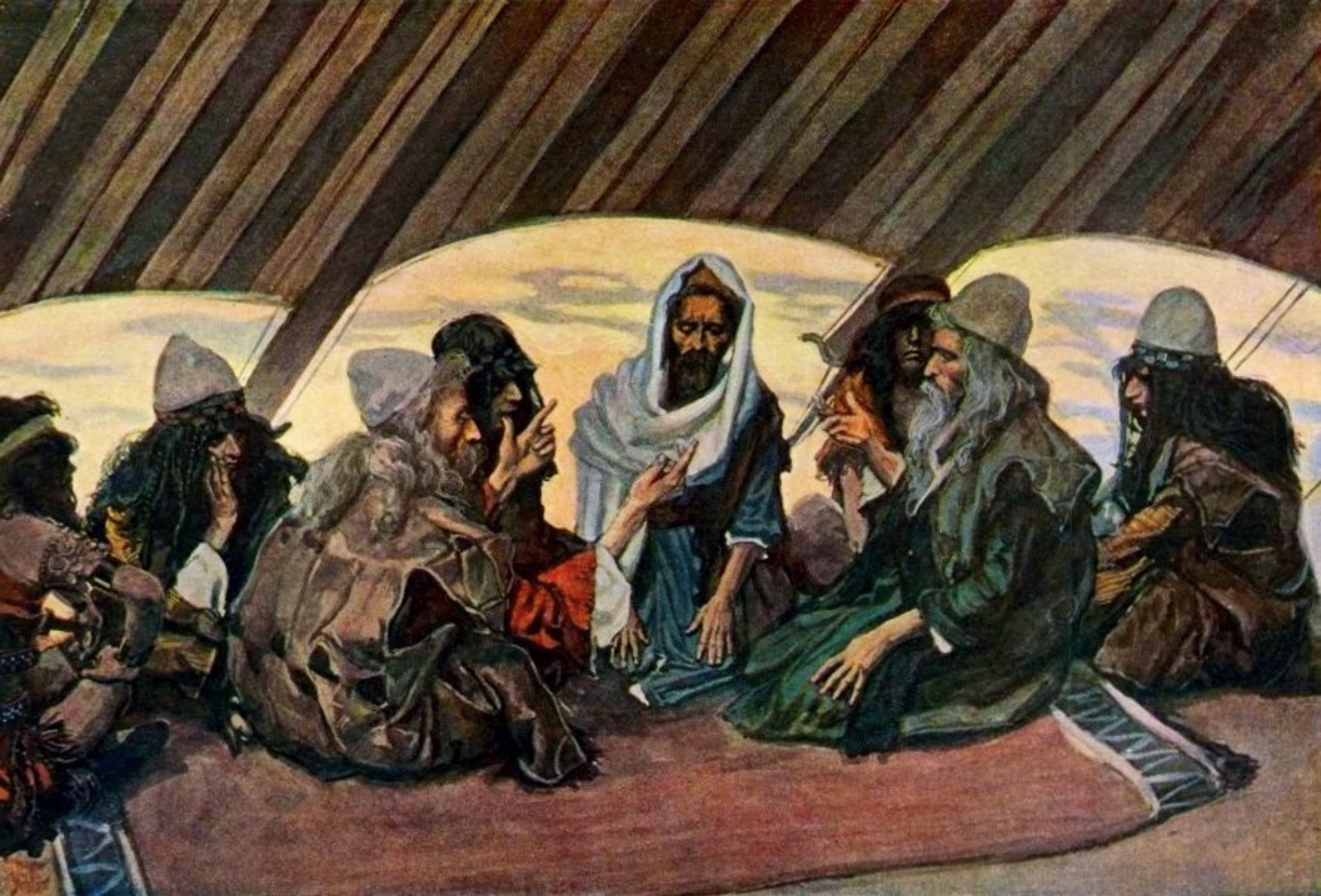
Jethro and Moses, watercolor circa 1900 by James Tissot


In this loose series of Scripture Reflections, I am sharing brief thoughts spurred on by my Bible reading this year. By way of reminder, my goal for these brief posts is two-fold:

(1) To remark on aspects of the biblical text that I find to be of interest that the reader may or may not have thought about previously.

(2) When possible, to point ahead to the work and person of Jesus Christ. I believe the Bible is a unified story that points to Jesus, which means that He is frequently alluded to or foreshadowed in some way throughout the biblical canon.

« Older posts Newer posts »

© 2026 The Doc File

Theme by Anders Noren — Up ↑