
Introduction: A Major Problem
In this post, I want to share some research regarding the faith of teens in the United States. One of the most important (and alarming) research findings is that what American Teens who call themselves Christians actually believe is not what “Christianity” has meant for 2,000 years.
As we look at the data, there are a couple of really important things to keep in mind. First, these are general conclusions drawn from research; that doesn’t mean they apply to every single teenager. Also, I’m not blaming teenagers for the problems and deficient beliefs we will discuss below. Teens believe what they do because adults—parents, youth ministers, teachers, leaders, the church, whoever—have failed to teach them any better.
Cultural Christianity: The Faith of American Teenagers

 The National Study of Youth and Religion (NSYR) was a massive research study conducted from 2002-2005. Findings from this study were published in two important works, Soul Searching: The Religious and Spiritual Lives of American Teenagers, by Christian Smith and Melinda Lundquist Denton, and Almost Christian: What the Faith of Our Teenagers Is Telling the American Church, by Kenda Creasy Dean:[1]
- Researchers studied more than 3,300 American teenagers between the ages of 13-17.
- After the initial survey, the researchers conducted 267 follow-up face-to-face interviews.
- 2,500 of the original 3,300 were revisited years later to see how their religious lives changed as they age.
- Teens from all different religious backgrounds were examined (not just Christian).
What they found was that 3 out of 4 American teenagers claim to be Christian, but only about half consider their faith to be important, and less than half practice their faith as a part of their daily lives.[2]
Furthermore, the report showed that “the vast majority” of U.S. teens are “incredibly inarticulate about their faith”—in other words, even those teens who claim to be Christians are unable to explain what it means to be a Christian or what they actually believe.[3]
Research shows that “the vast majority” of U.S. teens are “incredibly inarticulate about their faith” Share on XWhen asked questions about what they believed religiously, here were some of the actual responses:[4]
- Uh, I haven’t really thought about that [pause]. I don’t know.
- I believe in the [pause], I, ohhh [pause], I don’t think I’d really like to talk about that.
- Hm, I don’t know, I’d have to like ask somebody or something, I don’t know.
- Um, I guess I believe…[laughs], um, I don’t know. I don’t really know how to answer it.
Teens typically have a very difficult time explaining what it means to be a Christian or what they actually believe.
After the NSYR was completed, some of the experts who analyzed all of the data from this study realized that, although a lot of young people claim to be Christian, what they mean by “Christian” is not what that word has historically meant for the last 2,000 years. The NSYR suggests that many, many teenagers who consider themselves to be Christians don’t really practice Christianity at all; they practice a different religious faith altogether. In the words of Christian Smith and Melinda Lundquist Denton:
“A significant part of Christianity in the United States is actually only tenuously Christian in any sense that is seriously connected to the historical Christian tradition, but has rather morphed into Christianity’s misbegotten stepcousin, Christian Moralistic Therapeutic Deism.”[5]
So, a lot of young people who consider themselves to be Christians are not really practicing Christianity, but instead is a “misbegotten step-cousin” of Christianity—something that is kind of related to Christianity but really isn’t very close. Smith and Denton continue:
“The language, and therefore experience, of Trinity, holiness, sin, grace, justification, sanctification, church, Eucharist, heaven and hell appear, among most Christian teenagers in the United States at the very least, to be supplanted by the language of happiness, niceness, and an earned heavenly reward. It is not so much that U.S. Christianity is being secularized. Rather more subtly, Christianity is either degenerating into a pathetic version of itself or, more significantly, Christianity is actively being colonized and displaced by a quite different religious faith.”[6]
In other words, when most Christian teens talk about faith, they don’t talk about the things the Bible talks about: discipleship, sacrifice, holiness, sin, grace. Instead, they talk about things like “being nice” or “being a good person” or “getting to go to heaven when we die”. What a lot of teens talk about when they describe their faith, really isn’t Christianity at all.
And since it’s not really Christianity, the researchers came up with a new name for it: Moralistic Therapeutic Deism.
From the NSYR, here are the central beliefs of Moralistic Therapeutic Deism:[7]
- A god exists who created and orders the world and watches over life on earth.
- God wants people to be good, nice, and fair to each other, as taught in the Bible and by most world religions.
- The central goal of life is to be happy and to feel good about oneself.
- God is not involved in my life except when I need God to resolve a problem.
- Good people go to heaven when they die.
And this is why they call it Moralistic Therapeutic Deism.
- What does “Moralistic” mean? If you are a moral person, it means that you understand the difference between right and wrong, and you try to do those things that are right and generally be a good person (2, 5).
- What does “Therapeutic” mean? Usually, we think of this word in terms of going to therapy for something (physical therapy, occupational therapy, counseling, etc.). Therapy is a form of treatment you take in order to be healed or to feel better. So MTD is therapeutic in the sense that God helps us with our problems, and that the goal is for us to feel good about ourselves (3, 4).
- What does “Deism” mean? You might think of Deism in terms of European History and the intellectual movement called the Enlightenment; here we don’t mean Deism in a technical sense, but more in a general sense: a belief in a deity who created the world but isn’t too involved in everything that happens (1).
So you can see why it’s called Moralistic Therapeutic Deism: it’s about trying to be good, trying to feel good about ourselves, and it is loosely connected to belief in “God”. We might also call it Cultural Christianity. It is “Christianity” as our culture views it and practices it, but it is not Christianity as described in the Bible. From here forward, I will use Cultural Christianity as a synonym for Moralistic Therapeutic Deism.
When you put all of this together, American Cultural Christianity is a watered-down version of Christianity. Sometimes, it’s not so bad to water something down. I like to water down Gatorade when I drink it, because it makes it less heavy and I think it tastes better. Sometimes we water things down in order to make them more pleasant or to suit us better, and that’s okay. But Cultural Christianity is a watered-down Christianity, and that’s not okay. Sure, in some ways it’s more pleasant—Cultural Christianity is easier; it’s less demanding. It is a religion that will not offend anyone…but neither will it save anyone.
Remember earlier how we said that 3/4 of American teenagers consider themselves to be Christians but only about half consider it to be important, and less than half practice their faith as a part of their daily lives? That’s what Cultural Christianity is all about: something you believe, but not something that is so important that it upsets your life or really impacts how you live too much.
Here’s the problem with that sort of thinking:
“Christianity, if false, is of no importance, and if true, of infinite importance. The only thing it cannot be is moderately important.”
(C.S. Lewis)
Interlude: What About “Post-Christian” America?
As a quick aside, we are obviously living during a time of cultural transition and there are a lot of changes occurring. One of these transitions you may have heard about is that the United States is increasingly a post-Christian society. If we are increasingly “post-Christian” what does that mean about Cultural Christianity? In short, watered-down Christianity is on the decline.
To clarify, when you take a look at the data and surveys, what is happening is not that devoted followers of Jesus who are plugged into local churches are walking away from the faith in droves; it’s cultural Christians who are checking out. And honestly, that makes complete sense to me: there’s nothing about Cultural Christianity that demands anything from you, gives you meaning or purpose, or changes your life for the better—why would you hold onto it?
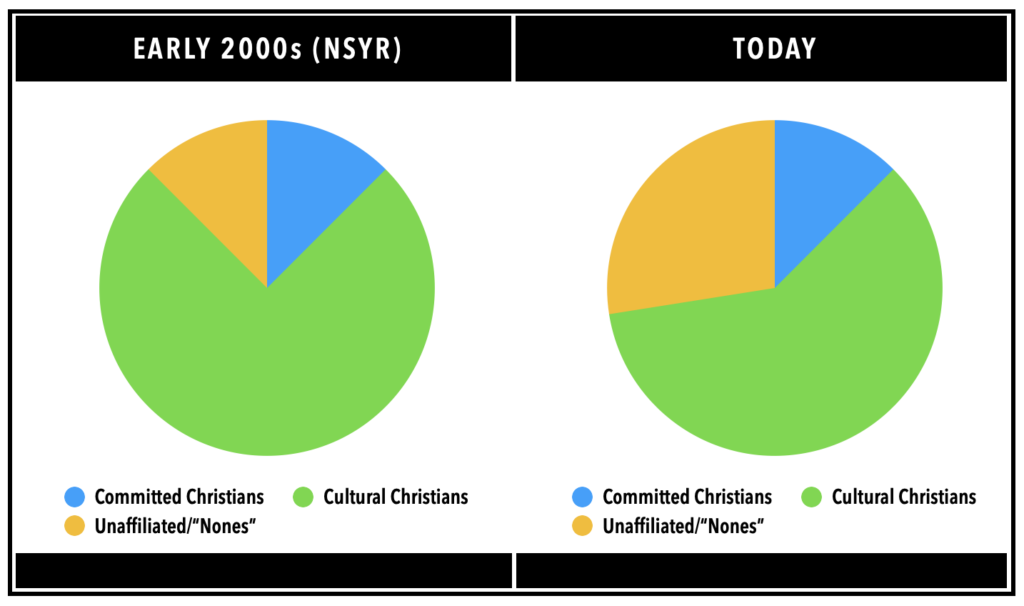
To summarize this differently, think in terms of a pie chart. At the time of the NSYR in the early 2000s, we might imagine that there was a large chunk of the pie that were cultural Christians, a small piece that professed no faith affiliation, and another small piece that represented committed Christians. Updated to today, the pie pieces would be apportioned differently: committed Christians still represent a similarly small piece, while the cultural Christian slice has shrunk in size, and the unaffiliated slice has grown.[8]
Nevertheless, the fact remains that, despite its decline, Cultural Christianity is still the belief system of a significant number of teenagers (and adults) in the United States.
Biblical Christianity: The Demands of Jesus
Let’s consider a different perspective.
We call ourselves Christians, and the word Christian simply means “follower of Christ,” someone who follows Jesus. If Jesus is our Lord, if He is our King, then we have to be loyal subjects of our King, and that means He gets to define what it means to follow Him.
If Jesus is Lord, that means He gets to define what it looks like to follow Him. Share on XSo, let’s look at what Jesus says, and then compare Biblical Christianity to Cultural Christianity:
24 Then Jesus told his disciples, “If anyone would come after me, let him deny himself and take up his cross and follow me. 25 For whoever would save his life will lose it, but whoever loses his life for my sake will find it. 26 For what will it profit a man if he gains the whole world and forfeits his soul? Or what shall a man give in return for his soul? 27 For the Son of Man is going to come with his angels in the glory of his Father, and then he will repay each person according to what he has done.
(Matthew 16.24-27)
Jesus says that if we want to be His followers, we have to deny ourselves, take up our crosses, and follow Him. In the ancient world, crosses were not used for jewelry, tattoos, or t-shirt designs; they were used for death. People were executed on crosses, and as we see in the crucifixion of Jesus, they were forced to carry their crosses to the place where they were hung on them to die. So Jesus is saying that would-be disciples must be ready to die. They have to die to self. That’s not an expression we use a lot—what does it mean to die to self? It means that we crucify—put to death—our own wishes, wants, and desires. We deny ourselves and what we want to do and instead seek to do the things God calls us to do.
Now, that is completely different from the cultural Christianity we’ve been discussing. Cultural Christianity is watered-down which makes it easy to swallow. It doesn’t offend anyone, it doesn’t demand sacrifice. It says that God wants you to be happy, and that He will bail you out of trouble and let you live with Him in heaven someday.
That is not what Jesus said, though. Jesus didn’t say following Him would be easy. He said it would be death.
Jesus didn’t say following Him would be easy. He said it would be death. Share on XLet’s go back and look at the core beliefs of Cultural Christianity and compare them to what Biblical Christianity says.
(1) A god exists who created and orders the world and watches over life on earth.
Of the five central beliefs of Cultural Christianity, this one is probably the most on target. It is true that God created the world and ordered it, and watches over life on earth. Beyond that, Scripture teaches that Jesus was intricately involved in creation, and it is through Him that our world holds together (Colossians 1.15-20).
But God is not some distant, disinterested Creator. God cares so much about what is going on in the world that through Jesus, He stepped into the world in order to fix what was broken and save us when we were lost.
(2) God wants people to be good, nice, and fair to each other, as taught in the Bible and by most world religions.
Does God want us to be good and nice and fair? Of course He does! That is a watered-down idea, though, because God wants us to be so much more than that.
In parables like the story of the Good Samaritan, we see that Jesus demands that His followers be hospitable and compassionate. We can be nice and polite without actually lifting a finger to help someone in need. We can say “please” and “thank you” and smile and go to church, but if we ignore those who are in need of food or clothing or companionship, God will reject us on the day of judgment (Matthew 25.41-46).
And another thing about being polite: a lot of people in our culture consider it to be rude or impolite to talk about religion in most social settings. But Jesus doesn’t want His disciples to observe social niceties if it means keeping their mouths shut about their faith. As Christians, we know that the world is sick and Jesus is the cure. Our job is to share the medicine with as many patients as possible! We are called to care enough about other people that we tell them about Jesus, even if our culture tells us to keep that to ourselves.
(3) The central goal of life is to be happy and to feel good about oneself.
This is, perhaps, the best example of all of these central beliefs of how much more Cultural Christianity is influenced by culture than by Christ.
In our culture, the most important goal in life is to be happy. We’re urged to “be true to ourselves” which is just another way of saying, “do what you want to do, do what feels good.” We are told to choose colleges, churches, and jobs based on what will make us happy. People divorce their spouses or walk out on their families because they aren’t happy as if somehow that justifies harming other people.
But God doesn’t think that our happiness is the most important thing. It’s not that God wants us to be miserable and unhappy; it’s just that He cares a lot more about our holiness than our happiness (1 Peter 1.14-16).
Jesus came and died on the cross to free us from sin and bring us salvation, not to enable us to selfishly go about in life doing whatever we can to be happy as often as we can. The central goal of life is to be faithful to God, rather than to feel good about ourselves. Because everything that exists, the whole arc of history, the eternal destiny of all things, is not about us; it’s about God.
We are commanded to rejoice (Philippians 4.4; 1 Thessalonians 5.16), and as Christians, we should be joyful people. But there is a stark difference between having joy in the knowledge that we are loved by our Heavenly Father, saved by the blood of Christ, indwelt by the Holy Spirit, and joined to the family of God, and doing whatever we can to experience a self-centered and shallow feeling that our culture calls happiness.
(4) God is not involved in my life except when I need God to resolve a problem.
The idea that God is some sort of cosmic parachute that we pull out and use only when things get really bad is entirely foreign to the message of Scripture. God is not just sitting there twiddling His thumbs, waiting for us to ask Him to help us pass a chemistry test or to get us out of trouble for lying to our boss.
The basic truth of the Incarnation—the Son of God putting on flesh and living as the man Jesus—is that God cares enough about us that He enters into life alongside us. Jesus showed us how to live and died to save us, and even today, through His word and His Holy Spirit, God is always a part of the lives of Christians; He’s not just off to the side somewhere waiting for us to ask Him for help when we get really desperate.
I’m not saying we shouldn’t pray to God when we are in trouble and need His help; of course, we should do that. But we should also pray to Him when things are great and everything is going well in our lives. And more than that, God should always be involved in our lives because as followers of Christ, our primary marching orders in life are not determined by what we want to do, but rather by what God calls us to do (remember, being a disciple of Jesus means to deny yourself, take up your cross, and follow Jesus!).
(5) Good people go to heaven when they die.
This might not sound so bad at first; what’s wrong with it?
First, the Bible argues that there are no good people!
We were created good, in God’s image, but we are tainted by sin. All of us sin and fall short of God’s glory (Romans 3.23) and the wages of sin is death (Romans 6.23). I am not good, and you are not good. We are selfish and prideful and unkind. We do not deserve heaven, and there is nothing we can do to earn eternal life. In fact, the Bible says that all of the good deeds we do, all of our righteous acts, are like filthy rags (Isaiah 64.6). At our best, we have no hope of being “good enough” to earn eternal life.
The good news is, good people don’t receive eternal life; saved people do! And God, in His grace, is willing to save any of us, even though we’re not good. Good people don’t earn salvation; God graciously offers the gift of salvation to all people, no matter how bad they are. We are saved by grace through faith (Ephesians 2.8-9).
Good people don’t receive eternal life; saved people do. Share on XThose who respond to God’s grace through faith in Christ and submission to Him in baptism are added to His Church, have their sins washed away, become a part of God’s people and God’s mission, and are also promised eternal life.
But “good people” as defined by society don’t go to heaven when they die. That’s not what the bible teaches.
These are two very different belief systems. No wonder they were called “misbegotten step-cousins”. They are barely related at all. It is very important that we make sure to teach the gospel that Jesus is Lord to our children and teens, rather than some sort of watered-down belief system based on doing good things and feeling good about ourselves.
Conclusion: We Must Do Better
I hope you can see how different Cultural Christianity and Biblical Christianity are. Really, they are two very different belief systems. No wonder they were called “misbegotten step-cousins”. They are barely related at all.
This was a major wake-up call for me when I first read the research. These findings should cause us to think very carefully about our own faith, and also what we are teaching our young people. We need to make sure that we are teaching them real, Biblical Christianity rather than something that has been watered down by our culture. We need to make sure that what we teach them explicitly in Bible classes and sermons is not undermined by what we teach them implicitly in the way we live our lives and make daily decisions. And we need to make sure that we teach them in a way that equips them to be able to speak about what they believe and put it into words.
Real, biblical Christianity is not as easy to swallow as the watered-down stuff—in fact, it can be really difficult. It requires that we die to ourselves. But it’s what Jesus demands, and it’s the only way to follow Him. This is what God wants our young people—and all people—to know, and this is what we must deliberately, intentionally teach.
[1]Kenda Creasy Dean, Almost Christian: What the Faith of Our Teenagers Is Telling the American Church (Oxford: Oxford University Press, 2010); Christian Smith with Melinda Lundquist Denton, Soul Searching: The Religious and Spiritual Lives of American Teenagers (Oxford: Oxford University Press, 2005).
Obviously, this data is not current, as the NSYR is almost 20 years old at this point. Indeed, today’s teenagers are from a different generational cohort than those studied in the NSYR (teens today are part of Generation Z, while those who were studied in the NSYR are Millennials). Nevertheless, there is no reason to think that the concerning patterns of belief that the NSYR uncovered have disappeared; if anything, they are worse now.
Having said that, there are some ways in which these findings may need to be nuanced or updated, and I will try to point those out as we go along.
[2]Kenda Creasy Dean, Almost Christian: What the Faith of Our Teenagers Is Telling the American Church (Oxford: Oxford University Press, 2010): 10; Christian Smith with Melinda Lundquist Denton, Soul Searching: The Religious and Spiritual Lives of American Teenagers (Oxford: Oxford University Press, 2005): 31.
Research on Gen Z students indicates that the percentage of teens who self-identify as Christian has fallen. While the NSYR revealed that roughly 3 out of 4 students identified as Christian, according to Barna, Gen Z: The Culture, Beliefs and Motivations Shaping the Next Generation (Barna Group and Impact 360 Institute, 2018): 26, that number is now more like 3 out of 5. The same research indicates that only 9% of Gen Z students are actively engaged in their faith, “with beliefs and practices that put faith front-and-center in their lives.”
[3]Smith and Denton, Soul Searching, 131.
[4]Ibid.
[5]Ibid., 171.
[6]Ibid.
[7]Dean, 14. By the way, “Moralistic Therapeutic Deism” is a descriptive term—no one actually self-identifies as a Moralistic Therapeutic Deist; it simply describes elements of this popular belief system.
[8]The chart here is inherently reductionistic and just used for the purpose of illustration. These wedges do not reflect precise percentages, and neither do they account for individuals belonging to other world religions.







